Transcribing Wagner’s Music

March 1, 2020
wagner

Richard and Cosima Wagner

I volunteer on the Distributed Proofreaders Music Team, which helps transcribe music in the books we work on for Project Gutenberg into audio for readers to listen to and enjoy. All kinds of books — not just books about music — can contain music: hymnbooks, children’s books, history books, biography books. All kinds of books contain music! These days, we are able to add sound files to what was once only a visual experience. What a wonderful technological advance!

The books we prepare for Project Gutenberg are in the public domain. Public domain means the music is old by today’s standards, and sometimes ancient by anyone’s standards. The internet in general, and YouTube specifically, offers an awesome amount of audio listening, even for musical relics! I’m always amazed when I go hunting for a specific tune and find it already online, sometimes in several versions. What a wonderful achievement! I no longer have just black noteheads on stave lines. Someone else has already thought this through and provided indications for tempo, dynamics, articulation, and instruments, things not always specified in the original score. Marvelous!

On the other hand, there are pieces that simply don’t have any guidance other than what’s provided in the book itself. Sometimes I just have to listen to lots of medieval music, or lots of African chants, or lots of Chinese opera to get a sense of the general direction, and then make my best guess.

Happily, Richard Wagner falls into the first category. Lots and lots of Wagner to listen to! Yet, when a book contains just snippets of his music, I have to find a handful of bars in any one of Wagner’s musical tomes to figure out how they should sound. His compositions not only go on for hours — sometimes they go on for days! Der Ring des Nibelungen comes to mind — four German-language epic music dramas spread over four consecutive evenings. The only solution for transcribing Wagner’s music is to take whatever hints I can find in the text, then start listening and researching full scores for all the information needed to recreate his glorious sounds. Armed with this knowledge, I then use music notation software and other tools to create the audio files.

I won’t bore you with all the details of getting from here to there. I will only say it was a committed effort of many, many hours over many weeks to pull this together. We’re volunteers, and as much as we love what we do, Real Life also has its demands.

Following are five excerpts from Wagner as Man and Artist by the eminent English musicologist Ernest Newman. Each excerpt contains Newman’s description of the music, an image of the music snippet, and an audio file (MP3) so you can hear it. To see and hear more, go to the HTML version of the e-book at Project Gutenberg, where you can also download PDF images of the music notation and MusicXML files that can be opened in just about any music notation program, as well as MP3 files. Enjoy!


From Die Walküre

Shakespeare’s magic is in the phrasing,—not, be it remembered, a merely extraneous, artificial grace added to the idea, a mere clothing that can be put on or off it at will, but a subtle interaction and mutual enkindlement of idea and expression. For the musician that enkindlement comes from the adding of music to the words: the music does for the idea what the style does for it in the case of the poet,—raises it to a higher emotional power, gives it colour, odour, incandescence, wings. Brynhilde comes to tell Siegfried that he must die. The mere announcement of the fact is next to nothing; the infinities and the solemn silences only gather about it when the orchestra gives out the wonderful theme.


wagnermusic1

From Das Liebesverbot

Nor in any other work but this would Wagner have accompanied with so irresponsible a theme the appeal of Claudio (sentenced to death) to his friend Luzio to seek the aid of Isabella—


wagnermusic2

In the third scene appears a theme that was afterwards expanded and put to splendid use in Tannhäuser. Here the nuns sing it behind the scenes to the words “Salve regina cœli.”


wagnermusic3

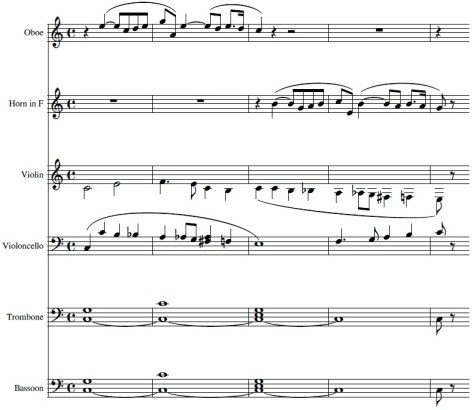
In the opening scene of the second Act,—the garden of the prison in which Claudio is awaiting death—we have another employment of the leit-motive, the oboe giving out softly the theme to which Claudio had previously urged Luzio to implore the help of Isabella, but now with appropriately altered harmonies—


wagnermusic4

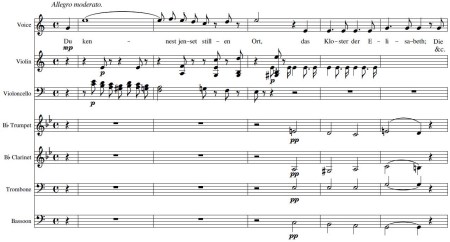
The later Wagnerian method of accumulating excitement, which we have seen anticipated in Die Feen, is employed also in Das Liebesverbot, as in the following passage, which, like the one previously quoted, gives us a decided foretaste of the meeting of Tristan and Isolde—


wagnermusic5


This post was contributed by Jude Eylander, a Distributed Proofreaders volunteer.


Ten (Eleven) Years at DP

January 1, 2020

Dans la Bibliothèque by Auguste Toulmouche

I recently reached my ten-year anniversary at Distributed Proofreaders. I thought it would be interesting to acknowledge ten memories, observations, events, changes, or other items of nostalgia and hopefully of interest to others — Screeching halt! I wrote that a year ago and never finished. So now it’s eleven years and eleven items.

The Beginning — Welcome!

Someone had mentioned Distributed Proofreaders on another website, and I came to see what it was about. I started at the DP page, decided to create an ID, and started as a beginner. I immediately felt welcome. People’s answers to questions, appreciation for efforts, and encouragement are part of the palpable fabric of DP life. This year, someone posted in the forums, “Being helpful is the sort of thing that DP does so well.” I agree. There’s a blog article about Comments That Matter that expresses this in more depth.

Nitpickers

I found a group of fellow nitpickers, perfectionists, error spotters, spelling geeks, and grammar guards. It’s great to be in a place where you can question the use of a comma, semi-colon, duplicated word, mis-seplling misspelling, etc., and instead of getting a long-suffering sigh in response, to know that the comment is appreciated or in some cases leads to a thoughtful discussion or a thank-you. I found a group of fellow nitpickers! If you are one also, this may be for you!

Diffs: A Source of Enlightenment

An e-book project at DP goes through several rounds of proofreading and formatting. After each round, a proofer or formatter can check his or her “diffs” — the changes made to the text of a project’s individual pages as it progresses through each round. (A diff doesn’t necessarily mean there was something wrong, just that the page text coming out of the subsequent round is different.) I learned so much from my diffs. Yes, I got gentle feedback for the pages I did in Begin (projects set aside especially for beginners). However, by looking at the changes the next rounds of proofers made to my pages, I also learned an incredible amount. I learned what my eyes were glossing over and seeing what they expected to see instead of what was there. I learned to slow down. I learned to stop for the day or at least take a break every so often. I learned to go over a page another time if I found I was just reading instead of proofing. I learned that I still need to access the Proofreading Guidelines regularly.

Variety, Variety, Variety

Within the first few days I was at DP, I had the temerity to work on an English-Spanish dictionary as well as part of the Encyclopædia Britannica (in the G’s). I’m pretty sure I worked on an issue of The American Missionary (a challenging 19th-Century periodical) in early days as well. I know I also worked on some Begin projects, got helpful feedback, and forged on ahead. Over time I’ve been impressed with the wide variety of projects we work on. There are of course English-language books published across time periods, mostly up through 1923 (due to copyright) in standard library categories like fiction, reference, science fiction, cookbooks, adventure, history, military, music, anthropology, etc., etc. Add to that books in those same categories, but in other languages: French, German, Catalan, Spanish, Esperanto, Italian, Latin, Dutch, Portuguese, Swedish, and Cebuano. But there are more — think of the patience of the DP volunteers who provide content and manage the projects, and the dedication of proofers and formatters to work on single- and dual-language dictionaries, multi-volume encyclopedias, “Complete Works of…,” etc. I’ve also seen and worked on thesis papers and handwritten documents. There are also relatively modern government publications about parks, national monuments, nature guides, and more. The variety seems infinite.

Working Site – Not Just Social

While there is definitely a rich social aspect to DP through the volunteer forums, that’s not the primary focus. This is a working site. People contribute in many, many ways. I like the feeling of my efforts being a small part that feeds into a much larger contribution. People’s work gets recognized. There are places to announce accomplishments, and DP Anniversaries are acknowledged and celebrated. Without that, I wouldn’t be aware of my tenth eleventh anniversary.

Incredible Volunteers

It’s incredible that so many people volunteer so much time to make this happen. It ranges from a-page-a-day to what approaches or even exceeds enough time for a full-time job. Volunteers are not just incredible for the time and/or consistency they donate, but for their incredible knowledge and willingness to share it with others.

International Community

There is a considerable international community involved at DP. There are contributors from English-speaking countries, but also from many other parts of the world. I mentioned some of the different languages in the Variety paragraph above. There are perspectives brought to various discussions that I wouldn’t be exposed to on a U.S.-only site.

It’s a Learning Site

I learn a lot from other volunteers. They are always willing to share their knowledge and answer questions. I’ve learned some html coding in setting up project comments, using templates others have provided, and then finding resources on the Internet to figure out how to do other things. I’ve learned from discussions on various threads. And of course, I’ve learned a lot from the content of projects I’ve worked on.

The Custom Proofreading Font Looks Normal Now

DP is continually looking for ways to make the volunteers’ work easier. For example, a DP volunteer created a display font especially for proofreading, DPCustomMono2. When I first proofed with it, I was amazed at how much it helped. It clearly differentiates among I, 1, l. It distinguishes O and 0 without strain. It helps point out capital W that should be lower-case w and much more. Although at first it seemed odd looking and just plain weird, one day I realized that I had gotten used to it. It was the day I was sure DPCustomMono2 was missing and had been replaced by a “normal” font. Looking more closely, I saw the l with the curve and the 0 with the dot. DPCustomMono2 looked “normal” to me now.

Change and Accomplishments

Over my eleven years at DP, there has been a lot of change and many accomplishments. DP’s management has changed from a “benevolent dictatorship” (being run by a single overworked volunteer) to a non-profit corporation with a Board of Trustees and a General Manager. DP posted its 14,000th e-book to Project Gutenberg a few weeks before I joined. We just posted our 38,000th e-book last month. That’s 24,000 books since I joined. The site has been made available in French. Hardware, operating system, middleware, and forum upgrades have been rolled out. Now we’re gearing up to support additional character sets. The site changes, but the sense of purpose continues, as do the improvements and milestones.

Blogging

This Blog was introduced in 2010, and DP volunteers were invited to contribute blog posts. Surprising myself, I found I had thoughts to share. Thoughts grew to paragraphs and to contributions. It’s a good feeling to see something I’ve worked on show up as an official blog post. It’s something I don’t think I would have attempted otherwise. Once again, although a year late, here’s another article.

Thanks for joining me on my journey through the past.

This post was contributed by WebRover, a Distributed Proofreaders volunteer.

Distributed Proofreaders wishes everyone a Happy New Year!


Proofreading a Technical Text

April 1, 2019

geodistribmap

Introduction

Distributed Proofreaders recently made Alfred Russel Wallace’s two-volume book The Geographical Distribution of Animals (1876) available for free download from Project Gutenberg (Volume I and Volume II).

Wallace and fellow naturalist Charles Darwin not only were colleagues in their researches, but also collaboratively originated seminal ideas about the development of animal species, resulting in what is now generally known as evolution.

Scientific or technical works like Geographical Distribution can present special challenges to the Distributed Proofreaders volunteers who work on them. This post explores some of those challenges.

The Distributed Proofreaders Process

Distributed Proofreaders volunteers acquire scanned images of public domain books either from online sources like The Internet Archive or by scanning the books manually. The scanned images for Geographical Distribution came from The Internet Archive.

The scanned page images are run through optical character recognition (OCR) software to turn them into editable text. Sometimes the resulting text contains what we call “scannos” — misinterpretations of the image by the OCR software, such as a speck on the image rendered as a period, or the word “I” rendered as a numeral 1. Under the guidance of a Project Manager, volunteers proofread the text for errors and to format it, a page at a time, in several rounds. The Distributed Proofreaders process enables many volunteers to work on the same book at the same time. Another volunteer (the post-processor) assembles the final product into a complete e-book which, after final checks for errors, is then posted to Project Gutenberg.

During the proofreading phase, many problems can be resolved easily. For example, a scanno, such as “carnage” for “carriage,” is simply corrected to match what appears in the original page image. Not all problems are small ones, though. The proofreader who encounters a more difficult problem, such as one of those discussed below, is required only to leave a note about it for future volunteers working on the text. Some proofreaders choose to go further and search reference materials, such as dictionaries, and ask for help in the project’s discussion forum or one of the specialised forums at Distributed Proofreaders.

While many projects at Distributed Proofreaders are straightforward, others present challenges like poor printing, resulting in poor scan quality and therefore errors in the raw text; antiquated language found in older texts; many or large tables of data, etc. The object is to determine the author’s true intention and reflect that in the final product.

Proofreading Geographical Distribution

From May to October, 2016, Distributed Proofreaders volunteers worked on the first volume, resolving (or attempting to resolve) several thorny issues, communicating with each other and the Project Manager in the Project Discussion.

This text had good quality scans, with very few typographical, spelling or grammar issues. The challenges lay in the fact that it was a deeply technical work with specialised biological terminology. Here are some of the interactions volunteers had in the Project Discussion.

Differentiating between æ and œ ligatures

With the clear scans, it was generally easy to distinguish between æ and œ ligatures. But the original printer apparently had some trouble doing so when working from the author’s manuscript. Misreading of the ligatures led to subsequent mistakes that were easily perpetuated in the rest of the work, even by such a scrupulous authority as Wallace.  Of course, in extenuation, the Internet age has made it much easier to check doubtful cases than it was in Wallace’s day.

One volunteer’s research could not determine whether Cænyra was a typo for the more likely Cœnyra. My researches led to the Bulletin of the British Museum (Natural History), Entomology Supplement 9 (1967), where Francis Hemming states that Cænyra is “an incorrect subsequent spelling of Cœnyra.”

Both Turacœna and Turacæna occur twice in Volume I, but Turacœna is not italicised on two pages, which makes it much easier to identify. Turacœna also appears twice, and Turacæna not at all, in Volume II. Volume II includes the index, and Wallace states in the errata for Volume II that misspellings have been corrected in the Index.  These facts make Turacœna the people’s choice.

Typographic or spelling errors

A very rare typographic error in Geographical Distribution is Wallace’s reference to “the living three-handed armadillos” for three-banded armadillos.

There is a reference, with a clear connection to kingfishers, to the genus Halycon. Exhaustive, in-depth research (even using dead-tree books on my shelf) suggested that it is a long-standing error which had been perpetuated. The genus, in my humble informed opinion, should be Halcyon (as Wallace has it in the second volume, as well as several times in the first volume). In other words, a rare typo.

When a typesetter uses the upside-down letter n, it will turn into the confusing letter u, as in Otiorhynchus vs. Otiorhyuchus. Which is correct? I go for the confusing u with n theory, as rhynchus in Greek refers to nose, beak or snout, and rhyuchus is not a sensible construction. This is where familiarity with Latin or Greek roots saves the day.

But if one sees the word drougo, knowing about drongo, or finds the word scink which is usually spelled skink nowadays; there is considerable doubt. Is it an older version, or a typo? Why does he have Ethiopian, except for the one occurrence of Ethiopean?

Sometimes the puzzle is intractable without a true subject specialist’s advice.  For instance, is it Ptilornis or Ptilorhis or even Ptiloris? Ptilorhis appears to be a late misspelling; but a Ptiloris exists; and Ptilornis ends with the root of ornithology.

Dealing with typos is, of course, the real elephant (Loxodonta africana or Elephas maximus) in the room. There are two kinds of taxonomists: lumpers and splitters. The splitters at one time had about a dozen elephant species; nowadays the lumpers are in the ascendance, and we have only two. Just in case you wondered.

One of the volunteers documented a few variations in spelling or typography: honey-sucker and honeysucker; king-fisher (in the index) and kingfisher (everywhere else); wood-pecker once, elsewhere woodpecker; aerial or aërial… The list goes on. It is for the post-processor ultimately to make the final decision about standardising such variations, but sharp-eyed proofreaders can help by leaving notes about their observations.

Scientific nomenclature

The system of naming organisms with a genus name followed by a species name is  universal, if complicated. This was never completely stable, and some tough  investigations had to be undertaken to decide which version (where the volumes had  more than one) was to be accepted.

A Distributed Proofreaders volunteer agonises: “How do you feel about Wallace’s occasional habit … to start species name with a capital letter? For me, it seems [to] violate everything I’ve learned about scientific names.… Have the rules regarding capitals been different, earlier?”

Wikipedia has an interesting article about binomial nomenclature, with links to more information.  It appears that for animals, the rule was changed to make species’ names start with a lower-case letter, a change that only happened many years later for plants.

Nowadays the rule is explicit and rigid — the genus starts with a capital and the species with a lower-case letter. In the old days there were many different rules at different times, so in the case of this project, we must follow Wallace’s usage.

Hyphenating biological names

I had to leave a general note about end-of-line hyphens splitting biological names. “Whenever I find one I check the name; but in any case, these are extremely rarely hyphenated, so please don’t put the hyphens back in unless you are absolutely certain!”

Rewards of Distributed Proofreading

Understanding historical context

Working with old and unusual material which might be otherwise unobtainable frequently supplies a context for current ideas. One example is Wallace’s puzzlement about the strange and sometimes anomalous animal habitats he found. I can’t help thinking how delighted he would have been to hear about continental drift, explained by plate tectonics, the theory which the South African geologist Alexander du Toit put on a solid footing after Alfred Wegener first floated the idea in 1912, decades after Geographical Distribution was published. This quote from Wallace illustrates my meaning perfectly:

Should we ever arrive at a fair knowledge of the physical changes that have resulted in the present condition, we shall almost certainly find that many of the differences and anomalies of their existing fauna and flora will be accounted for.

Understanding the author’s character

Wallace, like many naturalists, collected insects, including beetles. As he explained:

[These] families comprise the extensive series of ground beetles (Carabidæ) containing about 9,000 species, and the Longicorns, which are nearly as numerous and surpass them in variety of form and colour as well as in beauty. The Cetoniidæ and Buprestidæ are among the largest and most brilliant of beetles; the Lucanidæ are pre-eminent for remarkable form, and the Cicindelidæ for elegance; and all the families are especial favourites with entomologists, so that the whole earth has been ransacked to procure fresh species.

Results deduced from a study of these will, therefore, fairly represent the phenomena of distribution of Coleoptera, and, as they are very varied in their habits, perhaps of insects in general.

I am reminded of J.B.S Haldane, who was a British scientific polymath of the early 20th Century. It is variously reported that his reply to a question by a theologian whether anything could be concluded about the Creator from the study of natural history was “an inordinate fondness for beetles.”

Making texts accessible to all

Apart from the new things we Distributed Proofreaders volunteers learn every day from working on public domain projects, we have the great satisfaction of “preserving history one page at a time” and introducing new readers to the rewards of great old books like this one.

This post was contributed by Bess Richfield, a Distributed Proofreaders volunteer.


Preserving the Past … For the Future

January 1, 2019

Preserving the Past … For the Future … One Dig at a Time

archaeologyLooking forward to another day at the archaeology dig. Putting on the coffee and getting breakfast. Water containers to be filled with fresh water — it’s going to be HOT today, so need to take extra. Grabbing some food to throw into my pack along with the water. A trip to the barn to check on my animals — fresh water, everyone looks good. Throwing my pack into my vehicle and away I go!

Need to dig carefully — looks like someone broke a clay pot — all in pieces — and each piece needs to be carefully extracted from the soil. The pot will be reconstructed in the lab at a future time. Notes, notes, notes, never ending — this is the important stuff — keeping track of soil changes, artifacts found, any “stains” in the soil that may be the remains of poles holding up ancient structures. Here’s some rock debris — someone chipping away on a precious piece of rock to make a projectile point, scrapper, or other implement. Each piece of rock must be collected and labeled carefully. Some charcoal here — an ancient fire pit, rock-lined — need to photograph and draw a rough sketch. Wonder what they were cooking: deer? rabbit? fish? Maybe some of the potsherds from the broken clay pot can be sent out for protein analysis.

One never knows what is going to be found at a dig — but each little bit tells the story of the past and must be carefully preserved for future generations.

I’m very dirty and very tired and mosquito-eaten — but it’s been a good day and I feel great!

Preserving the Past … For the Future … One Page at a Time

That’s what I did as an archaeologist volunteer — but it’s not so very different from what I do as a Distributed Proofreaders volunteer.

Getting up in the morning and turning on the computer before doing anything else. Putting on the coffee and grabbing some breakfast. Logging into Distributed Proofreaders.

What shall be read today? Sometimes science, sometimes travel, sometimes anthropology, sometimes just choosing something different that I never even considered reading. Every book is important — the 5-page books to the 1,000-page books. The religious books — books of poems — science books — fictional books — travel books — music books — medical books — all interesting and need to be carefully proofed.

Here’s a book on engineering — wonder what sorts of things engineers were working on way back then? Another on an African tribe — a culture different from mine — thinking and doing things according to their needs and wants — wonder what they would think of Western culture? And another book on ocean biology — maybe will read this one for a while. All those Latin names of shells and sea creatures — they require a reader’s full attention. Here’s another book on submarines — somewhat technical — think I’ll read this next. Some math formulae and engineering terms — wonder how submarines have changed from past times to today?

Never know what books will be in the queue to be proofed but every one is important, each book tells a story of the past and must be meticulously proofed, formatted and preserved for future generations.

My back hurts, I need more coffee, my eyes are glazing over — but it’s been a good day and I feel great!

This post was contributed by eyecrochet, a DP volunteer.

The DP Blog wishes all its readers a very happy and healthy New Year!


How Time-Travel Led Me to Distributed Proofreaders

August 31, 2018

Samuel Pepys

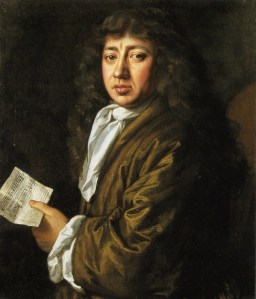
Over the years I’ve travelled in time again and again.

Through the letters of Abigail and John Adams, I’ve lived through the start of the American Revolutionary War, 18th-century smallpox vaccinations, travel abroad, and the early days of a new republic. The originally unpublished diaries of Mary Boykin Chesnut took me to the start of the U.S. Civil War. I sat with her and her friends waiting breathlessly for news from the Battle of Fort Sumter where their husbands and brothers fought. The diary of John Evelyn took me to the Sun King’s court and to England in the time of Charles II. I cried with him over the early death of his two young sons. And my mother’s diary from the year she turned 17 took me to the early days of World War II in Western Canada — full of accounts of boy-friends, dances, factory work, and friends going off to war (I can still remember my mother’s “You read my diary?! — Give it back!!”).

The time travel that has enthralled me most was nine years in 17th-century England with a young man so full of life and so involved in the events of his time.

I had wanted to read the diaries of Samuel Pepys for many years, when I found an abridged version in a local bookstore. It didn’t take me long to realize that there was little of interest there — no more than a collection of “he was really there” names and events. Then I found the Project Gutenberg version of the full nine years of the diary (although, the edition on which it was based having been published in 1893, it had a few ellipses to hide the most racy bits, which I soon found out how to track down elsewhere).

Diary of Samuel Pepys — Complete 1660 N.S.
Diary of Samuel Pepys — Complete 1661 N.S.
Diary of Samuel Pepys — Complete 1662 N.S.
Diary of Samuel Pepys — Complete 1663 N.S.
Diary of Samuel Pepys — Complete 1664 N.S.
Diary of Samuel Pepys — Complete 1665 N.S.
Diary of Samuel Pepys — Complete 1666 N.S.
Diary of Samuel Pepys — Complete 1667 N.S.
Diary of Samuel Pepys — Complete 1668 N.S
Diary of Samuel Pepys — Complete 1669 N.S.

The Project Gutenberg version opened up a whole new world to me — the world of a young man in his 20s celebrating Christmas openly after the puritanism of the Cromwell years, travelling with the court to return the rightful king to England, and obtaining a new and interesting job through the influence of highly-placed friends. It took me years to live through the diaries, reading slowly night by night and heading off to bed myself with his “And so to bed” which ended so many of his daily entries.

I lived through a young man’s excesses in his nightly drinking with his friends and his delight in learning about the “hair of the dog,” until his reluctant decision to lead a more sober life. I experienced his joy at playing musical instruments, and all the details of his many house-decorating forays. With him, I casually passed by the bonfires of Guy Fawkes Day celebrations and experienced the terror and excitement of “shooting the bridge” by riding out the torrent of Thames tidewater under London Bridge with the ferrymen. I lived through the plague as it decimated London, leaving the streets silent and empty as more and more deaths were recorded each day, and was terrified anew by the great fire of London and the drama of the king and his brother working tirelessly with the citizens to save the city. And there was the time when everybody feared imminent invasion by the Dutch and I went with Pepys to hide his valuables. He was upset that one bag of buried coins could not be found. And of course, there were his constant infidelities, described in detail despite the ever-present ellipses.

How did the adventures and infidelities of this young man lead me to Distributed Proofreaders? After a few years of downloading and reading the Pepys diaries that had been prepared for Project Gutenberg by David Widger, I felt guilty. I’d had such a lovely time in 17th-century England that it seemed wrong for me not to repay in some way. By joining Distributed Proofreaders, I discovered a way to help create e-books that other people could download and enjoy.

I hope that some of the books I have helped prepare have given readers as much joy as the Pepys diaries have given me, and that you’ll consider joining the time-travellers at Distributed Proofreaders on our journeys into the past.

This post was contributed by Linda Hamilton, General Manager of Distributed Proofreaders.


… this may be for you.

April 30, 2018

proofed textIf you are a perfectionist, a nit picker, a grammar “nut,” the punctuation police, know what the Oxford comma is, or can spot a typo or an anomaly a mile away, this may be for you.
If you would like a volunteer opportunity without a specific time or place commitment, this may be for you.

If you would like to volunteer from the comfort of your own home, your own PC, or your favorite library or coffee shop, this may be for you.

If you would like to be part of an online community with a shared purpose, mutually helpful and respectful, this may be for you.

If you enjoy passionate debate or if you choose to observe debate without participating, this may be for you.

If you like to read generally older materials, be in the know, review books before they become generally available (again), this may be for you.

If you are looking to be able to make a contribution that needn’t be a financial contribution, this may be for you.

If you want flexibility in what kind of volunteer work you do and which projects you work on, this may be for you.

If you are not afraid of getting addicted to an activity that is legal, this may be for you.

If you seek nerdy fun, this may be for you.

What is “this”? It’s volunteering time and energy to Distributed Proofreaders. For any, some or all of these reasons, I hope you’ll give distributed proofreading a try. You may discover that it really is for you.

This post was contributed by WebRover, a DP volunteer.


Learning How to DP

February 1, 2018

mentorcover_croppedOne thing evident in the Distributed Proofreaders forums is that DPers love helping people, often tripping over each other in their enthusiasm to help others master the skills they need to work on various DP tasks. Looking at this another way, it’s easy to see how working at DP can be enormously satisfying for those who enjoy working in teaching/learning environments–the learning curve is steep, but the rewards well worth the effort.

In addition to answering questions in the forums, there is a structured proofreading mentoring system which involves proofreading beginner projects in the second proofreading round and providing feedback to the newcomers who proofread the pages in the first round. What skills and qualities do P2 mentors require? Enthusiasm, a really good knowledge of the proofreading guidelines, empathy, and a genuine desire to help people master what is required of them to become good proofreaders/transcribers.

Formatting mentoring is similar, and, while a little less structured, involves giving a guiding hand to those who have begun the steep learning curve to become good formatters. The skills and qualities are the same as for proofreading mentors, with a sound knowledge of the formatting guidelines added to the mix. Whereas proofreading is most often right or wrong, formatting can be less defined with several ways to format a page correctly, so both formatting and mentoring formatters can be more challenging.

Post-processing mentors are magicians. They help people learn about the software tools available for post-processing, and how to install and use them. Then they guide the new post-processor through the steps required to check the pages for any last remaining errors. But their job hasn’t finished there! Once the new post-processor has mastered the skills to get that far, the mentor takes them through the process of creating html, epub and mobi versions of the ebook. But wait! there’s more … they need to help the learner check all of those versions in the available tools to make sure nothing has been missed so that the best possible product will be uploaded to Project Gutenberg.

Post-processing verifiers need all the mentoring skills mentioned above because when checking a post-processor’s work they need to be able to advise on the tools and processes used, as well as to carry out all the checks the post-processor has already done. Their job is to advise the post-processor on layout issues, to catch any remaining errors, and to help reword transcriber’s notes if they are unclear or don’t reflect what has been done when transcribing the book. Post-processors have invested a lot of time and effort into producing their ebooks and the decisions they have taken along the way are important ones, so tact is required when providing feedback. Just as well post-processors are always keen to learn and apply that knowledge to their books.

And then at every stage we have mentors who mentor the mentors, as well as the as yet unmentioned developers who are learning and teaching in every development task they work on.

A big thanks to all DPers who have mentored and taught other volunteers how to produce high quality ebooks, and to those who have developed the site and tools required to do our jobs.

This post was contributed by a DP volunteer.


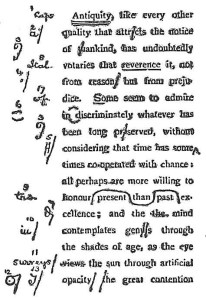
A Spell of Proofing

December 1, 2017

proofreader_cropped“I have some free time. I get to proof!” Proofing (as we call proofreading at Distributed Proofreaders) is relaxing. I get into a flow where time and place disappear and I am just in the page — in the zone.
“What shall I proof today? The project I have been chipping away at, a page at a time, has moved on. Oh, this project that I’ve been dipping into appears to be stuck in the round. What’s stopping it? Ah, it’s a page with a lot of Greek on it. I don’t think I can leave that page better than I found it. I’ll leave it for someone else.” Perhaps I’ll post about it in the Greek Team forum.

“Look, here’s a book someone proofed up to the Table of Contents (ToC).” I enjoy proofing ToCs because they often hold a few missed errors. “See — that page number is 33, not 38. It’s a bit obscure, but since the next entry is for page 35, it’s likely 33.” I’ll leave a note.

33[**38]

“Ooh look, it’s one of those old-fashioned detailed ToC entries that lists out subjects covered in the chapter separated by dashes. This line starts with a dash so the dash and the word following it need to move up to the prior line. The word is followed by a dash so that needs to move up too.” I change:

porches–rocking chairs–stoops
–steps–lazy conversation–sunset

to

porches–rocking chairs–stoops–steps–lazy
conversation–sunset

“The post-processor is going to have fun with that!”

I’m at the bottom of the page. Let me hit WordCheck (DP’s version of spellcheck). “Hunh. I didn’t notice ‘explain’ was mis-typeset ‘explarn’. I’d better exit and add a note.”

explarn[**explain]

I return to WordCheck. “Looks good.” Save and close.

“I’ve wrapped up the ToC and Illustrations pages. I’m not really interested in the content of this project. What else is available?”

“Oh, I see a novel, a Western. That should have different types of errors to seek out and find.”

I open a page. “Ugh — dialect. I’ll do just this page then find something else.” But dialect means dialogue. Dialogue often means quotation marks misplaced in the text — often mis-spaced ones or ones attached to the speaker instead of the conversation. “Yep, there’s one.”

he said,” Bring that thar hoss over hyar.”

I change that to:

he said, “Bring that thar hoss over hyar.”

Novels, juveniles, and Westerns often seem to have the worst typesetting: missing or misplaced quotation marks, missing periods at the ends of sentences, misspellings. They’re laced with dialect that at times makes reading and understanding the intended word difficult at best.

Speaking of reading: There’s proofing and there’s reading. It really helps to do both to find errors — but not at the same time. “Oh, this is really interesting.” “I didn’t know that.” “What happens next?” Sliding from proofing to reading can mean my eyes gloss over errors, unconsciously mentally fixing instances where a word is repeated, not noticing misplaced quotation marks, but still laser-focusing on typos, incorrect word usage and lack of continuity. Proofing to match letter and punctuation marks can mean I miss the typo because the letters match. These are all important errors to catch. Making separate reading passes and proofing passes as the page is open can help me find different kinds of errors. Muddling both into a single pass risks missing things.

“What? My free hour is up? How can that be? I just got started!”

This post was contributed by WebRover, a Distributed Proofreaders volunteer.


A Bohemian’s Bohemian

November 1, 2017

This post is dedicated to the memory of Elizabeth Oscanyan, affectionately known as Mama Beth, a Distributed Proofreaders volunteer who post-processed, among many other projects, Peter Altenberg’s Neues Altes and Semmering 1912“. The latter was her last project before she passed away last month.

Though she was not a native German speaker, in the true spirit of DP teamwork she worked with a German-speaking post-processing partner, woldemar, in order to make the project the best it could be. Another German-speaking DP volunteer, salmonofdoubt, was the post-processing verifier for the Altenberg projects and completed „Semmering 1912“ after Mama Beth died.

Mama Beth never shrank from a challenge, and the Altenberg books posed for her not only a language challenge but also a formatting challenge, due to Altenberg’s unique style, which often made it difficult to tell what was prose and what was poetry. Many thanks to woldemar and salmonofdoubt for helping her to make these projects as great as they are. Special thanks to salmonofdoubt for his kind assistance with the translations in this post.

Mama Beth was much loved by her many DP friends for her warmth and generosity. She will be much missed. Auf wiedersehen, Mama Beth.


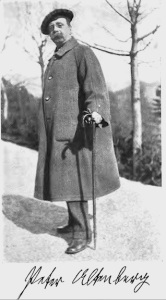
Peter Altenberg

Bohemians — not the Czechs, but rather those unorthodox artistes who came into full flower in 19th-Century Europe — will forever be associated with coffeehouses. And it was in the Belle Époque Viennese coffeehouse culture that the Austrian writer Peter Altenberg (1859-1919) gave birth to his eccentric, modernist work.

Born Richard Engländer into a middle-class Jewish family, Altenberg struggled against his parents’ bourgeois expectations, dropping out of both law and medical school. In his 30s, he plunged into the “Jung-Wien” (Young Vienna) artistic movement, even though he was older than most of its proponents, adopted oddball modes of dress — baggy clothes and broad-brimmed hats and sandals — and wrote the short poems and sketches that are the hallmark of his art.

Altenberg spent the vast majority of his time in Viennese cafés, especially the famous Café Central, where he even received his mail. There he hobnobbed with the likes of Hugo von Hofmannsthal, Adolf Loos, Gustav Klimt, and other fellow iconoclasts who led the modernist movement in fin-de-siècle Vienna. They admired him; he admired them, drank with them, borrowed money from them. And he wrote — often for them — numerous snippets of prose and poetry that demonstrated his wit, his poetic sensibility, and his zest for humanity and nature.

Altenberg liked to scribble his striking pieces on the backs of picture-postcards and mail them to his friends. One such friend was the composer Alban Berg, who wrote Fünf Orchesterlieder nach Ansichtskarten-Texten von Peter Altenberg (Five Orchestral Songs on Picture-Postcard Texts of Peter Altenberg), more conveniently known as the Altenberg Lieder. Its 1913 premiere in Vienna literally caused a riot in the middle of the piece, with the audience calling for both Berg and Altenberg to be committed. Too late — Altenberg had already checked himself into a private asylum a few months before the concert.

Some of Altenberg’s Ansichtskarten-Texten — including the texts of all five Altenberg Lieder — can be found at Project Gutenberg in the collection Neues Altes (New Old), published in 1911. Here is a blank-verse ode to the Soul:

Seele, wie bist du schöner, tiefer, nach Schneestürmen — — —.
Auch du hast sie, gleich der Natur — — —.
Und über beiden liegt noch ein trüber Hauch, wenn das Gewölk sich schon verzog!

Soul, how much lovelier you are, deeper, after snowstorms — — —.
You have them, too, like Nature — — —.
And over both still lies an overcast tinge, though the clouds already dispersed.

And here, a prose poem that is a poet’s heart-cry:

Hier ist Friede — — —. Hier weine ich mich aus über alles. Hier löst sich mein unermeßliches unfaßbares Leid, das meine Seele verbrennt. Siehe, hier sind keine Menschen, keine Ansiedlungen. Hier tropft Schnee leise in Wasserlachen — — —.

Here is peace — — —. Here I weep my heart out over everything.  Here is released my immense, unfathomable pain, which burns my soul. See, here are no people, no settlements. Here snow trickles gently into puddles — — —.

The asylum Altenberg had entered in late 1912 was where he completed another collection of short works, „Semmering 1912“, first published in 1913 and reissued in 1919, the year he died. Before committing himself, he had been staying at Semmering, an Austrian mountain resort. In “Winter auf dem Semmering” (“Winter on the Semmering”) he writes of his uneasy love affair with snow:

Ich habe zu meinen zahlreichen unglücklichen Lieben noch eine neue hinzubekommen — — — den Schnee! Er erfüllt mich mit Enthusiasmus, mit Melancholie.

I have added to my numerous unhappy loves yet a new one — — — snow! It fills me with enthusiasm, with melancholy.

In spite of his bouts with mental illness, Altenberg lived his unconventional life with gusto, and his vital spirit is fully reflected in his work. His many friends never stopped supporting him, even when he irritated them, and he was even nominated for a Nobel Prize in 1914 (but no prize was given that year, due to the outbreak of World War I). It is unfortunate that few of his works have been translated into English, but it is fortunate to have at least these German editions freely available to all on Project Gutenberg, thanks to the dedicated volunteers at Distributed Proofreaders.

This post was contributed by Linda Cantoni, a Distributed Proofreaders volunteer.


A Volunteer’s Thoughts on DP

August 1, 2017
majorca

From With a Camera in Majorca

Passing time at Distributed Proofreaders is not like working. It is for me a relaxing process that gives me many views of the world that I would have otherwise missed. I say missed because I have had neither the opportunity nor the money to travel, nor to read books as widely in my lifetime as I might have at one time wished to do. DP is a vicarious idea, where you can experience the world through books – one day a famous classic, the next maybe a few pages from a children’s book – a little adventure every day, the choices are wide. You can do as much or as little as you wish, and the tasks are variable and numerous. The wonderful world of books – maybe some are a little old-fashioned, but better late than never.

I have always lived in small villages near the sea, or on small boats, so computers were not a big thing with me. I only came to the connected world four years ago, rather late in my life, when I retired, and the village where I live had a rural wi-fi scheme installed. If I had only realized that there were sites like DP, it might have given me much greater incentive to become involved much sooner. I have always felt involved since my first day at DP. Like many other DPers, I found the site through downloading books from Project Gutenberg.

Proofing at DP is a relatively easy task, and working on so many different projects is like looking through a new window with every page that you do. Although formatting is a little more technical, the basics can be quickly learnt, and progress is made because everyone works as part of a large team. We contribute mutually, and one’s individual weaknesses are well covered by others’ combined strengths. The interaction between volunteers during this process makes it hard not to make friends, and so DP is a very friendly place to become attached to.

The bolder and more adventurous volunteers eventually progress to Post Processing, putting the projects into their final form before they are posted to PG. I quickly entered into this area and now have more than 50 books at PG from children’s books to larger and more difficult projects. I learned on the way to become quite proficient in image manipulation, especially old photographs and coloured book-plates.

Recently, I started to learn Content Providing and Project Managing. This has required further skills in OCR, and preparing and guiding the projects through the rounds. This has brought me into even closer contact with other volunteers, producing their requests and answering the inevitable questions as the books progress through the rounds. One of my recent efforts in this area is With a Camera in Majorca.

There are also important administrative jobs at DP held by Project Facilitators and “Squirrels” (the technical team who maintain the site and coding at DP, among other chores.) These tasks require experience that I have not yet acquired in my short time at DP.

Experienced volunteers who enjoy guiding new members can become Mentors and Post-Processing Verifiers. And for those who enjoy just reading, there is Smooth Reading, which, as its name implies, involves making sure that the book reads correctly in its final form and that there are no startling errors before it goes to PG.

I am very glad that I found DP. As a virtually housebound person it makes me feel useful, and the idea and the opportunity of making these books freely available at PG is a wonderful and altruistic pastime.

Please feel free to join us. I assure you that you will be made most welcome.

This post was contributed by readbueno, a DP volunteer.