New England Bluestocking

October 1, 2017

During the Enlightenment, that great period of intellectual exploration in the 18th Century, a group of educated Englishwomen, tired of being excluded from “masculine” literary and artistic discourse, banded together to form a celebrated salon known as the Blue Stockings Society.  It flourished for about half a century, attracting prominent guests such as Samuel Johnson and Horace Walpole. But by the 19th Century, its popularity had waned, and the term “bluestocking” became a pejorative one for any intellectual woman — stereotyped as a frumpy spinster with literary pretensions.

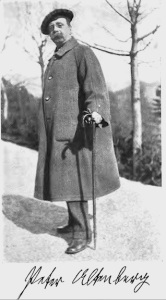
Guiney

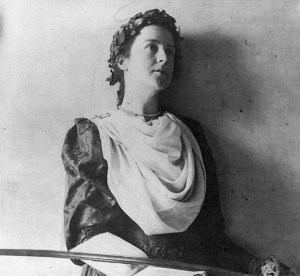
Louise Imogen Guiney as St. Barbara,
by Fred Holland Day.

As with all stereotypes, that view did a profound disservice to its targets. In 19th Century America, New England produced a rich vein of female literary talent. While those like Emily Dickinson and Louisa May Alcott take center stage today, there were others of great ability but lesser renown whose works deserve a revival. The poet and essayist Louise Imogen Guiney (1861-1920) is one of them.

Guiney was born in Roxbury, Massachusetts, the daughter of an Irish-born Civil War hero and lawyer. She was educated at a Catholic convent school, but her father’s death in 1877 forced her to work to support herself and her mother, taking jobs as a postmistress in a small Massachusetts town and a cataloger at the Boston Public Library. Meanwhile, at 19, she launched her literary career with a poem, “Charles Sumner,” published in a Boston newspaper. Her critically acclaimed poetry collections, Songs at the Start (1884) and The White Sail (1887), soon followed.

Guiney also garnered a reputation as an incisive and learned essayist. Her first essay collection, Goose-Quill Papers (1885) shows off her scholarship as well as her wit and flair. The amusing essay “On Teaching One’s Grandmother How to Suck Eggs” gives us a tongue-in-cheek survey of the subject:

In the days of the schoolmen, when no vexed question went without its fair showing, it seems incredible that the proposition hereto affixed as a title provoked no labyrinthine reasoning from any of those musty and hair-splitting philosophers. Aristotle himself overlooked it; Duns Scotus and the noted Aureolus Philip Theophrastus Bombast de Hohenheim Paracelsus were content to repeat his sin of omission. Even that seventeenth-century English essayist and scholar, “whose understanding was wide as the terrene firmament,” neither unearthed the origin of this singular implied practice, nor attempted in any way to uphold or depreciate it. The phrase hath scarce the grace of an Oriental precept, and scarce the dignity of Rome. It might sooner appertain to Sparta, where the old were held in reverence, and where their education, in a burst of filial anxiety, might be prolonged beyond the usual term of mental receptivity.

After her initial successes, Guiney became a key part of Boston’s aesthetic revival of the 1890s, and counted among her friends the poet and physician Oliver Wendell Holmes (to whom Goose-Quill Papers is dedicated), the architect Ralph Adams Cram, the poet Bliss Carman, and the photographer Fred Holland Day. Her third poetry collection, A Roadside Harp (1893) sealed her reputation as a fine aesthetic poet, with some flourishes harking back to an earlier time, as in “Tryste Noel”:

The Ox he openeth wide the Doore
And from the Snowe he calls her inne,
And he hath seen her Smile therefore,
Our Ladye without Sinne.
Now soone from Sleepe
A Starre shall leap,
And soone arrive both King and Hinde;
Amen, Amen:
But O, the place co’d I but finde!

Guiney began a new epoch in her life and work when she moved to England, where she liked “the velvety feel of the Past underfoot,” in 1901. She gave up poetry — her last collection, Happy Ending, was published in 1909 — and refocused much of her literary work on biographies of prominent English Catholics (Blessed Edmund Campion) and Irish historical figures (Robert Emmet). Her work was not lucrative, however, and she often went without food or coal in order to have enough money to buy books. She died of a stroke at her home in Gloucestershire in 1920.

Consistent with the stereotype of the bluestocking spinster, Guiney never married, and was said to share a “Boston marriage” with the writer Alice Brown. But, inconsistent with the stereotype, so far from being a frump, she was “tall and lithe. . . given to such outdoor pursuits as hiking,” as Douglass Shand-Tucci describes her in Boston Bohemia: 1881-1900. Guiney was not only “pretty, with beautiful dark gray eyes,” but also “warm and affectionate, even flirtatious, and altogether a buoyant free spirit with an irrepressible sense of humor.”

Guiney’s free spirit shines through in the dozen or so of her works available at Project Gutenberg. Her biographer, Henry G. Fairbanks, called her the “lost lady of American letters.” She deserves to be found again.

This post was contributed by Linda Cantoni, a Distributed Proofreaders volunteer.


The Book Report I Never Wrote

September 1, 2017

curwoodI wish I had read a book like James Oliver Curwood, Disciple of the Wilds, by H.D. Swiggett, when I was in school and had to write a book report. I would have had the material for a real book report. I knew teachers wanted something different from a summary of the plot, but I really didn’t get what that was. The reports my fellow students gave also varied from rambling plot “summaries” to concise ones, but little about the quality of the writing, the editing, or the message.

While proofing this book for Distributed Proofreaders, my mental process started with, “Who is this guy James Oliver Curwood and why did someone write a book about him?” Once that question was in the process of being answered, then my questions were more along the lines of, “Why was that random information included?” and “Really, didn’t you just tell me that but in different words?” to “Wow! Where did that come from?” and “Did the editor actually review this book? Did the author slap together articles into a book? Did he take research notes, shuffle them like a deck of cards, then turn them in as a book?”

I would have actually had material for a book review.

So, who is this guy James Oliver Curwood and why did someone write a book about him?

Curwood (1878-1927) was, in his day, a famous author with over 30 books published between 1908 and 1931. Two of his books each had more than a hundred thousand copies printed and sold of the first edition (The River’s End and The Valley of Silent Men). At least eighteen of his books and stories inspired movies. In fact, The River’s End has been turned into a movie three times: a silent version in 1920, and sound remakes in 1930 and 1940.

Curwood was an avid outdoors person from boyhood. He was not particularly attentive in school and dropped out or was expelled in tenth grade. As his biographer tells it,

When he was not present in school he was either writing tales of the wilds, or living them along the banks of the rivers nearby. In fact he had absented himself from classes on many occasions to devote more time to his stories. Jim Curwood finally developed into a real problem for his teachers in high school.

One day as he quietly came tip-toeing to his seat … the teacher … completed what he had to say with: “And dear Lord, we thank Thee for returning Nimrod safely to us this morning.” From that day forward his nickname at school was “Nimrod.”

As a teenager, Curwood went on long outdoor trips. He was a hunter who later became a serious conservationist/anti-hunter. Though he was American, his real love was for the Pacific Northwest of Canada. He turned his experiences in the outdoors into a series of adventure novels in that setting.

Curwood’s first published story was “The Fall of Shako,” printed in his hometown paper, The Argus of Owosso, Michigan, on November 21, 1894. He was 16. He wasn’t paid for it, but it brought him some notoriety. A resident of Owosso who didn’t like James’s father, also a James, assumed the father had written the article and wrote a blistering criticism which derided “the story [as] an insult to the intelligence of the people of the community and one composed of childish drivel.” The editor, seeing the possibility for publicity, published the criticism on the front page. The community sent hundreds of letters objecting to the harsh criticism of a youthful writer. The story made it to every large paper in the country. As Swiggett put it, “He was getting his name before the public as a writer and that in itself was worth its weight in gold.”

While Curwood didn’t complete high school, he passed an entrance exam to attend the University of Michigan for two years. He left to become a reporter, and thus started his adult writing career.

With the publication of Curwood’s first two books and the release of numerous articles and short stories in various magazines, all set in Canada, the Canadian Government offered the now somewhat famous James Oliver Curwood the sum of $1,800 a year plus expenses if he would explore the distant wilds of the Dominion and use all he saw as a basis for material in his future writings.

OK – so that’s the “school book report,” a short retelling of the story. Now for the review of the biographer’s style. In the first part of the biography, Swiggett lays out information about Curwood in an informative and easy-to-read story form. But the second portion provides randomly presented information, repetition, and unsubstantiated statements.

Perhaps I’m overstating it when I say “unsubstantiated,” but this passage seemed unsupported to me:

Jim was gloriously happy, of that there was little doubt, but for some apparently unknown reason, his wife was not. Perhaps it was because he had excluded her from his real life….

Had she stopped to realize that her husband was on his way to the top of the ladder and would eventually reach that goal, the marriage might have lasted.

This passage implies that, though she may have been seriously neglected, had Mrs. Curwood known that her husband would become rich and famous, the neglect wouldn’t have mattered and she would have stayed with him. I saw nothing that supported this and much to indicate that she was simply left behind to care for their children alone while he went off on his travels.

The next chapter discusses books being submitted and accepted for publication. It then jumps back to Curwood neglecting his wife and this resulting in divorce. Next it hops to book submissions and publication. The sense of a story is lost.

From this point forward the book seems to consist of a few paragraphs about a topic, a jump to something else that may have already been covered, and then another jump. For example:

⦁ A three-month trip to the wilderness with his brother
⦁ The offer from the Canadian government to pay him to explore and write about it
⦁ A trip to northwest Canada
⦁ Decision to settle in Owosso
⦁ Church supper in Owosso where he meets his future second wife
⦁ A trip to the wilderness with his new wife
⦁ Starting to write his third book in the wilderness cabin
⦁ Back to Owosso to build a house and writing studio, Curwood Castle
⦁ Back to the wilderness
⦁ Lots of books published
⦁ Jump back to book three
⦁ Discussion back and forth of books
⦁ Contract with publisher Bobbs-Merrill ends
⦁ Back and forth about his book Kazan

While the first half of the book told a story, the second half felt like the result of a stack of reference cards being dropped on the floor, picked up, poorly assembled back into order, and then just slapped into text. I suspect a deadline approached with less time than needed. However, the first half did create enough curiosity that I took a look at a James Curwood book as it went through the rounds at DP. But that’s a story for another day!

This post was contributed by WebRover, a DP volunteer.


A Volunteer’s Thoughts on DP

August 1, 2017
majorca

From With a Camera in Majorca

Passing time at Distributed Proofreaders is not like working. It is for me a relaxing process that gives me many views of the world that I would have otherwise missed. I say missed because I have had neither the opportunity nor the money to travel, nor to read books as widely in my lifetime as I might have at one time wished to do. DP is a vicarious idea, where you can experience the world through books – one day a famous classic, the next maybe a few pages from a children’s book – a little adventure every day, the choices are wide. You can do as much or as little as you wish, and the tasks are variable and numerous. The wonderful world of books – maybe some are a little old-fashioned, but better late than never.

I have always lived in small villages near the sea, or on small boats, so computers were not a big thing with me. I only came to the connected world four years ago, rather late in my life, when I retired, and the village where I live had a rural wi-fi scheme installed. If I had only realized that there were sites like DP, it might have given me much greater incentive to become involved much sooner. I have always felt involved since my first day at DP. Like many other DPers, I found the site through downloading books from Project Gutenberg.

Proofing at DP is a relatively easy task, and working on so many different projects is like looking through a new window with every page that you do. Although formatting is a little more technical, the basics can be quickly learnt, and progress is made because everyone works as part of a large team. We contribute mutually, and one’s individual weaknesses are well covered by others’ combined strengths. The interaction between volunteers during this process makes it hard not to make friends, and so DP is a very friendly place to become attached to.

The bolder and more adventurous volunteers eventually progress to Post Processing, putting the projects into their final form before they are posted to PG. I quickly entered into this area and now have more than 50 books at PG from children’s books to larger and more difficult projects. I learned on the way to become quite proficient in image manipulation, especially old photographs and coloured book-plates.

Recently, I started to learn Content Providing and Project Managing. This has required further skills in OCR, and preparing and guiding the projects through the rounds. This has brought me into even closer contact with other volunteers, producing their requests and answering the inevitable questions as the books progress through the rounds. One of my recent efforts in this area is With a Camera in Majorca.

There are also important administrative jobs at DP held by Project Facilitators and “Squirrels” (the technical team who maintain the site and coding at DP, among other chores.) These tasks require experience that I have not yet acquired in my short time at DP.

Experienced volunteers who enjoy guiding new members can become Mentors and Post-Processing Verifiers. And for those who enjoy just reading, there is Smooth Reading, which, as its name implies, involves making sure that the book reads correctly in its final form and that there are no startling errors before it goes to PG.

I am very glad that I found DP. As a virtually housebound person it makes me feel useful, and the idea and the opportunity of making these books freely available at PG is a wonderful and altruistic pastime.

Please feel free to join us. I assure you that you will be made most welcome.

This post was contributed by readbueno, a DP volunteer.


Celebrating 34,000 Titles

July 5, 2017

34k_Banner.jpg

Distributed Proofreaders proudly celebrates its 34,000th unique title posted to Project Gutenberg, with the very apt A Manual of the Art of Bookbinding, by James B. Nicholson. Many thanks to all the DP volunteers who worked on it!

The Manual of the Art of Bookbinding, originally published in 1856 and reprinted in 1878, has everything you ever wanted to know about the hands-on side of bookbinding, and then some. It was designed for the amateur who wanted to bind just one book; or the collector who wanted to bind his private library of books; or the “practical workman” who wanted to learn the trade. Bookbinding was a popular trade back then, but it gradually fell out of favor during the 20th Century – until a devastating flood hit Florence in 1966, and experienced bookbinders were desperately needed to save priceless books damaged by the floodwaters. Even with the rise of e-books, independent bookbinders and conservators are still thriving, and bookbinding workshops for amateurs can be found all over the world.

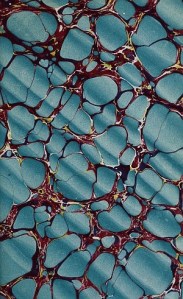
As the subtitle promibookbinding_endpaperses, the Manual contains “Full Instructions in the Different Branches of Forwarding, Gilding, and Finishing,” along with “The Art of Marbling Book-Edges and Paper” – including lovely full-color examples of marbling. The Preface sneers that “nearly all the works written upon the subject [are] obsolete; their descriptions no longer apply to the methods practised by the best workmen.” Nonetheless, the Manual borrows heavily from its predecessors, claiming to adopt the “best” of them while rejecting the “obsolete.”

After an introduction reviewing the history of bookbinding, Part I focuses on “Sheet-Work,” beginning with the basic but crucial work of folding the printed sheets, “the beauty of a book depending on its being properly and correctly folded, so that, when it is cut, the margin of the different pages may be uniform throughout, and present no transpositions, to the inconvenience of the reader and deterioration of the work.” There are instructions for “beating” the folded sheets into a solid block – that is, laying them out on a special stone and striking them repeatedly with a hammer, a process that even then was already mechanized with presses in commercial bookbinding, but is described for the benefit of the amateur who wants to hand-bind a book. There’s even advice to keep one’s legs together while beating, “to avoid hernia.”

Part II is devoted to “forwarding,” the process of attaching the boards that will become the front and back covers, adding in the end-papers, covering the boards with fabric or leather, and gilding the page edges. It’s a lot more complicated than it sounds; this part of the Manual occupies over 120 pages of detailed instructions. The author repeatedly emphasizes the need for special care in this phase of bookbinding, particularly when binding for a private customer: “Let the workman who strives to excel in his art remember that his work goes through the hands of critics and judges; that it possibly may be compared with the productions of the most celebrated artists.”

The fun part is in Part III, a treatise on “Ornamental Art.” After a brief review of ornamental styles from ancient Egypt to the time of Louis XIV, the reader is introduced to the art of “finishing.” Here the author warns the would-be bookbinder to have “correct ideas in regard to taste, and be able to distinguish it from caprice or mere fancy,” for the laws of taste “can be easily learned, and they are unchangeable.” There are examples of good taste and bad taste, and of how to make the ornamentation appropriate to the contents of the book. There follows an extended practical exposition of the art, with plates illustrating classic design styles that can be tooled or stamped into the covers and spine of the book. There are precise instructions on gilding, polishing, coloring, and other finishing touches, as well as advice on restoring old books. There’s even a handy glossary of bookbinding terms.

Mindful of who the ultimate beneficiary of these efforts would be, the book also contains “Hints for Book-Collectors,” starting with the all-important rule, “Never write your name upon the title-page of a book.” We promise not to, now that we know how much work and creativity go into the lovely art of bookbinding.

This post was contributed by Linda Cantoni, a Distributed Proofreaders volunteer.


O Canada

June 30, 2017

July 1, 2017, marks the 150th Anniversary of Canadian Confederation. In celebration, we offer this post – in English and in French – to announce Distributed Proofreaders’ posting of eight volumes of The Jesuit Relations and Allied Documents to Project Gutenberg. This is an important series of reports, in French, Latin, and Italian, with English translations, from Jesuit missionaries in what is now Canada to their superiors. The reports contain a wealth of detail about 17th Century native Canadian culture and the interactions between natives and Europeans. Congratulations to all the DP volunteers who worked on this monumental series, and to the people of Canada!

jesuitrelationsThe Jesuit Relations and Allied Documents are the reports of the Jesuit missionaries in New France, who wrote to their superiors to give an account of their work in the New France colonies in what is now Canada. The original texts were in French, Latin and Italian. According to Wikipedia, “Annually, between 1632 and 1673, the superior compiled a narrative or ‘Relation’ of the most important events which had occurred in the several missionary districts under his charge, sometimes using the exact words of the missionaries and sometimes summarizing the individual journals in a general account, based in part also upon the oral reports of visiting fathers. This annual ‘Relation’ was forwarded to the provincial of the Order in France. After he reviewed and edited it, he published the account in a series of duodecimo volumes, known collectively as The Jesuit Relations. At times the Jesuit Relations read like travel narratives, describing geographical features and observations about the local peoples, flora, and fauna.”

The story of New France is also, in part, the story of much of New England, and of States whose shores are washed by the Great Lakes and the Mississippi River. It may truly be said that the history of every one of our northern tier of commonwealths, from Maine to Minnesota, has its roots in the French régime. It is not true, as Bancroft avers, that the Jesuit was ever the pioneer of New France; we now know that in this land, as elsewhere in all ages, the trader nearly always preceded the priest. But the trader was not often a letter-writer or a diarist: hence, we owe our intimate knowledge of New France, particularly in the seventeenth century, chiefly to the wandering missionaries of the Society of Jesus.

This is how the preface of The Jesuit Relations and Allied Documents commences. The series is a large and ambitious project which assembles as many of the “Relations” as possible. The entire series consists of 73 volumes, including two volumes of indices. Edited by Reuben Gold Thwaites, secretary of the Wisconsin Historical Society, the series unifies numerous original Relations translated into English with cross-references across the volumes. The Jesuit Relations also include many other papers, manuscripts and letters from the archives of the Society of Jesus covering a period from 1610 to 1791.

The Relations are considered to be a rich ethnographic source, as they give a very detailed description of the lives of the native people: their habits, customs, their social structure, their religious rituals and beliefs, their cuisine, their games, their clothes, their governance. The Relations also offer geographical information on the weather and the location of New France.

Currently volumes one through eight can be found as e-books at Project Gutenberg. The series starts with a thorough introduction by the editor describing the different tribes of the native people in New France and the Jesuit missions that took place there. Each volume presents the original text and the English translation side by side and offers explanatory and bibliographical notes, as well as facsimiles, maps and portraits of the missionaries. The editor has remained faithful to the original text. Volumes one through three feature the Abenaki Mission in Acadia (now part of eastern Quebec, the Maritime Provinces, and the U.S. state of Maine) from 1610 to 1616. Volumes four through eight conclude the Abenaki Mission and continue with the Quebec and Huron Mission from 1625 to 1636.

This post was contributed by eleni, the DP volunteer who post-processed the eight volumes of The Jesuit Relations.


Le 1er juillet 2017 marque le cent cinquantième anniversaire de la Confédération canadienne. Nous offrons de le célébrer en annonçant ici — en anglais et en français — l’envoi au Projet Gutenberg de huit volumes des «Relations des Jésuites et Documents Connexes». Il s’agit d’une importante série de rapports, en français, en latin et en italien, avec une traduction anglaise, que les missionnaires jésuites envoyèrent à leurs supérieurs depuis le pays qui est aujourd’hui le Canada. Ces rapports contiennent une foule de détails sur les civilisations indiennes autochtones du 17e siècle, et sur les relations entre autochtones et Européens. Nos compliments à tous les bénévoles de DP qui ont travaillé sur cette série monumentale, et à la population du Canada!

Les «Relations des Jésuites et Documents Connexes» sont les rapports que les missionnaires jésuites de la Nouvelle-France envoyèrent à leurs supérieurs pour rendre compte de leur travail dans les colonies de la Nouvelle-France, le Canada d’aujourd’hui. Les textes originaux étaient en français, en latin et en italien. Selon Wikipedia, «Chaque année, entre 1632 et 1673, le Supérieur compila un récit ou “Relation” des événements les plus importants survenus dans les postes missionnaires dont il avait la charge; il le fit parfois selon les mots exacts des missionnaires, parfois en résumant les mémoires individuels sous forme de rapport général, ce dernier s’appuyant également sur les rapports oraux des Pères invités. Cette “Relation” annuelle était transmise au Provincial de l’Ordre en France. Après examen et révision, celui-ci publiait le rapport en une série de volumes in-12; l’ensemble est connu sous le nom de “Relations des Jésuites”. Celles-ci se lisent parfois comme des récits de voyage, détaillant des traits géographiques et des observations sur les populations locales, la flore et la faune.»

«L’histoire de la Nouvelle-France est aussi, pour une part, celle d’une grande partie de la Nouvelle-Angleterre et des États dont les rives sont baignées par les Grands Lacs et le Mississipi. En vérité, on peut dire que, du Maine au Minnesota, l’histoire de chacun de nos États du nord a ses racines dans le régime français. Il n’est pas vrai, comme l’affirme Bancroft, que le Jésuite ait été le pionnier de la Nouvelle-France; nous savons qu’en ce pays, comme ailleurs de tout temps, le commerçant a presque toujours précédé le prêtre. Mais le commerçant était rarement épistolier ou chroniqueur: c’est donc surtout aux missionnaires itinérants de la Compagnie de Jésus que nous devons notre connaissance détaillée de la Nouvelle-France, particulièrement au dix-septième siècle.»

Ainsi commence la préface des «Relations des Jésuites et Documents Connexes». La série est un vaste et ambitieux projet qui rassemble le plus grand nombre de «Relations» possible. Elle comporte au total 73 volumes, y compris deux volumes d’index. Éditée par Reuben Gold Thwaites, secrétaire de la Société Historique du Wisconsin, elle présente de façon cohérente un grand nombre de «Relations» originales traduites en anglais, avec des références internes d’un volume à l’autre. Les «Relations des Jésuites» comprennent aussi nombre d’autres documents, manuscrits et lettres des archives de la Compagnie de Jésus, couvrant les années 1610 à 1791.

Les «Relations» sont considérées comme une riche source ethnographique, car elles offrent une description très détaillée de la vie des peuples autochtones: leurs habitudes, leurs coutumes, leurs structures sociales, leurs rituels religieux et leurs croyances, leur cuisine, leurs jeux, leurs vêtements, leurs institutions. Elles offrent également des informations géographiques sur le climat et la région de la Nouvelle-France.

À ce jour, les volumes 1 à 8 sont disponibles sous forme de livre électronique sur le site du Projet Gutenberg. La série commence par une introduction approfondie dans laquelle l’éditeur décrit les différentes tribus des peuples autochtones de la Nouvelle-France, et les missions jésuites qui s’y déroulèrent. Chaque volume présente côte à côte le texte original et la traduction anglaise, offrant des notes explicatives et bibliographiques ainsi que des fac-similés, des cartes et des portraits des missionnaires. L’éditeur est resté fidèle au texte original. Les volumes 1 à 3 présentent la mission abénaquise en Acadie (aujourd’hui une partie du Québec oriental, des provinces maritimes et de l’État nord-américain du Maine), de 1610 à 1616. Les volumes 4 à 8 vont au terme de la mission abénaquise, passant ensuite à la mission du Québec et des Hurons, de 1625 à 1636.

Ce post est une contribution d’eleni, bénévole de DP qui a assuré le post-processing des huit volumes des «Relations des Jésuites».


Project Not Quite Nancy Drew

June 1, 2017

The Mystery Hunters at the Haunted Lodge coverSome of my early reading and re-reading included a few of the classics of juvenile literature: early books in the Hardy Boys series, Little Women and Little Men, the Little House on the Prairie series, and the lesser-known Maida series about a wealthy handicapped girl and her gang of friends. We were then living in Kingston, Rhode Island, whose public library had some Maida books in its collection, and after we moved, I never encountered any of that series again. Until the Internet came along, I was beginning to think I had imagined it.
Some of our family inside jokes and phrases came from the Hardy Boys books. As we remembered them, the Hardy Boys crept along “using every blade of grass for cover.” Mystery at Devil’s Paw, with its memorable line in the first chapter, “Dad! May Frank and I go to Alaska?” gave us this phrase as the echo for every improbable request. “The roadster sped along at 35 miles an hour!” was also a source of family amusement when stuck behind a slower moving automobile.

Project Not Quite Nancy Drew is a broad-based effort at Distributed Proofreaders tackling juvenile series like these, from Little Women and Little Men up through the Nancy Drew and Hardy Boys series – roughly from the 1880’s to the 1950’s. Started by DP volunteer hutcheson, it is open for anyone in the DP community to add to and participate in. Content Providers (people who provide page images) and Project Managers (people who shepherd books through the rounds) with books from a juvenile series are welcome to label their project as part of Project Not Quite Nancy Drew.

The Project Not Quite Nancy Drew label informs and attracts DP volunteers who have come to recognize these books as colorful and often humorous and unrealistic glimpses into the youth of the past, as youngsters fight crooks, fly through the air, solve mysteries, and outsmart adults. The kids use, and tinker with, all the new technologies introduced in the period – telegraph, radio, radar, motor cars, motor boats, cameras, airplanes, and submarines.

Another recurrent theme is exploring the world, going to remote places, meeting and living among strange people – sometimes with mass violence reflecting the world wars, sometimes learning mutual respect and tolerance. The books often use language and reflect attitudes unacceptable today. But you can also see some authors attempting to inculcate social and moral values that are still admirable.

According to Wikipedia, “Juvenile series are usually books written for a young adult audience beginning in the late 19th century, which feature a formulaic plot, continuing characters, and a positive conclusion.” Some of these series were written by an individual; others were organized by syndicates of anonymous authors, with plots centrally developed, and individual books contracted out for a fixed payment without royalty or byline. This type of book preparation continues today – a sort of distributed book-writing.

There has long been interest in juvenile series at DP. In 2005, there were discussions in the DP forums regarding a large number of books authored by Laura Lee Hope, which a volunteer had purchased to scan and upload to DP for eventual posting at Project Gutenberg. These included books in the Bobbsey Twins, Bunning Brown and His Sister Sue, Moving Picture Girls, Outdoor Girls, Six Little Bunkers, and Make-Believe Stories series.

“Laura Lee Hope,” incidentally, was a pseudonym used by the Stratemeyer Syndicate – best known for Nancy Drew and the Hardy Boys, among other series – whose books were written by unidentified ghostwriters for a flat rate. The Rover Boys series is believed to be the first Stratemeyer Syndicate series. Project Gutenberg has over two dozen Rover Boys books in its collection; DP volunteers posted 14 of them. Wikipedia has an extensive list of all of the Stratemeyer Syndicate’s series.

Project Not Quite Nancy Drew maintains a continuously updated list of juvenile series books in various states of progress at DP. Hutcheson began work with the Penny Parker series by Mildred A. Wirt, a ghostwriter for 20 of the early Nancy Drew stories, as well as Dana Girls, Kay Tracey, Ruth Darrow, and other series of her own. According to an interview with the author, Penny Parker was her favorite heroine.

Lesser-known juvenile series by notable authors include Aunt Jane’s Nieces, by Edith Van Dyne, a pseudonym for L. Frank Baum, author of the Oz series (one of which was DP’s 32,000th title); and Radio Man, by Ralph Milne Farley, a pseudonym for Roger Sherman Hoar, a Massachusetts state senator who was a descendant of an American founding father.

In addition to these books, there is a vast selection of others to chose from at Project Not Quite Nancy Drew; below are just a few. They range from not yet started to already posted to Project Gutenberg.

The Motor Boys by Clarence Young
Football Eleven by Ralph Henry Barbour
The Aeroplane Boys by Ashton Lamar (H. L. Sayler)
The Mystery Hunters by Capwell Wyckoff
The Girl Scouts by Edith Lavell
The Boy Chums by Wilmer M. Ely
Grace Harlowe Overland Riders by Jessie Graham Flower (Josephine Chase)
Sterling Boy Scouts by Scout Master Robert Shaler
Girl Scouts by Lilian Elizabeth Roy
The Radio-Phone Boys by Roy J. Snell
The Rover Boys by Edward Stratemeyer
The Campfire Girls (or Radio Girls) by Margaret Penrose
The Blue Grass Seminary Girls by Carolyn Judson Burnett
The Brighton Boys by James R. Driscoll
The Bungalow Boys by Dexter J. Forester
The Khaki Boys by Capt. Gordon Bates
Marjorie by Carolyn Wells
The Motor Rangers by Marvin West
Ocean Wireless Boys by Capt. Wilbur Lawton (John Henry Goldfrap)

Join us at DP and take a look at the Project Not Quite Nancy Drew wiki page (DP login required). You may enjoy proofing, formatting, smooth-reading, or post-processing these books, or even seeking out additional series or filling in missing books and running them through DP to make them available as e-books.

This post was contributed by WebRover with contributions by hutcheson, both DP volunteers.


Emmy’s Legacy

May 1, 2017

emmy_legacy_flower_wedding_finis

Distributed Proofreaders is a tight-knit community, and when beloved members pass away, we all grieve together. In February 2017, we lost Emmy. But her legacy lives on in the memory of her beautiful nature and in the many lovely e-books she left us.

Emmy was much loved for her warmth, her keen sense of humor, and her unfailing kindness. She never missed an opportunity to be friendly and helpful to anyone who needed a hand or a boost or a smile, and as a result she had many close friends among the DP volunteers.

And Emmy was a powerhouse. She joined DP in 2004 and performed many roles — proofer, formatter, Project Manager, Post-Processor, Post-Processor Verifier, and Mentor. She even contributed several pieces to this blog, though she preferred to do so anonymously. As Project Manager, she was responsible for 321 books posted to Project Gutenberg, all of which she also post-processed herself, including the lovely A Flower Wedding, which was DP’s 33,000th Unique Title. On top of that, she post-processed over 700 books for other Project Managers — making her responsible for contributing over 1,000 e-books to Project Gutenberg.

Although Emmy had a special love for children’s literature, her projects ranged from agriculture to Westerns and just about everything in between. To celebrate Emmy’s amazing legacy, DP’s General Manager, Linda Hamilton, put together a Project Gutenberg Bookshelf, Emmy’s Picks. It’s a library of extraordinary range and beauty.

And today, May 1, 2017, begins Children’s Book Week, a celebration of books for young readers, and a time that was always dear to Emmy’s heart. DP volunteers are making an extra effort for the celebration to produce children’s books in Emmy’s honor.

Browse, read, enjoy, remember.

This post was contributed by Linda Cantoni, a Distributed Proofreaders volunteer.


Motor Matt

March 31, 2017

During the “age of the dime novel,” generally considered to run from 1860 to 1915, popular entertainment options were quite limited compared to today. There was no film, television, radio or Internet, and theatre was a rare luxury for most. Instead, when someone wanted a quick dose of escapist adventure or romance, chances were good they would turn to a dime novel.

The first dime novels were small pamphlets of about a hundred pages, each containing a complete story. As the years went on, publisher competition led to the format’s evolution, adding more illustrations and more color, and experimenting with different price points. While the “dime” name has stuck as a term for the format, many of the most popular titles were actually “nickel weeklies” – booklets closely resembling today’s comic books, but containing prose in place of comic panels.

One of the most influential dime novel series was actually a nickel weekly called Tip Top Weekly, published by Street & Smith and containing the ongoing adventures of ideal American boy Frank Merriwell (and later, his brother and son). The Merriwell saga was filled with sports victories, action sequences, and a bit of romance – as readers spent a good part of the series speculating on which female character Frank would ultimately marry. Quite a few Merriwell adventures can be found on Project Gutenberg, but the scope of the series – a novel a week for decades – makes this one of the longest works of serial fiction ever written.

Motor Matt cover

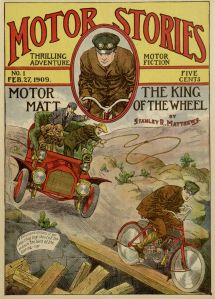
Another title, heavily influenced by Tip Top Weekly but of a more manageable size, has recently been added to the Project Gutenberg collection in its entirety, making it the first complete dime novel series to be found there. This series is Motor Stories, containing the adventures of “Motor Matt” King, a young man with a prodigious talent for working with gas-powered motors. Over the course of the series, he travels the country (and beyond), making friends and acquiring new vehicles to experiment with. The stories were clearly written with an eye on the news, as some of the technology described here – particularly heavier-than-air flight – was quite cutting-edge at the time of publication. There are 34 Motor Matt stories in all – 32 published as the Motor Stories nickel weekly, and two more published as part of Brave & Bold (a more general-purpose series) after Motor Stories was discontinued. While they hardly qualify as great literature, all of them remain surprisingly entertaining today.

The positive features of the series can all be attributed to its author, William Wallace Cook (writing as Stanley R. Matthews), an incredibly prolific writer who was one of the few to successfully bridge the gap from the dime novel era into the succeeding pulp era. Cook was fearless about approaching a wide variety of styles and genres, and he wrote very quickly. He also had a knack for plots, meaning that even though his stories were written speedily, they don’t feel hastily-constructed, and they usually contain at least one or two interesting twists. Cook is still remembered today for his creation of Plotto, a book containing a complex mechanism for generating plots and characters – it is still in print today. To learn more about Cook and his process, you can also take a look at his autobiographical work, The Fiction Factory, written under the name John Milton Edwards, which is available in the Project Gutenberg collection.

One of the ways in which Motor Stories is fascinating, but sometimes potentially offensive to modern readers, is in the way it portrays many of its characters. The series has a surprisingly diverse cast of characters, with many of its heroes and villains representing different parts of the world. It perhaps goes without saying that the prejudices of 1909, when the series was written, were a bit different than those of today, and much of this comes through in the text, which contains broad dialect, racial slurs and grossly stereotypical portrayals of certain ethnic groups.

In some ways, however, the books manage to contain surprisingly positive messages for the time. Matt himself, who is clearly designed as a model of ideal behavior for readers to emulate, treats everyone fairly and equally regardless of their race or nationality, even though his friends often do not. This is a dramatic change from earlier dime novel “heroes,” who in some cases were known to kill people on the basis of race without even asking questions (see Frank Reade and His Steam Horse in the Project Gutenberg collection for one example of this sort of behavior, though this is certainly not the only book to embrace the repellent philosophy that “the only good Indian is a dead Indian”). The author is also uniformly kind to characters of mixed race, apparently demonstrating a broad belief in the potential of the American “melting pot.” In a few cases, particularly when Chinese characters join the narrative late in the series, he also attempts to show cultural differences without dehumanizing the underlying characters – a feat that he only partially succeeds at, but that he tried puts him in a class above many of his contemporaries. Finally, while the series was clearly marketed toward boys, and most adventures go by with scarcely the appearance of a female face, on those occasions where a woman figures in the narrative, she is usually more than just a token for the “Motor Boys” to rescue (and on at least one occasion, she does the rescuing).

Apart from matters of representation, the biggest complaint most readers will have about the series is the fact that it ends where it does, with certain mysteries and plot threads entirely unresolved. Clearly Cook had set himself up to write many more of these if reader demand had been greater. As it is, the stories ended up having quite a long life. Not only were several of the early Motor Stories reprinted in Brave & Bold, but many of the stories were later edited together into longer novels to be sold in both paper-covered and cloth-bound formats. This makes the saga not only one of the last original dime novel epics but also a fairly early example of the juvenile series book later epitomized by Nancy Drew, the Hardy Boys and Tom Swift. For some reason, some of the names were changed during these edits, so it is possible that more readers over the years have known Motor Matt as “Bob Steele.” However, the original versions, with their colorful covers and bite-sized delivery, may well be the most fun. It is wonderful to have them so conveniently available to the world, after more than a century in obscurity.

This post was contributed by Demian Katz, a DP volunteer.


A Distributed Proofreaders Crossword

March 1, 2017

And now for something completely different: Hot off the Press is proud to present its very first crossword puzzle.

crossword-image

The crossword is based on a bit of entertaining juvenile fiction from the 1920s, Marjorie Dean: Marvelous Manager. In order to solve the puzzle, you’ll need to read the book. (Don’t worry, it’s not a heavy lift.)

There are a couple of ways you can do the puzzle. One is to solve it with the interactive version, where you simply click on a blank square, and the appropriate clue will pop up. Fill in the answer and click OK (or, if you’re inclined to peek — not that you would — click the Solve button). Clicking the Check Puzzle button at the bottom will give you the number of errors and incomplete words, in case you want to see how you’re doing. You can solve the interactive puzzle online or download the html file to solve it interactively offline.

The other way to do the puzzle, for those who prefer a good old-fashioned pencil (or, for the confident, pen), is to use the printable PDF version. And here’s the PDF answer key so you can check your solution. Or peek. Not that you would…

Happy Puzzling!

This crossword was created by FallenArchangel, a DP volunteer, using the free EclipseCrossword app.


The Typesetters, the Proofreaders, and the Scribes

February 1, 2017

scribeAt Distributed Proofreaders, we are all volunteers. We are under no time pressure to proof a certain number of pages, lines or characters. When we check out a page, we can take our careful time to complete it.

We can choose a character-dense page of mind-numbing lists of soldier’s names, ship’s crews, or index pages. We are free to select character-light pages of poetry, children’s tales or plays. Of course these come with their own challenges such as punctuation, dialogue with matching quotes or stage directions. We can pick technical manuals with footnotes, history with side notes, or  science with Latin biology names. We can switch back and forth to chip away at a tedious book interspersed with pages from a comedy or travelogue.

Every so often though, I stop and think about the original typesetters.

They didn’t get to pick their subject material, their deadline or their quota. They worked upside-down and backwards. They didn’t get to sit in their own home in their chosen desk set-up, with armchair, large screen, laptop or other comforts. Though we find errors in the texts that they set, many books contain very few of these errors. When I pause between tedious pages, I wonder how they did it.

Beyond the paycheck, what motivated them to set type on the nth day of the nnth page of a book that consisted mostly of lists, or indices? Even for text that would be more interesting to the typesetter, the thought of them having to complete a certain number of pages in a given day to meet a printing deadline is just impressive.

printing pressI know many have jobs today that require repetitive activities. But how many are so detail-oriented, with no automation, that leave a permanent record of how attentive you were vs. how much you were thinking about lunch? Maybe it was easier to review and go back and fix errors than I picture it to be. Maybe they got so they could set type automatically and be able to think of other things or converse.

When I’m proofing a challenging page, I sometimes think of that person who put those letters together for that page. I realize my task is so much easier. If I want I can stop after that page and hope some other proofer will do a page or two before I pick up that project again.  I can stop, eat dinner, and come back tomorrow to finish the page when I’m fresh.

I imagine a man standing at a workbench with his frames of letters and numbers and punctuation at one side, picking out the type one by one, hoping that the “I” box doesn’t contain a misplaced “l” or “1.” I see him possibly thinking about how much easier life is for him than it was for the medieval scribe. The scribe was working on a page for days, weeks, even months, one hand-drawn character at a time. I see the typesetter appreciating how much improved his own life is and how much more available his work makes books to his current readers. And I smile as I see him smile.

This post was contributed by WebRover, a DP volunteer.