Project Gutenberg celebrates 50,000 titles

September 18, 2015

Project Gutenberg 50,000 Books

Distributed Proofreaders proudly brings to you Project Gutenberg’s 50,000th title, John Gutenberg, First Master Printer, His Acts, and most remarkable Discourses, and his Death, by Franz von Dingelstedt, translated from the German and published in 1860.
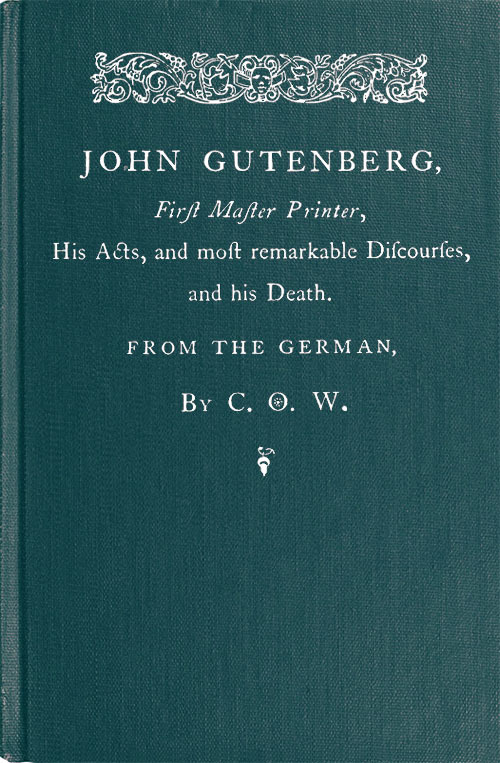
cover

I couldn’t think of a more appropriate title to celebrate this milestone. Johannes Gutenberg is known as the inventor of the moveable-type printing press, which led to the mass production of printed books and subsequent growth of literacy, knowledge and learning.

The project was first suggested by a DP volunteer. It was quickly picked up by one of our newer project managers, ably assisted by one of our more experienced and prolific project managers, who helped convert the long “s” used in the original publication to the regular “s” in use today.

With notification that PG was nearing its 50,000th book, the project manager suggested that if we hurried, perhaps we could finish it in time to be considered as a contender.

More than 30 volunteers joined in with no notice and made sure the pages were proofread and formatted to a standard of excellence, so that there was very little for the post-processor to have to do to assemble and check the pages for the final ebook. A draft was made available, and in next to no time smooth readers had read the book and reported their findings to ensure the ebook represented the original.

The book is a biography of the man, born Johann Gensfleisch, who preferred to be known as Johann Gutenberg (John Gutenberg in the translation). His inventions led to the printing of the first book published using moveable type, the Bible in Latin. He had little money and was unable to continue his experiments without financial backing. He met John Fust, who bankrolled Gutenberg’s venture, and the Bible was completed in time for the wedding of Fust’s daughter:

The Bible, on its part, had its silver clasps well rubbed and polished, and, being placed on a table, it shone, to the edification and admiration of all beholders.

The book quotes Gutenberg as saying:

My art belongs to me as much as to the rest of the world; let it remain the property of intelligence, and only be practised by those who have been initiated in it.

Yet he felt that his:

… art is not like any other art; a painter sketches his figures on the canvas, and he perfects the creation of his thought; the same with the poet, the engraver, the architect, and the musician; we, on the contrary, with our presses, are only the servants of others; printing is only an instrument for thinkers. Of what importance are the fingers which regulate the letters in a book? Of what importance is the hand which works the press, which arranges the pages and the leaves, which gives a visible form to the action of the mind?

Gutenberg toiled long and hard, working in dark, oppressive and humble conditions, but eventually he lost his business to Fust and died “neglected and in destitution.” His legacy, however, lives on, and his namesake, Project Gutenberg, continues the philosophy of sharing the printed word with the world.

This post was contributed by a DP volunteer.


DP Site Maintenance – 2015 Saturday 12

September 11, 2015

www.pgdp.net will be down for scheduled maintenance to upgrade the forum software starting Saturday September 12th at 2pm US Eastern. The site should be up again by 8pm US Eastern. During this time the site will be completely unavailable. Please note that although the scheduled outage period is six hours, the expectation is closer to four hours.

We’ll keep this blog post updated with progress during the outage. You can also find us in the pgdp Jabber conference room (pgdp@conference.jabber.org).


Update 2:03pm: Maintenance has started.

Update 3:00pm: Forum conversion progressing as expected. The system is working through 830k forum posts at the moment.

Update 4:00pm: 80% done with the forum posts then the system starts on the 300k private messages — we’re a chatty bunch!

Update 5:00pm: The forum posts are behind us and we’re half way through the private messages.

Update 5:59pm: Database conversion is finished and we’re now busy doing final forum configuration changes and tweaks.

Update 7:02pm: We’re almost done and are putting the finishing touches on it now. We expect to have it completed and the site up well within the next hour.

Update 7:46pm: Site is back up and operational, thank you for your patience!


A Soldier’s Daughter

September 5, 2015

A Soldier’s Daughter, by G.A. Henty, published in 1906, covercontains three stories. Each one is set in a different continent, but they are all very adventurous. What is more, they all show the bravery of girls — an unusual way to present them at the beginning of the twentieth century, when girls were expected to act like “ladies,” and adventures were considered to be the exclusive province of men.

The first story, “A Soldier’s Daughter,” tells us about Nita, the daughter of a major in a British military camp in Darlinger, India. The following quotes give an idea of what Nita’s father expected from her:

I have quite made up my mind at last, Nita, when I return from this expedition, to pack you off to your uncle in England; you are getting a great deal too old to be knocking about in a barrack-yard, and there are no ladies here who would keep you up to the mark. I know that you are a favourite with all the officers, but that only makes matters worse. You have been a regular tomboy for the last five years, and it is quite time that you were
taught to behave as a young lady.

I like a woman who can play an accompaniment to a good old English, Scotch, or Irish song.…

… there is no more necessary accomplishment on the frontier than for a woman to be able to make her own clothes.

But Nita is a very brave girl. One day, when her father is away with most of the troops, a local tribe attacks the camp, and Nita is captured. Nita not only manages to escape, but after a long, perilous, and adventurous trip, she and an officer — whom she rescued! — finally manage to reach a British camp, where Nita’s father, who thought his daughter was dead, can hold her in his arms again. And of course Nita is proclaimed a heroine!

The second story, which is situated in Germany, is called “How Count Conrad von Waldensturm Took Goldstein.” This is about a young count, who, after a war in which his father was killed, finds out that a rival Baron from a neighbouring castle has attacked Waldensturm and kidnapped the count’s sister Minna, with the purpose of marrying her to the baron’s evil son. With the help of the people of the villages, who are as eager as Count Conrad himself to overthrow the Baron of Goldstein, he is able to free his sister, and, with tricks and an ambush, to kill Baron Goldstein and his son, and make himself master of Castle Goldstein. And all this would not have been possible without the help of Bertha Grun, the daughter of a villager, who was appointed by the baron to be Minna von Waldensturm’s lady-in-waiting.

The last story takes us to Australia, and is called “A Raid by the Blacks.” The Roberts family are living on an outlying farming station in Australia. In those days, when life on a remote farm was extremely hard, people could use all the hands that were available, for every task. But look at the differences in education Effie and her brother received:

The boy, who was now fifteen, had been for the past two years at Sydney, living at his uncle’s and attending school. In another year he was to return to the station. He had gone most reluctantly, but his father had said: “I can quite understand your liking this life, Ned, but I don’t wish you to grow up simply a bush farmer. The colony is increasing fast, and there will be plenty of openings for a young fellow of intelligence and a fair education. I hope that by the time you grow up I shall be able to settle you on a farm like mine, and stock it well for you, if you decide upon following this sort of life, or to start you in any line that you may like to adopt in Sydney. You have had two years of running wild, and if you remain here you will speedily forget what little you have learned; but in any case, three years at school will be a great advantage to you.”

Effie, the daughter, was now fourteen, a strong healthy girl who could ride any horse on the station, had been taught to use both pistol and rifle, and was as bold and fearless as a boy.

Effie had her own tasks on the farm:

Effie went out twice a day with food for the horses, and each time carried a dozen large apples in her apron, which she gave them after they had eaten their corn.

Effie still was a girl of her time, however. When she had to escape the farm in boy’s clothes to ride off and get help from the neighbours, she was a bit embarrassed:

As Effie felt shy about appearing in boy’s clothes, Mrs. Talbot lent her a blouse and skirt.

The reader should note that the stories in A Soldier’s Daughter are not “politically correct” by today’s standards, in terms of how different races are presented. But the book is a creature of its time, and in my opinion, Nita, Bertha and Effie showed that they were real heroines!

This post was contributed by DP volunteer Eevee.


Proofing with Maps

August 8, 2015

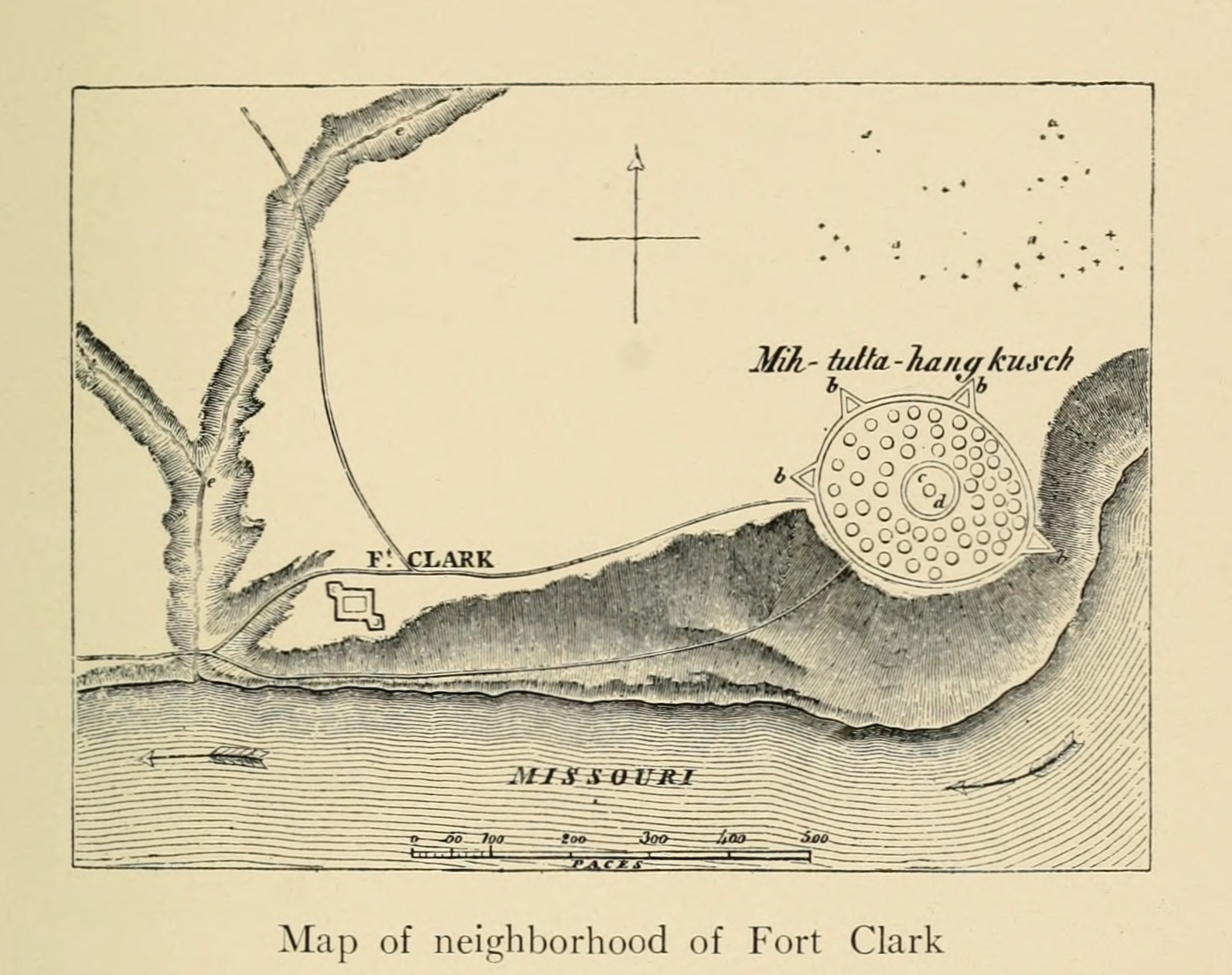
While proofing for Distributed Proofreaders, I often find myself opening up a mapping application to locate rivers, towns, buildings, forts, streets, etc. that are mentioned, described, or central to a project.  Sometimes it’s to figure out where they are. Sometimes it’s to try and see what’s being described.

map

For example, Early Western Travels, 1748-1846, Volume XXIII, describes some rock formations that the footnote identified as being in Dawson and Valley Counties, Montana. Using that information, I was able to view a photo of the rock formations. I’ve also found remote tiny towns that still exist in the American West — one even had a preserved historical district.

Florizel’s Folly (in progress at DP) led me to Brighton, EnglandYellowstone’s Living Geology: Earthquakes and Mountains (also in progress) to Old Faithful.

I posted in the DP forums about this and found another proofreader who was using mapping software to locate parks that were mentioned in old bird books as locations of certain birds. This person was interested in whether the parks have the same birds.

Of course, I look at maps because I love maps. So starting with a specific reference point from a book, I can get lost for half an hour or more exploring, envisioning, and virtually visiting. Anywhere. And how exciting when I get a chance to visit in person a site I’ve visited before via mapping software; for example, the Pony Express Statue in Sacramento Old Town.

If you haven’t tried this before, do! You may find yourself addicted.

This post was contributed by WebRover, a DP volunteer.


Celebrating 30,000 Titles

July 7, 2015

30K banner

Distributed Proofreaders has reached another milestone: we’ve posted 30,000 unique titles to Project Gutenberg!

We’re celebrating this achievement with a collection of 30 works, the product of DP volunteers’ perseverance and hard work in making a wide range of books available online:

These titles are an excellent illustration of what DP volunteers do every day:  We preserve and make available, for the delight and enlightenment of readers everywhere, a broad array of books on many subjects and in many languages. Congratulations to all who made this achievement possible!

This post was contributed by Linda Cantoni, a Distributed Proofreaders volunteer.


The Campaign of 1776 around New York and Brooklyn

July 4, 2015

Every once in a while, when my usual route home to Brooklyn from my job in Queens is clogged with traffic, I opt to take what I like to think of as the Revolutionary War Route. This route takes me past the site of a brilliant strategic move by the British that nearly cost the brand-new American nation its independence. You can learn much about that move from Henry Phelps Johnston’s fascinating account, The Campaign of 1776 around New York and Brooklyn, published in 1878.

map The campaign actually began months before the American Continental Congress issued its Declaration of Independence (the first e-book, by the way, that Project Gutenberg ever posted). Johnston relates how in January 1776, George Washington, rightly suspecting that the British would try to occupy New York City, obtained the Continental Congress’s approval to raise the city’s defenses. By August 1776, enough forts, batteries, barricades, and redoubts had been constructed so that the Americans “had inclosed themselves on the Brooklyn peninsula.”

The Americans, however, hadn’t reckoned on one key weakness in their position. Between them and the British lay a long, thickly wooded ridge, the product of glaciers receding thousands of years before. Today, this ridge is filled with parks and cemeteries, and along it runs the parkway I sometimes take to get home. Back in 1776, it was a wilderness. The Americans believed that they had all the important passes through this ridge under control.

But there was another pass that they had left essentially unguarded: the Jamaica Pass. Four miles to the east of the American lines, it was too isolated to keep covered effectively. Just a handful of officers were assigned to patrol it, for the Americans confidently believed that the British would be approaching from a different direction.

As Johnston puts it,

But little did the Americans suspect that at the very moment their defence seemed well arranged and their outguards vigilant they were already in the web which the enemy had been silently weaving around them during the night. That flanking column!… [W]ith crushing weight was it now to fall upon our outpost guards, who felt themselves secure along the hills and in the woods.

British troops poured through the pass, and the Americans were outflanked. They lost the Battle of Long Island, and eventually lost control of New York to the British. The war, fought on many fronts throughout the colonies, would not end until 1783.

The depth of Johnston’s scholarship is evident, but his writing is so clear that the reader never feels mired in detail. There are helpful maps, and a special bonus in Part II of the book: dozens of documents from the campaign that not only illustrate the strategies and concerns of the American generals, but also give a fascinating glimpse into everyday military life in the 18th Century. Johnston’s book is an outstanding contribution to American history.

Today is the 239th anniversary of American independence.

This post was contributed by Linda Cantoni, a Distributed Proofreaders volunteer.


The Librarian at Play

June 3, 2015
Lee Library

The Carnegie library in Lee, Massachusetts, c. 1909.

In the small New England town where my husband and I spend our vacations, the jewel of Main Street is a lovely public library built in 1907 from local marble. It’s a “Carnegie library” – one of the 2,500 libraries established worldwide with grants from steel tycoon Andrew Carnegie in the late 19th and early 20th Centuries.

A fictional version of one of those small-town Carnegie libraries is the setting for most of the pieces in The Librarian at Play by Edmund Lester Pearson, a delightfully humorous volume recounting, among other things, the daily interactions of the librarians with the quirky patrons of the library.

Pearson was a librarian and author, now best known for his fascinating true crime books, such as Studies in Murder, which are now classics of the genre. Educated at Harvard and the New York State Library School, he began his library career in Washington, D.C., and worked for a time at the Library of Congress. Beginning in 1906, he wrote a column, “The Librarian,” for a Boston newspaper, and it was this column that provided the amusing pieces in The Librarian at Play. The book was published in 1911, after he had moved back to his home town of Newburyport, Massachusetts – which, ironically, didn’t need a Carnegie library, because it had had a library of its own since 1854, and Pearson served on its Board of Trustees.

coverThe pieces in The Librarian at Play poke good-natured fun at books, readers, modern fictional characters, and even inventions. One piece features a salesman trying to sell the library an “interest gauge” that one attaches to a book to determine how interesting it is (the Letters of Junius doesn’t do too well, but a Conan Doyle story shoots the gauge up to a high level). Another piece concerns the exciting installation of a telephone at the library, which enables patrons to call for help in identifying a bird on the front lawn, or to get the answer to a newspaper contest question, or to locate a novel of which they know only the barest outlines of the plot, but not the title or author (“You see, it starts this way….”)

Even Andrew Carnegie is a source of playful humor. One fellow strongly suspects that the library doesn’t carry a particular socialist newspaper “because it’s Carnegie’s library, ain’t it, miss?” When the librarian replies that Carnegie merely donated the money for the building, the man insists that “he runs it, just the same” by using “people in his pay.” In another piece, an equally jaded gentleman opines that an overdue book notice demanding a fine is “just one of Carnegie’s games to get money out of yer.”

The Librarian at Play may be little known compared to Pearson’s true crime books, but it is a bright little gem in his body of work. Many thanks to the Distributed Proofreaders team for bringing it to the Project Gutenberg library.

This post was contributed by Linda Cantoni, a Distributed Proofreaders volunteer.


Archaeological Essays, Vol. II

May 7, 2015
Greek medicine vase

Ancient Greek medicine vase

Since archaeology is a subject that’s near and dear to my heart, I’ve smooth-read several books about it at DP. When I saw  Archaeological Essays, Vol. II, by Sir James Y. Simpson, show up in the smooth-reading pool, I thought, “Oh, boy! Another fun read!” Well, what I learned was, you can’t trust the title of a book. The first “essay,” which went on and on and on (you get the picture) had nothing to do with archaeology! It was entirely about the incidence of leprosy in Great Britain, Scotland, and parts of France! Now, mind you, the author quotes sources as far back as the 800s, but still! This is not archaeology.

I learned a lot about leprosy. I learned that there are three different kinds of it, that the ancient Greeks knew of it and called it “elephantiasis,” and that the Arabs had a different version of it. It is not the same thing as the swollen legs some people still get when infected by certain parasites. This particular author didn’t seem to think leprosy is very contagious. There was much discussion as to how leprosy arrived in Europe and England and spread to Scotland. There were rather graphic descriptions of what a person with leprosy looks like. I could almost be an expert in the field!

This is part of what makes smooth-reading so much fun. You never know what you’re going to end up with—or what you might learn!


Sunday School Stories

April 4, 2015

Maybee’s Stepping Stones by Archie Fell is a book of Sunday school stories for each week of the year. As I read it, I experienced a wide range of emotions — love, kindness, patience, life, death, naughtiness, guilt, fear, consequences, tolerance, forgiveness, family, community, happiness, sorrow, adversity, hope, loneliness, sadness, joy….

frontispiece

I gasped with alarm when Dick shot himself; when Tryphosa was overcome with the fire. I wanted to cry when Dick lay in the woods unheard, when Phosy and Aunty McFane became ill, and I rejoiced when Mrs. Harte and Bill Finnegan went to the Sabbath School, and when Dan Harte resolved to overcome his addiction to alcohol. I shared the children’s frustrations as they struggled with doing the right thing, and smiled unashamedly when their good deeds worked near miracles.

The stories may be old-fashioned, and based on Christianity, but the lessons are for us all, whether we believe in a god or not, whether our deeds are in person or via social media, whether we are young or old. We can all put out a hand in comfort and together we can grow in strength no matter what our trials and tribulations.

She had just been reading a chapter in the Bible out loud, and Aunty McFane said there was a promise for every ache she had. Isn’t it funny,” he  continued, turning to Miss Marvin, “that folks just as different as can be find exactly what they want in the Bible? — Maybee’s Stepping Stones, page 224.

Reading these stories, I couldn’t help but reminisce about when I was a little girl going to Sunday school.

Denomination meant nothing to us so the church we attended was the one within walking distance — I think it was Presbyterian. Our parents didn’t seem particularly religious, but they did make us go to Sunday school. Our father had in mind that if we weren’t christened it would be easier for us if we wanted to marry someone of strong faith in a particular church.

I never did work out my father’s beliefs. I suspect my mother was quite devout, although I did not know her to go to church, and she didn’t speak about religion much. She did go to a Catholic primary school — she had me shocked and in fits of laughter when she told me of the time she had to stand in front of an open fire with a piece of soap in her mouth because she had sworn at the nuns.

…  then she tried scrubbing the inside of his mouth with soap-suds — Maybee’s Stepping Stones, page 19.

My sister only recently told me the story of her second son who, at age six, when admonished for swearing, was threatened with a similar fate of having his mouth washed out with soap. The little boy went to the bathroom, grabbed some soap, foamed it up in his mouth, and went out to his mother and said, “Now I can swear.” I think there’s quite a bit of my mother’s determined spirit in both my sister and my nephew. The same son said to my sister the other week: “Do what you want, mother, you will anyway.”

My mother also told the story of a family member who was a Major in the Salvation Army. I heard her say many times that only the good die young. And I learnt that she had a very difficult time accepting the death of a daughter before I was born.

Upon the pine coffin, the girls in Miss Cox’s class laid a wreath of beautiful hot-house flowers; but all over the lid, and inside, around the pale face and over the white robe, were fresh, fragrant pond-lilies, their subtile perfume filling the room. — Maybee’s Stepping Stones, page 149.

We had Sunday School stories, much like those told in Maybee’s Stepping Stones. We collected a stamp for each story lesson we attended. When our stamp sheet was full, we were presented with a little book.

We had our “Sunday best” clothes, and how we did love dressing up, putting on our delicate little dresses with ribbons and bows, and polishing our little shoes. Going to Sunday school was exciting and something to look forward to. It added a purpose to our lives, spiritual and social.

But she made her appearance, bright and early, Sabbath morning, comparatively quite docile, submitted to be washed, shampooed, braided, and ruffled, with a most martyr-like air, and came out from the process not so very unlike the five other girls, among whom Say seated her, with such a happy look in her own blue eyes. Just to see her sitting there more than repaid the trouble. — Maybee’s Stepping Stones, page 106.

Our Sunday school was at the back of the church in a prefabricated corrugated steel “Nissen hut” like those used for temporary accommodation during the war years. The building is still there but it is no longer a church, and the hut has been replaced by a brick addition attached to the main building.

I mentioned above it was within walking distance. Back then, there was a church nearby almost everywhere. I thought about this in recent years when a neighbour who had become almost housebound because of poor vision and declining mobility told me that one of the things she missed most was being able to walk to church. Her old church building was still there, too, at the end of the street where she had lived most of her adult life, along with the convent buildings that had been converted first to a school, and then to an art gallery, and now left to crumble. The nearest church for her was now on the other side of town. Buses don’t run on Sundays in this small community so, with few friends or family interested in taking her to church, she had only television services to comfort her.

So much inward soul searching from a little children’s book — literary merit?… Well, the stories stand up to the test of time, is all I can conclude.

This post was contributed by a DP volunteer.


From Paper to App: How Distributed Proofreaders Got a Cebuano Dictionary on Smartphones

March 7, 2015

Because my wife’s native language is Cebuano, I am always on the lookout for resources in that language. Although widely spoken in the Southern Philippines, with about 30 million native speakers, the language lacks any official status and is mainly used in informal settings. Primary schools switch to a mix of English and Tagalog (re-branded as “Filipino” to make it a national language) after the first two years, and most official business takes place in English. As a result, there are very few publications in Cebuano.device-2015-02-23-204551

Back in 2006, I was able to obtain a set of scans of John U. Wolff’s Dictionary of Cebuano Visayan from somebody in the Philippines, and not much later I found a second set of scans available online from Cornell University. Immediately I noticed that this is a great resource for people who would like to study the language: it gives detailed grammatical information, and includes numerous sample sentences. Of course, it does have its issues: its use of non-standard orthography makes it less acceptable to most speakers of language, and the way the information on verb-usage is encoded is hard to understand even for a determined student. But still it would be very nice to have this book in a digital format.

Since the dictionary dates from 1972, at first I had little hope it could be re-published in Project Gutenberg; however, I got in touch with the author, now Emeritus Professor at Cornell University, and after consultation with the publisher he gave me permission to process the book for Project Gutenberg. Later on, I also noticed a very liberal “Public Domain” notice on this copy, stating that the book would enter the public domain in 1982.

Quickly, the process of preparing the scans for Distributed Proofreaders started: splitting all scans into columns, preparing instructions for the sometimes complex entries, and preparing several projects (one for each letter), such that proofers wouldn’t be shocked by a 2500+ page count, and more importantly, that work on it could be done in all rounds at once, and post-processing could get an early start with the first few letters.

When the first parts started to return from the site, the massive work of post-processing such a huge work started. Fiddling with regular expressions and custom-made conversion scripts in a combination of Perl and XSLT, I managed to massage the original typographic tagging to a far more useful structural tagging, such that all the various elements encoded in the dictionary were marked as such, with grammar labels, entries and sub-entries, sample sentences, and their translations having their own tag. This would also enable a spell-check of the entire document, in which the dictionary itself proved highly useful, because one of the first things I did with the data was to convert it into a SQL database, and build a web interface around it, which enabled me to quickly look up words in their context, and then use this interface to locate remaining issues in the data.

When all this was done, I was able to produce a huge (almost 10 megabyte) HTML and text file for submission to Project Gutenberg, and a nice PDF version which could be used to reprint the book; and, even better, I could publish the web interface on the website I set up to promote Bohol. All files required to process the dictionary are available online as well.

Since the introduction of tablet computers, I wanted to also create some software for them, and I got that opportunity in 2013, when I got three months of paid leave as part of my severance payment when my employer decided to close the Dutch office in which I was working. In that period, I dived into the architecture of Android apps, and basically re-coded the functionality of the website for a smartphone, in such a way that all the data was on-board and could be accessed without the need to be connected. Although the app was basically finished by October 2013, it took me quite some time to publish it, as I was occupied with other things, as a 7.2 earthquake in Bohol destroyed my in-laws’ house (as well as many other buildings, including some of its most beautiful historical churches). Also, I wanted to add some more features and polish the icons being used, and was investigating a way to earn something from the app. Seeing that this was not going happen soon, I decided to release the Cebuano-English Dictionary App for free, and also publish the complete source code, hoping it will prove a great resource for all with an interest in the Cebuano language, and hoping the source code will be helpful in building similar dictionaries for other languages. (Unfortunately, I won’t be making a version for the iPhone, as Apple requires DRM on all apps distributed through their iTunes store, and in general their conditions are incompatible with the GPL-3 I am using for my code).

Of course, all this wouldn’t have been possible without the diligent proofreading of many volunteers at Distributed Proofreaders — for that, daghang salamat (many thanks)!