Woman of Independence

July 4, 2016

Celebrations of American Independence generally focus on the men who made it happen. There were those who made it happen on paper, like John Adams, or Thomas Jefferson, or Benjamin Franklin. And there were those who made it happen on the battlefields, like George Washington, or Nathanael Greene, or Henry Knox. But there were no women in the Continental Congress, and no women in the Continental Army. As with many great historical events, women were, sadly, relegated to the sidelines.

Abigail Adams

Abigail Adams as a newlywed, 1766

But one woman had an important influence on the great event of American Independence, albeit from the sidelines. Abigail Adams, wife of John Adams, was her husband’s “dearest friend,” the mother of his children, the sounding board for his ideas.

Abigail Adams and Her Times, by Laura E. Richards (1917), is an engaging account, full of fascinating details that bring Colonial times to life. (“Snail-water,” a home remedy of the time for infants, is definitely not to be tried at home, and definitely not on infants.)

But Richards also brings Abigail herself to life. The great frustration of Abigail’s biographers has always been that she never kept a diary. Her youth and the early days of her marriage are not all that well documented. Although John Adams kept a diary, he only occasionally mentioned his wife in it. We learn who she is primarily from the many letters she exchanged with him — but that correspondence didn’t begin in earnest until a decade after their marriage, when he was thoroughly embroiled in the fight for American Independence and was away from home for long periods of time.

Richards deftly mines the letters for clues to Abigail’s character and personality. Abigail frequently signed herself “Portia,” after Shakespeare’s artful heroine. Her support for John’s important work was wholehearted, but she also urged him to consider greater rights for women:

… in the new code of laws which I suppose it will be necessary for you to make, I desire you would remember the ladies and be more generous and favorable to them than your ancestors. Do not put such unlimited power into the hands of the husbands. Remember, all men would be tyrants if they could. If particular care and attention is not paid to the ladies, we are determined to foment a rebellion, and will not hold ourselves bound by any laws in which we have no voice or representation.

Alas, Abigail’s hopes were not realized for nearly 150 years, but to John’s news that the Continental Congress had voted in favor of independence, she joyfully wrote:

By yesterday’s post I received two letters dated 3d and 4th of July, and though your letters never fail to give me pleasure, be the subject what it will, yet it was greatly heightened by the prospect of the future happiness and glory of our country. Nor am I a little gratified when I reflect that a person so nearly connected with me has had the honor of being a principal actor in laying a foundation for its future greatness.

May the foundation of our new Constitution be Justice, Truth, Righteousness! Like the wise man’s house, may it be founded upon these rocks, and then neither storm nor tempests will overthrow it!

Abigail remained John’s closest and most trusted adviser throughout the Revolution, during his Presidency, and afterward, while the titans who created the new nation struggled and quarreled over how it should be governed. Their joint epitaph is a fitting tribute to their partnership:

During an union of more than half a century they survived, in harmony of sentiment, principle, and affection, the tempests of civil commotion; meeting undaunted and surmounting the terrors and trials of that revolution, which secured the freedom of their country; improved the condition of their times; and brightened the prospects of futurity to the race of man upon earth.

July 4, 2016, is the 240th anniversary of American Independence.

This post was contributed by Linda Cantoni, a Distributed Proofreaders volunteer.


The Border and the Buffalo

June 1, 2016

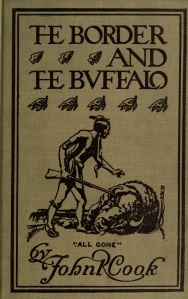
cover

Proofreading at Distributed Proofreaders has exposed me to a whole genre of books I never knew existed and which I’ve learned I really enjoy: first-hand accounts of the exploration and development of America—especially the American West.

Recently I worked on proofing one of these, a 1907 autobiography, The Border and the Buffalo: An Untold Story of the Southwest Plains, by John R. Cook. Cook participated in the slaughter of what is now believed to have been about 4.5 million American buffalo in a few years during the 1870s. Alarmed by the prospect of the buffalo’s extinction, several states, including Colorado and Kansas, had outlawed wholesale slaughter of buffalo. But not everyone thought that was a good idea. When the Texas Legislature met regarding a bill drawn up for the protection of buffalo,

General Phil. Sheridan … went to Austin, and, appearing before the joint assembly of the House and Senate, told them that they were making a sentimental mistake by legislating in the interest of the buffalo…. He said: “These men have done in the last two years and will do more in the next year, to settle the vexed Indian question, than the entire regular army has done in the last thirty years. They are destroying the Indians’ commissary; and it is a well-known fact that an army losing its base of supplies is placed at a great disadvantage. Send them powder and lead, if you will; but, for the sake of a lasting peace, let them kill, skin, and sell until the buffaloes are exterminated. Then your prairies can be covered with speckled cattle, and the festive cowboy, who follows the hunter as a second forerunner of an advanced civilization.”

I was aware that the buffalo slaughter had occurred, but had no idea of the role Sheridan had in encouraging it, nor that it was an intentional strategy to control the Native American populations and to open up the prairies for cattle. I had thought it was just the shortsightedness of individuals seeing the opportunity for financial gain and not realizing, or perhaps not caring, about their impact on the long-term survival of the species. They reduced the population of buffalo from multiple millions to what is believed to be only 300 in 1900. Today, with conservation efforts, the American buffalo population has increased to about half a million.

The hunters were after the hides and sometimes the tongues, which they dried and shipped east. In what appears to be an exception, Cook tells us about the Moore brothers, who “dried tons and tons of meat for a St. Louis firm.” In most cases, after killing the buffalo for their hides, the hunters left the rest behind.

But all was not wasted. When the army of hunters had annihilated those massive, sturdy creatures, the hair and bone scavengers followed them up with four- and six-horse, mule, or ox teams. They gathered up and hauled to the nearest railroad station every vestige of buffalo hair and bones that could be found.

I saw in 1874, the year before the great buffalo slaughter began in earnest, a rick of buffalo bones, on the Santa Fe railroad right-of-way, and twenty miles ahead of the track from Granada, Colorado, piled twelve feet high, nearly that wide at the base, and one-half mile long. Seven, eight, nine, and ten dollars per ton was realized from them alone.

I was also interested in the fact that individuals who had fought on opposite sides of the American Civil War, just a few years later, were working together in the American West. One group is described thus:

There were several ex-Confederate soldiers and Union ex-soldiers who had joined issues in a common cause. There were three school-teachers. All the party were native-born Americans with the exception of the two Englishmen, whose camp had been destroyed.

In the following tale they seemed to have more in common in the fact that they had had military experience than in the fact they had fought on opposite sides.

This book is written in an entertaining style. Cook introduces the reader to many characters of the time and tells interesting stories about them: the man who doesn’t realize he can use a left rear wagon-wheel to replace a damaged right rear wheel by turning it around—later known as Wrong-Wheel Jones; a horse that plays lame and dead and allows his owner to use his head as a gun rest; and Cook’s meeting with Pat Garrett, the man who later became sheriff of Lincoln County, New Mexico, and who killed Billy the Kid.

Through Cook we meet Smoky Hill Thompson, Squirrel-eye, Limpy Jim Smith, Wild Skillet, Crazy Burns, Buffalo Jones, Dirty-Face Jones, Arkansaw Jack, and Powder-Face Hudson, and sometimes we learn the source of their nicknames.

Cook also shows some regret at the slaughter he was involved in. Whether it really occurred at the time as represented, or whether it came to him when he wrote his autobiography some thirty years later, he reflects:

I then thought: What fertile soil! And what profitable and beautiful homes this region would make if only moisture were assured! How seemingly ruthless this slaughter of the thousands of tons of meat, one of the most wholesome and nutritious diets, as a rule, in the world!… Then a slight feeling of remorse would come over me for the part I was taking in this greatest of all “hunts to the death.” Then I would justify myself with the recollection of what General Sheridan had said; and I pictured to myself a white school-house on that knoll yonder where a mild maid was teaching future generals and statesmen the necessity of becoming familiar with the three R’s. Back there on that plateau I could see the court-house of a thriving county seat. On ahead is a good site for a church of any Christian denomination.

In addition to stories about killing buffalo, Cook tells many tales of encounters with Indians, personal stories of other travelers, and accounts of experiences while traveling through the American West in its last days before development. He provides an entertaining and insightful view of a time and place experienced and documented by only a few travelers. He wraps up one of his stories: “And this is just simply another of the many remarkable incidents that happened on the Range during the passing of the buffalo.”

This post was contributed by WebRover, a DP volunteer.


Celebrating 32,000 Titles

May 28, 2016

32k_Banner

Distributed Proofreaders is proud to celebrate its 32,000th title, Tik-Tok of Oz — many thanks to all the volunteers who worked on it!

The Wonderful Volumes of Oz – We’re off to see the Wizard!

Who among us has NOT seen the classic fairy tale The Wizard of Oz on television? Ah, but have you READ the original and the other volumes in the series?? Thanks to Distributed Proofreaders, there is no excuse!!

All of the volumes written by L. (Lyman) Frank Baum have been processed at DP. All are available on Project Gutenberg as text-only versions; but most, like our 32,000th title, have been redone with all of the original illustrations!

OzHeader
L. Frank Baum Oz Book List
The Wonderful Wizard of Oz
The Marvelous Land of Oz
Ozma of Oz
Dorothy and the Wizard in Oz
The Road to Oz
The Emerald City of Oz
The Patchwork Girl of Oz
Tik-Tok of Oz
The Scarecrow of Oz
Rinkitink in Oz
The Lost Princess of Oz
The Tin Woodman of Oz
The Magic of Oz
Glinda of Oz
Little Wizard Stories of Oz

The volume Tik-Tok of Oz is the latest to complete the journey through DP. Many of the characters from previous volumes make a reappearance, including Glinda, the Cowardly Lion, Betsy Bobbin, the Shaggy Man, Hank (the mule), Ozga and Polychrome, Dorothy, and Toto (too!). Tik-Tok, Queen Ann Soforth, Nome King, and Tittiti-Hoochoo are some of the new characters introduced in this volume.

Queen Ann Soforth of Oogaboo sets out to raise an army to conquer the Nome King. Betsy, Tik-Tok (a mechanical man who is guaranteed to work perfectly for a thousand years), Shaggy Man (with his Love Magnet), and a number of other characters team up with Queen Ann’ s “noble army” and save Oz!

I’ll confess that I have so far read only a few of the Oz tales. So, most of the characters are new to me. This is one of the best reasons to participate in activities such as Distributed Proofreaders—you may discover new treasures which were beloved a hundred years ago and still resonate today.

Although one person takes on the responsibility to transform a text file into a readable text version and an HTML version with coding to produce mobile versions (epub and mobi), each project requires quite a few folks to produce images, and to check the spelling, punctuation, and formatting. Tik-Tok took more than 60 DP volunteers to reach the post-processing stage. See this article for more on the DP process.

Now that I have completed this volume (I’ve read and helped produce the next in the series, The Scarecrow of Oz), I am looking forward to “catching up” on the others! Oh, by the way, did you know ALL of the animals CAN talk in Oz? Read Tik-Tok to hear what Toto has to say!

This post was contributed by Tom Cosmas, a DP volunteer who post-processed this project.


Popular Science, May 1900

May 1, 2016

Smooth-reading at Distributed Proofreaders can sometimes be a mixed bag, from the fascinating to the dull, even in the same project. When I smooth-read the May 1900 issue of The Popular Science Monthly, I found some of the articles quite interesting. Others were really rather boring, at least to me. For instance, I skim-read the article about blind fish. I really couldn’t make myself interested in how their skin and eyes work. Probably, to someone, this would be information of the utmost importance, but sadly, that article tended to put me to sleep. I found myself dozing off several times while attempting to read it, and eventually I decided to skip the rest of the article. There was another article that didn’t interest me, which was about International Law.

But there were also several articles in this magazine that I found enthralling. The first was about the total eclipse of the sun, May 28, 1900. It was interesting to see the meteorological charts that were drawn up. One chart could be used for predicting cloud cover over the path of the eclipse, and another chart showed what fraction of the surface of the sun would be covered during the time of the eclipse.

cloud cover chart

Chart II.—Probable State of the Sky along the Eclipse Track. Average percentage of cloudiness in May and June.

This article had particular appeal for me because in 1979, my husband and I traveled to Winnipeg, Canada, to witness the total solar eclipse that occurred on February 26. It was an amazing sight, and one I will never forget. In the summer of 2017 there will be another total solar eclipse which crosses the US. It will pass very close to Cairo, Illinois, and we intend to be there to see it.

So, reading about the 1900 eclipse brought back wonderful memories to me. I thoroughly enjoyed the author’s dissertation on the best way to take photos (which has not changed much, except that we now have digital cameras), speculation as to what the solar corona is, and general information about the eclipse.

This issue of Popular Science also includes an article titled “A Hundred Years of Chemistry.” What an interesting article! It speaks of new inventions such as the discovery of how to melt platinum, and how advances in electrical furnaces will change the future. There are many other interesting tidbits in this article, many of which have affected our lives today. For instance, the author wrote:

As we near the end of the century we find one more discovery to note, from a most unexpected quarter—the discovery of new gases in the atmosphere. In 1893 Lord Rayleigh was at work upon new determinations of density, with regard to the more important gases. In the case of nitrogen an anomaly appeared: nitrogen obtained from the atmosphere was found to be very slightly heavier than that prepared from chemical sources, but the difference was so slight that it might almost have been ignored. To Rayleigh, however, such a procedure was inadmissible, and he sought for an explanation of his results. Joining forces with Ramsay, the observed discrepancies were hunted down, and in 1894 the discovery of argon was announced. Ramsay soon found in certain rare minerals another new gas—helium—whose spectral lines had previously been noted in the spectrum of the sun; and still later, working with liquid air, he discovered four more of these strange elements—krypton, xenon, neon, and metargon. By extreme accuracy of measurement this chain of discovery was started, and, as some one has aptly said, it represents the triumph of the third decimal. A noble dissatisfaction with merely approximate data was the motive which initiated the work.

To the chemist these new gases are sorely puzzling. They come from a field which was thought to be exhausted, and cause us to wonder why they were not found before. The reason for the oversight is plain: the gases are devoid of chemical properties, at least none have yet been certainly observed. They are colorless, tasteless, odorless, inert; so far they have been found to be incapable of union with other elements; apart from some doubtful experiments of Berthelot, they form no chemical compounds. Under the periodic law they are difficult to classify; they seem to belong nowhere; they simply exist, unsocial, alone. Only by their density, their spectra, and some physical properties can these intractable new forms of matter be identified.

Finally, there is a short article about winking! Someone did a study trying to figure out how long a typical “wink” lasts. We would call the phenomenon being studied a blink, but still, to think that someone was able to actually time the duration of a blink of an eye (several eyes, actually) in 1900, is quite amazing to me.

Popular Science magazine has been around for a long time, and I encourage you all to check out some of the old editions being made available through Project Gutenberg. They’re fun! Well … mostly.


The Cambridge Book of Poetry for Children

March 31, 2016

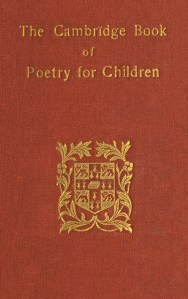
Cambridge Poetry coverShakespeare, Wordsworth, Coleridge, Dobell, Stevenson, Tennyson, Scott, Blake, Shelley … did you have a favourite poet when you were a child? A century ago, Kenneth Grahame put together a collection of poems from some of the most well-known and packaged them as The Cambridge Book of Poetry for Children. In his preface he explains how he chose the titles and concludes that the collection “is chiefly lyrical.” He says, “it is but a small sheaf that these gleanings amount to; but for those children who frankly do not care for poetry it will be more than enough; and for those who love it and delight in it, no ‘selection’ could ever be sufficiently satisfying.” I couldn’t agree more—there is something for everyone, even the not-so-young-anymore.
Take a look at the Contents of both Parts 1 and 2 and see if your favourites are there. Some of mine are—Blake’s “The Lamb” and “The Tiger”; Wordsworth’s “Daffodils”; Coleridge’s “Kubla Khan”; Tennyson’s “The Lady of Shallot” … let’s face it, there aren’t many that I don’t like. There are some I hadn’t recalled for a long time, and some I don’t remember, but it’s been fun reading them all. Here are some samples.

For the Very Smallest Ones, “I Saw a Ship a-sailing”:

I saw a ship a-sailing,
A-sailing on the sea;
And it was full of pretty things
For baby and for me.

And “Kitty: How to Treat Her”—I remember it word for word:

I like little Pussy, her coat is so warm,
And if I don’t hurt her she’ll do me no harm;
So I’ll not pull her tail, nor drive her away,
But Pussy and I very gently will play.

Do you remember “The Butterfly’s Ball,” by William Roscoe?

“Come, take up your hats, and away let us haste
To the Butterfly’s Ball and the Grasshopper’s Feast;
The Trumpeter, Gadfly, has summoned the crew,
And the revels are now only waiting for you.”

Or “Wynken, Blynken, and Nod,” by Eugene Field?

Wynken, Blynken, and Nod one night
Sailed off in a wooden shoe—
Sailed on a river of crystal light,
Into a sea of dew.

Shelley’s “Ode to the West Wind”—

O wild West Wind, thou breath of Autumn’s being,
Thou from whose unseen presence the leaves dead
Are driven, like ghosts from an enchanter fleeing,

and perhaps Charles Kingsley’s “The Old Buccaneer,” a great one for reading aloud:

Oh England is a pleasant place for them that’s rich and high,
But England is a cruel place for such poor folks as I;
And such a port for mariners I ne’er shall see again
As the pleasant Isle of Avès, beside the Spanish main.

This book summons up visions of family and friends, sitting around an open fire, each taking a turn at reading his or her favourite verse and perhaps talking about what makes it a favourite … is it the story, the words, the rhythm, the metre, the rhyme, the magic?… It’ll be something different for all of us. Hope some of you reading this will enjoy the book as much as I have.

This post was contributed by a DP volunteer.


How Does Your Garden Glow?

February 2, 2016

childrens_book_herbaceous

I love a garden. It touches and woos your senses. With sounds of rustling leaves, tools crunching into the soil, birds arguing over the spoils, bees buzzing the blossoms, rain spattering on broad leaves. Earthy scents, freshly turned earth, mint, broken leaves, flowers, spices. The textures of the leaves, soft, fuzzy, prickly, cool and smooth. Tastes … crackling radishes, firm tomatoes and squash, crisp lettuce and onions, freshly dug potatoes, strawberries right off the plant and won from the maurading and eager wildlife. You have to check to be sure the berries are ripe … often … wouldn’t do to serve others less than perfect berries. A well-kept garden is a beautiful thing.

Distributed Proofreaders has a discussion thread just for talking about our gardens. You’ll read what is growing in which parts of the world. What is failing and what is trying to take over.

gardening4_photo

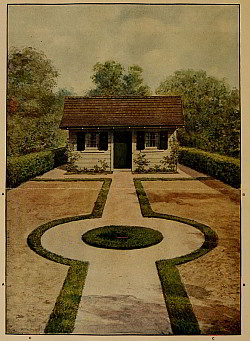
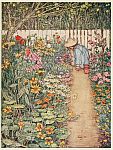
Additionally, and more importantly, DP has books about gardening. Books for children, books for those wanting to start and for those who, for want of a better term, want to dig deeper. One of my favourites has to be one we are working on right now from the classic Mary Frances series, The Mary Frances Garden Book, by Jane Eayre Fryer. Not only does this children’s book have beautiful illustrations and a fun narrative, it also has an actual picture of a plain garden that you cut out. Then, for each season, there are additional cut-outs with tabs that you tape on the back of the garden. Then you can fold them over the plain garden to show how the garden could look in full bloom. The book tells you to not cut it up but to trace the pictures. Thanks to the modern wonders of the Internet, though, you can print those pages out in their full glory and color!

plaingarden springgarden
Plain garden Spring garden

This is just one of the books on gardening for children soon to be available on Project  Gutenberg. A few more ready for your reading pleasure are:

daddy_garden gardening4lgirls childrens_book_garden
DADDY TAKES US TO THE GARDEN GARDENING FOR LITTLE GIRLS THE CHILDREN’S BOOK OF GARDENING
By
Howard R. Garis
By
Olive Hyde Foster
By
Mrs. Alfred Sidgwick
and
Mrs. Paynter

Obviously there are also books on gardening without cartoon drawings. If you are  interested in how to make things grow, here are just a few:

Or if you are more interested in a scientific approach, try one of these:

The sun is rising, the birds are starting to sing … open a book and come walk with me in a garden.

garden

 This post was contributed by a DP volunteer.

DP Celebrates 31,000 Titles

December 27, 2015

banner

Distributed Proofreaders is proud to celebrate its 31,000th title, Colour in the Flower Garden — many thanks to all the volunteers who worked on it!

lilies

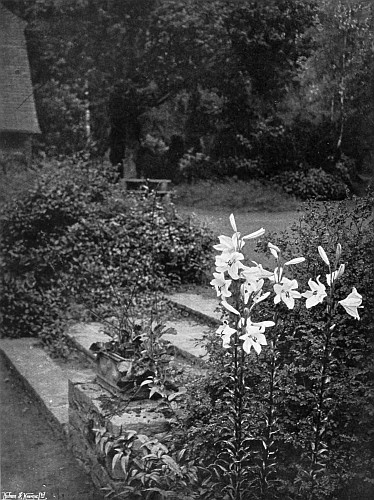
WHITE LILIES.

Gertrude Jekyll, probably (after Capability Brown) the most famous English garden designer, lived from 1843 to 1932 and created at least 400 major gardens within Europe and North America, often working closely with the architect Sir Edwin Lutyens. She set out to develop a career as a painter, but developed an interest in the use of colour in planting, and, possibly prompted by deteriorating eyesight, moved into garden design. She was heavily influenced by Impressionism, eschewing excessive formality in design and planting.

Her book Colour in the Flower Garden sums up the experience of 40 years, using the garden she designed for herself at Munstead Wood. The book describes her philosophy in detail and gives detailed planting schemes for many areas of the garden, but is by no means prescriptive. She describes what she has done and why, and lets the results speak for themselves.

It is also profusely illustrated with, regrettably monochrome, photographs of the garden.

For the gardener, it is a very accessible and interesting record, but from an age and of a scale which make it, perhaps, less than useful.

Two quotations give a flavour of the scale and ambition.

Talking of flower borders: “I believe that the only way in which it can be made successful is to devote certain borders to certain times of year; each border or garden region to be bright for from one to three months.”

And about one area of her garden: “Ten acres is but a small area for a bit of woodland, yet it can be made apparently much larger by well-considered treatment.”

I look out at my own garden (20 x 8 meters) and think, “I grow plants, but this is not, by Jekyll’s standards, a garden.”

This post was contributed by Les Galloway, a DP volunteer who post-processed this project.


Twelve Books of Christmas

December 23, 2015

holiday banner

Distributed Proofreaders loves to celebrate special days, and holiday-themed projects abound among its contributions to Project Gutenberg, including well over 100 Christmas-related books. These come from just about every genre: Christmas novels, stories, poetry, and plays for all ages; inspirational books and biographies of Jesus; and accounts of Christmas legends and customs throughout the centuries in different parts of the world. Here’s a selection of twelve of these books, in celebration of the twelve days of Christmas.

A Visit from St Nicholas

Lovely Christmas collaborations of famous authors and famous illustrators include Charles Dickens’s classic A Christmas Carol, illustrated by Arthur Rackham. Walter Crane wrote and provided rich color illustrations in A Winter Nosegay, a delightful little collection of Christmas tales for children. Old Christmas, taken from Washington Irving’s Sketch Book, is filled with entertaining sketches by Randolph Caldecott. And here is the classic poem A Visit from Saint Nicholas — a.k.a. The Night Before Christmas — by Clement Clarke Moore, beautifully illustrated by F.O.C. Darley.

Religious offerings include Ernest Renan’s excellent Vie de Jésus, also available in English as The Life of Jesus. For children, there is The Boyhood of Jesus by an anonymous author. Inspirational thoughts abound in A Christmas Gift, written “to the American Home and the Youth of America” by a Danish Lutheran minister.

For those interested in the history of Christmas, there is The Book of Christmas, by Thomas K. Hervey, which traces the origins of various English Christmas customs back to ancient pagan winter festivals such as the Roman Saturnalia and the Northern European Yule. Or Christmastide, by William Sandys, which includes Christmas carols you can listen to. Christmas customs in different parts of the world are represented by several books, including Yule-Tide in Many Lands by Mary Poague Pringle and Clara A. Urann, and The Christmas Kalends of Provence by Thomas A. Janvier.

Finally, for sly Christmas humor, check out A Christmas Garland, “woven” by Max Beerbohm. This is a 1912 collection of Christmas stories that are actually spot-on parodies of the styles of noted literary figures, including Henry James, H.G. Wells, Thomas Hardy, and G.K. Chesterton.

Merry Christmas to all, and to all a Happy New Year!

This post was contributed by Linda Cantoni, a Distributed Proofreaders volunteer.


P.T. Barnum’s Struggles and Triumphs

November 7, 2015

Barnum

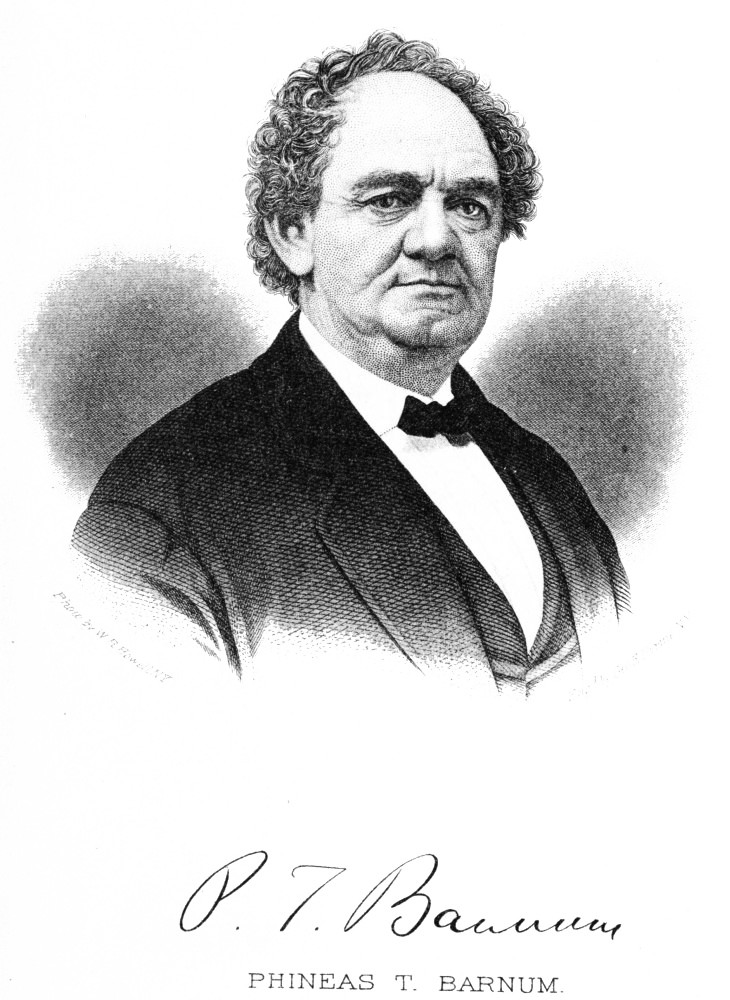
Even though it may be common knowledge to some, I had not known that P.T. Barnum was the owner and manager of a museum. I’d only thought of him in relation to travelling circuses. Struggles and Triumphs: or, Forty Years’ Recollections of P.T. Barnum, by the great showman himself, describes how he went from being involved with travelling circuses to owning and running a museum (funny and entertaining, I thought) as well as the tribulations of managing the museum once he’d acquired it (even funnier).

To describe the details of how he came to own the museum might potentially spoil the story for the reader, but I’ll give a couple of examples of the on the job training which he experienced himself whilst endeavouring to turn his museum into a success via trial and error, as well as some of the wisdom or street nous or business acumen or psychological tricks which he brought to the endeavour himself.

Above the entrance to his museum he situated a small band of musicians. They weren’t very good, but that meant they were relatively cheap, the idea being to make noise and attract attention. If, however, the band were to be too good, then people might just stand on the side of the street and listen to the music for free rather than pay the small price of admission and actually enter the museum as intended. As the band was not very good, a lot of people entered the museum, after being reeled in by the music to find out what it was all about, just to get away from the noise.

Another strategy he employed in order to drum up business was to hire a man to take a plain house brick and simply walk a circular route around town, passing several busy intersections, and intermittently stop, put down the brick and just stand there next to the brick for a few moments before picking up the brick again and continuing on his route. It was critical that he not respond to anybody asking him what he was up to or what the deal was in regards to the brick he carried. He also had no sign mentioning the museum or anything else. At the end of his silent route, he would enter the museum, taking a simple tour of all the exhibits, before once again going out and walking his route through town and performing his little interaction with the brick here and there in one continuous cyclic pantomime. Many people followed him, since he would not reply to basic inquiries, and even paid the small price of admission to the museum just in order to follow him inside and figure out what this curious fellow was up to.

His intention was to keep the price of admission low, but have high turnover by getting as many people in and out of the museum as possible in a constant stream of customers. The customers, however, had other ideas. They brought box lunches and sought to make a day of it, to the point that he could not sell more tickets to let more people in, even though at that point he had more people lining up just to get into his museum, because the interior of his museum was simply full to the brim with customers already, who intended to get their money’s worth by staying most of the day. He countered this by opening a backdoor of the museum and putting up a sign stating “TO THE EGRESS,” pointing to that rear exit. The malingering crowd of customers inside the museum who weren’t playing his bums-through-the-turnstiles game properly, in his opinion, thought the sign indicated another newly opened exotic exhibit and left the museum via that exit to check it out, allowing the queues out the front to once again flow, as well as the money from further ticket sales.

There’s little doubt that Barnum had a head for business and showmanship, as the museum was a huge success. But it was very interesting, funny and entertaining to read the details of how that success was created and how inevitable problems were overcome.

I haven’t even mentioned the adventures of tiny Tom Thumb, the “Little General”, whom Barnum took on tour through Europe. The interactions of the pint-sized charmer with the royalty of Britain and France, for example, were a delight to read in and of themselves.

This post was contributed by FallenArchangel, a DP volunteer.


Project Gutenberg celebrates 50,000 titles

September 18, 2015

Project Gutenberg 50,000 Books

Distributed Proofreaders proudly brings to you Project Gutenberg’s 50,000th title, John Gutenberg, First Master Printer, His Acts, and most remarkable Discourses, and his Death, by Franz von Dingelstedt, translated from the German and published in 1860.

cover

I couldn’t think of a more appropriate title to celebrate this milestone. Johannes Gutenberg is known as the inventor of the moveable-type printing press, which led to the mass production of printed books and subsequent growth of literacy, knowledge and learning.

The project was first suggested by a DP volunteer. It was quickly picked up by one of our newer project managers, ably assisted by one of our more experienced and prolific project managers, who helped convert the long “s” used in the original publication to the regular “s” in use today.

With notification that PG was nearing its 50,000th book, the project manager suggested that if we hurried, perhaps we could finish it in time to be considered as a contender.

More than 30 volunteers joined in with no notice and made sure the pages were proofread and formatted to a standard of excellence, so that there was very little for the post-processor to have to do to assemble and check the pages for the final ebook. A draft was made available, and in next to no time smooth readers had read the book and reported their findings to ensure the ebook represented the original.

The book is a biography of the man, born Johann Gensfleisch, who preferred to be known as Johann Gutenberg (John Gutenberg in the translation). His inventions led to the printing of the first book published using moveable type, the Bible in Latin. He had little money and was unable to continue his experiments without financial backing. He met John Fust, who bankrolled Gutenberg’s venture, and the Bible was completed in time for the wedding of Fust’s daughter:

The Bible, on its part, had its silver clasps well rubbed and polished, and, being placed on a table, it shone, to the edification and admiration of all beholders.

The book quotes Gutenberg as saying:

My art belongs to me as much as to the rest of the world; let it remain the property of intelligence, and only be practised by those who have been initiated in it.

Yet he felt that his:

… art is not like any other art; a painter sketches his figures on the canvas, and he perfects the creation of his thought; the same with the poet, the engraver, the architect, and the musician; we, on the contrary, with our presses, are only the servants of others; printing is only an instrument for thinkers. Of what importance are the fingers which regulate the letters in a book? Of what importance is the hand which works the press, which arranges the pages and the leaves, which gives a visible form to the action of the mind?

Gutenberg toiled long and hard, working in dark, oppressive and humble conditions, but eventually he lost his business to Fust and died “neglected and in destitution.” His legacy, however, lives on, and his namesake, Project Gutenberg, continues the philosophy of sharing the printed word with the world.

This post was contributed by a DP volunteer.