The Cambridge Book of Poetry for Children

March 31, 2016

Cambridge Poetry coverShakespeare, Wordsworth, Coleridge, Dobell, Stevenson, Tennyson, Scott, Blake, Shelley … did you have a favourite poet when you were a child? A century ago, Kenneth Grahame put together a collection of poems from some of the most well-known and packaged them as The Cambridge Book of Poetry for Children. In his preface he explains how he chose the titles and concludes that the collection “is chiefly lyrical.” He says, “it is but a small sheaf that these gleanings amount to; but for those children who frankly do not care for poetry it will be more than enough; and for those who love it and delight in it, no ‘selection’ could ever be sufficiently satisfying.” I couldn’t agree more—there is something for everyone, even the not-so-young-anymore.
Take a look at the Contents of both Parts 1 and 2 and see if your favourites are there. Some of mine are—Blake’s “The Lamb” and “The Tiger”; Wordsworth’s “Daffodils”; Coleridge’s “Kubla Khan”; Tennyson’s “The Lady of Shallot” … let’s face it, there aren’t many that I don’t like. There are some I hadn’t recalled for a long time, and some I don’t remember, but it’s been fun reading them all. Here are some samples.

For the Very Smallest Ones, “I Saw a Ship a-sailing”:

I saw a ship a-sailing,
A-sailing on the sea;
And it was full of pretty things
For baby and for me.

And “Kitty: How to Treat Her”—I remember it word for word:

I like little Pussy, her coat is so warm,
And if I don’t hurt her she’ll do me no harm;
So I’ll not pull her tail, nor drive her away,
But Pussy and I very gently will play.

Do you remember “The Butterfly’s Ball,” by William Roscoe?

“Come, take up your hats, and away let us haste
To the Butterfly’s Ball and the Grasshopper’s Feast;
The Trumpeter, Gadfly, has summoned the crew,
And the revels are now only waiting for you.”

Or “Wynken, Blynken, and Nod,” by Eugene Field?

Wynken, Blynken, and Nod one night
Sailed off in a wooden shoe—
Sailed on a river of crystal light,
Into a sea of dew.

Shelley’s “Ode to the West Wind”—

O wild West Wind, thou breath of Autumn’s being,
Thou from whose unseen presence the leaves dead
Are driven, like ghosts from an enchanter fleeing,

and perhaps Charles Kingsley’s “The Old Buccaneer,” a great one for reading aloud:

Oh England is a pleasant place for them that’s rich and high,
But England is a cruel place for such poor folks as I;
And such a port for mariners I ne’er shall see again
As the pleasant Isle of Avès, beside the Spanish main.

This book summons up visions of family and friends, sitting around an open fire, each taking a turn at reading his or her favourite verse and perhaps talking about what makes it a favourite … is it the story, the words, the rhythm, the metre, the rhyme, the magic?… It’ll be something different for all of us. Hope some of you reading this will enjoy the book as much as I have.

This post was contributed by a DP volunteer.


How Does Your Garden Glow?

February 2, 2016

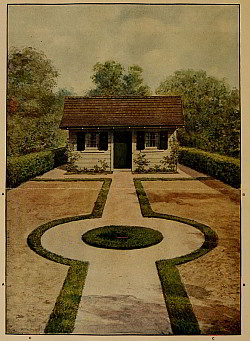
childrens_book_herbaceous

I love a garden. It touches and woos your senses. With sounds of rustling leaves, tools crunching into the soil, birds arguing over the spoils, bees buzzing the blossoms, rain spattering on broad leaves. Earthy scents, freshly turned earth, mint, broken leaves, flowers, spices. The textures of the leaves, soft, fuzzy, prickly, cool and smooth. Tastes … crackling radishes, firm tomatoes and squash, crisp lettuce and onions, freshly dug potatoes, strawberries right off the plant and won from the maurading and eager wildlife. You have to check to be sure the berries are ripe … often … wouldn’t do to serve others less than perfect berries. A well-kept garden is a beautiful thing.

Distributed Proofreaders has a discussion thread just for talking about our gardens. You’ll read what is growing in which parts of the world. What is failing and what is trying to take over.

gardening4_photo

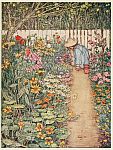
Additionally, and more importantly, DP has books about gardening. Books for children, books for those wanting to start and for those who, for want of a better term, want to dig deeper. One of my favourites has to be one we are working on right now from the classic Mary Frances series, The Mary Frances Garden Book, by Jane Eayre Fryer. Not only does this children’s book have beautiful illustrations and a fun narrative, it also has an actual picture of a plain garden that you cut out. Then, for each season, there are additional cut-outs with tabs that you tape on the back of the garden. Then you can fold them over the plain garden to show how the garden could look in full bloom. The book tells you to not cut it up but to trace the pictures. Thanks to the modern wonders of the Internet, though, you can print those pages out in their full glory and color!

plaingarden springgarden
Plain garden Spring garden

This is just one of the books on gardening for children soon to be available on Project  Gutenberg. A few more ready for your reading pleasure are:

daddy_garden gardening4lgirls childrens_book_garden
DADDY TAKES US TO THE GARDEN GARDENING FOR LITTLE GIRLS THE CHILDREN’S BOOK OF GARDENING
By
Howard R. Garis
By
Olive Hyde Foster
By
Mrs. Alfred Sidgwick
and
Mrs. Paynter

Obviously there are also books on gardening without cartoon drawings. If you are  interested in how to make things grow, here are just a few:

Or if you are more interested in a scientific approach, try one of these:

The sun is rising, the birds are starting to sing … open a book and come walk with me in a garden.

garden

 This post was contributed by a DP volunteer.

DP Celebrates 31,000 Titles

December 27, 2015

banner

Distributed Proofreaders is proud to celebrate its 31,000th title, Colour in the Flower Garden — many thanks to all the volunteers who worked on it!

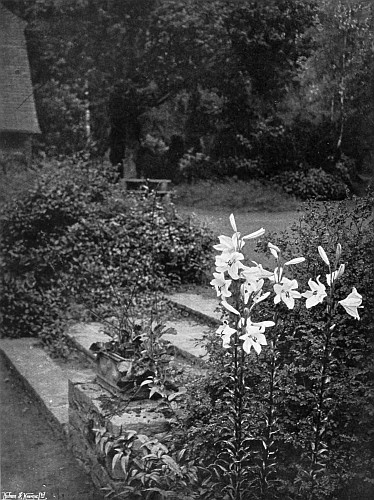
lilies

WHITE LILIES.

Gertrude Jekyll, probably (after Capability Brown) the most famous English garden designer, lived from 1843 to 1932 and created at least 400 major gardens within Europe and North America, often working closely with the architect Sir Edwin Lutyens. She set out to develop a career as a painter, but developed an interest in the use of colour in planting, and, possibly prompted by deteriorating eyesight, moved into garden design. She was heavily influenced by Impressionism, eschewing excessive formality in design and planting.

Her book Colour in the Flower Garden sums up the experience of 40 years, using the garden she designed for herself at Munstead Wood. The book describes her philosophy in detail and gives detailed planting schemes for many areas of the garden, but is by no means prescriptive. She describes what she has done and why, and lets the results speak for themselves.

It is also profusely illustrated with, regrettably monochrome, photographs of the garden.

For the gardener, it is a very accessible and interesting record, but from an age and of a scale which make it, perhaps, less than useful.

Two quotations give a flavour of the scale and ambition.

Talking of flower borders: “I believe that the only way in which it can be made successful is to devote certain borders to certain times of year; each border or garden region to be bright for from one to three months.”

And about one area of her garden: “Ten acres is but a small area for a bit of woodland, yet it can be made apparently much larger by well-considered treatment.”

I look out at my own garden (20 x 8 meters) and think, “I grow plants, but this is not, by Jekyll’s standards, a garden.”

This post was contributed by Les Galloway, a DP volunteer who post-processed this project.


Twelve Books of Christmas

December 23, 2015

holiday banner

Distributed Proofreaders loves to celebrate special days, and holiday-themed projects abound among its contributions to Project Gutenberg, including well over 100 Christmas-related books. These come from just about every genre: Christmas novels, stories, poetry, and plays for all ages; inspirational books and biographies of Jesus; and accounts of Christmas legends and customs throughout the centuries in different parts of the world. Here’s a selection of twelve of these books, in celebration of the twelve days of Christmas.

A Visit from St Nicholas

Lovely Christmas collaborations of famous authors and famous illustrators include Charles Dickens’s classic A Christmas Carol, illustrated by Arthur Rackham. Walter Crane wrote and provided rich color illustrations in A Winter Nosegay, a delightful little collection of Christmas tales for children. Old Christmas, taken from Washington Irving’s Sketch Book, is filled with entertaining sketches by Randolph Caldecott. And here is the classic poem A Visit from Saint Nicholas — a.k.a. The Night Before Christmas — by Clement Clarke Moore, beautifully illustrated by F.O.C. Darley.

Religious offerings include Ernest Renan’s excellent Vie de Jésus, also available in English as The Life of Jesus. For children, there is The Boyhood of Jesus by an anonymous author. Inspirational thoughts abound in A Christmas Gift, written “to the American Home and the Youth of America” by a Danish Lutheran minister.

For those interested in the history of Christmas, there is The Book of Christmas, by Thomas K. Hervey, which traces the origins of various English Christmas customs back to ancient pagan winter festivals such as the Roman Saturnalia and the Northern European Yule. Or Christmastide, by William Sandys, which includes Christmas carols you can listen to. Christmas customs in different parts of the world are represented by several books, including Yule-Tide in Many Lands by Mary Poague Pringle and Clara A. Urann, and The Christmas Kalends of Provence by Thomas A. Janvier.

Finally, for sly Christmas humor, check out A Christmas Garland, “woven” by Max Beerbohm. This is a 1912 collection of Christmas stories that are actually spot-on parodies of the styles of noted literary figures, including Henry James, H.G. Wells, Thomas Hardy, and G.K. Chesterton.

Merry Christmas to all, and to all a Happy New Year!

This post was contributed by Linda Cantoni, a Distributed Proofreaders volunteer.


P.T. Barnum’s Struggles and Triumphs

November 7, 2015

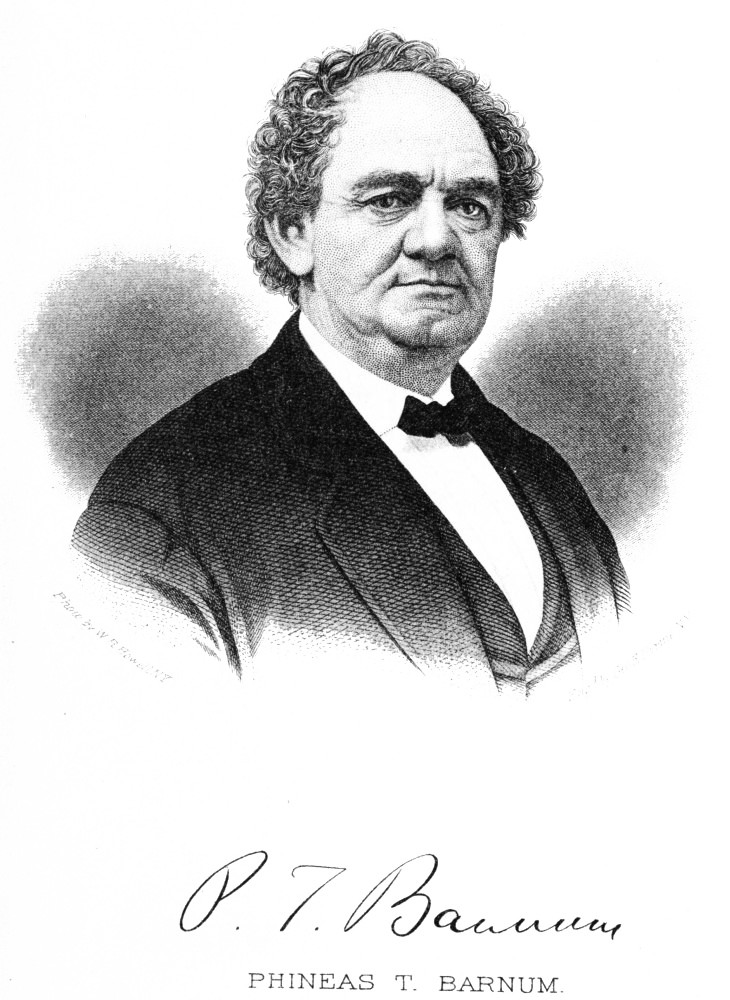
Barnum

Even though it may be common knowledge to some, I had not known that P.T. Barnum was the owner and manager of a museum. I’d only thought of him in relation to travelling circuses. Struggles and Triumphs: or, Forty Years’ Recollections of P.T. Barnum, by the great showman himself, describes how he went from being involved with travelling circuses to owning and running a museum (funny and entertaining, I thought) as well as the tribulations of managing the museum once he’d acquired it (even funnier).

To describe the details of how he came to own the museum might potentially spoil the story for the reader, but I’ll give a couple of examples of the on the job training which he experienced himself whilst endeavouring to turn his museum into a success via trial and error, as well as some of the wisdom or street nous or business acumen or psychological tricks which he brought to the endeavour himself.

Above the entrance to his museum he situated a small band of musicians. They weren’t very good, but that meant they were relatively cheap, the idea being to make noise and attract attention. If, however, the band were to be too good, then people might just stand on the side of the street and listen to the music for free rather than pay the small price of admission and actually enter the museum as intended. As the band was not very good, a lot of people entered the museum, after being reeled in by the music to find out what it was all about, just to get away from the noise.

Another strategy he employed in order to drum up business was to hire a man to take a plain house brick and simply walk a circular route around town, passing several busy intersections, and intermittently stop, put down the brick and just stand there next to the brick for a few moments before picking up the brick again and continuing on his route. It was critical that he not respond to anybody asking him what he was up to or what the deal was in regards to the brick he carried. He also had no sign mentioning the museum or anything else. At the end of his silent route, he would enter the museum, taking a simple tour of all the exhibits, before once again going out and walking his route through town and performing his little interaction with the brick here and there in one continuous cyclic pantomime. Many people followed him, since he would not reply to basic inquiries, and even paid the small price of admission to the museum just in order to follow him inside and figure out what this curious fellow was up to.

His intention was to keep the price of admission low, but have high turnover by getting as many people in and out of the museum as possible in a constant stream of customers. The customers, however, had other ideas. They brought box lunches and sought to make a day of it, to the point that he could not sell more tickets to let more people in, even though at that point he had more people lining up just to get into his museum, because the interior of his museum was simply full to the brim with customers already, who intended to get their money’s worth by staying most of the day. He countered this by opening a backdoor of the museum and putting up a sign stating “TO THE EGRESS,” pointing to that rear exit. The malingering crowd of customers inside the museum who weren’t playing his bums-through-the-turnstiles game properly, in his opinion, thought the sign indicated another newly opened exotic exhibit and left the museum via that exit to check it out, allowing the queues out the front to once again flow, as well as the money from further ticket sales.

There’s little doubt that Barnum had a head for business and showmanship, as the museum was a huge success. But it was very interesting, funny and entertaining to read the details of how that success was created and how inevitable problems were overcome.

I haven’t even mentioned the adventures of tiny Tom Thumb, the “Little General”, whom Barnum took on tour through Europe. The interactions of the pint-sized charmer with the royalty of Britain and France, for example, were a delight to read in and of themselves.

This post was contributed by FallenArchangel, a DP volunteer.


Project Gutenberg celebrates 50,000 titles

September 18, 2015

Project Gutenberg 50,000 Books

Distributed Proofreaders proudly brings to you Project Gutenberg’s 50,000th title, John Gutenberg, First Master Printer, His Acts, and most remarkable Discourses, and his Death, by Franz von Dingelstedt, translated from the German and published in 1860.

cover

I couldn’t think of a more appropriate title to celebrate this milestone. Johannes Gutenberg is known as the inventor of the moveable-type printing press, which led to the mass production of printed books and subsequent growth of literacy, knowledge and learning.

The project was first suggested by a DP volunteer. It was quickly picked up by one of our newer project managers, ably assisted by one of our more experienced and prolific project managers, who helped convert the long “s” used in the original publication to the regular “s” in use today.

With notification that PG was nearing its 50,000th book, the project manager suggested that if we hurried, perhaps we could finish it in time to be considered as a contender.

More than 30 volunteers joined in with no notice and made sure the pages were proofread and formatted to a standard of excellence, so that there was very little for the post-processor to have to do to assemble and check the pages for the final ebook. A draft was made available, and in next to no time smooth readers had read the book and reported their findings to ensure the ebook represented the original.

The book is a biography of the man, born Johann Gensfleisch, who preferred to be known as Johann Gutenberg (John Gutenberg in the translation). His inventions led to the printing of the first book published using moveable type, the Bible in Latin. He had little money and was unable to continue his experiments without financial backing. He met John Fust, who bankrolled Gutenberg’s venture, and the Bible was completed in time for the wedding of Fust’s daughter:

The Bible, on its part, had its silver clasps well rubbed and polished, and, being placed on a table, it shone, to the edification and admiration of all beholders.

The book quotes Gutenberg as saying:

My art belongs to me as much as to the rest of the world; let it remain the property of intelligence, and only be practised by those who have been initiated in it.

Yet he felt that his:

… art is not like any other art; a painter sketches his figures on the canvas, and he perfects the creation of his thought; the same with the poet, the engraver, the architect, and the musician; we, on the contrary, with our presses, are only the servants of others; printing is only an instrument for thinkers. Of what importance are the fingers which regulate the letters in a book? Of what importance is the hand which works the press, which arranges the pages and the leaves, which gives a visible form to the action of the mind?

Gutenberg toiled long and hard, working in dark, oppressive and humble conditions, but eventually he lost his business to Fust and died “neglected and in destitution.” His legacy, however, lives on, and his namesake, Project Gutenberg, continues the philosophy of sharing the printed word with the world.

This post was contributed by a DP volunteer.


A Soldier’s Daughter

September 5, 2015

A Soldier’s Daughter, by G.A. Henty, published in 1906, covercontains three stories. Each one is set in a different continent, but they are all very adventurous. What is more, they all show the bravery of girls — an unusual way to present them at the beginning of the twentieth century, when girls were expected to act like “ladies,” and adventures were considered to be the exclusive province of men.

The first story, “A Soldier’s Daughter,” tells us about Nita, the daughter of a major in a British military camp in Darlinger, India. The following quotes give an idea of what Nita’s father expected from her:

I have quite made up my mind at last, Nita, when I return from this expedition, to pack you off to your uncle in England; you are getting a great deal too old to be knocking about in a barrack-yard, and there are no ladies here who would keep you up to the mark. I know that you are a favourite with all the officers, but that only makes matters worse. You have been a regular tomboy for the last five years, and it is quite time that you were
taught to behave as a young lady.

I like a woman who can play an accompaniment to a good old English, Scotch, or Irish song.…

… there is no more necessary accomplishment on the frontier than for a woman to be able to make her own clothes.

But Nita is a very brave girl. One day, when her father is away with most of the troops, a local tribe attacks the camp, and Nita is captured. Nita not only manages to escape, but after a long, perilous, and adventurous trip, she and an officer — whom she rescued! — finally manage to reach a British camp, where Nita’s father, who thought his daughter was dead, can hold her in his arms again. And of course Nita is proclaimed a heroine!

The second story, which is situated in Germany, is called “How Count Conrad von Waldensturm Took Goldstein.” This is about a young count, who, after a war in which his father was killed, finds out that a rival Baron from a neighbouring castle has attacked Waldensturm and kidnapped the count’s sister Minna, with the purpose of marrying her to the baron’s evil son. With the help of the people of the villages, who are as eager as Count Conrad himself to overthrow the Baron of Goldstein, he is able to free his sister, and, with tricks and an ambush, to kill Baron Goldstein and his son, and make himself master of Castle Goldstein. And all this would not have been possible without the help of Bertha Grun, the daughter of a villager, who was appointed by the baron to be Minna von Waldensturm’s lady-in-waiting.

The last story takes us to Australia, and is called “A Raid by the Blacks.” The Roberts family are living on an outlying farming station in Australia. In those days, when life on a remote farm was extremely hard, people could use all the hands that were available, for every task. But look at the differences in education Effie and her brother received:

The boy, who was now fifteen, had been for the past two years at Sydney, living at his uncle’s and attending school. In another year he was to return to the station. He had gone most reluctantly, but his father had said: “I can quite understand your liking this life, Ned, but I don’t wish you to grow up simply a bush farmer. The colony is increasing fast, and there will be plenty of openings for a young fellow of intelligence and a fair education. I hope that by the time you grow up I shall be able to settle you on a farm like mine, and stock it well for you, if you decide upon following this sort of life, or to start you in any line that you may like to adopt in Sydney. You have had two years of running wild, and if you remain here you will speedily forget what little you have learned; but in any case, three years at school will be a great advantage to you.”

Effie, the daughter, was now fourteen, a strong healthy girl who could ride any horse on the station, had been taught to use both pistol and rifle, and was as bold and fearless as a boy.

Effie had her own tasks on the farm:

Effie went out twice a day with food for the horses, and each time carried a dozen large apples in her apron, which she gave them after they had eaten their corn.

Effie still was a girl of her time, however. When she had to escape the farm in boy’s clothes to ride off and get help from the neighbours, she was a bit embarrassed:

As Effie felt shy about appearing in boy’s clothes, Mrs. Talbot lent her a blouse and skirt.

The reader should note that the stories in A Soldier’s Daughter are not “politically correct” by today’s standards, in terms of how different races are presented. But the book is a creature of its time, and in my opinion, Nita, Bertha and Effie showed that they were real heroines!

This post was contributed by DP volunteer Eevee.


The Campaign of 1776 around New York and Brooklyn

July 4, 2015

Every once in a while, when my usual route home to Brooklyn from my job in Queens is clogged with traffic, I opt to take what I like to think of as the Revolutionary War Route. This route takes me past the site of a brilliant strategic move by the British that nearly cost the brand-new American nation its independence. You can learn much about that move from Henry Phelps Johnston’s fascinating account, The Campaign of 1776 around New York and Brooklyn, published in 1878.

map The campaign actually began months before the American Continental Congress issued its Declaration of Independence (the first e-book, by the way, that Project Gutenberg ever posted). Johnston relates how in January 1776, George Washington, rightly suspecting that the British would try to occupy New York City, obtained the Continental Congress’s approval to raise the city’s defenses. By August 1776, enough forts, batteries, barricades, and redoubts had been constructed so that the Americans “had inclosed themselves on the Brooklyn peninsula.”

The Americans, however, hadn’t reckoned on one key weakness in their position. Between them and the British lay a long, thickly wooded ridge, the product of glaciers receding thousands of years before. Today, this ridge is filled with parks and cemeteries, and along it runs the parkway I sometimes take to get home. Back in 1776, it was a wilderness. The Americans believed that they had all the important passes through this ridge under control.

But there was another pass that they had left essentially unguarded: the Jamaica Pass. Four miles to the east of the American lines, it was too isolated to keep covered effectively. Just a handful of officers were assigned to patrol it, for the Americans confidently believed that the British would be approaching from a different direction.

As Johnston puts it,

But little did the Americans suspect that at the very moment their defence seemed well arranged and their outguards vigilant they were already in the web which the enemy had been silently weaving around them during the night. That flanking column!… [W]ith crushing weight was it now to fall upon our outpost guards, who felt themselves secure along the hills and in the woods.

British troops poured through the pass, and the Americans were outflanked. They lost the Battle of Long Island, and eventually lost control of New York to the British. The war, fought on many fronts throughout the colonies, would not end until 1783.

The depth of Johnston’s scholarship is evident, but his writing is so clear that the reader never feels mired in detail. There are helpful maps, and a special bonus in Part II of the book: dozens of documents from the campaign that not only illustrate the strategies and concerns of the American generals, but also give a fascinating glimpse into everyday military life in the 18th Century. Johnston’s book is an outstanding contribution to American history.

Today is the 239th anniversary of American independence.

This post was contributed by Linda Cantoni, a Distributed Proofreaders volunteer.


The Librarian at Play

June 3, 2015
Lee Library

The Carnegie library in Lee, Massachusetts, c. 1909.

In the small New England town where my husband and I spend our vacations, the jewel of Main Street is a lovely public library built in 1907 from local marble. It’s a “Carnegie library” – one of the 2,500 libraries established worldwide with grants from steel tycoon Andrew Carnegie in the late 19th and early 20th Centuries.

A fictional version of one of those small-town Carnegie libraries is the setting for most of the pieces in The Librarian at Play by Edmund Lester Pearson, a delightfully humorous volume recounting, among other things, the daily interactions of the librarians with the quirky patrons of the library.

Pearson was a librarian and author, now best known for his fascinating true crime books, such as Studies in Murder, which are now classics of the genre. Educated at Harvard and the New York State Library School, he began his library career in Washington, D.C., and worked for a time at the Library of Congress. Beginning in 1906, he wrote a column, “The Librarian,” for a Boston newspaper, and it was this column that provided the amusing pieces in The Librarian at Play. The book was published in 1911, after he had moved back to his home town of Newburyport, Massachusetts – which, ironically, didn’t need a Carnegie library, because it had had a library of its own since 1854, and Pearson served on its Board of Trustees.

coverThe pieces in The Librarian at Play poke good-natured fun at books, readers, modern fictional characters, and even inventions. One piece features a salesman trying to sell the library an “interest gauge” that one attaches to a book to determine how interesting it is (the Letters of Junius doesn’t do too well, but a Conan Doyle story shoots the gauge up to a high level). Another piece concerns the exciting installation of a telephone at the library, which enables patrons to call for help in identifying a bird on the front lawn, or to get the answer to a newspaper contest question, or to locate a novel of which they know only the barest outlines of the plot, but not the title or author (“You see, it starts this way….”)

Even Andrew Carnegie is a source of playful humor. One fellow strongly suspects that the library doesn’t carry a particular socialist newspaper “because it’s Carnegie’s library, ain’t it, miss?” When the librarian replies that Carnegie merely donated the money for the building, the man insists that “he runs it, just the same” by using “people in his pay.” In another piece, an equally jaded gentleman opines that an overdue book notice demanding a fine is “just one of Carnegie’s games to get money out of yer.”

The Librarian at Play may be little known compared to Pearson’s true crime books, but it is a bright little gem in his body of work. Many thanks to the Distributed Proofreaders team for bringing it to the Project Gutenberg library.

This post was contributed by Linda Cantoni, a Distributed Proofreaders volunteer.


Archaeological Essays, Vol. II

May 7, 2015
Greek medicine vase

Ancient Greek medicine vase

Since archaeology is a subject that’s near and dear to my heart, I’ve smooth-read several books about it at DP. When I saw  Archaeological Essays, Vol. II, by Sir James Y. Simpson, show up in the smooth-reading pool, I thought, “Oh, boy! Another fun read!” Well, what I learned was, you can’t trust the title of a book. The first “essay,” which went on and on and on (you get the picture) had nothing to do with archaeology! It was entirely about the incidence of leprosy in Great Britain, Scotland, and parts of France! Now, mind you, the author quotes sources as far back as the 800s, but still! This is not archaeology.

I learned a lot about leprosy. I learned that there are three different kinds of it, that the ancient Greeks knew of it and called it “elephantiasis,” and that the Arabs had a different version of it. It is not the same thing as the swollen legs some people still get when infected by certain parasites. This particular author didn’t seem to think leprosy is very contagious. There was much discussion as to how leprosy arrived in Europe and England and spread to Scotland. There were rather graphic descriptions of what a person with leprosy looks like. I could almost be an expert in the field!

This is part of what makes smooth-reading so much fun. You never know what you’re going to end up with—or what you might learn!