A Day at Waterloo

January 7, 2015

Early last year I downloaded A Week at Waterloo in 1815, by Lady Magdalene De Lancey, from Project Gutenberg. I was soon caught by the story, written by the widow of Colonel Sir William Howe De Lancey.

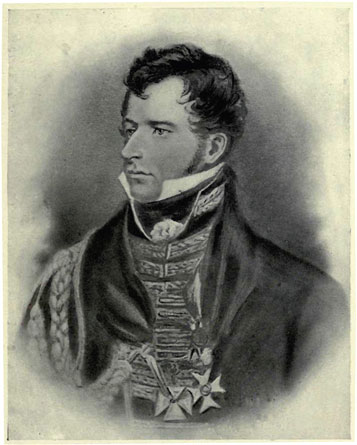
De Lancey

Col. Sir William Howe De Lancey

Sir William was mortally wounded in a skirmish, the day before the big battle at Waterloo, when he was riding at Wellington’s side. He was hit in his side by a cannonball that threw him off his horse. He was not killed immediately, but survived his wound for six days. When his men saw he wasn’t dead yet, they moved him to a barn, where he was left for several hours, till the fight was over, and he could be transported to a nearby farm.

When his wife, who was staying in Antwerp, heard that he was wounded, or maybe dead, she didn’t hesitate to look for transport that would bring her to her husband. When she finally got there, after much trouble, she was relieved to find him still alive.

The cannonball left a gigantic bruise on Sir William’s side. In those circumstances, nobody could really tell the severity of his wound. Lady De Lancey nursed her husband, never leaving his side. But he didn’t make it. After his death, examination revealed that the cannonball had broken several ribs, which had penetrated his lung.

I was very much touched by this story. Sir William seemed to have been a good man, and his comrades, his superiors, and his family speak very highly of him in this memoir. You can find a full review of it here.

Now to my own story. A few weeks after I read the book, my dog died. I was very sad, and so was my son. We felt lost in the house. We decided it would do us good to get out and make a day-trip. I proposed that we should go to Waterloo, as it is only an hour’s drive from our place, but I had never been there. So the next Saturday we went.

memorial

Waterloo Memorial at Evere

First we visited the cemetery in Evere, where the British casualties are entombed, and there is a beautiful memorial monument on top of the tomb. The illustration is on page 118 of the book. If you look at it, you can see on the left stairs going down. This is where you enter the tomb, and inside there are niches containing the remains of the officers. I soon found William De Lancey’s last resting place, and stood a few minutes in silence, honouring this brave man, and his fellow officers and soldiers. (The soldiers with lower rank are also buried there, outside the tomb, but within the outer walls that you can see around the monument.)

Afterwards we went to Waterloo, where we visited the Wellington Museum, located in the house where Wellington had his headquarters. On a wall in one of the rooms was a newspaper page, and in the bottom right corner I could read amongst the names of the casualties: William De Lancey, mortally wounded.

We also climbed the stairs to the top of the Waterloo Lion, from where we had a view over the entire battlefield. Later we also visited Napoleon’s last headquarters.

This day was a very interesting experience, being at the place where so many gave their lives. But it was William De Lancey and his wife who touched my heart.

Thank you, all the members of the Distributed Proofreaders team, who worked so hard to make this book available for the world!

This post was contributed by Eevee, a DP volunteer.


Typesetting

October 8, 2014

Typesetting is a topic close to the hearts of many DPers, and the foundation on which the books we work on were built.

I learnt typewriting on a manual typewriter when I was at school. A classmate secured a job as an editor with a magazine based on the skills she learnt in the course we were doing. I was so envious! Editor on a magazine, with no work experience, and no qualification. A few years earlier, when asked by a teacher what I wanted to be, I replied I wanted to be a journalist, not because I wanted to be a writer, but because I wanted to work on newspapers, with those monstrous printing presses and the glorious smell of ink, and fiddly bits of lead.

I did manage to become a journalist and editor, but the huge presses were ageing, and typesetting was becoming regarded as no more than wordprocessing on a computer. I remember being chastised for the miles of galley paper that spewed out of the printer one time when I forgot to close off the heading command properly and ended up with a whole article in 72-point Times, a somewhat expensive mistake as rolls of galley proof paper were not cheap.

setting type

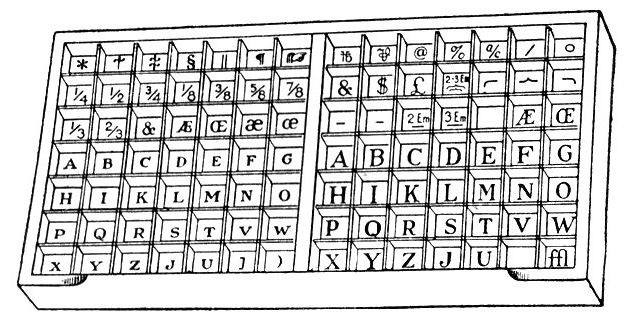
Working on the book, Typesetting, by A. A. Stewart, for Project Gutenberg, I couldn’t help but reflect and wish I could have been an apprentice hand compositor and daydream about what the publishing industry must have been like when each character had to be manually placed in the composing stick; when the characters of each font were housed in separate type cases; when measurements for line lengths, page sizes, and margins, had to be mentally calculated quickly and accurately; when justification of lines was achieved by manually placing a mix of different space widths characters (and even resorting to “pieces of paper or thin card” if metal thin spaces were not at hand).

type case

Imagine being able to set type and be able to read the text upside down; to have the dexterity to take a piece of type from the case and place it in the case; to proofread the lines of type and correct mistakes before justifying the lines.

upside down

How arduous the correction process, where “Simple errors like the exchanging of one type for another of the same width, the turning of an inverted character, or the transposition of letters or words, are corrected by pressing the line at both ends to lift it up about one-third of its height and picking out the wrong types with the finger and thumb. The line is then dropped in place and the right types put in.”

Not to mention having to wash the type and placing each character back into the proper slots in the proper cases, so that the type pieces could be used over and over.

Sitting at my computer, selecting fonts, messing about with HTML and CSS coding, I still want to be an apprentice hand compositor. “Typesetting, a primer of information about working at the case, justifying, spacing, correcting, making-up, and other operations employed in setting type by hand”, is an excellent training manual that gives me an insight into what I would have been doing had I been able to achieve my dream.

This post was contributed by a DP volunteer.


Introducing . . . Harrison Ford! (1918 Edition)

September 24, 2014

cover

I was looking for an online copy of The Cruise of the Make-Believes by Tom Gallon to find out if a certain bit of punctuation was a colon or semi-colon (semi-colon, by the way), and, as one does when Googling, I found other links with the same title: one was to Turner Classic Movies and another to the Internet Movie Database. Yes! My book was turned into a movie in 1918. A silent movie!

I pointed the link out to a friend, and she noted who one of the leading men was: Harrison Ford. Now we both knew that in 1918, it wasn’t Han Solo or Indiana Jones or the President. Time for more searching.

This not-at-all make-believe Harrison Ford was born in 1884 in Kansas City, Missouri. He started in the theater on the east coast before moving to Hollywood in 1915. He was in over forty films. His final was his only talkie, Love in High Gear, which was released in 1932. He then took his career back to the stage and also began directing there. During World War II, he toured with the USO. He died in 1957, without having had children, and is no relation to that other Harrison Ford.

Harrison Ford

One of his hobbies was collecting old books . . . a man after DP’s own heart. I’ve no idea why this book was chosen to be made into a movie. It seems no better nor worse than any of our other romances. Old books, you just never know where they will take you. This one took me on a hunt to find the first dreamy Harrison Ford.

You can read more about this Harrison Ford here or here or here, all of which I used for my information with gratitude.

This post was contributed by a DP volunteer.


What have you been reading lately?

July 25, 2014

I have a varied, some would say bizarre, reading list. Everything from popular fiction to science (in every branch) to fairy tales to dictionaries and encyclopaedias to old books of all kinds. Some very old books indeed.

Hello, my name’s CJ and I’m a Smooth-Reader.

I found Distributed Proofreaders just over five years ago, and fell in love. I’ve always spotted the misspellings and iffy punctuation in the books I read, and here was my chance to be as nitpicking as I wanted with nobody to tell me I was peculiar. In fact, everyone else was like me. So I couldn’t be that odd after all.

I started like everyone else, checking that the text we produce matches the original book as closely as possible. I graduated to putting formatting codes around text that needed it, and two months after signing up I did my first Smooth-Read. I’ve now read 146 books and I’m looking forward to reading many more.

It’s great to be part of a team effort like this, doing something as worthwhile as preserving all these old texts. I like it that we don’t just work on the classics of literature and the “big” scientific texts that everybody knows about. All those less known books deserve saving too—and can be more interesting because they’ve been forgotten. I love that I can talk about a shared interest to people from the USA to the Philippines, and Australia to Hawaii—as well as nearer to home in the UK. Whatever the time of day or night there’s always someone around. (Don’t tell anyone, but there’s fun stuff too—like word games and jokes.)

What was my first Smooth-Read? It was a set of three plays by Olive Dargan, The Mortal Gods and Other Plays, published in 1912. After reading them, I felt we ought to have let the playwright remain in obscurity. I didn’t like it at all, and this piece of dialogue should explain why. (Phania, allegedly an adult, is speaking to her father and, sadly, this is typical of her conversational style.)

Pha. Lose me? O, never, daddy, never! I’m
Your pipsey, wipsey, umpsey, ownty own!

It didn’t put me off Smooth-Reading, however, and eight days later I sent in comments on something much more enjoyable—The Eighteenth Century in English Caricature  by Selwyn Brinton. During the rest of the year, I read adventures and romances, fairy tales from China and Russia, science fiction, essays, archaeology, healthcare, history, science and cookery.

2010 brought a new list of books—more fiction of all sorts, biographies, political pamplets and books. I think my favourite of the whole year (and competition was fierce) was Jacko and Jumpo Kinkytail (The Funny Monkey Boys), a collection of bedtime stories for young children. Most of it was read while on a train home from work. My journey wasn’t normally that long, but something happened on the way home—something I felt compelled to share with the poor post-processor of the book.

I’m stuck on a train. Someone’s thrown a large tractor tyre on the tracks, we hit it at speed and everything rattled and shook and jumped, we did an emergency stop and then everything went off. The engine’s badly damaged (no fuel, water or oil, no electrics or anything) and we’re sat in a wooded cutting waiting for rescue. They’ve put detonators (yes, detonators!!) on the track ahead of us so that the relief train knows when it’s getting near. Oh—and it’s hot—very hot. I was going to the theatre tonight, having saved up for the ticket, but it starts in an hour, so even if the train arrives now, we can’t get to the town where I live in time for me to get home and back.

I also shared the progress of the rescue effort as I read on. At twenty past seven the rescue train arrived (three hours after we’d set off) and we were transferred to it. At eight o’clock the police declared it a crime scene and we weren’t allowed to leave. Finally, at ten past eight, we were on our way.

Hooray for Smooth-Reading—I would have been as bored as the rest of the passengers after three and a half hours on a stationary train in a heatwave. Instead, I walked into my house that night having done on the train what I would normally do in an evening at home, making the commute part of my leisure time instead of lost hours.

Among the books I read in 2011 were an account of explorers and missionaries in Africa and a compilation of Creole proverbs (two of which were far too indelicate for our sensitive compiler to translate into English). There were also fiction, natural history, political tirades, magazines, and a book on etiquette.

In the following year I had a bit of a break, while I did other things, but at the end of the year I picked up a some fascinating books from the 15th and 16th centuries that brought history to life. The first was a couple of volumes of The Paston Letters, a collection of letters, wills and other documents relating to an influential Norfolk family between 1422 and 1509. It gives an insight into not just the political events of the time, but also domestic concerns and family quarrels that sound very modern.

Image of Friction Clutch Mechanism

Aultman & Taylor Friction Clutch

The second was the first volume of Holinshed’s Chronicles of England, Scotland, and Ireland. This overview of Britain as it was in 1587, and the history of how it got there, is informative, entertaining, even chatty. The author wanders off the topic, and then comes back saying “now, where was I again?” You get anecdotes, recipes and gossip in with your history and the description of every aspect of life in Elizabethan England.

2013 brought a new crop, including books about apples, George Washington’s first military campaign, Vasco da Gama’s first voyage and handicrafts for boys. There were works by Erasmus and Galileo, a somewhat gruesome (but informative) book on amputation from 1764 and a variety of novels.

A standout was Farm Engines and How to Run Them: The Young Engineer’s Guide, containing the most amazing technical drawings, of which my favourite is the one to the right. I think it’s the combination of the hugely detailed part and the outline drawing of the surrounding engine that attracts me. It’s worth downloading this book for the pictures alone.

This is why I love Smooth-Reading. There are so many different things to read that, whatever you like, you’re bound to find something you’ll enjoy. So do give it a go. You never know what you’ll discover.

I’m looking forward to what the next year will bring me to read, but in the meantime, I’ll just return to that philosophy book and an adventure novel from 1921.


Ten Years of Music at DP

June 17, 2014

Today Distributed Proofreaders celebrates the 10th anniversary of its Music Team, which has been helping to make beautiful music for Project Gutenberg e-books since June 17, 2004.

music

Medieval French music notation

Founded by DP volunteer David Newman, a classical singer and voice teacher who provided dozens of music-related projects to DP, the Music Team was designed to bring together DPers who wanted to preserve more music books. Thus began a vibrant community of music-lovers, musicians and non-musicians alike, who share thoughts on finding, creating, managing, proofing, formatting, post-processing, and transcribing music-related projects.

Team discussions have wrestled with big issues, like whether and how to incorporate music transcription (i.e., creating sound files from printed music) into the DP formatting rounds, what music notation software should be the DP standard, and how to handle projects consisting solely of music notation with little or no text. DPers have conducted experiments in different methods, and the creative efforts to improve the overall transcription process continue to this day.

But these aren’t the Music Team’s only accomplishments. The team has long been a clearinghouse and sounding board for Content Providers in search of feedback and volunteers to work on important music projects. Post-Processors come to the team to find volunteer transcribers who can create sound files for a vast variety of DP projects, including children’s books and even novels. Some projects might contain some simple melodies; some might have dozens of pages of orchestral music. For projects with lots of music, team members have created “distributed transcription” systems in which any DPer with any music software can participate. One example is the delightful Traditional Games of England, Scotland, and Ireland, a two-volume set with dozens of children’s game songs, on which several Music Team members collaborated.

Music Team members also lend their expertise to answer a wide array of music questions from DPers. A project might have some arcane bit of music notation, often found in the older texts being worked on at DP. Or there might be a question whether some odd-looking notation is, in fact, a printer error. Music transcribers often ask the team to proofread (or even “proof-listen”) to the music they’ve transcribed, for accuracy or for aesthetics.

One thing is certain: being able to hear the music in an e-book enhances the reader’s experience immeasurably. Happy Anniversary, Music Team, and thanks for the melodies!

This post was contributed by Linda Cantoni, a Distributed Proofreaders volunteer.


Castes and Tribes of Southern India by Edgar Thurston

April 23, 2014

Image of front cover of bookBack in 1995-96, I lived in India for about one and a half years, with the initial idea of making a number of multimedia productions on Indian art, culture, and history, but ended up mostly working on Indian language dictionary databases….

One of the sources I encountered in India was the various multi-volume sets entitled “Castes and Tribes of…” for various regions, such as the Central Provinces, Bengal, The Punjab, and, one of the biggest sets, the seven volume work covering Southern India. All these books were put together at the behest of the British Government by officials and their Indian assistants in the late nineteenth and early twentieth century. There are even several volumes on “Criminal Tribes”. These sets describe, in its entire intricate detail, the mind-baffling complexity of Indian society a hundred years ago. A society that has been quickly changing and has already lost much of this complexity—sometimes for the better, but sometimes not—and is today changing at an even faster rate, losing much of its colourful diversity in the process.

For one of the multimedia productions, I proposed to digitize the entire set, and produce a CD “Castes and Tribes of India”, to make this massive piece of work available again. The project never made it.

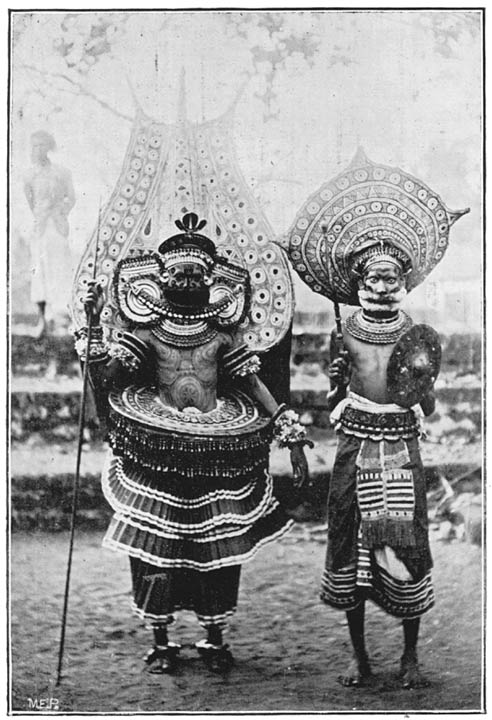
Image of Malayan Devil-Dancers (pl4-441)

Malayan Devil-Dancers

The books are of an encyclopedic nature. After a relatively short general introduction, they treat the castes and tribes in alphabetical order, in articles, that can sometimes just encompass a single paragraph, but sometimes as long enough to fill a monograph. For the time, many of these volumes are lavishly illustrated with photographs (The original set on the Central Provinces even used collotypes, a costly raster-free reproduction technique that preserves the sharpness and details of the original photographs). As the articles are written by various people, and often based on older publications or articles, the quality and scope of the articles varies somewhat, but in general, they give an interesting oversight of each caste or tribe described. Since the terms “caste” and “tribe” are used liberally, you can also find very interesting articles in those books on for example Anglo-Indians, Mar Thoma Christians, and Cochin Jews, and groups living in almost stone-age conditions such as the Irula, as well as the highly secluded Nambudiri Brahmins.

A few years after my return to Holland, in 1998, I managed to purchase an original 1909 copy of Thurston’s 7-volume set on Southern India, as well as reprints of many of the other sets, for digitization and inclusion in Project Gutenberg. At that time, I started scanning these volumes, but just as quickly stopped doing so, as I found out that the scanning would damage the costly volumes, and put the project on hold. I did continue with the (less costly) 4-volume facsimile reprint on the Central Provinces. Several years later, I purchased a scanner that would cause less damage to the books, and continued scanning, and shortly afterwards discovered that the scans were being added to the Internet Archive collection, so I no longer needed to scan the remaining volumes (except for a few missing pages). Anyway, starting from 2006, the projects appeared on the Distributed Proofreading site, slowly but steadily making their moves through the rounds, until, finally, the last volume left the rounds in 2011, and the huge task of post-processing this work started, which was complicated, due to the many words with accents, and the numerous tables in the books. Finally, on 21 June 2013, the entire set got posted on Project Gutenberg.

Almost 18 years after first envisioning this project, and 15 years after starting work on it, one of the biggest projects I’ve worked on for Project Gutenberg has come to a close. If somebody is interested, the original volumes are for sale (they won’t be cheap though). For the time being, I will leave the remaining sets to be picked up by other volunteers.

The 7 volumes of  Castes and Tribes and of Southern India are available here: I, II, III, IV, V, VI, VII.

The 4 volumes of The Tribes and Castes of the Central Provinces of India are available here: I, II, III, VI.


Mendelssohn in Italy

February 3, 2013

Sometimes we DP volunteers wonder whether anyone actually reads or uses the e-books we produce. After all, with most of the world’s best-known works already posted to Project Gutenberg, nowadays we tend to labor on the somewhat obscure.

Mendelssohn

Felix Mendelssohn in 1839

But the books we produce are being read and used every day, by readers, students, teachers, scholars, and even musicians. Here’s a real-life example: Last year, my husband, an orchestra conductor, asked me to put together some program notes for one of his concerts. His idea was to have me be a sort of narrator, reading the notes to the audience before each piece. One of the pieces was to be Felix Mendelssohn’s Symphony No. 4, the “Italian.”

Because the notes were to be given live, I wanted to make sure they’d be especially interesting to a general audience.

Technical details about the music were not going to do the trick. With the Italian Symphony, I was in luck twice over. First, in the course of my research, I learned that it had been inspired by Mendelssohn’s first trip to Italy in 1830, when he was just 21. Second, better yet, I remembered a book then in progress at DP and since posted to PG: the Letters of Felix Mendelssohn Bartholdy from Italy and Switzerland. I decided to take appropriate excerpts from the letters and read one before each movement of the symphony.

These exuberant letters to Mendelssohn’s parents, brother, and sisters back home in Berlin express the manifold wonders he experienced on his journey. The ruined glory of the Roman Forum and the Colosseum, the stunning loveliness of the hills, the romantic palazzi and canals of Venice, all spoke to his deepest sense of beauty.

Here is young Mendelssohn, newly arrived in Venice, eagerly writing to his parents on October 10, 1830:

Italy at last! And what I have all my life considered as the greatest possible felicity is now begun, and I am basking in it.

You can hear this youthful enthusiasm in the exciting opening bars of the Italian Symphony, which he began writing on this trip. As he wrote to his sister Fanny from Rome on February 22, 1831:

I have once more begun to compose with fresh vigour, and the Italian symphony makes rapid progress; it will be the most sportive piece I have yet composed, especially the last movement.

Except for the last movement, which is based on a lively Italian dance called the saltarello, there is nothing particularly Italian about the music itself. Rather, it evokes the impressions of an awestruck tourist, impressions he shared with his family in his letters home.

The stately tone of the symphony’s second movement is reflected in this letter to his parents, from Rome, November 8, 1830:

Just as Venice, with her past, reminded me of a vast monument: her crumbling modern palaces, and the perpetual remembrance of former splendour, causing sad and discordant sensations; so does the past of Rome suggest the impersonation of history; her monuments elevate the soul, inspiring solemn yet serene feelings, and it is a thought fraught with exultation that man is capable of producing creations, which, after the lapse of a thousand years, still renovate and animate others.

The third movement of the symphony, a graceful minuet, puts one in mind of Botticelli’s lovely painting, Primavera. It hangs in the Uffizi Gallery in Florence, where Mendelssohn immersed himself in the glories of Italian art, as he wrote to his sisters, June 25, 1831:

I have to-day passed the whole forenoon, from ten till three, in the gallery; it was glorious!… I wandered about among the pictures, feeling so much sympathy, and such kindly emotions in gazing at them. I now first thoroughly realized the great charm of a large collection of the highest works of art. You pass from one to the other, sitting and dreaming for an hour before some picture, and then on to the next…. I could not help meditating on all these great men, so long passed away from earth, though their whole inner soul is still displayed in such lustre to us, and to all the world.

The symphony’s rushing, leaping saltarello finale may have been inspired by something like the festival Mendelssohn saw in Florence, as he described it to his sisters on June 26, 1831:

It was Midsummer’s day, and a celebrated fête was to take place in Florence the same evening…. I heard a tumult, and looking out of the window I saw crowds, both young and old, all hurrying in their holiday costumes across the bridges. I followed them to the Corso, and then to the races; afterwards to the illuminated Pergola, and last of all to a masked ball in the Goldoni Theatre…. I recalled to myself the various occurrences of the day, and the thoughts that had chased each other through my mind, and resolved to write them all to you. It is in fact a reminiscence for myself, for it may not be so suggestive to you, but it will one day be of service to me, enabling me to recall various scenes connected with fair Italy.

It was indeed of service to him. The memories and inspirations of the trip, recorded in his letters, enabled him to finish the symphony quickly upon his return to Germany, and he himself conducted the premiere in London in 1833. Although he was never entirely happy with it, it deservedly remains one of the most popular works in the symphonic repertoire.

And, thanks to DP, the audience at my husband’s concert, hearing Mendelssohn’s own words accompany his music, cheered loud and long.

This post was contributed by Linda Cantoni, a Distributed Proofreaders volunteer.


24,000 Books Posted – Celebrating with Lamartine’s “Cours Familier de Littérature”

November 6, 2012

Having had very busy post-processors in October, the celebration day for the 24,000th book snuck up on us quite suddenly. It turned out that we’d reach that point before October was over! I couldn’t assemble the information for today’s post any sooner, so sorry for being a week late.

It’s a long-standing tradition that we pick one book for the round number, and this time the honour went to volume 14 of the 28-volume “Cours Familier de Littérature” by Lamartine. Volume 14 was the last volume to be posted of all the volumes of this series that were in progress at Distributed Proofreaders.

Since I don’t speak French and know nothing of this series, I asked Mireille, who’s been managing all the Lamartine projects since starting on the series in 2007, for some information. Here’s what she has to say:

The name of Lamartine (1790-1869), one of the greatest French poets, is well known. He wrote “Les Méditations” (1820), “Le dernier chant du pèlerinage d’Harold” (1825), “Jocelyn” (1836),  and “La Chute d’un ange” (1838).

But the “Cours Familier de Littérature”, written for his living during 13 years, from 1856 until his death, is not so well known, and most probably is totally ignored by many people, French or not. That is why I have chosen and started, in 2007, to produce the 20 volumes of the series available on Gallica with Distributed Proofreaders.

The “Cours familier de Littérature” is quite unique in literature. It is more than a series of lessons about literature, it is the live illustration of Lamartine’s personal and profound feelings about events which occurred at that time and also in the past and in the entire world.

It is now difficult to find and buy the complete series of the 28 volumes written by Lamartine.

Volumes 18 and 23-28 are still missing in the Gallica collection, volume 2 was not prepared because of the very bad quality of the Gallica PDF format. Thanks to everybody who can help to find them.

Warm thanks to Lostpaces, the PPer of the 20 e-books published by Project Gutenberg.

Thanks, Mireille, for taking on and completing such an ambitious project! And thanks to all the volunteers who worked on those books over the years.

As soon as this information, including the missing volumes, was posted to the DP forums, offers for help poured in. It turns out that what was true back then isn’t necessarily true now. Thanks to the big scanning projects that digitize whole libraries, the missing volumes are available now with high quality scans. So the celebration of the last volume of this series on DP spawned a few new projects – the missing volumes will be run as well, so the series will be available with all its volumes on Project Gutenberg in the future.


Garage Musings

October 10, 2010

For some reason, quite a bit of DP’s history seems to be connected to garages. On the last of the 10 days celebrating 10 years of DP, let’s have another look at history by following Juliet Sutherland into her garage:

I’ve been working out in my garage for the last week or so and it has brought back lots of memories about Distributed Proofreaders. I joined DP in April, 2002 when the site still ran on a computer in our founder charlz’ house. Preserve old books! What a wonderful idea! As with so many DP volunteers, I was immediately hooked. Very soon, proofing wasn’t enough. I pestered charlz into sending me various directions until finally I was able to scan a book. Oh happy day! It was Land of the Blue Flower by Francis Hodgson Burnett and was quickly followed by The Little Hunchback Zia by the same author. I chose those books because they were very short and small. And thus began eight years of providing content to DP.

My favorite part of providing content was buying the old books. At that time there were very few archives of scanned books so we did most of our scanning ourselves. Where ever I went, I found the used book stores and scoured their discount areas for inexpensive books that we could work on at DP. I drove to used book sales as much as two hours away from home, and came back with a car full of books. I bought a little laptop computer to keep David’s list on so that I wouldn’t get duplicates. Yes, I was thoroughly addicted. The boxes and stacks kept piling up. Finally, I resorted to banishing them to the garage. And then some more, and a few more, and then another box or three or five. I quickly had far more material than I could ever scan in a lifetime. And a huge mound grew in the garage. Greg Newby got so tired of doing my copyright clearances that he asked me to help do them for everyone. And still the mounds grew. When I eventually made neater stacks I ended up with about 6 pallets worth of boxes, stacked 3-4 feet high. I put myself on a strict moratorium regarding buying books for DP. No more!

Fast-forward to my garage today. DP has posted over 18,000 titles. PG has over 30,000. The Internet Archive (TIA) has been making lovely scans of huge numbers of books. Do I really need everything in those boxes in the garage? I’ve been sorting through, finding the books that have been posted, the ones that have already been scanned by the Internet Archive, and the ones that appear in neither place. I’ve made it through 1.5 pallets worth so far. I’ve found 4 boxes of books that are already at PG, 2.5 boxes that are not at the Internet Archive, and 2 boxes worth of material that I recycled since it was in lousy shape and available from TIA. Also one mystery box.*

As I work on those books, I remember so many people who were active in the early years. Some are still at DP, others have moved on. I think about the newer volunteers who might enjoy working on some of these books. And I continue to be amazed at the dedication of the DP volunteers and the volume of material that they produce.

* Small world story. I found a box, all sealed up for shipping, that didn’t contain books and that was addressed to someone in a nearby town. The UPS label had the phone number, so I called, spoke to the addressee and he came by to pick up the box. I figured that UPS had delivered the box by mistake at a time when I was ordering lots of boxes of bound periodicals from ebay. But he was totally mystified. Nothing in the box looked familiar. Today I got an email from my oldest daughter with a forwarded message from facebook. Here is what must have actually happened. The addressee received something unmemorable in that box. The box was then used to deliver books to the Booksale where I volunteer. I must have taken the box home for my oldest daughter to use for packing up her things to move to California. She filled and taped up the box and put it in the garage with the rest of her things. When the movers came, the box was overlooked and eventually added to one of my piles of book boxes. After that move, the only major thing oldest daughter was missing was the box with the tiles she’d brought back from her semester abroad in Turkey. And now, 4 years later, the mystery of the missing tiles has been solved. Now we just have to get the box back….


“Turn around when possible.”

October 4, 2010

“Tern around whin possible,” suggested the sat-nav.

“But you told me to turn right at that junction,” I complained.  We all talk to our sat-navs, don’t we?

Ken, my Aussie-voiced sat-nav was silent.  (I’d got fed up with the previous incumbent, a very refined lady I called Penelope so I downloaded Ken, really just so I could swear at him without feeling that Penelope would burst into tears and complain to Mummy I suppose.)

I was five and half hours and 460km from home on the outskirts of Seville.  I had a further four hours and 400km of driving in front of me and that Australian idiot had sent me up a dirt track so I could crawl behind a Spanish cart, presumably being drawn by a Spanish donkey which was hidden up front in the clouds of dust.

It all started with a ‘Hello how are you’ email from a very old friend who told me that she’d sold up everything in England and was now a ‘near neighbour’ living in Spain.  I was very interested because this old lady has been collecting children’s books since she was a child herself and I’d been itching for a chance to have a look at her collection.  In response to a cordial welcome to the Iberian peninsula from me she said that she had packed up her whole library and shipped it out to Spain with her and that I’d be welcome to ‘pop over’ and have a look at it.  1800km round trip? Pop over?  Absolutely!

Ah-ha!  A turning.  Quick reverse into it and we’re off again.  This time I’m going to insist that if Ken tells me that there’s a ‘Roit tern ahid’ I’m going to want confirmation in writing on a road-sign too.

As it was so far and also as my old friend was not happy for me to take any books away we’d agreed that I would bring the computer and scanner with me and set up shop at her place while I harvested material for DP.  I had no idea how long all this would take, one page at a time, so I warned my wife that we may be living apart for quite a long time!  One good thing though, I knew that Lindy wouldn’t expect me to dress for dinner so I wouldn’t need much in the way of clothing.  Also we were just getting into summer in Almeria so shorts and tee-shirts would cover the body satisfactorily.  Little did I know…

I finally pulled up at a very grand gateway, “You hiv reeched your distination.” Thank you Ken.  The sun was setting as I drove up the drive to the house, parked and stepped out.  It was freezing!  Like all deserts, Almeria is baking during the day and fiendishly cold at night.  So much for shorts!

Lindy came to the door wearing what appeared to be two dressing gowns.  She had aged a lot since I had last seen her and seemed lost in the folds.  “Come in, dear boy,” she said.  “You’ll freeze out there.  Did you bring anything warmer to wear?  No matter.  I’ll find you something of Bill’s.”  She led the way right through the house into a tiny kitchen which was dominated by a huge stove which seemed to vibrate with the heat it was throwing out.  Soon I was muffled up and smelling distinctly of mothballs in a sweater and slightly tight trousers which belonged to Bill, her late husband.

She produced a bowl of hot soup from the pot which was simmering on the stove.  It was early evening so I said that I’d like to set up my computer this evening and make a start on any books I found first thing in the morning.

I was led into a huge dark room.  “I seldom come in here at night,” said Lindy. “That’s why I haven’t bothered to replace most of the bulbs as they blew.”  In the light of the two remaining lamps I could see that all the walls were lined with book-cases about ten feet high.  Above that were windows on three sides of the room.  “This used to be the counting-house,” Lindy said.  “It was where the day labourers would stand in line to receive their wages.  It’s the biggest room in the house so I thought it would be ideal to house the library.”  There were thousands of books.  The ones nearest the door seemed to be modern paper-backs but further off in the gloom the older books looked dark and dusty.  What struck me was the variation in size of those old tomes.  In places a second shelf had been fitted half way along an existing line of books to take two rows of smaller ones.  The end result was a feeling of complete disarray.  Not at all like a lending library with neat standard shelf sizes and careful labelling.  Tomorrow I was just going to have to start at one end and work my way round the room.  We cleared the books off a big table that stood in the middle of the room and I found a power outlet that I could plug my extension lead into.  Lindy produced a reading lamp and a short search found a working bulb for it.  All set for tomorrow.

Lindy said that she was an early riser and liked to take herself off to bed to read rather early in the evening.  I was happy with that plan as there was not much more I could do that evening and I was feeling a tad jaded after my ten hour drive.

The next few days followed the same routine; find a book, check that the publication date was earlier than Jan 1923 (therefore out of copyright), and then check that it hadn’t been claimed by someone else at DP or had already made it into Project Gutenberg.  Once past those hurdles it’s just a matter of sitting down and scanning the book right through.  There were a few snags.  No Internet connection in the library so I had to work from a stored list of books already cleared for DP.  The move from a moist cool climate to the brutal climate of Almeria had not been kind to the books so most were very brittle and the pages were likely to drop out.  The worst ones were simply bundles of pages held between their separated covers and tied together with string.  Some of the books were priceless and have now made their way to the safety of Project Gutenberg.  For example, there was a first edition of The Sleeping Beauty, illustrated by Arthur Rackham.

The really high point of my trip happened when I found an old manila folder containing the three ‘Baby’ books by Walter Crane.  The manila envelope had saved them from further damage but the pages were so fragile that I spent a whole afternoon just working on those images.  You can see the results here:

The Baby’s Bouquet

The Baby’s Opera

The Baby’s Own Aesop

I never did get to end of Lindy’s library.  I stuck it out for six days.  It was pretty clear from the start that I could only make a small dent in her collection.  The sizzling days when the only comfortable clothes were just a pair of shorts and frigid nights when my fingers became too stiff to safely turn the pages of a priceless book all became too much for me.  In the end I had to admit defeat and just be grateful for the wonderful books I had found.  The opportunity has passed now, I understand that Lindy’s library was broken up and sold off the following year and that she has moved back to England.  In any case another year in that environment would have rendered most of the older books too fragile to handle.  But still, we managed to preserve some of the gems from her collection so that children in years to come will be able to enjoy the books that she did when ‘she was a child herself’.  Thank you Lindy.

For other books that Mebyon scanned during his time at Lindy’s house, see here.