We are time travelers

March 1, 2016

detail from Allegory of Vanity, by Antonio de PeredaAs part of Distributed Proofreaders, yes, we are time travelers. We get glimpses of time. This is not just because we work on history books written in their own time. We also get a contemporary perspective on technology, science, medicine, entertainment, vocabulary, attitudes, personalities, language, and more from a different time.

Because public domain is restricted in America to items that were published before 1923, with a few exceptions, we spend most of our proofing time in the past. We’re not hopping back and forth between something using current vocabulary and spelling vs. something older. We stay in the past. As a result when we see words like burthen, intrust, inclosure, to-day, skilful, musquitoes, &c., we begin to recognize them as accurate for the time and see them as old friends. We know that a receipt is a recipe. We learn that children are encouraged to work on projects with knives, saws, chemicals and the like (see this review of The Boy Craftsman for a good example of that). Oh yes, we are in another time.

We discover references to some event that was common knowledge at the time a book was published, and that knowledge is lost now. Several books with stories of early US western travel refer to stopping at the farm of early missionaries, the Whitmans. And then they end that portion of the tale with, “of course that was before the massacre.” Apparently any reader of the time knew about the Whitman massacre.

On any given day, volunteers at DP have the opportunity to travel to many times and many places. To-day my choices include: Nagaland in northeast India, in ancient times as viewed in the late 1800s and early 1900s; Mexico in the early 1500s; Königgrätz, Bohemia, in 1866; print shops in the US and England in 1888; England from 1066 to 1154; English towns in the 1400s; Russia from 1903 to 1912; Napoleonic War experiences during the period 1804-1814, compiled before 1815, in a book originally published in 1839 that nearly disappeared before being republished in this edition in 1902. This example demonstrates that there are the times in the books and the times of the books—when they are about vs. when they were written, published and printed. In a single volume we can go back to at least three times: the time being presented, the time it was written—which impacts word choice, perspective and attitude—and the time it was published—which impacts typesetting, font, characters (like long s) and layout.

Come and join us. Where else can you make such a trip through time!

This post was contributed by WebRover, a DP volunteer.


How Does Your Garden Glow?

February 2, 2016

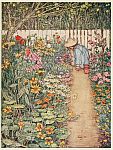
childrens_book_herbaceous

I love a garden. It touches and woos your senses. With sounds of rustling leaves, tools crunching into the soil, birds arguing over the spoils, bees buzzing the blossoms, rain spattering on broad leaves. Earthy scents, freshly turned earth, mint, broken leaves, flowers, spices. The textures of the leaves, soft, fuzzy, prickly, cool and smooth. Tastes … crackling radishes, firm tomatoes and squash, crisp lettuce and onions, freshly dug potatoes, strawberries right off the plant and won from the maurading and eager wildlife. You have to check to be sure the berries are ripe … often … wouldn’t do to serve others less than perfect berries. A well-kept garden is a beautiful thing.

Distributed Proofreaders has a discussion thread just for talking about our gardens. You’ll read what is growing in which parts of the world. What is failing and what is trying to take over.

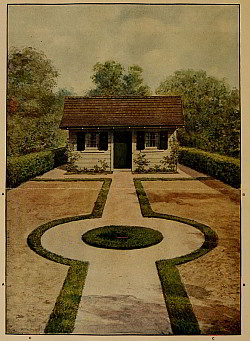
gardening4_photo

Additionally, and more importantly, DP has books about gardening. Books for children, books for those wanting to start and for those who, for want of a better term, want to dig deeper. One of my favourites has to be one we are working on right now from the classic Mary Frances series, The Mary Frances Garden Book, by Jane Eayre Fryer. Not only does this children’s book have beautiful illustrations and a fun narrative, it also has an actual picture of a plain garden that you cut out. Then, for each season, there are additional cut-outs with tabs that you tape on the back of the garden. Then you can fold them over the plain garden to show how the garden could look in full bloom. The book tells you to not cut it up but to trace the pictures. Thanks to the modern wonders of the Internet, though, you can print those pages out in their full glory and color!

plaingarden springgarden
Plain garden Spring garden

This is just one of the books on gardening for children soon to be available on Project  Gutenberg. A few more ready for your reading pleasure are:

daddy_garden gardening4lgirls childrens_book_garden
DADDY TAKES US TO THE GARDEN GARDENING FOR LITTLE GIRLS THE CHILDREN’S BOOK OF GARDENING
By
Howard R. Garis
By
Olive Hyde Foster
By
Mrs. Alfred Sidgwick
and
Mrs. Paynter

Obviously there are also books on gardening without cartoon drawings. If you are  interested in how to make things grow, here are just a few:

Or if you are more interested in a scientific approach, try one of these:

The sun is rising, the birds are starting to sing … open a book and come walk with me in a garden.

garden

 This post was contributed by a DP volunteer.

DP Celebrates 31,000 Titles

December 27, 2015

banner

Distributed Proofreaders is proud to celebrate its 31,000th title, Colour in the Flower Garden — many thanks to all the volunteers who worked on it!

lilies

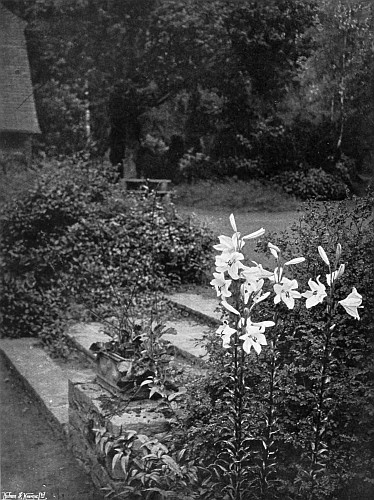
WHITE LILIES.

Gertrude Jekyll, probably (after Capability Brown) the most famous English garden designer, lived from 1843 to 1932 and created at least 400 major gardens within Europe and North America, often working closely with the architect Sir Edwin Lutyens. She set out to develop a career as a painter, but developed an interest in the use of colour in planting, and, possibly prompted by deteriorating eyesight, moved into garden design. She was heavily influenced by Impressionism, eschewing excessive formality in design and planting.

Her book Colour in the Flower Garden sums up the experience of 40 years, using the garden she designed for herself at Munstead Wood. The book describes her philosophy in detail and gives detailed planting schemes for many areas of the garden, but is by no means prescriptive. She describes what she has done and why, and lets the results speak for themselves.

It is also profusely illustrated with, regrettably monochrome, photographs of the garden.

For the gardener, it is a very accessible and interesting record, but from an age and of a scale which make it, perhaps, less than useful.

Two quotations give a flavour of the scale and ambition.

Talking of flower borders: “I believe that the only way in which it can be made successful is to devote certain borders to certain times of year; each border or garden region to be bright for from one to three months.”

And about one area of her garden: “Ten acres is but a small area for a bit of woodland, yet it can be made apparently much larger by well-considered treatment.”

I look out at my own garden (20 x 8 meters) and think, “I grow plants, but this is not, by Jekyll’s standards, a garden.”

This post was contributed by Les Galloway, a DP volunteer who post-processed this project.


Twelve Books of Christmas

December 23, 2015

holiday banner

Distributed Proofreaders loves to celebrate special days, and holiday-themed projects abound among its contributions to Project Gutenberg, including well over 100 Christmas-related books. These come from just about every genre: Christmas novels, stories, poetry, and plays for all ages; inspirational books and biographies of Jesus; and accounts of Christmas legends and customs throughout the centuries in different parts of the world. Here’s a selection of twelve of these books, in celebration of the twelve days of Christmas.

A Visit from St Nicholas

Lovely Christmas collaborations of famous authors and famous illustrators include Charles Dickens’s classic A Christmas Carol, illustrated by Arthur Rackham. Walter Crane wrote and provided rich color illustrations in A Winter Nosegay, a delightful little collection of Christmas tales for children. Old Christmas, taken from Washington Irving’s Sketch Book, is filled with entertaining sketches by Randolph Caldecott. And here is the classic poem A Visit from Saint Nicholas — a.k.a. The Night Before Christmas — by Clement Clarke Moore, beautifully illustrated by F.O.C. Darley.

Religious offerings include Ernest Renan’s excellent Vie de Jésus, also available in English as The Life of Jesus. For children, there is The Boyhood of Jesus by an anonymous author. Inspirational thoughts abound in A Christmas Gift, written “to the American Home and the Youth of America” by a Danish Lutheran minister.

For those interested in the history of Christmas, there is The Book of Christmas, by Thomas K. Hervey, which traces the origins of various English Christmas customs back to ancient pagan winter festivals such as the Roman Saturnalia and the Northern European Yule. Or Christmastide, by William Sandys, which includes Christmas carols you can listen to. Christmas customs in different parts of the world are represented by several books, including Yule-Tide in Many Lands by Mary Poague Pringle and Clara A. Urann, and The Christmas Kalends of Provence by Thomas A. Janvier.

Finally, for sly Christmas humor, check out A Christmas Garland, “woven” by Max Beerbohm. This is a 1912 collection of Christmas stories that are actually spot-on parodies of the styles of noted literary figures, including Henry James, H.G. Wells, Thomas Hardy, and G.K. Chesterton.

Merry Christmas to all, and to all a Happy New Year!

This post was contributed by Linda Cantoni, a Distributed Proofreaders volunteer.


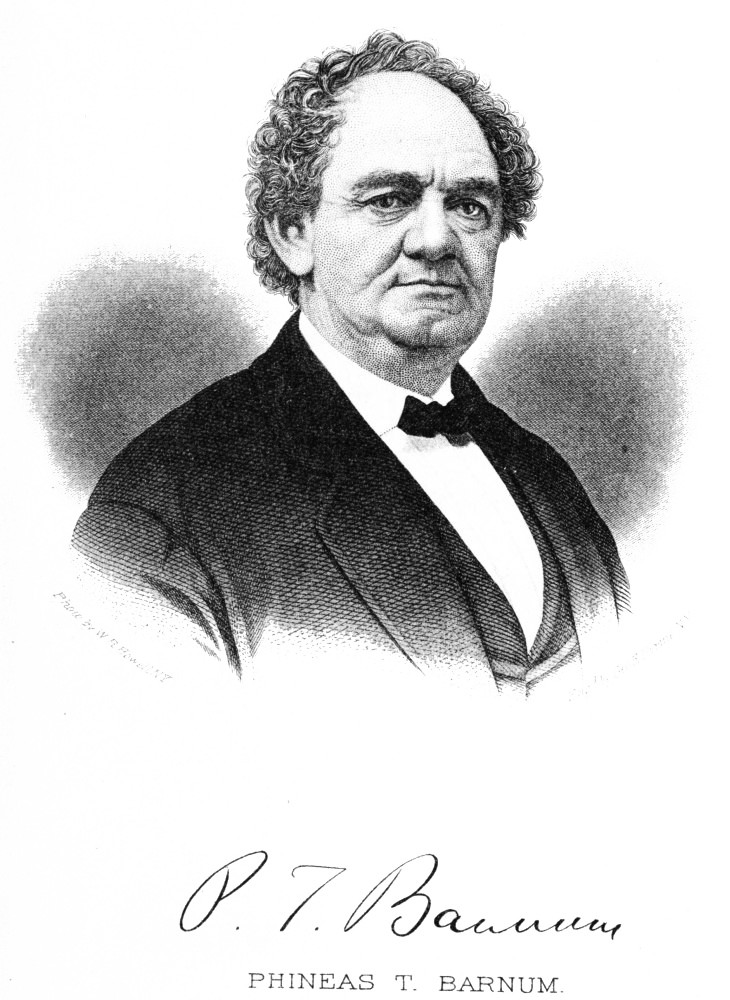
P.T. Barnum’s Struggles and Triumphs

November 7, 2015

Barnum

Even though it may be common knowledge to some, I had not known that P.T. Barnum was the owner and manager of a museum. I’d only thought of him in relation to travelling circuses. Struggles and Triumphs: or, Forty Years’ Recollections of P.T. Barnum, by the great showman himself, describes how he went from being involved with travelling circuses to owning and running a museum (funny and entertaining, I thought) as well as the tribulations of managing the museum once he’d acquired it (even funnier).

To describe the details of how he came to own the museum might potentially spoil the story for the reader, but I’ll give a couple of examples of the on the job training which he experienced himself whilst endeavouring to turn his museum into a success via trial and error, as well as some of the wisdom or street nous or business acumen or psychological tricks which he brought to the endeavour himself.

Above the entrance to his museum he situated a small band of musicians. They weren’t very good, but that meant they were relatively cheap, the idea being to make noise and attract attention. If, however, the band were to be too good, then people might just stand on the side of the street and listen to the music for free rather than pay the small price of admission and actually enter the museum as intended. As the band was not very good, a lot of people entered the museum, after being reeled in by the music to find out what it was all about, just to get away from the noise.

Another strategy he employed in order to drum up business was to hire a man to take a plain house brick and simply walk a circular route around town, passing several busy intersections, and intermittently stop, put down the brick and just stand there next to the brick for a few moments before picking up the brick again and continuing on his route. It was critical that he not respond to anybody asking him what he was up to or what the deal was in regards to the brick he carried. He also had no sign mentioning the museum or anything else. At the end of his silent route, he would enter the museum, taking a simple tour of all the exhibits, before once again going out and walking his route through town and performing his little interaction with the brick here and there in one continuous cyclic pantomime. Many people followed him, since he would not reply to basic inquiries, and even paid the small price of admission to the museum just in order to follow him inside and figure out what this curious fellow was up to.

His intention was to keep the price of admission low, but have high turnover by getting as many people in and out of the museum as possible in a constant stream of customers. The customers, however, had other ideas. They brought box lunches and sought to make a day of it, to the point that he could not sell more tickets to let more people in, even though at that point he had more people lining up just to get into his museum, because the interior of his museum was simply full to the brim with customers already, who intended to get their money’s worth by staying most of the day. He countered this by opening a backdoor of the museum and putting up a sign stating “TO THE EGRESS,” pointing to that rear exit. The malingering crowd of customers inside the museum who weren’t playing his bums-through-the-turnstiles game properly, in his opinion, thought the sign indicated another newly opened exotic exhibit and left the museum via that exit to check it out, allowing the queues out the front to once again flow, as well as the money from further ticket sales.

There’s little doubt that Barnum had a head for business and showmanship, as the museum was a huge success. But it was very interesting, funny and entertaining to read the details of how that success was created and how inevitable problems were overcome.

I haven’t even mentioned the adventures of tiny Tom Thumb, the “Little General”, whom Barnum took on tour through Europe. The interactions of the pint-sized charmer with the royalty of Britain and France, for example, were a delight to read in and of themselves.

This post was contributed by FallenArchangel, a DP volunteer.


Happy 15th Anniversary! (Part 6)

October 26, 2015
15th anniversary banner

Semper ad Meliora (Always towards better things)

This is the sixth and last in a series of posts celebrating Distributed Proofreaders’ 15th Anniversary.

Comic Insects cover

26000 Comic Insects, by F.A.S. Reid (1872), was posted October 1, 2013, as the 26,000th book. This is a collection of amusing poems about insects and features delightful illustrations by Berry F. Berry. The Hot off the Press blog post for this milestone, which coincided with DP’s 13th anniversary, can be found here.

27000 Number 27,000 was the 13-volume Storia della decadenza e rovina dell’impero romano (The History of the Decline and Fall of the Roman Empire), an Italian translation of the classic work by British historian Edward Gibbon, posted March 28, 2014. It was originally published in London in separate volumes between 1776 and 1789. Italian author Davide Bertolotti translated it to Italian, and his version was published in Milan between 1820 and 1824. See the Hot off the Press blog post here.

28000 For a change of pace, The Mystery of Choice, by Robert W. Chambers (1897), was posted as the 28,000th selection on August 16, 2014. This book is a collection of short, related stories with topics ranging from a murder mystery, to the ghost of a dark priest, to the search for dinosaurs — in short, something for everyone. The Hot off the Press blog post about it is here.

29000 Histoire de France (History of France), by Jules Michelet (1867), was posted on January 14, 2015, making it the 29,000th contribution from DP to Project Gutenberg. This 19-volume masterpiece took Michelet 30 years to complete, and it took DP over nine years to transform the complete set into a high-quality set of e-books — a tremendous accomplishment all around. Here is the Hot off the Press blog post celebrating this milestone.

30K banner

30000 As you may expect, the 30,000th title was represented not by a single book, but by 30, posted on July 7, 2015. They represent the vast scope of DP volunteers’ work, with books on science, technology, medicine, poetry, archaeology, folklore, literature, drama, history, autobiography, political science, and fiction, both general and juvenile. They include works in English, French, German, Spanish, and Italian. Each of the thirty titles represents countless hours of work by DP’s many volunteers, who performed myriad tasks such as preparing the page scans, setting up the projects, carefully proofing and formatting the texts page-by-page to ensure their high quality, post-processing, smooth-reading, and verifying them — not to mention those who make all that work possible by maintaining and improving DP’s online systems, mentoring, and performing a host of other essential tasks. This Hot off the Press blog post gives the list of books, with links, for this milestone.

PG’s 50,000th title DP had the honor of contributing Project Gutenberg’s 50,000th title just last month, on September 17, 2015. This was, appropriately, John Gutenberg, First Master Printer, His Acts, and most remarkable Discourses, and his Death, by Franz von Dingelstedt. The Hot off the Press blog post celebrating this achievement is here. As part of DP’s 15th Anniversary celebration, a DP volunteer recorded an audiobook of this title for Librivox.

Thanks and congratulations to the entire Distributed Proofreaders community, whose dedication to “preserving history one page at a time” has made this 15th Anniversary celebration possible.

These 15th Anniversary posts were contributed by WebRover, a DP volunteer.


Happy 15th Anniversary! (Part 5)

October 21, 2015
15th anniversary banner

Semper ad Meliora (Always towards better things)

This is the fifth in a series of posts celebrating Distributed Proofreaders’ 15th Anniversary.

21000 The 21,000th contribution, on August 22, 2011, was The Pros and Cons of Vivisection, by Charles Richet (1908). Vivisection (experimental surgery on living beings) has long been a controversial practice. The author, a distinguished French physiologist, tries to “set forth, as impartially as possible, the reasons which militate for and against vivisection. It is, however, a physiologist who is speaking, therefore no one will be surprised that he should defend a practice which is at the basis of the science he teaches.”

22000 We go to January 2, 2012 — and 1901 — for the 22,000th offering, The Nibelungenlied, the great medieval German epic poem, translated into English by William Nanson Lettsom. It tells the tale of the hero Siegfried, who slays a dragon, gains a treasure, fights a number of battles, and wins a fair lady — thereby setting into motion a tangled and tragic plot that is famously the basis for Richard Wagner’s great opera cycle, The Ring of the Nibelung.

Leaving the Ship

Leaving the Ship, from Crusoe’s Island

23000 June 5, 2012, gave us Crusoe’s Island: A Ramble in the Footsteps of Alexander Selkirk, by John Ross Browne, the 23,000th contribution. Published in 1864, this is an account of the Irish-born American author’s experiences in the Juan Fernández Islands, his stint as a government commissioner in California, and his life as an agent in the Nevada silver mines. The author’s sketches are included.

24000 French literature provided the 24,000th book, on October 31, 2012, Cours familier de littérature (Familiar Literature Courses, vol. 14, 1862), by M.A. de Lamartine. Alphonse Marie Louis de Prat de Lamartine, Chevalier de Pratz, was a French writer, poet, and politician who was instrumental in the foundation of the French Second Republic. He ended his life in poverty, publishing monthly installments of the Cours familier de littérature to support himself. You can find the celebratory blog post for this milestone here.

25K banner

25000 DP’s 25,000th book was, appropriately for the “silver milestone,” The Art and Practice of Silver Printing, by pioneering photographers H.P. Robinson and Captain Abney (1881), which was posted April 10, 2013. The authors noted, “The one defect of silver printing is the possibility of its results fading; but surely it is better to be beautiful, if fading, than permanent and ugly. It is better to be charmed with a beautiful thing for a few years, than be bored by an ugly one for ever.” You can read more about this book on Hot off the Press here.

Next: The celebration continues with milestones 26000 to 30000.

These 15th Anniversary posts were contributed by WebRover, a DP volunteer.


Happy 15th Anniversary! (Part 4)

October 16, 2015
15th anniversary banner

Semper ad Meliora (Always towards better things)

This is the fourth in a series of posts celebrating Distributed Proofreaders’ 15th Anniversary.

ABC Cover

16000 October 1, 2009, brought to Project Gutenberg ABC: Petits Contes (ABC: Short Stories), by Jules Lemaître (1919, French). This is a beautifully illustrated children’s book. Even if you can’t recognize a single French word, this book is worth downloading for the striking color illustrations by “Job” (Jacques Onfroy de Bréville).

17000 DP saw its next milestone book, the 17,000th, on March 4, 2010: The Position of Woman in Primitive Society, by British author and headmistress C. Gasquoine Hartley (1914). From the introductory chapter: “This little book is an attempt to establish the position of the mother in the family. It sets out to investigate those early states of society, when, through the widespread prevalence of descent through the mother, the survival of the family clan and, in some cases, the property rights were dependent on women and not on men.”

18000 The 18,000th book, made available June 15, 2010, is Area Handbook for Romania, by Eugene K. Keefe et al. (1972), a U.S. Government publication. The Foreword describes it as “one of a series of handbooks prepared by Foreign Area Studies (FAS) of The American University, designed to be useful to military and other personnel who need a convenient compilation of basic facts about the social, economic, political, and military institutions and practices of various countries. The emphasis is on objective description of the nation’s present society and the kinds of possible or probable changes that might be expected in the future.”

10th anniversary banner

10th Anniversary On October 1, 2010, DP kicked off a 10-day celebration of its 10th anniversary. This blog was inaugurated on that date with A Decade of Dedication, and continued each day until October 10 celebrating DP-produced books and DP volunteer stories: The Journal of Sir Walter Scott, An Introduction to Astronomy, “Turn around when possible,” Kipling’s Just So Stories, Rimsky-Korsakov’s Principles of Orchestration, the Encyclopedia of Needlework, In Pursuit of Poetry, Come out of the Kitchen, and, finally, a slice of DP history from its former General Manager, Garage Musings.

19000 The 19,000th title was a Dutch offering, Vanden Vos Reinaerde, Uitgegeven en Toegelicht, edited by W.J.A. Jonckbloet (1856), posted November 9, 2010. This is a critical edition of the medieval fables about the clever Reynard the Fox, which were satirical commentaries on human society disguised as animal tales.

20000 Then, on April 7, 2011, DP celebrated its 20,000th title with multiple books in multiple languages: English; Italian, including Neapolitan and Sicilian dialects; German, including Middle High German; Latin, including Latino sine flexione; Dutch; French; and Esperanto. You can find the full list, with links, in this celebratory blog post.

Next: The celebration continues with milestones 21000 to 25000.

These 15th Anniversary posts were contributed by WebRover, a DP volunteer.


Happy 15th Anniversary! (Part 3)

October 11, 2015
15th anniversary banner

Semper ad Meliora (Always towards better things)

This is the third in a series of posts celebrating Distributed Proofreaders’ 15th Anniversary.

Freud

Sigmund Freud

11000 The Northern Nut Growers Association Thirty-fourth Annual Report (1943) was the 11,000th title that Distributed Proofreaders posted to Project Gutenberg, on September 12, 2007. This was part of what we at DP call an “uberproject” — a large-scale multi-volume project, in this case a series of annual reports of the non-profit Northern Nut Growers Association from 1911 to 1963.

12000 DP’s 12,000th title — one of three milestones reached in 2008 — was Zur Psychopathologie des Alltagslebens (The Psychopathology of Everyday Life), by Sigmund Freud (1904, German), posted on January 26, 2008. This classic work by the father of psychoanalysis is a study of the so-called “Freudian slip” — a mistake that theoretically has a deeper psychological meaning.

13000 The 13,000th title, posted on June 24, 2008, was A World of Girls (1891), by the Irish author L.T. Meade. Meade was a prolific writer of moral tales, romances, and adventure stories, as well as scientific articles. A World of Girls was her first school story, and an early example of the genre.

14000 On December 1, 2008, DP posted its 14,000th title, The Art of Stage Dancing, by Ned Wayburn (1925). Wayburn was a successful Broadway dance “director” (he didn’t like the term “choreographer”) of the early 20th Century. This book shares his method of teaching different styles of dancing and his experiences. You can find a “Hot off the Press” review of it here.

15K banner

15000 The 15,000th title, halfway to our present milestone, was Philosophical Transactions of the Royal Society (vol. I, 1665-1666), edited by Henry Oldenburg. It was posted on May 12, 2009. The subtitle says it all: “Giving Some Accompt of the Present Undertakings, Studies, and Labours of the Ingenious in Many Considerable Parts of the World.” This is the first issue of the journal of The Royal Society, the oldest scientific society still in existence. Philosophical Transactions is still being published today, and is celebrating its 350th anniversary this year.

Next: The celebration continues with milestones 16000 to 20000.

These 15th Anniversary posts were contributed by WebRover, a DP volunteer.


Happy 15th Anniversary! (Part 2)

October 6, 2015
15th anniversary banner

Semper ad Meliora (Always towards better things)

This is the second in a series of posts celebrating Distributed Proofreaders’ 15th Anniversary.

6000 For its 6,000th title, DP submitted the two volumes of The Journal of Sir Walter Scott. This diary of the famed Scottish novelist runs from 1825 to 1832. Two days after he started the diary, Scott expressed concerns about the financial stability of his publisher, in which he was a significant investor. The following year, the publisher failed, leaving Scott with some £130,000 of debt (the equivalent of about £9.5 million today). Scott then spent the next seven years — the rest of his life — churning out more novels in his bestselling Waverley series, as well as other writings, to pay off this massive debt. You can find a blog review of it here.

7000 On June 23, 2005, DP contributed three books, each in a different language, to celebrate its 7,000th title and the language diversity of its work:

DuBois

W.E.B. Du Bois

8000 February 8, 2006, saw the 8,000th title from DP, The Suppression of the African Slave-Trade to the United States of America, 1638-1870, by W. E. B. Du Bois. Du Bois was a leading African-American scholar and activist. This, his first book, published in 1896, was a revised version of his 1895 doctoral dissertation at Harvard University, where he was the first African-American student to earn a Ph.D. degree. Du Bois helped found the NAACP in 1909. He published over one hundred articles and essays, and authored twenty-one books, including two novels.

9000 On September 4, 2006, DP again offered multiple books for a milestone, with “a trinity of diversity” to celebrate its 9,000th title. This was represented by:

  • Kelly Miller’s History of the World War for Human Rights, by Kelly Miller. This 1919 treatise by a noted African-American mathematician and author “sets forth the black man’s part in the world’s war with the logical sequence of facts and the brilliant power of statement for which the author is famous,” according to the publisher’s introduction. It contains numerous historic photographs.
  • Poems, by Christina G. Rossetti. British poet Christina Rossetti, sister of the equally famous Pre-Raphaelite poet and artist Dante Gabriel Rossetti, wrote children’s, devotional, and romantic poems. She is best known for “Goblin Market,” “Remember,” and the lyrics to the Christmas carol “In the Bleak Mid-Winter,” all of which appear in this 1906 collection.
  • Hey Diddle Diddle and Baby Bunting, illustrated by Randolph Caldecott. This 1882 picture book of two nursery rhymes, illustrated by the famed British artist, is a lovely example of Caldecott’s work. The prestigious Caldecott Medal, awarded to the most distinguished American picture book for children, was named after him.

10K banner

10000 For the 10,000th title milestone on March 9, 2007, DP offered a collection of fifteen books:

Next: The celebration continues with milestones 11,000 to 15,000.

These 15th Anniversary posts were contributed by WebRover, a DP volunteer.