Clever Hans

January 1, 2017
Clever Hans

Clever Hans

Can a horse think like a human?

To many people in the early years of the 20th Century, the answer to that question was “Yes!” After all, thousands had seen von Osten’s Russian trotting horse, Clever Hans, use hoof taps and head nods to solve multiplication and division problems, spell out words, name colours, and answer complex questions from a variety of people, even those who had never worked with him before. Sceptics were quickly convinced that what they were seeing was an animal capable of conceptual thought, limited solely by the lack of the ability to speak from taking his place in human society.

In Clever Hans (The Horse of Mr. von Osten), biologist/psychologist Oskar Pfungst disproved popular opinion regarding that clever horse — and, in so doing, created a landmark study in how to apply the experimental method to human and animal behaviour.

What made this horse seem so clever? Was it intentional fraud, rote behaviour, thought transference (yes, that too had been suggested), true intelligence or something else? Oskar Pfungst found the answer by means of a series of experiments. And the data, graphs and analysis of those experiments not only solved the mystery — they formed the foundation for future behavioural studies such as Experimental Psychology.

So, was Clever Hans truly clever? He was — for a horse. In order to win his carrot and bread rewards, he had learned how to interpret the tiny involuntary visual clues that helped him determine how many hoof taps or what sort of head nods were expected by his human companions. Pfungst’s hard work proved that, if Clever Hans’ handlers asked Hans a question for which they did not know the answer, Hans could not respond correctly; only when they did know the answer, and when the horse could see them as they awaited his response, did he give correct answers.

Oskar Pfungst’s colleagues recognized that this book represented an important step in understanding human and animal behaviour. But they also recognized the bravery of the writer — Clever Hans was not a “perfectly gentle” horse. In fact, Pfungst suffered several bites throughout the study.

This post was contributed by lhamilton, the DP General Manager.


Memoirs of a Post-Processor

December 1, 2016

When I joined Distributed Proofreaders, I started with proofing and formatting as I assume most people do. I came across some fascinating snippets that I would never have read otherwise, but found I lacked the patient attention required to do a good job. This left smooth reading, at which I knew I would be hopeless, or post-processing, so post-processing it was. It probably helped that I had been a programmer in a previous existence, but I started, foolishly, with more difficult books but benefited from some very helpful and supportive post-processing verifiers.

With a hundred or so books and counting, why do I do it? Certainly to make the books available again. It produces a useful product: To ensure that the work of the many proofers, formatters and smooth readers is not in vain. But I do it mostly for the satisfaction of seeing a working ebook emerge from the collection of plain text and images I start with.

I do not specialise and the sheer range and variety of books available never fails to amaze. My reading of 18th and 19th Century books never got much beyond Sheridan le Fanu and Wilkie Collins, so I have come across a world of literature – biography, humour, philosophy, religion, science, poetry, history, fiction – which I did not realise even existed. Thank you, DP!

Glastonbury Abbey

Glastonbury Abbey, from The Gate of Remembrance

One highlight is The Gate of Remembrance, subtitled, “The Story of the Psychological Experiment which Resulted in the Discovery of the Edgar Chapel at Glastonbury,” by the noted British architect, archaeologist, and psychical researcher Frederick Bligh Bond. This is a detailed account of an experiment with automatic writing over a period of years, which, the author maintains, led to the discovery of the lost chapels at Glastonbury. The author shows total confidence in the method and tackles criticism head-on in the preface. Written in a more credulous (or perhaps less hidebound) age, it is hard to imagine any serious architect or archaeologist even contemplating this approach today. Publishing would now be instant professional suicide. I am very sceptical, yet, it seemed to work, and the sincerity of the protagonists seems beyond doubt.

A completist approach to science  writing was still feasible in the late 19th Century and surprisingly popular. Now no author could possibly undertake such a venture and no publisher would consider it. Popular Scientific Recreations, by French scientist Gaston Tissandier, probably published in the 1880s, at 770 pages and 900 illustrations covering every scientific discipline known from Astronomy to Zoology, via parlour games, is an example of the genre. While it is incomplete and sometimes incorrect, it is remarkably comprehensive and up to date. Given that the author developed and flew an electric dirigible (how far has electric manned flight developed in the last 130 years!) this should not be surprising.

Another example is Outlines of Creation, by Elisha Noyce, a more modest 1858 publication of 340 pages, limiting itself to astronomy, geology and life. While unequivocally creationist in outlook, it presents the scientific evidence comprehensively and  comprehensibly, and is beautifully illustrated. As the author explained in the Introduction,

The want of a general knowledge of those works of the Great Creator which are constantly spread out before us, in these days of easy acquirement, amounts almost to a sin, for it is by the study of Nature in all her varied forms and associations, that we learn to “look from Nature up to Nature’s God;” for who can look upon the works of God without a feeling of awe and admiration?

Staying positive and not dwelling on the horrors of war, vivisection, adulteration of food, primitive medicine, etc., I enjoyed the gentle humour and the depiction of genteel life in the books by American author John Habberton, Helen’s Babies and Budge and Toddie. Concerning  the generally disruptive adventures of the two toddlers and, perhaps, marred by the author’s excessive use of baby talk, they are very light, but enlivened by excellent illustrations.

A final curio, for those who might want definitions of futtocks, dead rising, spirketing, breast hooks and many more, is A Naval Expositor by Thomas Riley Blanckley, a dictionary of naval terms from 1750.

This post was contributed by throth, a DP volunteer.


Decorated by Walter Crane

November 28, 2016

33K banner

Distributed Proofreaders celebrates its 33,000th title posted to Project Gutenberg.

“. . . decorated by Walter Crane.” As soon as I saw those words I knew I was sunk. When a fellow Distributed Proofreaders volunteer wrote and told me she’d stumbled across this book and it just reminded her of me (okay, she said it jumped up and down and screamed my name, but I digress), I had to check it out. And there it was: “. . .decorated by Walter Crane.” Walter Crane is one of my favorite illustrators. Right up there with H. R. Millar, Randolph Caldecott, Kate Greenaway. . .

A Flower Wedding title page“Decorated by Walter Crane.” A Flower Wedding is Distributed Proofreaders’ 33,000th e-book production. This beautiful little book tells the tale of the wedding of two flowers, their guests and even the feast. It was reprinted in 2014 for the exhibition of Wedding Dresses 1775-2014 at the Victoria and Albert Museum in London.

Young LAD’S LOVE had courted Miss Meadow·Sweet,
And the two soon agreed at the Altar to meet.

The flowers for the most part, scorn the names chosen by the botanists and claim the ones given them by the grandmothers, great-aunts, uncles and other loving gardeners who named them for their shape, beauty, colour and charm.

In Ladysmocks, Bridesmaids, Forget·me·not blue,
With their sashes all tied in Love·knot·true.

The gifts the guests brought would fill a fanciful home with treasures . . . decorated by Walter Crane.

Buttercups gold, and a Pitcher-plant
Nay, everything that a house could want.

The bride and groom ride off in a Venus flytrap with the guests calling after:

“Speedwell, and be happy,” their friends gaily say;

and the party continues.

The Wild-thyme they had, and the fuss that was made
Kept the guests in a rout thro’ the Deadly night shade.

Lavishly decorated by Walter Crane. He was remarkably prolific, painting not only illustrations in many children’s books, but also murals, flyers and posters for the Socialist movement, wallpapers, tiles, pottery. He also taught, and two of his books based on his lecture series, The Bases of Design and Line and Form, can be found on Project Gutenberg as well. He was not above scandal for the time. Firstly, he supported Socialist causes and, speaking of support, whilst Vice President of the Healthy and Artistic Dress Union, he illustrated a pamphlet, “How to Dress Without a Corset.” He attended a meeting of Boston anarchists and declared that he thought the Haymarket Square Riot convictions were wrong. This cost him a great deal of public support in the United States, including financial support. But it eventually blew over, and his beautiful art continued on. Our lives may be a bit richer, our children’s imaginations a bit fuller, because they were decorated by Walter Crane.

A Flower Wedding final illustration

This post was contributed by a DP volunteer.


The Child of the Moat

November 1, 2016

What makes good children’s fiction? Is it about education – showing children how the world works and exploring how they might react when it’s their turn? Or is it more about entertainment and giving children something they want?

One of the joys of proofreading books at DP is coming across attitudes that have changed so much that motivations are almost unrecognisable. Especially when the change has been so slow that we only realise things have changed when we look back. The past can indeed be a foreign country.

Illustration from The Child of the MoatToday, children’s books have to compete with a huge range of different entertainment options, and they have first and foremost to appeal to the child. In a previous age they were bought by parents for their children, and it seems to me that a major requirement was to give the child a strong moral compass. If you’re thinking that’s the same today, I would encourage you to take a look at The Child of the Moat, by Ian B. Stoughton Holborn (or Holbourn).

Written exactly a hundred years ago during the First World War, the book describes the adventures of a twelve year old girl, set at the time of the Reformation. In spite of everything that fate throws at Aline, our young heroine always manages to act in precisely the way that a parent would want their children to act. I had to look twice to check that the subtitle wasn’t “A book to teach young girls proper decorum.” Aline is kind, forgiving, intelligent, well-educated, hard-working, selfless, uncomplaining, brave, perceptive, saintly.… At one point, she fights her way into a burning building to effect a rescue without, it seems, any thought of her own life.

Yeah, that’s what I thought too. Then I read this about the author on Wikipedia:

Holbourn was a second-class passenger on the RMS Lusitania on her last voyage in May 1915. During the voyage, Holbourn befriended 12-year-old Avis Dolphin, who was being escorted to school and family in England by two nurses, Hilda Ellis and Sarah Smith.

With his insights into the largely hushed-up events surrounding the wreck of the RMS Oceanic off Foula, Professor Holbourn was aware of the imminent dangers presented to ocean liners during the First World War, and as a passenger on Lusitania was prepared to face the worst. Holbourn attempted to insist that Captain William Thomas Turner should take the precautions of ordering lifeboat drills and instructing passengers on how to wear lifejackets. His efforts to stimulate safety awareness during a time of war were unwelcome, and he was asked to keep quiet. When the ship was torpedoed, Holbourn guided Avis Dolphin and her nurses to his cabin where he fitted them with life belts, even offering up his own; he then steered them through the tilting passageways to the decks above and into a lifeboat. This lifeboat capsized while being lowered into the water. Nevertheless, Avis was saved, though her nurses were not.

Holbourn himself dived into the ocean to find himself surrounded by a mass of bodies and wreckage. His hope of reaching the nearest boat was interrupted when he stopped to help a man who was floating helplessly nearby. By the time Holbourn found his way to a boat, the man he had pulled along with him was dead.

Holbourn was picked up by the fishing boat Wanderer of Peel and later transferred to the Stormcock. He was one of over 750 rescued from the Lusitania to arrive at Queenstown in Ireland that night.

Holbourn continued to write and remained lifelong friends with Avis Dolphin. One of his books, The Child of the Moat (1916), was written for Avis because she had complained that books for girls were uninteresting.

Not bad for a professor of archaeology.

I have to say, I thoroughly enjoyed proofreading this book, and am happy to see the finished product posted to Project Gutenberg.

And if you have any thoughts about mentioning any of the inaccuracies or anachronisms in the book, let me give the last word to the author:

When, therefore, your learned uncle tells you that the story is all wrong and that they did not fence with helmets and that the curtsey was not invented till much later and that the library is far too big and so on; you just tell him to write you a sixteenth century story and then you send it to me, and we will see how he gets along.

This post was contributed by wainwra, a DP volunteer. 


Sweet Sixteen

October 1, 2016

coverIt’s time for another Distributed Proofreaders celebration: Our 16th Anniversary!

Last year, we commemorated our 15th Anniversary with a look back at our many accomplishments since DP’s founding on October 1, 2000. Here’s a retrospective on DP’s achievements over the last year.

Milestones

31,000 titles. In December 2015, DP posted its 31,000th unique title to Project Gutenberg, Colour in the Flower Garden. You can read all about it in this celebratory post.

32,000 titles. Just five months later, in May 2016, DP posted its 32,000th title, Tik-Tok of Oz. See the blog post on this milestone for more on this and other books in the beloved Oz series that DP has contributed to PG.

Significant Projects

The Expositor’s Bible. In December 2015, DP posted the second volume of The Expositor’s Bible: The Book of the Twelve Prophets, a 19th-Century commentary on the Bible by leading British theologians of the day. With 564 pages, 38 chapters, Hebrew, Greek, and Arabic quotations, and 1,556 footnotes, this single volume was a massive project in itself. But its posting marked the completion of a 50-volume set, all produced by DP – an outstanding achievement.

Charles Sumner’s complete works. In January 2016, DP posted the last of 20 volumes of Charles Sumner: His Complete Works, all contributed by DP. Charles Sumner (1811-1874) was an important 19th-Century American senator, abolitionist, and civil rights activist.

Princess Napraxine. Also in January, DP posted the third and final volume of Princess Napraxine, one of the most ambitious novels of the British writer Ouida (pen name of Maria Louise Ramé, 1839-1908). It is the tragic tale of a beautiful, worldly woman, the wealthy man obsessed with her, and the penniless young girl he marries to forget her.

Revolutionary correspondence. In July, DP posted the second volume of The Diplomatic Correspondence of the American Revolution. This completed a fascinating 12-volume set of letters involving nearly every significant figure in the American Revolution, edited by the noted 19th-Century historian Jared Sparks. DP contributed all 12 volumes.

15th Anniversary Projects

Over the last year, DP volunteers worked on a variety of projects that were selected especially for the 15th Anniversary celebration. Some have something to do with the number 15, others are of particular literary or historical significance. A quick look at these special projects shows the vast range of the books we work on at DP:

Over 2,000 Titles

DP posted a whopping 2,156 titles to PG over the last year.

Updating and Streamlining

As we’ve been churning out books, our volunteers have also been making significant updates to our site, including:

  • a full upgrade of our forum software
  • changes to the remote file manager
  • updates to WordCheck (DP’s spell checker)
  • improvements to the interface for viewing changes (“diffs”) made to the text of a project’s individual pages as it progresses through each round of proofreading or formatting
  • a new welcoming e-mail to new volunteers
  • updated (and much crisper) logos
  • a new Preview feature for formatters, and
  • the establishment of a DP Official Documentation wiki.

Happy Sweet Sixteen to all the DP volunteers who made these achievements possible!

This post was contributed by Linda Cantoni, a Distributed Proofreaders volunteer.


Comments That Matter!

September 1, 2016

DP logo“Thank you for working on this project.”  There I was, a new member of Distributed Proofreaders, tentatively asking what I was sure was a stupid question. I was sure that the answer would be glaringly obvious in the proofreading guidelines, but that I’d totally missed it. How nice to get a gentle answer and “Thank you for working on this project.” Or “Thanks for asking.”  Wow!  These were comments that mattered. These comments encouraged me to come back!

So I came back. I found the forum. I posted there. Back came comments. Recognizing that I was new, people said, “Welcome to DP!”  I got validation that the “diff” (i.e., change) that someone made to my edited page did not mean I’d made a mistake. Sometimes changes are made because of ambiguity. Sometimes different people interpret the same wording differently. Sometimes I understood the guidelines and the person after me did not. “Welcome to DP!” “Your questions matter.”  “Thanks for asking.” These are comments that make a difference!

The managers of the projects (mostly books) that we work on create project comments. They tell us a little about the book or the author. They emphasize items in the Guidelines that we will see in the project and need to deal with. They point out things that are not in the guidelines that may cause questions and provide answers before we need to ask. They may ask us to do something a little different than the usual in this one project. From these comments we decide if this is the right project for us to work on.  These are comments that matter!

In the Forums we post about Distributed Proofreaders aspects we care about. There’s change we want, functionality we want, Guidelines we want changed, Guidelines we want clarified, Guidelines we have different opinions on, language support we want, where we believe we need to focus efforts, where we feel we’re bogging down, what we have resources for, what we don’t. Because we care, we’re passionate. What we comment matters. How we comment matters!

Comments that welcome us. Comments that guide us. Comments that appreciate our efforts. Comments that push us to grow. Comments that help us as we each strive to leave each page better than we found it. These are comments that matter! These are comments made by volunteers who matter!

This post was contributed by WebRover, a DP volunteer.


Woman of Independence

July 4, 2016

Celebrations of American Independence generally focus on the men who made it happen. There were those who made it happen on paper, like John Adams, or Thomas Jefferson, or Benjamin Franklin. And there were those who made it happen on the battlefields, like George Washington, or Nathanael Greene, or Henry Knox. But there were no women in the Continental Congress, and no women in the Continental Army. As with many great historical events, women were, sadly, relegated to the sidelines.

Abigail Adams

Abigail Adams as a newlywed, 1766

But one woman had an important influence on the great event of American Independence, albeit from the sidelines. Abigail Adams, wife of John Adams, was her husband’s “dearest friend,” the mother of his children, the sounding board for his ideas.

Abigail Adams and Her Times, by Laura E. Richards (1917), is an engaging account, full of fascinating details that bring Colonial times to life. (“Snail-water,” a home remedy of the time for infants, is definitely not to be tried at home, and definitely not on infants.)

But Richards also brings Abigail herself to life. The great frustration of Abigail’s biographers has always been that she never kept a diary. Her youth and the early days of her marriage are not all that well documented. Although John Adams kept a diary, he only occasionally mentioned his wife in it. We learn who she is primarily from the many letters she exchanged with him — but that correspondence didn’t begin in earnest until a decade after their marriage, when he was thoroughly embroiled in the fight for American Independence and was away from home for long periods of time.

Richards deftly mines the letters for clues to Abigail’s character and personality. Abigail frequently signed herself “Portia,” after Shakespeare’s artful heroine. Her support for John’s important work was wholehearted, but she also urged him to consider greater rights for women:

… in the new code of laws which I suppose it will be necessary for you to make, I desire you would remember the ladies and be more generous and favorable to them than your ancestors. Do not put such unlimited power into the hands of the husbands. Remember, all men would be tyrants if they could. If particular care and attention is not paid to the ladies, we are determined to foment a rebellion, and will not hold ourselves bound by any laws in which we have no voice or representation.

Alas, Abigail’s hopes were not realized for nearly 150 years, but to John’s news that the Continental Congress had voted in favor of independence, she joyfully wrote:

By yesterday’s post I received two letters dated 3d and 4th of July, and though your letters never fail to give me pleasure, be the subject what it will, yet it was greatly heightened by the prospect of the future happiness and glory of our country. Nor am I a little gratified when I reflect that a person so nearly connected with me has had the honor of being a principal actor in laying a foundation for its future greatness.

May the foundation of our new Constitution be Justice, Truth, Righteousness! Like the wise man’s house, may it be founded upon these rocks, and then neither storm nor tempests will overthrow it!

Abigail remained John’s closest and most trusted adviser throughout the Revolution, during his Presidency, and afterward, while the titans who created the new nation struggled and quarreled over how it should be governed. Their joint epitaph is a fitting tribute to their partnership:

During an union of more than half a century they survived, in harmony of sentiment, principle, and affection, the tempests of civil commotion; meeting undaunted and surmounting the terrors and trials of that revolution, which secured the freedom of their country; improved the condition of their times; and brightened the prospects of futurity to the race of man upon earth.

July 4, 2016, is the 240th anniversary of American Independence.

This post was contributed by Linda Cantoni, a Distributed Proofreaders volunteer.


The Border and the Buffalo

June 1, 2016

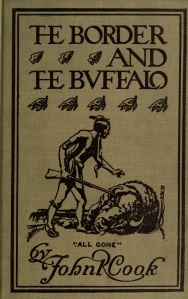
cover

Proofreading at Distributed Proofreaders has exposed me to a whole genre of books I never knew existed and which I’ve learned I really enjoy: first-hand accounts of the exploration and development of America—especially the American West.

Recently I worked on proofing one of these, a 1907 autobiography, The Border and the Buffalo: An Untold Story of the Southwest Plains, by John R. Cook. Cook participated in the slaughter of what is now believed to have been about 4.5 million American buffalo in a few years during the 1870s. Alarmed by the prospect of the buffalo’s extinction, several states, including Colorado and Kansas, had outlawed wholesale slaughter of buffalo. But not everyone thought that was a good idea. When the Texas Legislature met regarding a bill drawn up for the protection of buffalo,

General Phil. Sheridan … went to Austin, and, appearing before the joint assembly of the House and Senate, told them that they were making a sentimental mistake by legislating in the interest of the buffalo…. He said: “These men have done in the last two years and will do more in the next year, to settle the vexed Indian question, than the entire regular army has done in the last thirty years. They are destroying the Indians’ commissary; and it is a well-known fact that an army losing its base of supplies is placed at a great disadvantage. Send them powder and lead, if you will; but, for the sake of a lasting peace, let them kill, skin, and sell until the buffaloes are exterminated. Then your prairies can be covered with speckled cattle, and the festive cowboy, who follows the hunter as a second forerunner of an advanced civilization.”

I was aware that the buffalo slaughter had occurred, but had no idea of the role Sheridan had in encouraging it, nor that it was an intentional strategy to control the Native American populations and to open up the prairies for cattle. I had thought it was just the shortsightedness of individuals seeing the opportunity for financial gain and not realizing, or perhaps not caring, about their impact on the long-term survival of the species. They reduced the population of buffalo from multiple millions to what is believed to be only 300 in 1900. Today, with conservation efforts, the American buffalo population has increased to about half a million.

The hunters were after the hides and sometimes the tongues, which they dried and shipped east. In what appears to be an exception, Cook tells us about the Moore brothers, who “dried tons and tons of meat for a St. Louis firm.” In most cases, after killing the buffalo for their hides, the hunters left the rest behind.

But all was not wasted. When the army of hunters had annihilated those massive, sturdy creatures, the hair and bone scavengers followed them up with four- and six-horse, mule, or ox teams. They gathered up and hauled to the nearest railroad station every vestige of buffalo hair and bones that could be found.

I saw in 1874, the year before the great buffalo slaughter began in earnest, a rick of buffalo bones, on the Santa Fe railroad right-of-way, and twenty miles ahead of the track from Granada, Colorado, piled twelve feet high, nearly that wide at the base, and one-half mile long. Seven, eight, nine, and ten dollars per ton was realized from them alone.

I was also interested in the fact that individuals who had fought on opposite sides of the American Civil War, just a few years later, were working together in the American West. One group is described thus:

There were several ex-Confederate soldiers and Union ex-soldiers who had joined issues in a common cause. There were three school-teachers. All the party were native-born Americans with the exception of the two Englishmen, whose camp had been destroyed.

In the following tale they seemed to have more in common in the fact that they had had military experience than in the fact they had fought on opposite sides.

This book is written in an entertaining style. Cook introduces the reader to many characters of the time and tells interesting stories about them: the man who doesn’t realize he can use a left rear wagon-wheel to replace a damaged right rear wheel by turning it around—later known as Wrong-Wheel Jones; a horse that plays lame and dead and allows his owner to use his head as a gun rest; and Cook’s meeting with Pat Garrett, the man who later became sheriff of Lincoln County, New Mexico, and who killed Billy the Kid.

Through Cook we meet Smoky Hill Thompson, Squirrel-eye, Limpy Jim Smith, Wild Skillet, Crazy Burns, Buffalo Jones, Dirty-Face Jones, Arkansaw Jack, and Powder-Face Hudson, and sometimes we learn the source of their nicknames.

Cook also shows some regret at the slaughter he was involved in. Whether it really occurred at the time as represented, or whether it came to him when he wrote his autobiography some thirty years later, he reflects:

I then thought: What fertile soil! And what profitable and beautiful homes this region would make if only moisture were assured! How seemingly ruthless this slaughter of the thousands of tons of meat, one of the most wholesome and nutritious diets, as a rule, in the world!… Then a slight feeling of remorse would come over me for the part I was taking in this greatest of all “hunts to the death.” Then I would justify myself with the recollection of what General Sheridan had said; and I pictured to myself a white school-house on that knoll yonder where a mild maid was teaching future generals and statesmen the necessity of becoming familiar with the three R’s. Back there on that plateau I could see the court-house of a thriving county seat. On ahead is a good site for a church of any Christian denomination.

In addition to stories about killing buffalo, Cook tells many tales of encounters with Indians, personal stories of other travelers, and accounts of experiences while traveling through the American West in its last days before development. He provides an entertaining and insightful view of a time and place experienced and documented by only a few travelers. He wraps up one of his stories: “And this is just simply another of the many remarkable incidents that happened on the Range during the passing of the buffalo.”

This post was contributed by WebRover, a DP volunteer.

Celebrating 32,000 Titles

May 28, 2016

32k_Banner

Distributed Proofreaders is proud to celebrate its 32,000th title, Tik-Tok of Oz — many thanks to all the volunteers who worked on it!

The Wonderful Volumes of Oz – We’re off to see the Wizard!

Who among us has NOT seen the classic fairy tale The Wizard of Oz on television? Ah, but have you READ the original and the other volumes in the series?? Thanks to Distributed Proofreaders, there is no excuse!!

All of the volumes written by L. (Lyman) Frank Baum have been processed at DP. All are available on Project Gutenberg as text-only versions; but most, like our 32,000th title, have been redone with all of the original illustrations!

OzHeader
L. Frank Baum Oz Book List
The Wonderful Wizard of Oz
The Marvelous Land of Oz
Ozma of Oz
Dorothy and the Wizard in Oz
The Road to Oz
The Emerald City of Oz
The Patchwork Girl of Oz
Tik-Tok of Oz
The Scarecrow of Oz
Rinkitink in Oz
The Lost Princess of Oz
The Tin Woodman of Oz
The Magic of Oz
Glinda of Oz
Little Wizard Stories of Oz

The volume Tik-Tok of Oz is the latest to complete the journey through DP. Many of the characters from previous volumes make a reappearance, including Glinda, the Cowardly Lion, Betsy Bobbin, the Shaggy Man, Hank (the mule), Ozga and Polychrome, Dorothy, and Toto (too!). Tik-Tok, Queen Ann Soforth, Nome King, and Tittiti-Hoochoo are some of the new characters introduced in this volume.

Queen Ann Soforth of Oogaboo sets out to raise an army to conquer the Nome King. Betsy, Tik-Tok (a mechanical man who is guaranteed to work perfectly for a thousand years), Shaggy Man (with his Love Magnet), and a number of other characters team up with Queen Ann’ s “noble army” and save Oz!

I’ll confess that I have so far read only a few of the Oz tales. So, most of the characters are new to me. This is one of the best reasons to participate in activities such as Distributed Proofreaders—you may discover new treasures which were beloved a hundred years ago and still resonate today.

Although one person takes on the responsibility to transform a text file into a readable text version and an HTML version with coding to produce mobile versions (epub and mobi), each project requires quite a few folks to produce images, and to check the spelling, punctuation, and formatting. Tik-Tok took more than 60 DP volunteers to reach the post-processing stage. See this article for more on the DP process.

Now that I have completed this volume (I’ve read and helped produce the next in the series, The Scarecrow of Oz), I am looking forward to “catching up” on the others! Oh, by the way, did you know ALL of the animals CAN talk in Oz? Read Tik-Tok to hear what Toto has to say!

This post was contributed by Tom Cosmas, a DP volunteer who post-processed this project.


The Cambridge Book of Poetry for Children

March 31, 2016

Cambridge Poetry coverShakespeare, Wordsworth, Coleridge, Dobell, Stevenson, Tennyson, Scott, Blake, Shelley … did you have a favourite poet when you were a child? A century ago, Kenneth Grahame put together a collection of poems from some of the most well-known and packaged them as The Cambridge Book of Poetry for Children. In his preface he explains how he chose the titles and concludes that the collection “is chiefly lyrical.” He says, “it is but a small sheaf that these gleanings amount to; but for those children who frankly do not care for poetry it will be more than enough; and for those who love it and delight in it, no ‘selection’ could ever be sufficiently satisfying.” I couldn’t agree more—there is something for everyone, even the not-so-young-anymore.

Take a look at the Contents of both Parts 1 and 2 and see if your favourites are there. Some of mine are—Blake’s “The Lamb” and “The Tiger”; Wordsworth’s “Daffodils”; Coleridge’s “Kubla Khan”; Tennyson’s “The Lady of Shallot” … let’s face it, there aren’t many that I don’t like. There are some I hadn’t recalled for a long time, and some I don’t remember, but it’s been fun reading them all. Here are some samples.

For the Very Smallest Ones, “I Saw a Ship a-sailing”:

I saw a ship a-sailing,
A-sailing on the sea;
And it was full of pretty things
For baby and for me.

And “Kitty: How to Treat Her”—I remember it word for word:

I like little Pussy, her coat is so warm,
And if I don’t hurt her she’ll do me no harm;
So I’ll not pull her tail, nor drive her away,
But Pussy and I very gently will play.

Do you remember “The Butterfly’s Ball,” by William Roscoe?

“Come, take up your hats, and away let us haste
To the Butterfly’s Ball and the Grasshopper’s Feast;
The Trumpeter, Gadfly, has summoned the crew,
And the revels are now only waiting for you.”

Or “Wynken, Blynken, and Nod,” by Eugene Field?

Wynken, Blynken, and Nod one night
Sailed off in a wooden shoe—
Sailed on a river of crystal light,
Into a sea of dew.

Shelley’s “Ode to the West Wind”—

O wild West Wind, thou breath of Autumn’s being,
Thou from whose unseen presence the leaves dead
Are driven, like ghosts from an enchanter fleeing,

and perhaps Charles Kingsley’s “The Old Buccaneer,” a great one for reading aloud:

Oh England is a pleasant place for them that’s rich and high,
But England is a cruel place for such poor folks as I;
And such a port for mariners I ne’er shall see again
As the pleasant Isle of Avès, beside the Spanish main.

This book summons up visions of family and friends, sitting around an open fire, each taking a turn at reading his or her favourite verse and perhaps talking about what makes it a favourite … is it the story, the words, the rhythm, the metre, the rhyme, the magic?… It’ll be something different for all of us. Hope some of you reading this will enjoy the book as much as I have.

This post was contributed by a DP volunteer.