I’m a Content Provider for Distributed Proofreaders, the volunteer project that produces ebooks for Project Gutenberg. Apart from using books from mainstream publishers, I also enjoy providing works from less traditional publishers. One example is the advertising picture card albums that became hugely popular in the Netherlands during the first half of the twentieth century. During that period, hundreds of titles were published by manufacturers of coffee and tea, tobacco, chocolate, biscuits, soap, and other everyday consumer goods. Customers collected small picture cards—or coupons that could be exchanged for them—that were packed with the products. The goal was to encourage customer loyalty by motivating people to complete the albums.
Most albums required between 100 and 144 plates, making completion a lengthy process. New albums would be released at regular intervals, to keep interest going. There was considerable competition between various companies to make those albums as pretty and desirable as possible; professional artists and renowned authors were hired to provide the plates and accompanying text, and the Dutch public embraced them en masse. Apart from the company name on the cover, and a mention in the preface, they are mostly devoid of further advertising (although some would smuggle in a few more mentions).
At the time, high-quality color printing was still relatively expensive, making these richly illustrated albums remarkable publications for ordinary households. People spent a lot of time collecting and exchanging plates, and gluing them into the albums. They often became family heirlooms, and, until recently, were quite expensive to obtain. However, in recent years their price has dropped considerably, probably because the third or fourth generation no longer appreciates the considerable effort that parents or grandparents put into getting them complete.
Today these albums offer a fascinating snapshot of early twentieth-century Dutch culture. Besides their artistic merit, they reflect contemporary ideas about education, nature, history, geography, and everyday life. Among the most famous of these albums were the nature-albums published by the biscuit company Verkade. Between 1903 and 1940, the company published thirty albums. The first three were just colorful cards without accompanying text, but after that, they hired the renowned naturalist Jac. P. Thijsse to produce a narrative to accompany the images, and professional designers to make the albums attractive. Of these, I have already added eight to the Project Gutenberg collection, with several more in the works.
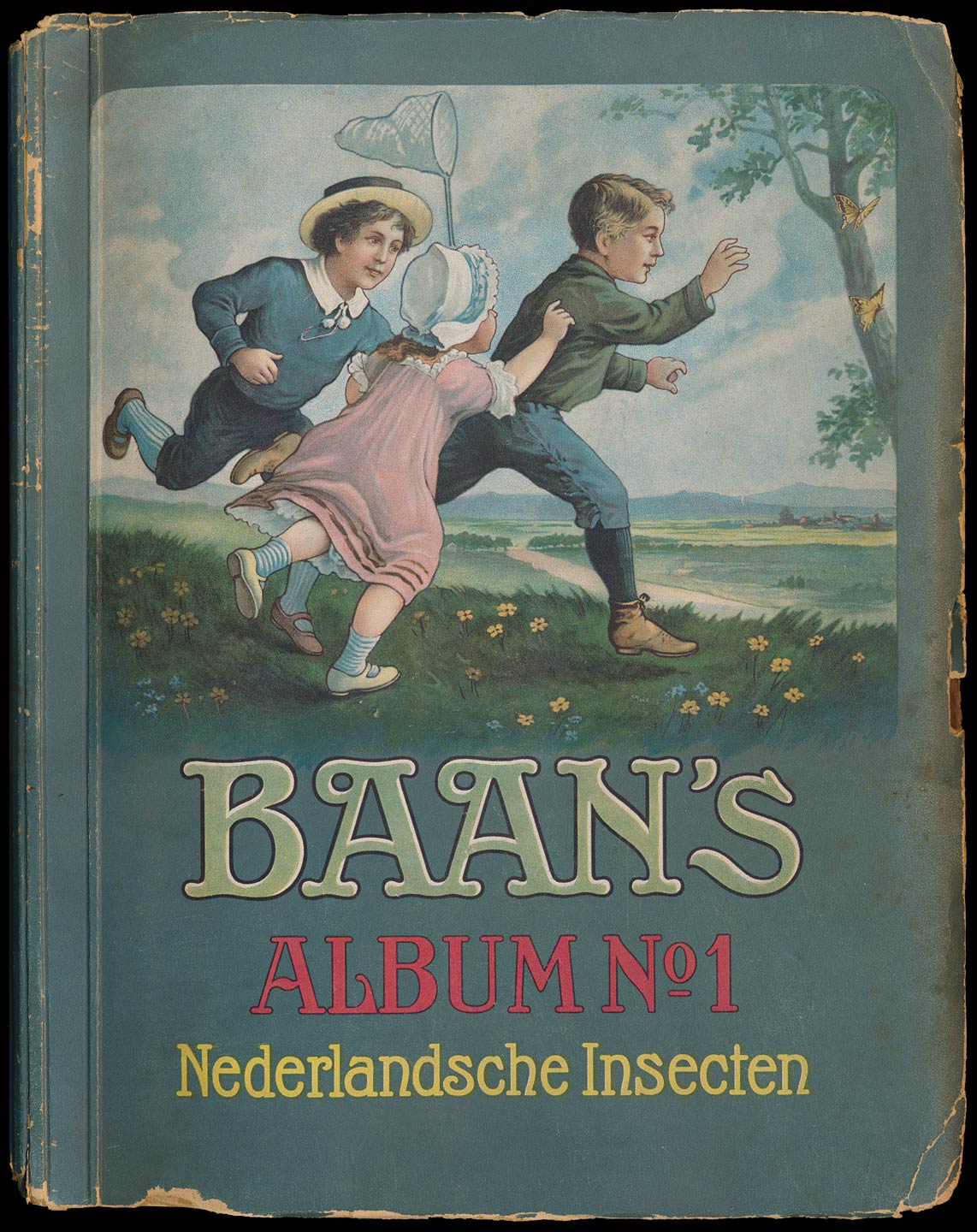
Another stunning album is Nederlandsche Insecten (Dutch Insects), which was published in 1915 by the J.C. Baan company from the town of Alkmaar, trading in coffee and tea. This album required no fewer than 180 small colored plates of insects to be collected. The empty album itself could be purchased for 50 cents, including postage (roughly €6.39 in today’s money).
The author, P. Teunissen, was the agricultural and horticultural editor of the Amsterdam newspaper Het Nieuws van den Dag (The News of the Day). He wrote a substantial text consisting of a general introduction to insects—their anatomy, life cycles, reproduction, and their benefits or harm to humans—followed by detailed descriptions of each of the insects illustrated.
The painted illustrations themselves were originally printed with chromolithography, and were most likely produced in Germany. The artist is unknown. They are about 36 by 60 mm in size, and are all to be mounted vertically, regardless of the actual orientation of the image. The front cover shows three children playing with a butterfly net, and the back cover shows a mother with children collecting the cards, but despite this, it should not be mistaken for a children’s book.
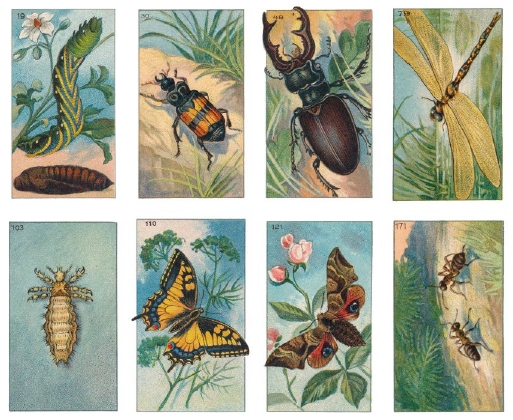
Unfortunately, the production quality of the book was not that good, so most copies that have survived to this day are in poor condition, with issues like brittle covers. But the plates are sometimes damaged as well—by the very class of creatures it describes: insects, which appear to have developed a taste for either the paper or the glue used to mount the plates. This makes it quite a challenge to digitize them. To get the album complete, with all pictures in reasonable quality, I had to purchase two copies from the Dutch equivalent of eBay, Marktplaats.
After obtaining the albums, the first thing I do is scan the illustrations. For some albums, the plates are attached only at the corners, and I carefully remove them to scan both the front and back (which does contain advertising or explanatory text). But in the case of Nederlandsche Insecten they were glued, so I could scan only the front. I scan the plates at 600 DPI. After that, I scan the text pages at a lower resolution, and prepare them for proofreading at Distributed Proofreaders. Since the text is in Dutch, the pages don’t proceed quickly through the rounds because we have only a limited number of Dutch proofreaders on the site, but that is not a major concern for me, because in the meantime, I too have a lot of work to do.
Each scanned illustration has to be cleaned, that is, cropped, color-corrected, and cleared of minor imperfections using photo editing software. When those images have a white border, I will retain that border, and make it fully white. Per image, that can take five to 15 minutes, depending on their state.
The front and back cover of Nederlandsche Insecten posed some special challenges. First of all, it was too large for my scanner, which meant I had to scan it in parts, and then stitch the parts together (which is quite tricky), and then it was also heavily scratched, so I had a lot of scratch removal to do.
My goal is not to make the album look brand new, although I do want to remove disfiguring scratches and stains while preserving the aged character of the original object. Given the large number of scratches in Nederlandsche Insecten, this alone took me several hours.
At the same time that I was processing the images, every page of the text went through multiple rounds of volunteer proofreading and formatting. Once that process was complete, I combined the text and images in HTML format and uploaded it to Project Gutenberg, where it is available for free in various formats.
Even if you do not read Dutch, it is worth browsing through Nederlandsche Insecten and the other advertising picture card albums at Project Gutenberg simply to admire the beautiful illustrations.
This post was contributed by Jeroen Hellingman, a Distributed Proofreaders volunteer.


A lot of love and technical skills went into this work. Those unassuming albums are among my favourite PG books.
Thanks, Jeroen.