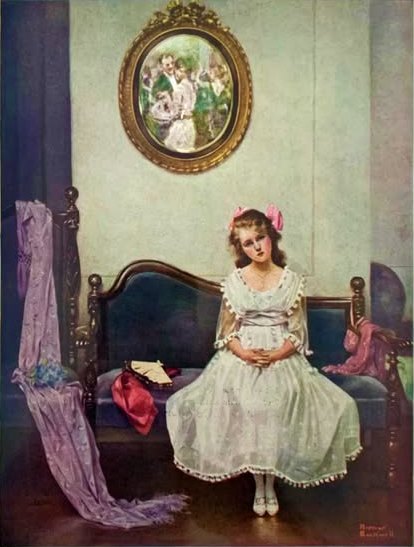
Most people have experienced being a wallflower at some point or another in their social lives. You might have been the shy kid at a party afraid to ask someone to dance. Or maybe you’re the insecure grownup at a gathering where you don’t know anybody, have no idea how to start a conversation with a random guest, and wouldn’t want to start one even if you did know how. You cling to the wall like an Erysimum capitatum (Western wallflower) so as not to mingle, thereby eliminating – you hope – the risk of making a fool of yourself.
Fear not: Thanks to the volunteers at Distributed Proofreaders and Project Gutenberg, introverts can get free help from How Not to Be a Wallflower, by John Woodworth. It’s a short tome giving tongue-in-cheek advice, part of the long-running “Little Blue Book” series of booklets published from 1919 to 1978. (For more information on the series, see our blog post on Life of John Brown).
Woodworth’s sly humor is entertaining and a bit risqué at times. How Not to Be a Wallflower was written in 1928, so it’s a slight surprise to read detailed advice on how a young lady should perform her toilette: “Another good practice after a bath is to stand before a mirror and give yourself a good once-over.” He recounts that a young lady of his acquaintance once showed him (though he does not describe the circumstances) a “very beautiful” three-piece satin lingerie outfit – bra, panties, and slip. He suggests that “the Bible is just as naughty as anything that has been written in the last ten years.” Times had definitely changed after World War I – just a decade or so earlier, few would have dared to write so frankly about such things for a general audience.
The booklet pokes fun equally at female and male wallflowers, dividing each category into several types. On the female side, there is, for example, “The Elderly Ingenue” at a dance for young people: “From this distance one would judge her to be a very nice young lady but when you get closer you find that she is not at all what you expected her to be. She is a perennial.” On the male side, there is “The Lewd Dancer,” who “attracts attention by the gyrations of his hips and the avid appearance of his face,” no doubt while doing something like the Charleston or the shimmy – in a corner by himself. Probably the most hilarious type is “The Drunk,” who attends a costume party dressed as John the Baptist’s head on a platter, with chaotic results.
How Not to Be a Wallflower contains numerous references to trends of the 1920s. It talks about flappers and college boys whose jalopies are covered with “queer, crazy labels.” Hot topics like Prohibition and companionate marriage crop up, as do celebrated Jazz Age figures like Edna St. Vincent Millay, F. Scott Fitzgerald, and Pablo Picasso. It’s an entertaining slice of life from a century ago that can nonetheless still raise a chuckle today.
This post was contributed by Linda Cantoni, a Distributed Proofreaders volunteer.


