
This post celebrates the 51,000th unique title Distributed Proofreaders has posted to Project Gutenberg: The Zoology of the Voyage of H.M.S. Beagle (Part V: Reptiles), by Thomas Bell, edited by Charles Darwin. Congratulations and thanks to all the Distributed Proofreaders and Project Gutenberg volunteers who helped us reach this major milestone!
In December 1831, 22-year-old Charles Darwin, fresh from Cambridge University, boarded H.M.S. Beagle as a “gentleman naturalist.” The Royal Navy ship was to conduct a two-year survey of the coasts of South America, including the Galápagos Islands. The voyage actually lasted five years and was the foundation for Darwin’s revolutionary work on natural selection and evolution.
On that voyage, Darwin, who had been an easily distracted and at times indifferent student, found his true calling. His primary interest at the time was in geology. As the ship charted the coasts, Darwin went ashore to study the land, but he became fascinated by the native flora and fauna, and by the many fossils he discovered. He collected numerous specimens, many of which eventually found their way into the Natural History Museum in London and the Museum of Zoology at Cambridge University, among others. Early in the trip, he used a plankton net to capture sea creatures and was astounded by how beautiful they were, as he recorded in his diary: “Many of these creatures so low in the scale of nature are most exquisite in their forms & rich colours. — It creates a feeling of wonder that so much beauty should be apparently created for such little purpose.”
Darwin made copious notes about his observations. When he got back to England in 1836, he sought to have them published but didn’t have the financial means to do so. As he relates in the Preface to Part I of The Zoology of the Voyage of H.M.S. Beagle, he applied to the British government, which granted him £1,000 to publish his notes, with engravings, “in a convenient form, and at a cheap rate” and “in such a manner as to be most advantageous to the Public at large.”
Realizing that he was not an expert in zoology, Darwin engaged the help of several prominent scientists in the field to write up and enhance his reports. These included ornithologist John Gould, author of The Birds of Australia, the third volume of which was the 38,000th title Distributed Proofreaders contributed to Project Gutenberg. Gould’s wife Elizabeth Coxen Gould provided the lovely illustrations for that and for Part III of the Beagle reports. All five scientists who worked on the project were credited as authors, with Darwin as editor.
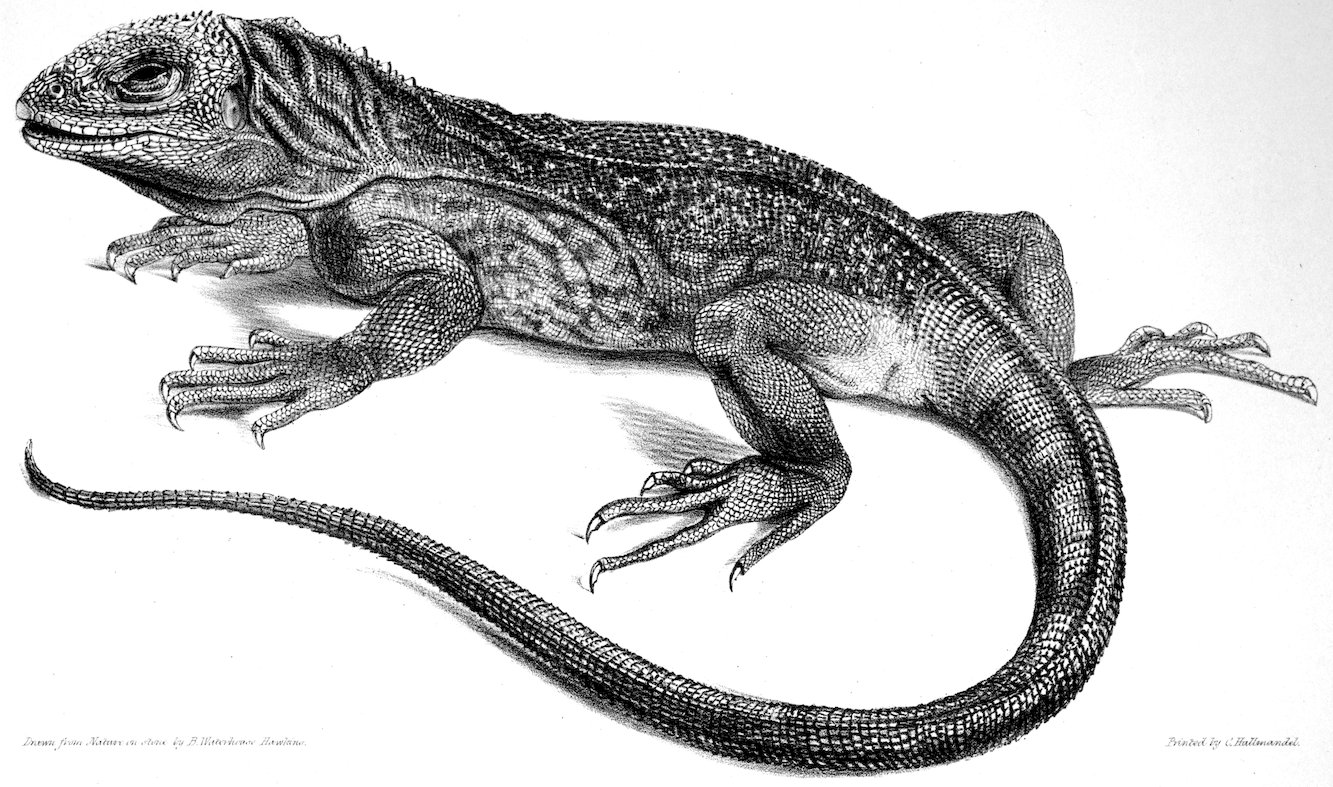
The reports were initially published in 19 unbound parts from 1838 to 1843, priced at 8s. apiece, and then released as five bound volumes from 1839 to 1843, all copiously illustrated with engravings. Our 51,000th title, Part V: Reptiles, completes the set at Project Gutenberg. Oddly, it doesn’t mention the giant tortoises Darwin found on the Galápagos Islands, but it does discuss the iguanas. It was authored by Thomas Bell, a dental surgeon who became a zoology professor at King’s College, London. Ironically, Bell is notorious for having been blind to the monumental significance of Darwin’s natural selection theory. Darwin presented his theory at a meeting of the Linnean Society in 1858. Bell, who was the chairman, did not consider it important enough to mention in his annual report, stating, “The year which has passed has not, indeed, been marked by any of those striking discoveries which at once revolutionize, so to speak, the department of science on which they bear.”
Thanks to the volunteers at Distributed Proofreaders and Project Gutenberg, the many wonders that Darwin discovered on his groundbreaking voyage are available to all for free.
The Zoology of the Voyage of H.M.S. Beagle
Part I: Fossil Mammalia, by Richard Owen
Part II: Mammalia, by George R. Waterhouse
Part III: Birds, by John Gould
Part IV: Fish, by Leonard Jenyns
Part V: Reptiles, by Thomas Bell
This post was contributed by Linda Cantoni, a Distributed Proofreaders volunteer.


