Distributed Proofreaders is 26 years old today, and Hot off the Press is celebrating with a fitting contribution to Project Gutenberg: The Pentateuch of Printing by English typographer William Blades.
This generously illustrated book covers the history of Western typography and printing from ancient times to the late 19th Century. It is fancifully arranged like the Pentateuch (first five books) of the Bible, with five chapters headed “Genesis,” “Exodus,” “Leviticus,” “Numbers,” and “Deuteronomy,” plus a bonus section headed “A Chapter on Judges,” connecting these chapter titles metaphorically to various aspects of printing’s history.
Blades poses the question, “Who invented Printing?” He cites the controversy as to whether it was Johannes Gutenberg or Laurens Coster, both 15th-Century European printers (though the claim for Coster is now considered legend rather than fact). What Blades doesn’t acknowledge is that printing with woodblocks and, later, moveable type had been invented centuries earlier in Asia. Blades credits the Chinese only with the invention of paper.
Europeans simply didn’t know yet about Asian printing. As Eric Marshall White notes in his recent book, Johannes Gutenberg: A Biography in Books, “even Marco Polo famously neglected to mention Chinese printing.” Gutenberg and other printers of his time were working in the dark, which made them genuine pioneers in the field. The more accurate question would be, “Who invented the printing press?” And the answer is certainly Gutenberg, whose true crowning achievement was to invent a mechanized process with moveable (and durable) metal type, making it easier to produce multiple copies, thus revolutionizing the world of books by making them widely available.
This limitation aside, Blades provides a detailed account of typography and printing. He begins the “Genesis” chapter with the development of writing in the ancient world, citing stamped clay tablets, stone engravings, styli and wax tablets, and ink on papyrus. Then, in 14th-Century Europe, came “block books,” in which images and text were carved into wood and coated with an ink made from lampblack (carbon) and oil, then stamped on parchment or paper. And illuminated manuscripts, mainly created by monks, were copied and decorated by hand and disseminated to the wealthy.
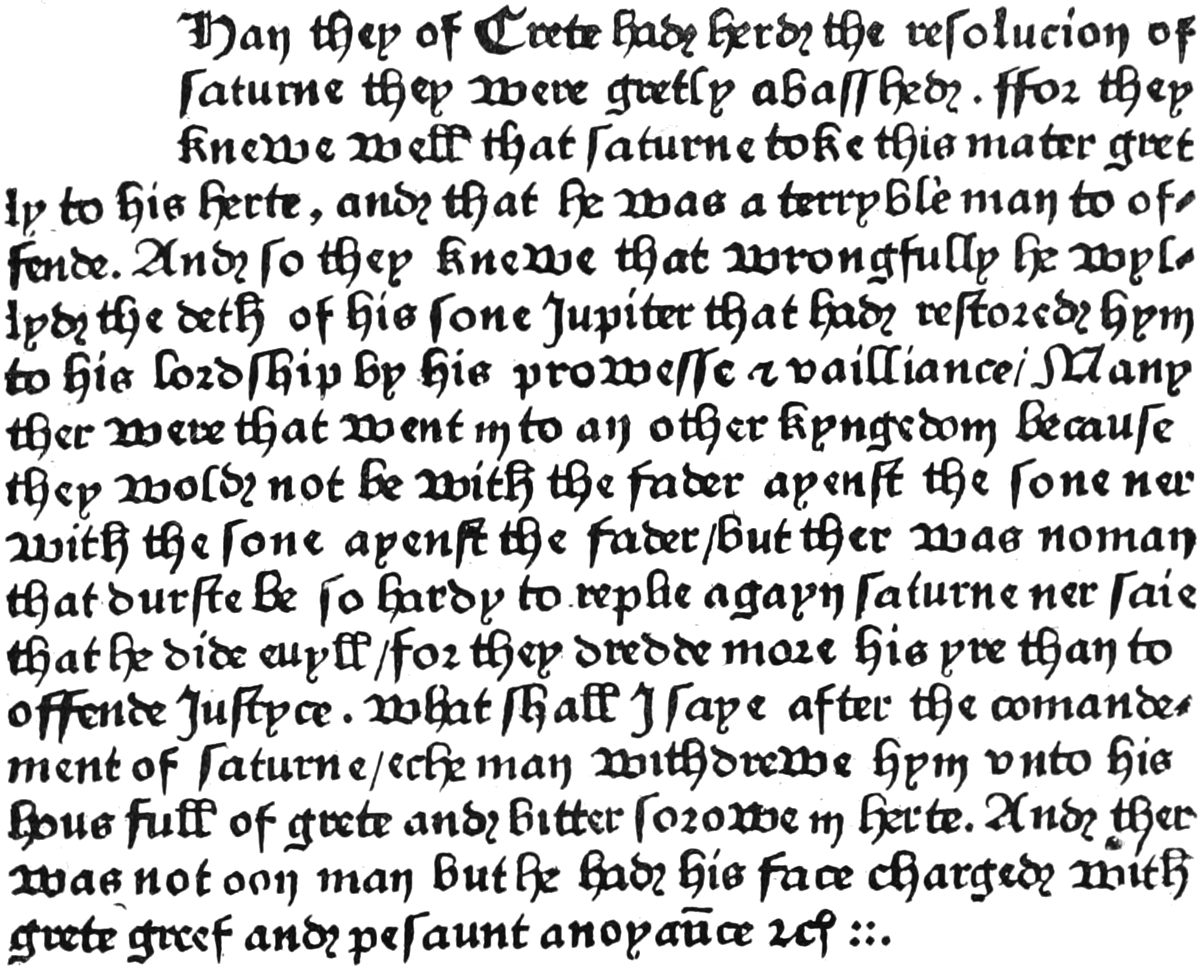
In the “Exodus” chapter, Blades describes how, thanks to Gutenberg, printing presses proliferated throughout continental Europe in the 15th Century, and then to Britain. Blades places special focus on William Caxton – Blades had published a book about him in 1861 – believed to have been the first printer in England and the first seller of printed books there. Blades notes that printing later made it to the New World, with the first press in the Americas established in Mexico City in about 1539; and a century later the first press in British North America, in Cambridge, Massachusetts (whose first publication was the famous Bay Psalm Book in 1640).
The “Leviticus” chapter is a fascinating overview of the process of printing, including type-foundry – the creation of typefaces on moveable metal type. Blades discusses how the early presses worked and the practical challenges they posed to printers of the time, as they required two men to operate: “One ‘beat’ the ‘form,’ that is, he dabbed two big, soft balls covered with ink over all the type; the other placed the white paper on the ‘tympan,’ and ran the whole, by means of a winch, beneath the ‘platen,’ and then made a strong pull at the bar.”
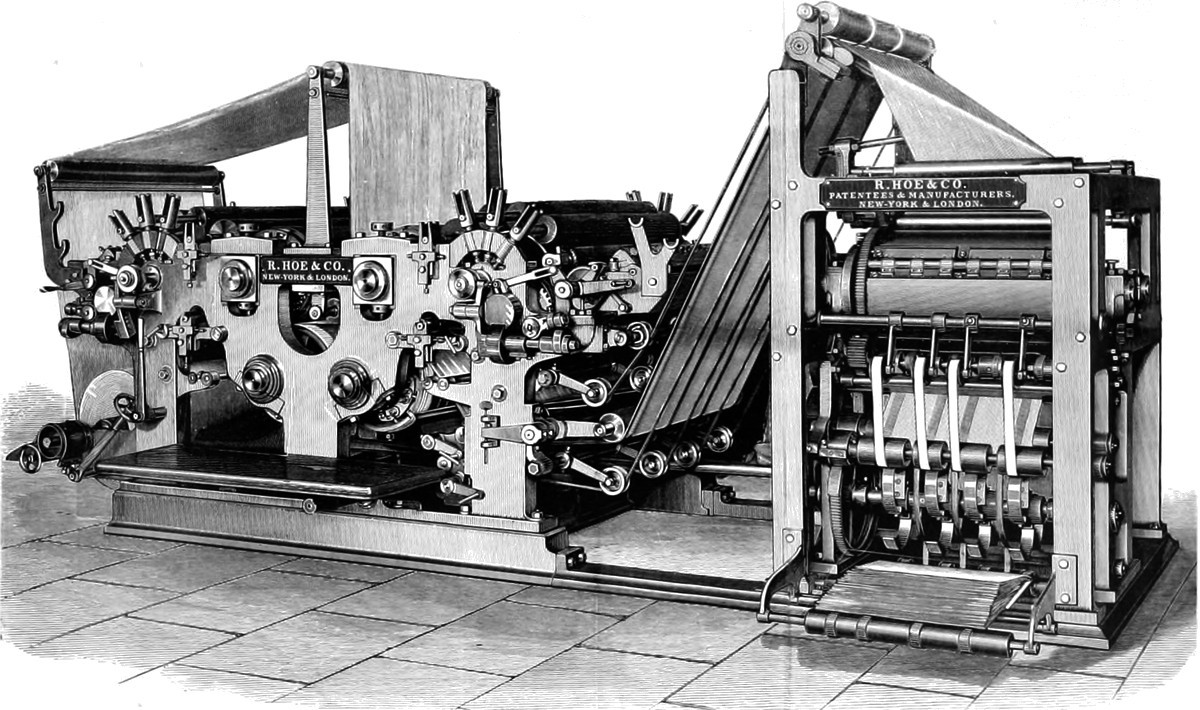
Blades expands the discussion to modern methods in “Deuteronomy.” The invention of a steam-powered press by Friedrich Koenig, patented in 1810, revolutionized the industry. It had a huge impact on the newspaper business, because thousands of copies could be rapidly and cheaply printed and disseminated to the public. As Blades describes it,
“Few sights are more impressive than the machine-room of one of our daily papers in the small hours of the morning…. At one end of the machine is a heavy reel of paper, sufficient to make about 6,000 complete papers. It is wound round a core like that used for a garden-hose, and forms a solid mass, which unwinds rapidly when the machine grips it. A knife with unerring precision cuts off each paper as soon as printed, and delivers it onto a collecting board. Soon after No. 1 machine gets to work, No. 2 is supplied with plates and started; so with the other machines, until eight or nine are all printing at once, each delivering about 12,000 complete copies an hour, so that with eight machines the delivery would be 96,000 per hour.”
Blades turns his attention to “great and noble men who have served God and their country as printers” in the “Numbers” chapter. This contains mini-biographies of famous printers throughout Europe, like Gutenberg and Caxton, including a mention of the American Founding Father Benjamin Franklin, who began his career as a printer. Finally, the chapter on “Judges” gives an extensive bibliography of books on typography and printing.
Blades, who himself wrote a number of works on these subjects (several of which are available at Project Gutenberg), left The Pentateuch of Printing unfinished at his death in 1890. It was completed by his friend, the author Talbot Baines Reed, a popular English writer of fiction for boys. (A number of Reed’s books are also available at Project Gutenberg.) Reed contributed a “Memoir” of Blades that reflects not only Blades’s scholarship, but also the respect he enjoyed among his colleagues.
Thanks to the volunteers at Distributed Proofreaders and Project Gutenberg, Blades’s expertise is available to all for free.
This post was contributed by Linda Cantoni, a Distributed Proofreaders volunteer.


 Posted by LCantoni


