Celebrating 50,000 Titles

December 7, 2025

This post celebrates the 50,000th unique title Distributed Proofreaders has posted to Project Gutenberg: A Dictionary of the Art of Printingby William Savage. Congratulations and thanks to all the Distributed Proofreaders and Project Gutenberg volunteers who helped us reach this major milestone!

The first book printed in England using the moveable-type technology invented by Johannes Gutenberg was published by William Caxton in 1473. Ironically, the considerable skills needed to manufacture paper, inks, type-metal letters in foundries, and mechanical printing presses were handed down only orally for more than two centuries.

It fell to Joseph Moxon to publish the first treatise describing many of these skills, Mechanick Exercises, or The Doctrine of Handy-Works Applied to the Art of Printing, in 1683/4. He himself was a master printer, and his book was intended to be a practical manual for the printing trade. Clearly the art of printing in his time was not for the faint-hearted. Preparation of ink involved boiling varnish in a cauldron, with a real danger of the fumes catching fire and “Firing the Place it is made in.” Casting the type-metal letters (fonts) in a foundry produced “Poysonous Fumes” from the antimony used in the process.
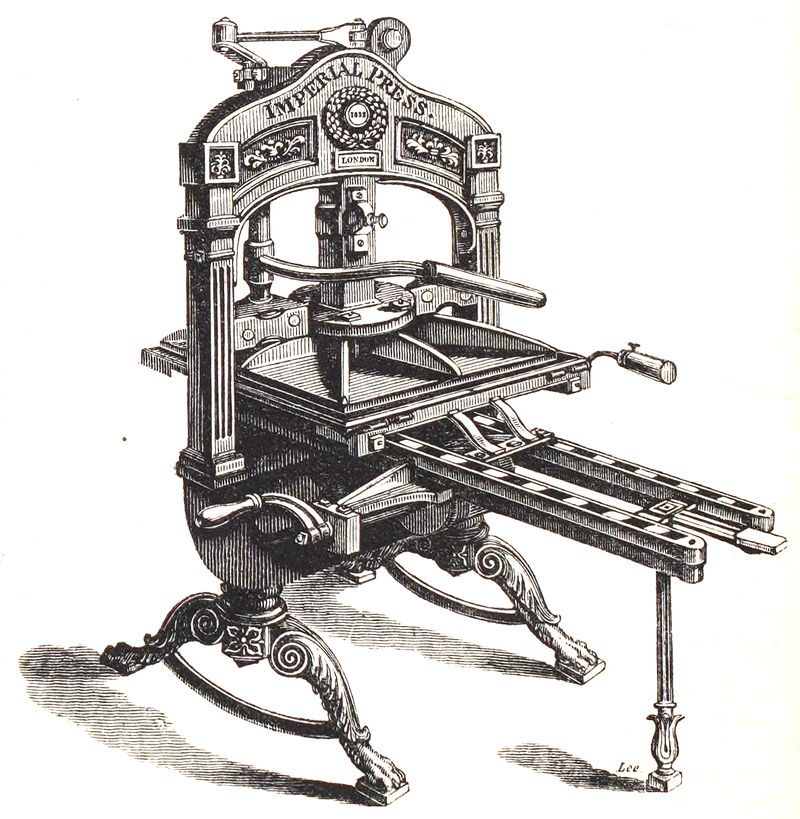
Sherwin and Cope's Imperial Press

Another 160 years would pass until William Savage, also a printer by trade, published A Dictionary of the Art of Printing. It was intended as an update to Moxon’s manual, reflecting the current (as of 1840) state of moveable-type technology. He chose the structure of a dictionary to describe detailed “how-to” segments on every aspect of printing and binding a book. He widened the scope to explain all the colorful jargon of the trade, and included alphabet tables and grammatical summaries of almost every language produced by the many British type-metal foundries of that time, from Arabic and Armenian to Sanskrit and Saxon.

What does “Upper case” really mean? See “Case.” How does one fold an octavo sheet? See “Imposing.” What is a “Galley Slave”? What is a “Gathering”? What is “Brevier”? What size is diamond, pearl, emerald, or pica font? See “Types”. How much was a compositor paid for composing 1,000 letters? See “Scale of Prices.”

Savage’s dictionary has many quotes from Moxon’s manual showing how relevant it remained two centuries later, even as the technology advanced. He also acknowledges the future electrotype technology, which was starting to revolutionize the printing industry globally. (See “Galvanism.”) Although printing technology has continued to advance beyond electrotyping to lithography and phototypesetting and digital printing, it is remarkable how much of the early printing terminology remains in our language today.

The volunteers at Distributed Proofreaders are very proud to have A Dictionary of the Art of Printing as their 50,000th unique title for Project Gutenberg.

This post was contributed by jandac, a Distributed Proofreaders volunteer who post-processed A Dictionary of the Art of Printing.


Project Gutenberg celebrates 50,000 titles

September 18, 2015

Project Gutenberg 50,000 Books

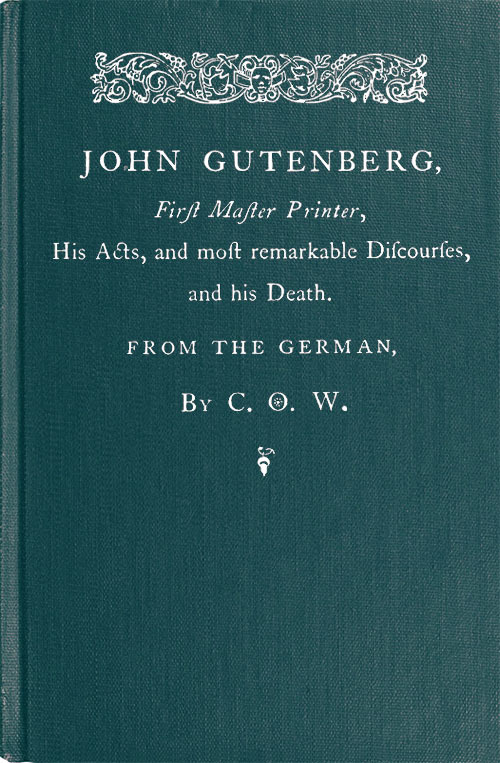
Distributed Proofreaders proudly brings to you Project Gutenberg’s 50,000th title, John Gutenberg, First Master Printer, His Acts, and most remarkable Discourses, and his Death, by Franz von Dingelstedt, translated from the German and published in 1860.

cover

I couldn’t think of a more appropriate title to celebrate this milestone. Johannes Gutenberg is known as the inventor of the moveable-type printing press, which led to the mass production of printed books and subsequent growth of literacy, knowledge and learning.

The project was first suggested by a DP volunteer. It was quickly picked up by one of our newer project managers, ably assisted by one of our more experienced and prolific project managers, who helped convert the long “s” used in the original publication to the regular “s” in use today.

With notification that PG was nearing its 50,000th book, the project manager suggested that if we hurried, perhaps we could finish it in time to be considered as a contender.

More than 30 volunteers joined in with no notice and made sure the pages were proofread and formatted to a standard of excellence, so that there was very little for the post-processor to have to do to assemble and check the pages for the final ebook. A draft was made available, and in next to no time smooth readers had read the book and reported their findings to ensure the ebook represented the original.

The book is a biography of the man, born Johann Gensfleisch, who preferred to be known as Johann Gutenberg (John Gutenberg in the translation). His inventions led to the printing of the first book published using moveable type, the Bible in Latin. He had little money and was unable to continue his experiments without financial backing. He met John Fust, who bankrolled Gutenberg’s venture, and the Bible was completed in time for the wedding of Fust’s daughter:

The Bible, on its part, had its silver clasps well rubbed and polished, and, being placed on a table, it shone, to the edification and admiration of all beholders.

The book quotes Gutenberg as saying:

My art belongs to me as much as to the rest of the world; let it remain the property of intelligence, and only be practised by those who have been initiated in it.

Yet he felt that his:

… art is not like any other art; a painter sketches his figures on the canvas, and he perfects the creation of his thought; the same with the poet, the engraver, the architect, and the musician; we, on the contrary, with our presses, are only the servants of others; printing is only an instrument for thinkers. Of what importance are the fingers which regulate the letters in a book? Of what importance is the hand which works the press, which arranges the pages and the leaves, which gives a visible form to the action of the mind?

Gutenberg toiled long and hard, working in dark, oppressive and humble conditions, but eventually he lost his business to Fust and died “neglected and in destitution.” His legacy, however, lives on, and his namesake, Project Gutenberg, continues the philosophy of sharing the printed word with the world.

This post was contributed by a DP volunteer.