The Art of Stage Dancing

November 24, 2010

It started as an all-too-common story: a young performer — an actor, dancer, musician, stage director — from the Midwest comes to New York to break into the big time on Broadway. His specialty act on the piano wowed ’em in his hometown, and he’s determined that it’ll wow ’em in New York.

But when he gets there to play his first gig, he finds that there’s no piano at the theater. Worse, he discovers that someone has stolen his act and has already performed it all over town. Now he has no job. He has no money. He trudges from agent to agent in a vain search for a break. He now understands why they call Broadway the “Boulevard of Broken Dreams.”

But the dream of Ned Wayburn (1874-1942) wasn’t broken yet. His ragtime piano playing eventually caught the attention of one of the great Broadway stars of the 1890s, May Irwin, who hired him to accompany her for the princely sum of $25 a week. And from that big break grew Wayburn’s outstanding career as the first important choreographer on Broadway.

Actually, Wayburn didn’t care for the title “choreographer.” He styled himself as a director, and from 1901 into the 1920s he was one of the kings of Broadway, his spectacular vaudeville shows drawing huge crowds. He perfected synchronized chorus-line dancing, using large numbers of attractive young female dancers in imaginative, precisely-timed production numbers. He hit the pinnacle of his career when he directed the Ziegfeld Follies several years in a row, from 1916 to 1923.

But in spite of his success, financial security frequently eluded Wayburn. He went bankrupt for the first of several times in 1908. He bought a theater in 1915 to showcase his own productions, only to have it shut down four months later. He became involved in a messy divorce and was nearly jailed for failing to pay alimony.

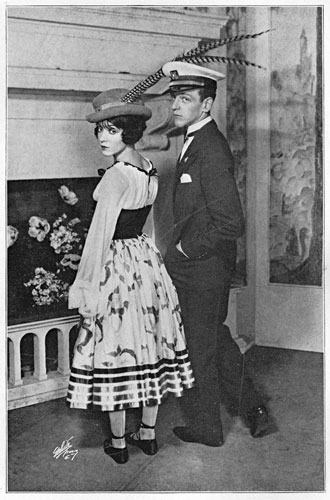
Fred and Adele Astaire

Fred and Adele Astaire, pupils of Ned Wayburn

To shore up his finances, Wayburn opened a dance school in Manhattan in 1905. Among his early students were a young Fred Astaire and his sister, Adele. By the 1920s, the school was a Broadway institution, training legions of dancers in Wayburn’s unique styles of tap dancing (which some claim he invented), acrobatic dancing, “modern Americanized ballet,” specialty dancing, and ballroom dancing. The Art of Stage Dancing, written in 1925, is essentially a book-length advertisement for the Ned Wayburn Studios of Stage Dancing — but a fascinating advertisement nonetheless.

Wayburn’s book is chock full of photographs of the Broadway stars of yesteryear whom Wayburn had taught, or with whom he had worked, in his long career: Fred and Adele Astaire, the Dolly Sisters, Eddie Cantor, Will Rogers, W.C. Fields, Marion Davies, Gertrude Lawrence, Al Jolson, and a host of other greats who are now, alas, forgotten.

But the book is more than just a self-congratulatory plug for Wayburn and his school. It’s also a complete guide for the would-be dancing star (primarily female, of course), with detailed, richly illustrated chapters on dance styles, steps, and tempos (with music); makeup and costume; stage technique; exercise, diet (with daily menus to slim down or fatten up), and health; and much more. Wayburn even threw in a collection of sample contracts so that his students would know what to expect in the real world.

Wayburn believed fervently in the power of confidence as the key to stage success:

Be patient, you who would star and see your name go up in the bright lights on the Great White Way. Do not get discouraged. You will meet with obstacles on the route to fame undoubtedly, as others have done, and, like the others who have finally arrived, you must overcome them one at a time as they appear, by sheer force of willpower, determination, pluck or whatever you desire to call it. If you are a weakling and lack strength of character do not ever take up a stage career, for you will get many a bump; so be prepared to stand it. For only those who are determined to succeed will ever reach the top, where there is plenty of room always.

Unfortunately, no amount of confidence could stop the march of time for Wayburn. The Depression brought both vaudeville and the Ned Wayburn Studios to a slow and painful end. Wayburn went bankrupt for the last time in 1935; he died in 1942 at the age of 68. But his legacy lives on in every Broadway show with a chorus line.

The Art of Stage Dancing was the 14,000th title posted to Project Gutenberg by Distributed Proofreaders.

This post was contributed by Linda Cantoni, a Distributed Proofreaders volunteer.


Real “Little Women” Letters

November 20, 2010

For all those who have ever read Little Women and loved it, Little Women Letters from the House of Alcott shows how much of Little Women was based upon Louisa May Alcott’s own family.  What makes this biography special is that it is primarily told in the letters that the Alcott family wrote each other, including a letter from five year old Anna telling her mother that “You have a splendid husband”.

I don’t know if Bronson Alcott was that splendid of a husband (he was a failure as a businessman, and his family lived in poverty most of their childhood), but he definitely was a “splendid” father.

Here is what he wrote Elizabeth on her fifth birthday:

Page of letter to Elizabeth on her 5th birthday

Page of letter to Elizabeth on her 5th birthday

1840

I    I    I    I    I    Years
one two three four five
birth-day
in the
cottage

My very dear little girl,

You make me very happy every time I look at your smiling pleasant face—and you make me very sorry every time I see your face look cross and unpleasant. You are now five years old. You can keep your little face pleasant all the time, if you will try, and be happy yourself, and make everybody else happy too. Father wants to have his little girl happy all the time. He hopes her little friends and her presents and plays will make her happy to-day; and this little note too. Last birthday you were in Beach Street, in the great City, now you are at your little cottage in the country where all is pretty and pleasant, and you have fields and woods, and brooks and flowers to please my little Queen, and keep her eyes, and ears, and hands and tongue and feet, all busy. This little note is from

FATHER,

who loves his little girl very much, and knows that she loves him very dearly.

Play, play,
All the day,
Jump and run
Every one,
Full of fun,
All take
A piece of cake,
For my sake.

Unfortunately, having him as a father had its downside, including the Fruitlands experiment and its failure that was immortalized by Louisa Alcott in her “Transcendental Wild Oats.”

The detail of it is thus described by a friend of the Alcott family, who had the story from Bronson Alcott himself:

The crop failures necessitated the community living on a barley diet, as anything animal was not allowed, not even milk and eggs. Now and then they gave a thought as to what they should do for shoes when those they had were gone; for depriving the cow of her skin was a crime not to be tolerated. The barley crop was injured in harvesting, and before long want was staring them in the face. The Alcotts remained at Fruitlands till mid-winter in dire poverty, all the guests having taken their departure as provisions vanished. Friends came to the rescue, and, Mr. Alcott concluded with pathos in his voice, “We put our little women on an ox-sled and made our way to Concord! So faded one of the dreams of my youth. I have given you the facts as they were; Louisa has given the comic side in ‘Transcendental Wild Oats’; but Mrs. Alcott could give you the tragic side.”

Indeed, it was always Mrs. Alcott who could have given the tragic side, skillfully as she kept her worries hidden. Her own family, indignant because Bronson Alcott could not better provide the material needs for his family, on more than one occasion besought the faithful wife to leave him.

Reading this book, I am struck by how strong an impact the father had on that family. Bronson Alcott was an idealist, with strongly-held views of the world, and he passed those strongly held views to his children with love and tender care.

Strongly-held views taught with love and tender care are not necessarily correct. For instance, I doubt my daughters would agree with the sentiment of a young Louisa Alcott that “love of cats” is a vice. Having Bronson Alcott as a father definitely was a mixed bag, the type of life that makes great source material for a novel.


A Week at Waterloo in 1815

November 17, 2010

One might think, from the title, that A Week at Waterloo in 1815 is an old soldier’s memoir of a glorious battle. But the lengthy subtitle, “Lady De Lancey’s Narrative: Being an Account of How She Nursed Her Husband, Colonel Sir William Howe De Lancey, Quartermaster-General of the Army, Mortally Wounded in the Great Battle,” is the first clue that this is no ordinary military tale. Lady De Lancey’s narrative is, instead, a heart-wrenching account of a young bride who tended to her husband in his last agonizing days.

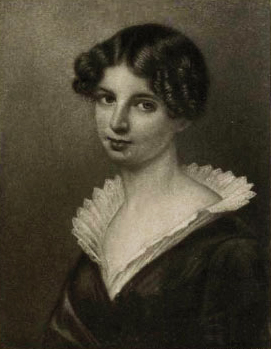
Lady Magdalene De Lancey

Lady Magdalene De Lancey

Magdalene Hall De Lancey (1793-1822), daughter of the noted Scottish geologist Sir James Hall of Dunglass, married Sir William Howe De Lancey (1778-1815) in April 1815. De Lancey was a descendant of the prominent De Lancey (or Delancey) family of New York City (Delancey Street on the Lower East Side of Manhattan was named after them). Sir William’s branch of the family were Loyalists during the American Revolution, and fled to England when the British lost the war in 1783. Sir William joined the British Army as a teenager in 1792, and, shortly after his marriage to Magdalene, began serving under the Duke of Wellington in the last Napoleonic War.

As was the custom in those days, Magdalene accompanied her new husband when he was posted to Brussels for the Belgian campaign, in June 1815. Their first days there were surprisingly peaceful and happy. It soon became clear, however, that the French would attack Brussels, so Magdalene moved to Antwerp while Sir William went off to battle. He wrote her on June 16, assuring her that he was safe.

It was the last letter she would receive from him. On June 18, 1815, in the first hours of the Battle of Waterloo, a cannonball struck Sir William in the back, sending him flying off his horse. Wellington himself saw Sir William fall, and rushed to his side. Believing that the wound was fatal, Sir William begged to be left to die on the field of battle, and asked Wellington to give his wife a last message. He was moved to a cottage, where, believed to be dead, he was left untended for a day and a half.

Meanwhile, the day after the battle, Magdalene was told that her husband had “died like a soldier.” Overcome by grief, she locked herself in her room:

I locked the outer door, and shut the inner one, so that no one could again intrude. They sent Emma [her maid] to entreat I would be bled; but I was not reasonable enough for that, and would not comply. I wandered about the room incessantly, beseeching for mercy, though I felt that now, even Heaven could not be merciful.

But Heaven was, for a time, merciful. The following day, Magdalene received the news that her husband was, in fact, alive, though badly wounded; a fellow officer had found him in the cottage and had gotten a surgeon to treat him. Magdalene made ready to go to her husband immediately. She was in a state of terror as she waited for her carriage:

I would not if I could, describe the state I was in for two hours more; then I lost all self-command. . . . My agitation and anxiety increased. I had the dreadful idea haunting me that I should arrive perhaps half an hour too late. This got the better of me, and I paced backward and forward in the parlour very fast, and my breathing was like screaming.

The horrors of the battle were brought home to her as her carriage approached Waterloo. “The horses screamed at the smell of corruption, which in many places was offensive,” she wrote. But she rejoiced to find her husband alive. His first stoic words to her were, “Come, Magdalene, this is a sad business, is it not?”

For the next six days, Magdalene nursed her husband in what was essentially a hovel with few supplies or conveniences. At first, he seemed to improve somewhat, but he was soon coughing up blood. His breathing became labored, and he developed severe chest pain and a fever. And no wonder: the cannonball had smashed eight of his ribs, and his lungs were punctured. The only medical treatment he received, typical of the day, was to be bled repeatedly — a fine treatment indeed for one who was bleeding internally!

On the night of the fifth day, Sir William, unable to sleep, asked Magdalene to lie down with him in his tiny sickbed against the wall:

He said if I could lie down beside him it would cut off five or six hours. I said it was impossible, for I was afraid to hurt him, there was so little room. His mind seemed quite bent upon it. Therefore I stood upon a chair and stepped over him, for he could not move an inch, and he lay at the outer edge. He was delighted; and it shortened the night indeed, for we both fell asleep.

The next day his lungs filled with water, and Magdalene knew the end was near:

I sat down by my husband and took his hand; he said he wished I would not look so unhappy. I wept; and he spoke to me with so much affection. He repeated every endearing expression. He bade me kiss him. He called me his dear wife. . . . [H]e looked up at me and said, “Magdalene, my love, the spirits.” I stooped down close to him and held the bottle of lavender to him: I also sprinkled some near him. He looked pleased. He gave a little gulp, as if something was in his throat. The doctor said, “Ah, poor De Lancey! He is gone.” I pressed my lips to his, and left the room.

Sir William was buried two days later near Brussels. Magdalene made a final visit to his grave on July 4. Her narrative concludes: “At eleven o’clock that same day, I set out for England. That day, three months before, I was married.”

After her return to England, Magdalene wrote A Week at Waterloo in 1815 at her brother’s request. It was privately circulated among family and friends. Magdalene remarried, but died in 1822, at the age of 29, giving birth to her third child. A Week at Waterloo in 1815 was published for the first time in 1906, and became a part of the Project Gutenberg library in 2010.

Magdalene De Lancey’s simple, unaffected style has an impact that no florid emotional verbiage could match. An introduction and notes in the published edition give historical context to the narrative, but her story transcends mere historical fact. It is a story of love and loss, ineffably human, and unforgettable.

This post was contributed by Linda Cantoni, a Distributed Proofreaders volunteer.


Mathematical Recreations and Essays

November 13, 2010

W. W. Rouse Ball‘s “Mathematical Recreations and Essays” contains an odd but decidedly interesting collection of essays about a range of different subjects. The 4th edition dating from 1905 was recently posted to Project Gutenberg. Far from being interesting to mathematicians only, this book has something for everybody who’s interested in puzzles and number games or in the history of science.

The book is divided into two parts of quite different character. The first part, titled “Mathematical Recreations,” ranges from simple number games of the “guess the number” kind to magical squares and mazes, discussing topics such as mathematical and geometrical fallacies, the “Eight Queens” problem on a chessboard, map colourings and many more. The problems presented are not exactly new or original and don’t pretend to be, but I like the systematic treatment given to many of them.

Part II of the book, titled “Miscellaneous Essays and Problems,” contains a wealth of historical information about mathematics-related topics made even more fascinating by the fact that it was written more than a century ago. It starts with a description of the development of the Mathematical Tripos at Cambridge, giving a very interesting glimpse into the history of mathematics education at one of Britain’s most prestigious universities. The next chapters give a history of classical geometrical problems, the quadrature of the circle the most prominent of them, followed by an introduction to Mersenne’s numbers. After that comes a short description of the “scientific” aspect of astrology, which the author himself wasn’t too sure whether to include. There’s a chapter introducing early cryptography, one on hyper-space, including space with more than three dimensions as well as non-Euclidean geometry, and one on time measurements.

But my absolute favourite is the last chapter on matter and ether theories. At the time this book was written, the internal workings of atoms were not yet known and the subject of the wildest speculations. The author gives an account of the different theories proposed and how they explain the way atoms interact with each other. Rather than reporting scientific developments from a historical standpoint, this chapter provides some valuable insights into science in action, which makes it really fun to read.

Tucked away behind the index are advertisements for the W. W. Rouse Ball’s other works, together with blurbs from probably every review that was ever printed. Let me cite from one of the reviews for this book, which I have to heartily agree with:

… A great deal of the information is hardly accessible in any English books; and Mr. Ball would deserve the gratitude of mathematicians for having merely collected the facts. But he has presented them with such lucidity and vivacity of style that there is not a dull page in the book; and he has added minute and full bibliographical references which greatly enhance the value of his work.–The Cambridge Review.

I thoroughly enjoyed reading this book and would really like to see the other works by this author on PG: they are surely worth a closer look.


Farthest North

November 10, 2010

In our time of comfortable air-travel, it is hard to imagine that just 115 years ago neither the North or the South-pole had ever been set foot upon by mankind, but this is exactly what the Norwegian explorer Fridtjof Nansen set out to do in 1893, with a purpose-built ship, the “Fram”, and a team of hardened men all willing to risk their lives for this mission.

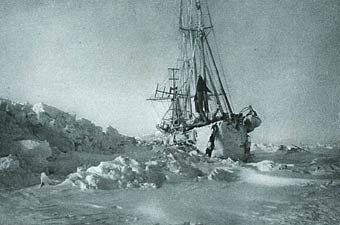
The "Fram" in the ice

The "Fram" in the ice (from Farthest North, volume II)

Nansen’s richly illustrated book, Farthest North; Being the Record of a Voyage of Exploration of the Ship “Fram” 1893-96 and of a Fifteen Months’ Sleigh Journey by Dr. Nansen and Lieut. Johansen, originally published in Norwegian in 1897, was translated into English the same year. In it, Nansen describes the inventiveness he used to organize such a mission with fairly limited means. The “Fram” had a number of interesting innovations. Its hull was specially designed to be lifted by the drifting ice, instead of being crushed; and the ship had a featured windmill, to provide electricity, and thus some bright electric light through the long polar night.

Volume I (Project Gutenberg ebook 30197) describes the planning phase, and how the “Fram” set out to sail as far North as it could, intentionally letting itself be captured by the ice, in an attempt to drift further North than any ship had reached before.

Volume II (Project Gutenberg ebook 34120) continues with the even more dare-devil attempt by Nansen and his companion Johanson to reach the North Pole on sledges pulled by dogs. During this trip, they killed their dogs one-by-one, feeding the weaker or exhausted ones to the remaining ones–the same, much criticized, method that brought Amundsen to the South Pole 16 years later. They reached the at that time record setting latitude of 86 degrees 15 minutes North before heading South again. During this trip South, they lost their remaining dogs, and were finally forced to build a hut and stop for the winter on Franz Josef Land, North of Spitsbergen. Here they survived by shooting over-curious ice-bears, and using them as food, until they were able to reach a small outpost built by the British explorer Jackson, just a few miles from where they survived the winter with so much hardship.

From here, the journey home proceeds smoothly, and the two explorers were rejoined with their crew who had survived another winter in the ice on the “Fram”, before being able to return home.

The "Fram" as it is today

The "Fram" as it is today, in the Fram Museum

The book is a pleasant read, and is illustrated with hundreds of photographs and drawings; including a number of color plates from pencil sketches made during the trip.

Nansen went on to become an influential statesman, with an important role for Norwegian independence, and an even more important role in saving millions of lives in Russia, Armenia, and Turkey with the High Commission for Refugees, for which he was awarded the Nobel peace prize in 1922.

After being the ship that reached the Northern-most latitude, the “Fram” also became the ship to reach the Southern-most latitude during Amundsens expedition to reach the South-Pole in 1911. Today, the “Fram” can still be visited: it has been pulled ashore in Oslo, and a museum, the Frammuseet, has been build around it. The visit will be even more impressive after reading this book, when, after short inspection of the cabins where these men have been living for three years, you realize some of the hardships they must have gone through. (This visit can easily be combined with a visit to the Norwegian Maritime Museum, the Kon-Tiki Museum, and the Viking Ship Museum, all located at walking distance from each other.)


The Show Goes On and On

November 6, 2010

Vaudeville was big entertainment in the U.S. during the late 19th and early 20th century. For one price you could buy a ticket and see a combination of singers, dancers, comedians, acrobats, etc.  Many of the entertainers went on to do movies, radio and TV such as The Marx Brothers, Charlie Chaplin, Sammy Davis, Jr., James Cagney, and Bing Crosby. However, so many of the lesser known acts have been lost forever.

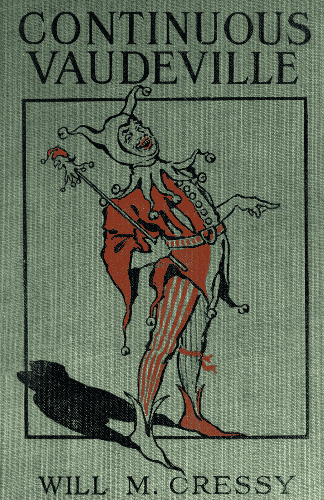
With Continuous Vaudeville, author Will M. Cressy gives the reader jokes and humorous stories. But they are jokes and stories about the performers, the acts, the staff of the theaters, and the audience. It is just a little peek into the world of vaudeville.

James J. Corbett was indulging in one of his semi-annual attacks of acting, and it came along to a place where the villain was to say—

“Then die, you dog,” and shoot Jim, who fell, wounded, to the floor.

Upon this occasion the villain spoke the line, pulled the trigger, and Jim fell. But the gun did not go off. Instantly Jim raised himself on his elbow and said in agonized tones—

“My God; shot with an air gun.”

He also gives tidbits from newspapers and things he has seen, and people he has met during his travels. At one point he has a list of actual signs that include:

Chicago. “I. D. Kay. Fresh Vegetables”

Oakland, Cal. “Dr. Muchmore, Dentist”

Paris, Ky. “Ice Cream & Washing Done Here.”

Spokane, Wash. “Bed Bath & Booze 15c. All Nations welcome but Carrie.”

Cressy certainly knew his subject. He was one part of the popular sketch comedy act, Cressy and Dayne. (Blanche Dayne was Cressy’s wife).

The illustrations were done by Hal Merritt. They are humorous in their own right and certainly fit the stories well.   Such as the illustration and story below:

The train had stopped at Reno for a few minutes; it was just at dusk and as the night was warm we got out and were walking up and down the platform. There was a billboard at the end of the station and the bill poster was pasting up some paper advertising the coming of “The Widow’s Mite” Company. An old chap came along, stopped and looked at it, but, owing to the poor light could not quite make out what it was; so he said to the bill poster,

“What show is it, Bill?”

“The Widow’s Mite.”

The old fellow pondered on it for a moment, then as he turned away he said, half to himself,

“Might? They do.”

We are lucky to have this opportunity to read the funny stories and learn about vaudeville at the same time. At one point, Cressy says:

I see there is an act playing in Vaudeville this year by the name of Doolittle & Steel. Make your own jokes.

Thanks to Continuous Vaudeville, we don’t have to come up with jokes. We can just enjoy.


Letters of a Lunatic

November 3, 2010

Letters of a Lunatic: A Brief Exposition of My University Life, During the Years 1853-54. The title says it all. The author was Professor George J. Adler, the date of publication was 1854, and the situation was reminescent of the old quote: “Even a paranoid can have enemies.”

Prof. Adler was a noted lexicographer of his time, made famous for his dictionary of the German and English languages. Until 1854, he was chair of German Language at the University of the City of New-York. In 1854, he was found insane and was committed to the Bloomingdale Insane Asylum, where he subsequently died. Letters of a Lunatic was a short tract written by him stating his side of the story of what happened.

My main object was of course to vindicate and defend my character, my professional honor and my most sacred rights as a rational man and as a public educator, against the invasions of narrow-minded and unjust aggressors, whose machinations have for several years been busily at work in subverting what other men have reared before them, in retarding and impeding what the intelligence of our age and country is eager to accelerate and to promote.

The tract includes letters from him to the head of his university, to the mayor of New York, and to others unnamed. In addition to that, there are: a letter supposedly from the head of his university, comments on some of the letters, and a section outlining the Law of Intellectual Freedom. Revealing are his comments that:

The scum of New-York in the shape of Negroes, Irishmen, Germans, &c., were hired, in well-organized gangs, to drop mysterious allusions and to offer me other insults in the street, (and thus I was daily forced to see and hear things in New-York, of which I had never dreamt before,) while a body of proselyting religionists were busy in their endeavors to make me a submissive tool of some ecclesiastical party or else to rob me of the last prospect of eating a respectable piece of bread and butter.

and that:

A night or week of such proceedings would be enough to set a man crazy. What must be their effect if they continue for months? And yet expressions like the following were perpetually ringing in my ears:—”Go on!” “You are the man!” “You are not the man!” “Go on! no, stop!” (by the same voice in the same breath.) “Out of the Institution with that man!” (by the laurelled valedictorian of last year.), “Stand up!” (by Prof. C——, close to my door.) “He started with nothing!” (by the same voice in the same place). “Pray!” (by ditto.) “You have finished!” “Go away!” “Thank God, that that man is out of the Institution!” (by a lady member of a certain religious fraternity, on terms of intimacy with a certain prominent politician of the neighborhood.) “Pursue him, worm that never d-i-e-s!” (theatrically shrieked by the same voice.) “You are a dead man! Dead, dead, dead, dead!” (by the voice of a certain popular preacher. ) “He is deceived, he is deceived!” (by the spokesman of a body of theological students in front of the neighboring Seminary, as I was passing.) And at times even: “Die!” “Break!” (on the supposition that I was in embarrassed circumstances.) “Whore!” even was one of the delectable cries! To these I should add the mysterious blowings of noses (both within sight and hearing,) frightfully significant coughs, horse-laughs, shouts and other methods of demonstration, such as striking the sidewalk in front of my windows with a cane, usually accompanied with some remark: “I understand that passage so!” for example.

There might have been a powerful conspiracy, or he might have been delusional, or both. No matter what was the truth, it was a fascinating read.


Dress as a Fine Art: With Suggestions on Children’s Dress. by Mrs. Merrifield.

October 30, 2010
This was first published in England in the London Art Journal and this book is an edition put together for publication in America in 1854. Mrs Merrifield is writing about clothing as more than just a covering to preserve modesty or protect us from the elements. I can’t put it better than she does, so here’s a quote from the book.

“In a state so highly civilized as that in which we live, the art of dress has become extremely complicated. That it is an art to set off our persons to the greatest advantage must be generally admitted, and we think it is one which, under certain conditions, may be studied by the most scrupulous. An art implies skill and dexterity in setting off or employing the gifts of nature to the greatest advantage, and we are surely not wrong in laying it down as a general principle, that every one may endeavor to set off or improve his or her personal appearance, provided that, in doing so, the party is guilty of no deception.

“… the rules of society require that to a certain extent we should adopt those forms of dress which are in common use, but our own judgment should be exercised in adapting these forms to our individual proportions, complexions, ages, and stations in society. …… Our persons change with our years; the child passes into youth, the youth into maturity, maturity changes into old age. Every period of life has its peculiar external characteristics, its pleasures, its pains, and its pursuits. The art of dress consists in properly adapting our clothing to these changes.”

Her aim is to give people guidance on the principles they should follow when deciding on what they should wear, so as not to look ridiculous.

“In the present essay, we propose to offer some general observations on form in dress. The subject is, however, both difficult and complicated, and as it is easier to condemn than to improve or perfect, we shall more frequently indicate what fashions should not be adopted, than recommend others to the patronage of our readers.”

Although it’s an admirable intention, sadly the passage of time has made it more likely you’ll laugh at what she says. She means what she says about condemning and doesn’t hold back!

Figure 25 from bookThere are chapters on head dresses and the idea of dress as a fine art and then separate chapters for the head, the dress and the feet. The remaining chapters are remarks on particular costumes, economy of ornamentation and thoughts on principles to bear in mind when considering children’s clothing. Mrs Merrifield doesn’t just talk about the dress of her day, but describes the development of fashions and styles through the ages, with comments on those things she considers good (and bad). This is backed up by 12 plates containing nearly 100 pictures illustrating what she’s talking about, so you can see what she’s describing.

I picked this book out to read because I’ve always been interested in how people lived in the past, including how they dressed, and thought it would be good to read (I was right). My travel to work includes a long train journey and I read this on my daily commute. My fellow travellers were looking at me a little disapprovingly because I was enjoying myself far too much for someone on their way to work. Mrs Merrifield was a lady of strong opinions and I laughed out loud at quite a bit of what she said–or rather how she said it. I think that even people who aren’t fascinated by the history of dress would like this book, just because of that.

On a more serious note, it’s always interesting to read something by a person who’s passionate about their subject, and there’s no doubt the author of this work cared greatly about what she saw as the problems caused by following the extremes of fashion. Not only crimes against style and good taste, but the health problems caused by certain things including wearing next to nothing in cold weather (which will ring a bell with anyone who’s seen groups of young women shivering in thin, short dresses in the middle of winter).

There are also things in here that are still relevant and interesting today. The distortion of the body to fit a fashionable ideal was something of which Mrs Merrifield disapproved profoundly–just look at the pointy toes and high heels in fashion at the moment (I have toes and knees that prove how bad for you those are!). She makes a good point–later confirmed by scientists–about the damage done by wearing corsets to give yourself a tiny waist.

She has clear views about what is suitable for women of different ages (she is writing particularly about women’s dress), how ugly some hats are, the tyranny of fashion. There are times when she sounds just like the middle aged and elderly people now who make disapproving comments about the fashions of the day. In particular, I’d better make the most of the couple of years I have left to wear bright colours and sleeveless tops.

“The French, whose taste in dress is so far in advance of our own, say, that ladies who are cinquante ans sonnés, should neither wear gay colors, nor dresses of slight materials, flowers, feathers, or much jewelry; that they should cover their hair, wear high dresses and long sleeves.”

Although we do still have quite firm ideas about what you should wear at different ages. How many of us haven’t looked at a middle aged person dressed like a 17 year old and made uncharitable comments to our friends? I know I’ve done it.

I think my favourite passage was this one, making me doubt that she knew any men (or that they lied to her about their reaction to a low neckline). She goes on to say that older ladies most certainly should not disply their ageing necks and shoulders as it is “disgusting”.

“It is singular that the practice of wearing dresses cut low round the bust should be limited to what is called full dress, and to the higher, and, except in this instance, the more refined classes. Is it to display a beautiful neck and shoulders? No; for in this case it would be confined to those who had beautiful necks and shoulders to display. Is it to obtain the admiration of the other sex? That cannot be; for we believe that men look upon this exposure with unmitigated distaste, and that they are inclined to doubt the modesty of those young ladies who make so profuse a display of their charms.

In summary–do give this book a try. Even if it’s just the unintentional comedy that a modern reader would get from strong opinions, firmly expressed it’s worthwhile. The surprisingly large number of comments that are still relevant are thought provoking and many can still be heard in some form or other today.

Enjoy!


Space, Time and Gravitation

October 27, 2010

According to Einstein’s general theory of relativity, first published in 1915, the phenomenon we experience as gravitation can be interpreted purely geometrically. Objects moving in the absence of external forces travel along “geodesics”, curves generalizing straight lines. However, in the presence of matter, the geometry of space-time is not Euclidean. Instead, nearby geodesics move closer together, similarly to longitude lines on the surface of the earth as one walks toward the north or south pole. Bodies moving along converging geodesics are, perforce, attracted to each other.

Eclipse Instruments at Sobral

Eclipse Instruments at Sobral

Among the predictions of general relativity is the bending of light by gravitation. In May 1919, Arthur Eddington led an expedition to the Isle of Principe in the Gulf of Guinea, West Africa. A companion expedition was sent to Sobral, in northern Brazil. A rare and timely astronomical coincidence was due to occur: a total solar eclipse as the sun passed through the Hyades, “an exceptional field of bright stars” in Eddington’s words. The expeditions’ goal was to photograph the deflection of starlight by the sun’s gravitational field. Newton’s law of gravitation also predicted deflection, but by an amount only half as great as Einstein’s prediction. The plates from Sobral showed, within bounds of experimental uncertainty, a greater deflection than predicted by Newtonian gravitation. Both sets of plates were entirely consistent with Einstein’s prediction. This initial experimental confirmation of general relativity catapulted Einstein to international fame.

Written in 1920, Eddington’s “Space, Time and Gravitation” is one of the first popular accounts of general relativity. The book begins with an imaginary conversation between a classical physicist, a pure mathematician, and a relativistic physicist who challenges the classical physicist (and therefore the reader) to reconsider the static, Galilean concepts of space and time. Chapter by chapter, using little more than the Pythagorean theorem, Eddington builds an ever-stronger case for the relativistic thesis: Space and time are not independent absolutes, but together comprise a single physical entity in which disparate physical ideas become unified.

The decades bracketing 1920 saw a dramatic shift in cosmology. In 1917, Einstein used general relativity to model the entire universe, introducing a “cosmological constant” in his field equations in order to obtain a static solution. In 1922, Alexander Friedmann found expanding solutions to Einstein’s original field equations (without a cosmological constant). By 1929, Edwin Hubble had discovered that distant galaxies were moving away from the earth at speeds proportional to their distance, an experimental suggestion that Friedmann’s model was closer to reality than Einstein’s. Eddington’s book predates these foundational discoveries, and even contains cosmological speculations that seem naive in retrospect. Despite this, the book remains a lively, accessible, and literate introduction to the rich geometric background underlying Einstein’s general theory of relativity.

This review was contributed by DP-volunteer adhere.


Bibliomania; or Book-Madness

October 23, 2010

What wild desires, what restless torments seize
The hapless man. who feels the book-disease….
—John Ferriar, The Bibliomania

bibliomania, n. A rage for collecting and possessing books.
Oxford English Dictionary

I’ve always been crazy about books — what DPer isn’t? — but I am decidedly not a bibliomaniac. A bibliomaniac isn’t a voracious reader; a bibliomaniac is a voracious collector, an obsessive-compulsive accumulator of books as objects, often without regard to content. The term “bibliomania” was popularized in 1809 by Dr. John Ferriar, a Manchester physician whose satiric poem, The Bibliomania, poked fun at book-hoarders who lived only to haunt book-auctions and spend their entire fortunes expanding their libraries beyond all reason. The poem was dedicated to English collector Richard Heber, who filled eight houses with his collection of over 150,000 books.

The Book Fool

The Book Fool

Inspired by Dr. Ferriar’s witty verse, Thomas Frognall Dibdin (1776-1847), bibliographer of the second Earl Spencer’s magnificent library, made his own playful study of the subject, also dedicated to Heber. Bibliomania; or Book-Madness was first published in 1809 and considerably expanded in 1811. Many editions followed, even after Dibdin’s death. The Project Gutenberg edition was created from a modern reprint of an 1876 edition that was itself a republication of Dibdin’s 1842 revised edition.

The popularity of Bibliomania did not lie in its text, which takes the form of a dialogue among several personable characters, dominated by Lysander (the voice of Dibdin), who expounds on the history of book-collecting mania through the ages. The true value of Bibliomania is, instead, in its extensive footnotes — far longer than the main text — which are filled with fascinating anecdotes about real-life bibliomaniacs, along with comprehensive catalogues of their collections and the prices the books fetched at auction after their owners’ deaths. There are chatty accounts, too, of the lives of noteworthy (and often eccentric) librarians and bibliographers.

Here, for example, we find John Leland, Henry VIII’s “antiquary and library-keeper,” who collected such a large number of manuscripts from the dissolution of the monasteries that he became deranged trying to catalogue them. We find also Antonio Magliabechi, the illiterate Florentine street urchin who rose to become the librarian for the Medici. Here are Thomas Bodley’s letters to the chancellors of Oxford University, proposing to build and stock a new library for his alma mater. And here is a Shakespeare First Folio of 1623, in the collection of one Martin Folkes, Esq., sold in 1756 for just 3l. 3s. — a paltry sum even then for such a priceless volume. In a discussion of Archbishop Cranmer’s English Bible, one can even find an itemized account of how much it cost to burn Cranmer at the stake (a little over 11 shillings).

Bibliomania is a rich and entertaining pageant of books and book-collectors, famous and obscure. DPers will be especially interested to find, in the catalogues, many books that they have worked on. Just be careful: It may not take much to turn a bibliophile into a bibliomaniac.

This post was contributed by Linda Cantoni, a Distributed Proofreaders volunteer.