Farthest North

November 10, 2010

In our time of comfortable air-travel, it is hard to imagine that just 115 years ago neither the North or the South-pole had ever been set foot upon by mankind, but this is exactly what the Norwegian explorer Fridtjof Nansen set out to do in 1893, with a purpose-built ship, the “Fram”, and a team of hardened men all willing to risk their lives for this mission.

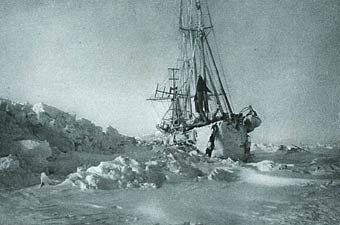
The "Fram" in the ice

The "Fram" in the ice (from Farthest North, volume II)

Nansen’s richly illustrated book, Farthest North; Being the Record of a Voyage of Exploration of the Ship “Fram” 1893-96 and of a Fifteen Months’ Sleigh Journey by Dr. Nansen and Lieut. Johansen, originally published in Norwegian in 1897, was translated into English the same year. In it, Nansen describes the inventiveness he used to organize such a mission with fairly limited means. The “Fram” had a number of interesting innovations. Its hull was specially designed to be lifted by the drifting ice, instead of being crushed; and the ship had a featured windmill, to provide electricity, and thus some bright electric light through the long polar night.

Volume I (Project Gutenberg ebook 30197) describes the planning phase, and how the “Fram” set out to sail as far North as it could, intentionally letting itself be captured by the ice, in an attempt to drift further North than any ship had reached before.

Volume II (Project Gutenberg ebook 34120) continues with the even more dare-devil attempt by Nansen and his companion Johanson to reach the North Pole on sledges pulled by dogs. During this trip, they killed their dogs one-by-one, feeding the weaker or exhausted ones to the remaining ones–the same, much criticized, method that brought Amundsen to the South Pole 16 years later. They reached the at that time record setting latitude of 86 degrees 15 minutes North before heading South again. During this trip South, they lost their remaining dogs, and were finally forced to build a hut and stop for the winter on Franz Josef Land, North of Spitsbergen. Here they survived by shooting over-curious ice-bears, and using them as food, until they were able to reach a small outpost built by the British explorer Jackson, just a few miles from where they survived the winter with so much hardship.

From here, the journey home proceeds smoothly, and the two explorers were rejoined with their crew who had survived another winter in the ice on the “Fram”, before being able to return home.

The "Fram" as it is today

The "Fram" as it is today, in the Fram Museum

The book is a pleasant read, and is illustrated with hundreds of photographs and drawings; including a number of color plates from pencil sketches made during the trip.

Nansen went on to become an influential statesman, with an important role for Norwegian independence, and an even more important role in saving millions of lives in Russia, Armenia, and Turkey with the High Commission for Refugees, for which he was awarded the Nobel peace prize in 1922.

After being the ship that reached the Northern-most latitude, the “Fram” also became the ship to reach the Southern-most latitude during Amundsens expedition to reach the South-Pole in 1911. Today, the “Fram” can still be visited: it has been pulled ashore in Oslo, and a museum, the Frammuseet, has been build around it. The visit will be even more impressive after reading this book, when, after short inspection of the cabins where these men have been living for three years, you realize some of the hardships they must have gone through. (This visit can easily be combined with a visit to the Norwegian Maritime Museum, the Kon-Tiki Museum, and the Viking Ship Museum, all located at walking distance from each other.)


The Show Goes On and On

November 6, 2010

Vaudeville was big entertainment in the U.S. during the late 19th and early 20th century. For one price you could buy a ticket and see a combination of singers, dancers, comedians, acrobats, etc.  Many of the entertainers went on to do movies, radio and TV such as The Marx Brothers, Charlie Chaplin, Sammy Davis, Jr., James Cagney, and Bing Crosby. However, so many of the lesser known acts have been lost forever.

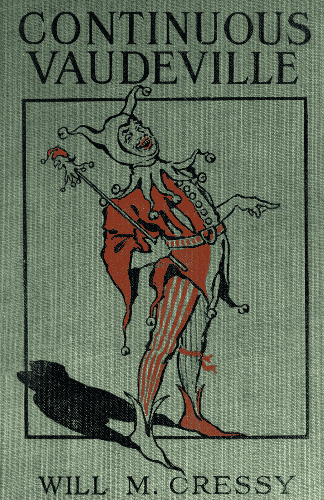
With Continuous Vaudeville, author Will M. Cressy gives the reader jokes and humorous stories. But they are jokes and stories about the performers, the acts, the staff of the theaters, and the audience. It is just a little peek into the world of vaudeville.

James J. Corbett was indulging in one of his semi-annual attacks of acting, and it came along to a place where the villain was to say—

“Then die, you dog,” and shoot Jim, who fell, wounded, to the floor.

Upon this occasion the villain spoke the line, pulled the trigger, and Jim fell. But the gun did not go off. Instantly Jim raised himself on his elbow and said in agonized tones—

“My God; shot with an air gun.”

He also gives tidbits from newspapers and things he has seen, and people he has met during his travels. At one point he has a list of actual signs that include:

Chicago. “I. D. Kay. Fresh Vegetables”

Oakland, Cal. “Dr. Muchmore, Dentist”

Paris, Ky. “Ice Cream & Washing Done Here.”

Spokane, Wash. “Bed Bath & Booze 15c. All Nations welcome but Carrie.”

Cressy certainly knew his subject. He was one part of the popular sketch comedy act, Cressy and Dayne. (Blanche Dayne was Cressy’s wife).

The illustrations were done by Hal Merritt. They are humorous in their own right and certainly fit the stories well.   Such as the illustration and story below:

The train had stopped at Reno for a few minutes; it was just at dusk and as the night was warm we got out and were walking up and down the platform. There was a billboard at the end of the station and the bill poster was pasting up some paper advertising the coming of “The Widow’s Mite” Company. An old chap came along, stopped and looked at it, but, owing to the poor light could not quite make out what it was; so he said to the bill poster,

“What show is it, Bill?”

“The Widow’s Mite.”

The old fellow pondered on it for a moment, then as he turned away he said, half to himself,

“Might? They do.”

We are lucky to have this opportunity to read the funny stories and learn about vaudeville at the same time. At one point, Cressy says:

I see there is an act playing in Vaudeville this year by the name of Doolittle & Steel. Make your own jokes.

Thanks to Continuous Vaudeville, we don’t have to come up with jokes. We can just enjoy.


Letters of a Lunatic

November 3, 2010

Letters of a Lunatic: A Brief Exposition of My University Life, During the Years 1853-54. The title says it all. The author was Professor George J. Adler, the date of publication was 1854, and the situation was reminescent of the old quote: “Even a paranoid can have enemies.”

Prof. Adler was a noted lexicographer of his time, made famous for his dictionary of the German and English languages. Until 1854, he was chair of German Language at the University of the City of New-York. In 1854, he was found insane and was committed to the Bloomingdale Insane Asylum, where he subsequently died. Letters of a Lunatic was a short tract written by him stating his side of the story of what happened.

My main object was of course to vindicate and defend my character, my professional honor and my most sacred rights as a rational man and as a public educator, against the invasions of narrow-minded and unjust aggressors, whose machinations have for several years been busily at work in subverting what other men have reared before them, in retarding and impeding what the intelligence of our age and country is eager to accelerate and to promote.

The tract includes letters from him to the head of his university, to the mayor of New York, and to others unnamed. In addition to that, there are: a letter supposedly from the head of his university, comments on some of the letters, and a section outlining the Law of Intellectual Freedom. Revealing are his comments that:

The scum of New-York in the shape of Negroes, Irishmen, Germans, &c., were hired, in well-organized gangs, to drop mysterious allusions and to offer me other insults in the street, (and thus I was daily forced to see and hear things in New-York, of which I had never dreamt before,) while a body of proselyting religionists were busy in their endeavors to make me a submissive tool of some ecclesiastical party or else to rob me of the last prospect of eating a respectable piece of bread and butter.

and that:

A night or week of such proceedings would be enough to set a man crazy. What must be their effect if they continue for months? And yet expressions like the following were perpetually ringing in my ears:—”Go on!” “You are the man!” “You are not the man!” “Go on! no, stop!” (by the same voice in the same breath.) “Out of the Institution with that man!” (by the laurelled valedictorian of last year.), “Stand up!” (by Prof. C——, close to my door.) “He started with nothing!” (by the same voice in the same place). “Pray!” (by ditto.) “You have finished!” “Go away!” “Thank God, that that man is out of the Institution!” (by a lady member of a certain religious fraternity, on terms of intimacy with a certain prominent politician of the neighborhood.) “Pursue him, worm that never d-i-e-s!” (theatrically shrieked by the same voice.) “You are a dead man! Dead, dead, dead, dead!” (by the voice of a certain popular preacher. ) “He is deceived, he is deceived!” (by the spokesman of a body of theological students in front of the neighboring Seminary, as I was passing.) And at times even: “Die!” “Break!” (on the supposition that I was in embarrassed circumstances.) “Whore!” even was one of the delectable cries! To these I should add the mysterious blowings of noses (both within sight and hearing,) frightfully significant coughs, horse-laughs, shouts and other methods of demonstration, such as striking the sidewalk in front of my windows with a cane, usually accompanied with some remark: “I understand that passage so!” for example.

There might have been a powerful conspiracy, or he might have been delusional, or both. No matter what was the truth, it was a fascinating read.


Dress as a Fine Art: With Suggestions on Children’s Dress. by Mrs. Merrifield.

October 30, 2010
This was first published in England in the London Art Journal and this book is an edition put together for publication in America in 1854. Mrs Merrifield is writing about clothing as more than just a covering to preserve modesty or protect us from the elements. I can’t put it better than she does, so here’s a quote from the book.

“In a state so highly civilized as that in which we live, the art of dress has become extremely complicated. That it is an art to set off our persons to the greatest advantage must be generally admitted, and we think it is one which, under certain conditions, may be studied by the most scrupulous. An art implies skill and dexterity in setting off or employing the gifts of nature to the greatest advantage, and we are surely not wrong in laying it down as a general principle, that every one may endeavor to set off or improve his or her personal appearance, provided that, in doing so, the party is guilty of no deception.

“… the rules of society require that to a certain extent we should adopt those forms of dress which are in common use, but our own judgment should be exercised in adapting these forms to our individual proportions, complexions, ages, and stations in society. …… Our persons change with our years; the child passes into youth, the youth into maturity, maturity changes into old age. Every period of life has its peculiar external characteristics, its pleasures, its pains, and its pursuits. The art of dress consists in properly adapting our clothing to these changes.”

Her aim is to give people guidance on the principles they should follow when deciding on what they should wear, so as not to look ridiculous.

“In the present essay, we propose to offer some general observations on form in dress. The subject is, however, both difficult and complicated, and as it is easier to condemn than to improve or perfect, we shall more frequently indicate what fashions should not be adopted, than recommend others to the patronage of our readers.”

Although it’s an admirable intention, sadly the passage of time has made it more likely you’ll laugh at what she says. She means what she says about condemning and doesn’t hold back!

Figure 25 from bookThere are chapters on head dresses and the idea of dress as a fine art and then separate chapters for the head, the dress and the feet. The remaining chapters are remarks on particular costumes, economy of ornamentation and thoughts on principles to bear in mind when considering children’s clothing. Mrs Merrifield doesn’t just talk about the dress of her day, but describes the development of fashions and styles through the ages, with comments on those things she considers good (and bad). This is backed up by 12 plates containing nearly 100 pictures illustrating what she’s talking about, so you can see what she’s describing.

I picked this book out to read because I’ve always been interested in how people lived in the past, including how they dressed, and thought it would be good to read (I was right). My travel to work includes a long train journey and I read this on my daily commute. My fellow travellers were looking at me a little disapprovingly because I was enjoying myself far too much for someone on their way to work. Mrs Merrifield was a lady of strong opinions and I laughed out loud at quite a bit of what she said–or rather how she said it. I think that even people who aren’t fascinated by the history of dress would like this book, just because of that.

On a more serious note, it’s always interesting to read something by a person who’s passionate about their subject, and there’s no doubt the author of this work cared greatly about what she saw as the problems caused by following the extremes of fashion. Not only crimes against style and good taste, but the health problems caused by certain things including wearing next to nothing in cold weather (which will ring a bell with anyone who’s seen groups of young women shivering in thin, short dresses in the middle of winter).

There are also things in here that are still relevant and interesting today. The distortion of the body to fit a fashionable ideal was something of which Mrs Merrifield disapproved profoundly–just look at the pointy toes and high heels in fashion at the moment (I have toes and knees that prove how bad for you those are!). She makes a good point–later confirmed by scientists–about the damage done by wearing corsets to give yourself a tiny waist.

She has clear views about what is suitable for women of different ages (she is writing particularly about women’s dress), how ugly some hats are, the tyranny of fashion. There are times when she sounds just like the middle aged and elderly people now who make disapproving comments about the fashions of the day. In particular, I’d better make the most of the couple of years I have left to wear bright colours and sleeveless tops.

“The French, whose taste in dress is so far in advance of our own, say, that ladies who are cinquante ans sonnés, should neither wear gay colors, nor dresses of slight materials, flowers, feathers, or much jewelry; that they should cover their hair, wear high dresses and long sleeves.”

Although we do still have quite firm ideas about what you should wear at different ages. How many of us haven’t looked at a middle aged person dressed like a 17 year old and made uncharitable comments to our friends? I know I’ve done it.

I think my favourite passage was this one, making me doubt that she knew any men (or that they lied to her about their reaction to a low neckline). She goes on to say that older ladies most certainly should not disply their ageing necks and shoulders as it is “disgusting”.

“It is singular that the practice of wearing dresses cut low round the bust should be limited to what is called full dress, and to the higher, and, except in this instance, the more refined classes. Is it to display a beautiful neck and shoulders? No; for in this case it would be confined to those who had beautiful necks and shoulders to display. Is it to obtain the admiration of the other sex? That cannot be; for we believe that men look upon this exposure with unmitigated distaste, and that they are inclined to doubt the modesty of those young ladies who make so profuse a display of their charms.

In summary–do give this book a try. Even if it’s just the unintentional comedy that a modern reader would get from strong opinions, firmly expressed it’s worthwhile. The surprisingly large number of comments that are still relevant are thought provoking and many can still be heard in some form or other today.

Enjoy!


Space, Time and Gravitation

October 27, 2010

According to Einstein’s general theory of relativity, first published in 1915, the phenomenon we experience as gravitation can be interpreted purely geometrically. Objects moving in the absence of external forces travel along “geodesics”, curves generalizing straight lines. However, in the presence of matter, the geometry of space-time is not Euclidean. Instead, nearby geodesics move closer together, similarly to longitude lines on the surface of the earth as one walks toward the north or south pole. Bodies moving along converging geodesics are, perforce, attracted to each other.

Eclipse Instruments at Sobral

Eclipse Instruments at Sobral

Among the predictions of general relativity is the bending of light by gravitation. In May 1919, Arthur Eddington led an expedition to the Isle of Principe in the Gulf of Guinea, West Africa. A companion expedition was sent to Sobral, in northern Brazil. A rare and timely astronomical coincidence was due to occur: a total solar eclipse as the sun passed through the Hyades, “an exceptional field of bright stars” in Eddington’s words. The expeditions’ goal was to photograph the deflection of starlight by the sun’s gravitational field. Newton’s law of gravitation also predicted deflection, but by an amount only half as great as Einstein’s prediction. The plates from Sobral showed, within bounds of experimental uncertainty, a greater deflection than predicted by Newtonian gravitation. Both sets of plates were entirely consistent with Einstein’s prediction. This initial experimental confirmation of general relativity catapulted Einstein to international fame.

Written in 1920, Eddington’s “Space, Time and Gravitation” is one of the first popular accounts of general relativity. The book begins with an imaginary conversation between a classical physicist, a pure mathematician, and a relativistic physicist who challenges the classical physicist (and therefore the reader) to reconsider the static, Galilean concepts of space and time. Chapter by chapter, using little more than the Pythagorean theorem, Eddington builds an ever-stronger case for the relativistic thesis: Space and time are not independent absolutes, but together comprise a single physical entity in which disparate physical ideas become unified.

The decades bracketing 1920 saw a dramatic shift in cosmology. In 1917, Einstein used general relativity to model the entire universe, introducing a “cosmological constant” in his field equations in order to obtain a static solution. In 1922, Alexander Friedmann found expanding solutions to Einstein’s original field equations (without a cosmological constant). By 1929, Edwin Hubble had discovered that distant galaxies were moving away from the earth at speeds proportional to their distance, an experimental suggestion that Friedmann’s model was closer to reality than Einstein’s. Eddington’s book predates these foundational discoveries, and even contains cosmological speculations that seem naive in retrospect. Despite this, the book remains a lively, accessible, and literate introduction to the rich geometric background underlying Einstein’s general theory of relativity.

This review was contributed by DP-volunteer adhere.


Bibliomania; or Book-Madness

October 23, 2010

What wild desires, what restless torments seize
The hapless man. who feels the book-disease….
—John Ferriar, The Bibliomania

bibliomania, n. A rage for collecting and possessing books.
Oxford English Dictionary

I’ve always been crazy about books — what DPer isn’t? — but I am decidedly not a bibliomaniac. A bibliomaniac isn’t a voracious reader; a bibliomaniac is a voracious collector, an obsessive-compulsive accumulator of books as objects, often without regard to content. The term “bibliomania” was popularized in 1809 by Dr. John Ferriar, a Manchester physician whose satiric poem, The Bibliomania, poked fun at book-hoarders who lived only to haunt book-auctions and spend their entire fortunes expanding their libraries beyond all reason. The poem was dedicated to English collector Richard Heber, who filled eight houses with his collection of over 150,000 books.

The Book Fool

The Book Fool

Inspired by Dr. Ferriar’s witty verse, Thomas Frognall Dibdin (1776-1847), bibliographer of the second Earl Spencer’s magnificent library, made his own playful study of the subject, also dedicated to Heber. Bibliomania; or Book-Madness was first published in 1809 and considerably expanded in 1811. Many editions followed, even after Dibdin’s death. The Project Gutenberg edition was created from a modern reprint of an 1876 edition that was itself a republication of Dibdin’s 1842 revised edition.

The popularity of Bibliomania did not lie in its text, which takes the form of a dialogue among several personable characters, dominated by Lysander (the voice of Dibdin), who expounds on the history of book-collecting mania through the ages. The true value of Bibliomania is, instead, in its extensive footnotes — far longer than the main text — which are filled with fascinating anecdotes about real-life bibliomaniacs, along with comprehensive catalogues of their collections and the prices the books fetched at auction after their owners’ deaths. There are chatty accounts, too, of the lives of noteworthy (and often eccentric) librarians and bibliographers.

Here, for example, we find John Leland, Henry VIII’s “antiquary and library-keeper,” who collected such a large number of manuscripts from the dissolution of the monasteries that he became deranged trying to catalogue them. We find also Antonio Magliabechi, the illiterate Florentine street urchin who rose to become the librarian for the Medici. Here are Thomas Bodley’s letters to the chancellors of Oxford University, proposing to build and stock a new library for his alma mater. And here is a Shakespeare First Folio of 1623, in the collection of one Martin Folkes, Esq., sold in 1756 for just 3l. 3s. — a paltry sum even then for such a priceless volume. In a discussion of Archbishop Cranmer’s English Bible, one can even find an itemized account of how much it cost to burn Cranmer at the stake (a little over 11 shillings).

Bibliomania is a rich and entertaining pageant of books and book-collectors, famous and obscure. DPers will be especially interested to find, in the catalogues, many books that they have worked on. Just be careful: It may not take much to turn a bibliophile into a bibliomaniac.

This post was contributed by Linda Cantoni, a Distributed Proofreaders volunteer.


Momotaro

October 20, 2010

Momotaro and retainers

In the same way that the classic fairy tale “Cinderella” has become part of Western culture, the fairy tale “Momotaro” has become ubiquitous in Japanese culture, with references to it cropping up in comic strips, movies, comedy shows, posters, anime, manga, advertisements, toys, and even government propaganda. There is even a Hello Kitty anime version of the tale available on DVD.

One illustrated telling of that story is Momotaro or Little Peachling, found in the Japanese Fairy Tale Series. This book tells the tale of an old couple that finds a peach, and from that peach pops up a little boy. They adopt him and he grows up strong and goes off to the island of the devils to take their riches. Joining him are three animals:

Then first a dog came to the side of the way and said; “Momotaro! What have you there hanging at your belt?” He replied: “I have some of the very best Japanese millet dumplings.” “Give me one and I will go with you,” said the dog. So Momotaro took a dumpling out of his pouch and gave it to the dog. Then a monkey came and got one the same way. A pheasant also came flying and said: “Give me a dumpling too, and I will go I along with you.” So all three went along with him.

There is a battle with a great multitude of the devil’s retainers, and then with the chief of the devils, called Akandoji. At the end Momotaro triumphs and returns to his adopted parents. There is a happy ending for everyone, except for the devils.

I had heard about the story for decades. This was the first time that I actually read it. Reading it as an adult, I had qualms about the legality of Momotaro’s actions. But then children don’t normally concern themselves with the property rights of devils.


Taxing the American Colonies

October 16, 2010

One of the follies listed in Barbara Tuchman’s The March of Folly: From Troy to Vietnam is “The British Lose America.” A major reason for this “folly” was the attempt to shift to the American colonies the burden of the high debts resulting from a recent war with France.

While, in hindsight, that attempt was “folly”; at the time, some thought it seemed like a good idea. That is shown in the political tract The Justice and Necessity of Taxing the American Colonies, Demonstrated Together with a Vindication of the Authority of Parliament, printed for J. Almon in London in 1766.

Americans are called insolent, undutiful, and disobedient. Addressing the colonies, the author states:

But let me tell thee that the money raised by the stamp act, being all necessary for paying the troops within thy own territories, must center wholly in thyself, and therefore cannot possibly drain thee of thy bullion.

It is true, this act will hinder thee from sucking out the blood of thy mother, and gorging thyself with the fruit of her labour. But at this thou oughtest not to repine, as experience assures us that the most certain method of rendering a body politick, as well as natural, wholesome and long-lived, is to preserve a due equilibrium between its different members; not to allow any part to rob another of its nourishment, but, when there is any danger, any probability of such a catastrophe, to make an immediate revulsion, for fear of an unnatural superfetation, or of the absolute ruin and destruction of the whole.

All countries, unaccustomed to taxes, are at first violently prepossessed against them, though the price, which they give for their liberty: like an ox untamed to the yoke, they show, at first, a very stubborn neck, but by degrees become docile, and yield a willing obedience. Scotland was very much averse to the tax on malt; but she is so far from being ruined by it, that it has only taught her to double her industry, and to supply, by labour, what she was obliged to give up to the necessities of the state. Can America be said to be poorer, to be more scanty of money than Scotland? No. What then follows? America must be taxed.

As to the claim by the Americans that they are not represented in parliament:

True; you are not; no more is one twentieth of the British nation; but they may, when they become freeholders, or burgesses: so may you; therefore complain not; for it is impossible to render any human institution absolutely perfect. Were the English animated by your spirit, they would overturn the constitution to-morrow.

Think of this as 18th century spin-doctoring. All in all, it was a good read. The book provides an interesting glimpse into that era.


Calculus Made Easy

October 13, 2010

The mathematical study of rates of change and total change, also known as “the differential and integral calculus”, has frightened generations of students. Ironically, this scholastic trauma is often unnecessary: Many formal rules of calculus are nearly trivial to carry out. The mathematical difficulties lie in understanding and using the rigorous logical framework of the calculus—what mathematicians nowadays term “elementary real analysis”—and in establishing the correctness of the formal manipulations and their connections with mathematical interpretations.

Sylvanus Phillips Thompson’s “Calculus Made Easy” gives cogent yet entertaining and irreverent explanations of these easy calculational rules. Justifications are conceptual, but beneficially simplified and intuitive. Popularized and later updated by the recreational mathematics author Martin Gardner, “Calculus Made Easy” has remained a widely-read introductory text for the past century.

With the appearance of Project Gutenberg’s public domain version on July 28, 2010, the second British edition of this classic, originally published in 1914, is freely available over the Internet. In its first weeks, the book has proved wildly popular for a mathematics text.

Thompson’s choice of material is both varied and selective. Most topics will be familiar to the modern student: Differentials as minute quantities; derivatives as relative rates of change; rules for differentiating sums, products, quotients, and compositions of functions; the geometric meaning of the first and second derivatives; finding maxima and minima; the natural exponential and logarithm functions; circular trig functions; partial derivatives; integration and antidifferentiation; the fundamental theorems; integration by parts, and by partial fractions; elementary differential equations, including exact first-order equations and d’Alembert’s solution of the one-dimensional wave equation.

If you’ve had unpleasant experiences with calculus, if your knowledge has grown rusty, or if you’ve simply never encountered this powerful and intriguing branch of mathematics, Thompson’s gem of a textbook should prove a pleasant, thought-provoking, and ultimately rewarding read.

This review was contributed by DP-volunteer adhere.


Come Out of the Kitchen

October 9, 2010

One of the joys of proofreading for Distributing Proofreaders is finding a book that keeps you proofreading beyond your daily goal because you want to find out what happens next. Come Out of the Kitchen by Alice Duer Miller was one such book. Even more fun was post-processing the book later on because then I got to read the whole book and I got to see the illustrations and photos that were missing during the proofreading phase.


Scene from Act I of the 1916 play


Apparently, this story first appeared in Harper’s Bazar in 1915. It was then made into a comedy by A. E. Thomas that became a hit on Broadway, opening on October 1916 at the Cohan Theatre and playing for 224 performances. The play starred Ruth Chatterton, who twenty years later played the selfish wife in William Wyler’s classic film Dodsworth.

The novel was published in 1916, with photos from the play and illustrations. Later, there was also a film version of Come Out of the Kitchen in 1919, and a 1925 musical called The Magnolia Lady (47 performances) with Ruth Chatterton and her newly-aquired husband (Ralph Forbes).

The story is of a rich young man from the North who rents a Revelly Hall in the South. One condition that he made in renting the mansion was that servants be provided. The servants that came with the house included “an excellent cook, a good butler, a rather inefficient housemaid, and a dangerous extra boy,” none of whom were what they appeared to be, as shown in this segment early in the book:

On her the eyes of her future employer had already been fixed since the door first opened, and it would be hardly possible to exaggerate the effect produced by her appearance. She might have stepped from a Mid-Victorian Keepsake, or Book of Beauty. She should have worn eternally a crinoline and a wreath of flowers; her soft gray-blue eyes, her little bowed mouth, her slim throat, should have been the subject of a perpetual steel engraving. She was small, and light of bone, and her hands, crossed upon her check apron (for she was in her working dress), were so little and soft that they seemed hardly capable of lifting a pot or kettle.

Mrs. Falkener expressed the general sentiment exactly when she gasped:

“And you are the cook?”

The cook, whose eyes had been decorously fixed upon the floor, now raised them, and sweeping one rapid glance across both her employer and the speaker, whispered discreetly:

“Yes, ma’am.”

“What is your name?”

And at this question a curious thing happened. The butler and Reed answered simultaneously. Only, the butler said “Jane,” and Reed, with equal conviction, said “Ellen.”

Ignoring this seeming contradiction, the cook fixed her dove-like glance on Mrs. Falkener and answered:

“My name is Jane-Ellen, ma’am.”

Add to this mix: an amorous real estate man, a lecherous lawyer (who wanted to get the cook fired so she would work for him), Mrs. Falkener (who wanted the cook fired because she was too beautiful to have around the man she wanted as a son-in-law), at least one hat, and a cat. The result was a nice, fun read.