Castes and Tribes of Southern India by Edgar Thurston

April 23, 2014

Image of front cover of bookBack in 1995-96, I lived in India for about one and a half years, with the initial idea of making a number of multimedia productions on Indian art, culture, and history, but ended up mostly working on Indian language dictionary databases….

One of the sources I encountered in India was the various multi-volume sets entitled “Castes and Tribes of…” for various regions, such as the Central Provinces, Bengal, The Punjab, and, one of the biggest sets, the seven volume work covering Southern India. All these books were put together at the behest of the British Government by officials and their Indian assistants in the late nineteenth and early twentieth century. There are even several volumes on “Criminal Tribes”. These sets describe, in its entire intricate detail, the mind-baffling complexity of Indian society a hundred years ago. A society that has been quickly changing and has already lost much of this complexity—sometimes for the better, but sometimes not—and is today changing at an even faster rate, losing much of its colourful diversity in the process.

For one of the multimedia productions, I proposed to digitize the entire set, and produce a CD “Castes and Tribes of India”, to make this massive piece of work available again. The project never made it.

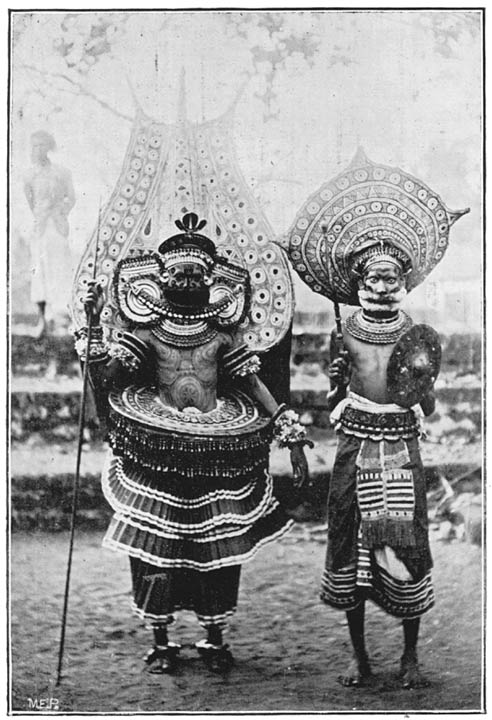
Image of Malayan Devil-Dancers (pl4-441)

Malayan Devil-Dancers

The books are of an encyclopedic nature. After a relatively short general introduction, they treat the castes and tribes in alphabetical order, in articles, that can sometimes just encompass a single paragraph, but sometimes as long enough to fill a monograph. For the time, many of these volumes are lavishly illustrated with photographs (The original set on the Central Provinces even used collotypes, a costly raster-free reproduction technique that preserves the sharpness and details of the original photographs). As the articles are written by various people, and often based on older publications or articles, the quality and scope of the articles varies somewhat, but in general, they give an interesting oversight of each caste or tribe described. Since the terms “caste” and “tribe” are used liberally, you can also find very interesting articles in those books on for example Anglo-Indians, Mar Thoma Christians, and Cochin Jews, and groups living in almost stone-age conditions such as the Irula, as well as the highly secluded Nambudiri Brahmins.

A few years after my return to Holland, in 1998, I managed to purchase an original 1909 copy of Thurston’s 7-volume set on Southern India, as well as reprints of many of the other sets, for digitization and inclusion in Project Gutenberg. At that time, I started scanning these volumes, but just as quickly stopped doing so, as I found out that the scanning would damage the costly volumes, and put the project on hold. I did continue with the (less costly) 4-volume facsimile reprint on the Central Provinces. Several years later, I purchased a scanner that would cause less damage to the books, and continued scanning, and shortly afterwards discovered that the scans were being added to the Internet Archive collection, so I no longer needed to scan the remaining volumes (except for a few missing pages). Anyway, starting from 2006, the projects appeared on the Distributed Proofreading site, slowly but steadily making their moves through the rounds, until, finally, the last volume left the rounds in 2011, and the huge task of post-processing this work started, which was complicated, due to the many words with accents, and the numerous tables in the books. Finally, on 21 June 2013, the entire set got posted on Project Gutenberg.

Almost 18 years after first envisioning this project, and 15 years after starting work on it, one of the biggest projects I’ve worked on for Project Gutenberg has come to a close. If somebody is interested, the original volumes are for sale (they won’t be cheap though). For the time being, I will leave the remaining sets to be picked up by other volunteers.

The 7 volumes of  Castes and Tribes and of Southern India are available here: I, II, III, IV, V, VI, VII.

The 4 volumes of The Tribes and Castes of the Central Provinces of India are available here: I, II, III, VI.


A Very Special 27,000th Title

March 29, 2014

27,000 titles

It’s time to celebrate another Distributed Proofreaders achievement—our 27,000th title posted to Project Gutenberg, Storia della decadenza e rovina dell’impero romano, an Italian translation of The History of the Decline and Fall of the Roman Empire, by the famed English historian Edward Gibbon (1737-1794).

Decline and Fall is a monumental work, distinguished not only by Gibbon’s outstanding scholarship, but also by his witty, ironic commentary and iconoclastic views of the events he describes. His theory of Rome’s decline and fall was essentially that her citizens had become spoiled by success. The most controversial part of his argument was that Christianity contributed to Rome’s fall by shifting people’s focus from real-life practicalities to a spiritual afterlife.

The Italian translation, by the noted Italian author Davide Bertolotti, is a 13-volume tour-de-force, published in Milan between 1820 and 1824. He based his translation on a 1791 London edition, which Bertolotti described as “ottima e sicura edizione” (“an excellent and trustworthy edition”), mentioned by Gibbon himself in his Memoirs. Bertolotti promised that, unlike a previous Italian translation, “Non una idea, non una parola importante, venne ad essa tolta, mutata od aggiunta” (“Not a single idea, not a single important word, was deleted, changed or added”). That might be a motto for what DP does.

Congratulazioni e grazie to the dedicated DP volunteers who made this milestone possible!

This post was contributed by Linda Cantoni, a Distributed Proofreaders volunteer.


Something to Do in the Meantime

March 5, 2014

While the Distributed Proofreaders website is down, you might like to check out some of the other books we’ve already posted to Project Gutenberg. One you may enjoy is a book I read recently, Poison Romance and Poison Mysteries by CJS Thompson.
Picture of book cover
This thoroughly enjoyable book, published in 1904, begins with an advertisement for the health-giving properties of Eno’s Fruit Salt and ends with an advert from a tea and coffee purveyor. I’m not sure they’d have been too happy at the association with poisons. It’s partly a history of poisons and poisoning and partly a titillating true-crime book, with a foray into criticism of the use of poison in fiction.

  • Enjoy the reviews (all recommended it, except for the Daily Mail, which was a bit sniffy about it)
  • Wonder at the story of poisons throughout human history
  • Thrill as you read the details of actual cases of poisoning
  • Gasp with astonishment at how easy it will be for you to poison someone after reading this book 1
  • Smile at the critique of the unrealistic use of poisons in fiction—even Shakespeare doesn’t escape censure
  • Ponder whether the advertisers knew their products were being advertised in a book about poison
1  Although I don’t think he realised he was writing a poisoner’s manual, and I don’t recommend experimenting. 😉

Interestingly, tobacco is included in the list of poisons, it seems that even in 1904, tobacco was considered harmful by some.

The habitual inhalation of tobacco smoke is undoubtedly harmful, but unless the smoke be intentionally inhaled, very little makes its way into the lungs.

Employed to excess, it enfeebles digestion, produces emaciation and general debility, and is often the beginning of serious nervous disorders.

But on the other hand

Be this as it may, the moderate smoking of tobacco has, in most cases, even beneficial results, and there appears little doubt that it acts as a solace and comfort to the poor as well as the rich. It soothes the restless, calms mental and corporeal inquietude, and produces a condition of repose without a corresponding reaction or after-effect. In adults, especially those liable to mental worry, and all brain workers, its action is often a boon, the only danger being in overstepping the boundary of moderation to excess.

Indeed, at the beginning of the 1600s, King James I is reported as describing smoking as

a custom loathsome to the eye, hatefull to the nose, harmfull to the brain, dangerous to the lungs; and in the black, stinking fume thereof, nearest resembling the horrible Stygian smoake of the pit that is bottomlesse

When criticising the fictional depiction of poison, the author’s worst strictures are reserved for

the lady novelist is the greatest sinner in this respect, and stranger poisons are evolved from her fertile brain than were ever known to man.

Real life poisoning cases are described and analysed, including various ladies who were accused of murdering their husbands and lovers, a doctor who murdered his brother in law, another who killed his wife and mother in law, the infamous Neill Cream who killed a number of young women, and a celebrated recent American murder case.

In recommending this book, I really can’t put it better than the reviewers did at the time.

The Saturday Review:—”A great deal of curious information concerning the history of poisons and poisonings.”

Illustrated London News:—”The story portions will attract most attention, and the poisoned gloves and rings of old romance supply satisfaction to that sensational instinct which is absent in hardly one of us.”

The Queen:—”Will fascinate most people. Is very readably written. Its only fault is that it is too short.”

Liverpool Courier:—”It is a readable book as well as an able one. The author is an eminent toxicologist and writes pleasantly on the lore connected with the science.”

The Scotsman:—”It is successful and interesting. Full of odd and startling information.”

Aberdeen Free Press:—”Fascinates the majority of his readers. One could wish that Mr. Thompson had written much more.”

Glasgow Citizen:—”A book of the week.”

Glasgow Herald:—”Light and eminently readable.”

My own review? A fascinating, entertaining book that should be on everybody’s ‘must read’ list.


Spinning-Wheel Stories

February 13, 2014

Some time ago I smooth-read Spinning-Wheel Stories, by Louisa May Alcott. What a fun book to read! I enjoy Alcott’s story-telling style, and her ability to inject small morals into stories without being too preachy most of the time. She has occasional lapses, as most authors do, but in general she is able to capture and hold my interest. This particular book is a collection of short stories, recited to amuse children who are visiting their grandmother over the Christmas holidays. The children are kept indoors by severe winter weather, and are slowly going stir-crazy. In an effort to amuse the children, Grandmother and Aunt Elinore tell them stories each evening.

One of my favorite little stories in this book is the incident where the children are romping in the attic, and they discover the old spinning wheel. Almost everything else in the attic is dusty and obviously has not been touched for a long time. But the spinning wheel is clean and there is still flax on the distaff. The children lug the spinning wheel down to where Grandmother is sitting next to the fire, and the girls ask her to teach them how to spin.

Grandma's Story

Grandma’s Story

A thrilling tale ensues, as the wheel goes round and round while Grandmother begins her story. There are wolves, a race, and much excitement in this story! And best of all, it’s a true tale of Grandmother’s life.

If I still had young children, I would love to read this book with them. The stories told here recount events from days long gone by: spinning wheels, big-wheel bicycles, young girls learning to cook, heroic Native Americans, and many others. I think youngsters today would probably enjoy the stories, given an opportunity to read them.


Funny Books

October 31, 2013

Recently I smooth-read two books for Distributed Proofreaders. Both were funny, and I thought others might enjoy them too.

The first book is titled Bizarre, and was written by Lawton Mackall. It’s a collection of humorous essays and observations on life in general. Among other things, there is a description of pockets that made me laugh out loud! Mr. Mackall wrote about advertisers, and embarrassing advertisements that would pop out at him when he was scanning magazines or papers at public newsstands. I think you’ll agree that not much has changed:

“In short, the race of endorsers, produced by the eugenics of advertising, is not subject to the ills that ordinary flesh is heir to. They are the heroes of the present age, deified, like Greek Orion, in the realms of “space”–long-legged, serene, divinely handsome. We, poor mortals, humbly try to imitate them, and lay our wealth at their shrines, as did the Ancients at the altars of their gods. Our Ceres is Aunt Jemima; our Mercury is Phoebe Snow; our Adonis is the Arrow Collar youth; our Venus is the Physical Culture lady; and our Romulus and Remus are the Gold Dust Twins.”

And another essay that made me laugh was the one about how a new wife should learn to take care of her husband. Makall wrote:

“_Feeding._–This is the most important problem a wife has to face. The husband must be made to feel that he is well fed. Otherwise he will not be contented and docile.

During the first week after marriage, when he is still quite infantile and tender to the point of mushiness, he may be fed from the hand or spoon. This method will be found especially satisfactory in cases where the husband shows symptoms of sickly sentimentality.

Throughout the entire first month he will be so demanding of care, so bewildered by the strange new world in which he finds himself, as to be barely able to maintain sanity; in short, he will be so soso that she will have to prepare all the food herself, or at least make him think she does.

But later a change of diet will be found necessary. He will demand scientifically prepared foods. If the change is managed in the right way, it can be accomplished with only slight upset to his disposition. Simply alter the feeding formula so that the total quantity is lessened and the proportion of sugar and burnt materials is increased. It will soon take effect. In a day or two he will say, with a worried look, “Darling, I’m afraid the cooking is too much for you.” And you know what he really means. After that the transition to avowedly professional cooking will be quite painless.”

If you enjoy chuckling at Life’s little oddities, I think you’ll enjoy Mr. Mackall’s book.

The second amusing book is one titled Funny Epitaphs, Collected by Arthur Wentworth Eaton. I have always enjoyed reading about epitaphs. I don’t know why; there’s just something about them that I find interesting and sometimes enjoyable. And I thoroughly enjoyed the epitaphs recorded there. Here’s one:

John Knott, of Sheffield, England:

Here lies a man that was Knott born,
His father was Knott before him,
He lived Knott, and did Knott die,
Yet underneath this stone doth lie.

I also saw a variation of one of my favorites, which reads:

Here lies the body
Of Jonathan Crowder.
He burst while drinking
A Seidlitz powder.
Called from this world
To his heavenly rest,
He should have waited
Till it effervesced!

There are many other amusing epitaphs recorded in this little book, as well as some that are more poignant than funny. I think it’s worth taking a peek at the book.

I hope you enjoy reading these books as much as I did. Laughter is, after all, the best medicine. Or so the proverbial “they” say!


Comic Insects—a fun way to celebrate 13 years of Distributed Proofreaders

October 1, 2013

Comic Insects

Yes, we have more than one reason to celebrate today! It’s been 13 years that Distributed Proofreaders opened its doors and started on its mission, and during those 13 years exactly 26,000 e-books have been uploaded to Project Gutenberg for all to enjoy. That’s an average of 2,000 books a year!

Comic Insects, the book chosen to mark the round 26,000, is just gorgeous: beautiful color plates about the creepy-crawlies accompanied by whimsical verses. There’s not that much more to say about it, go have a look yourself!

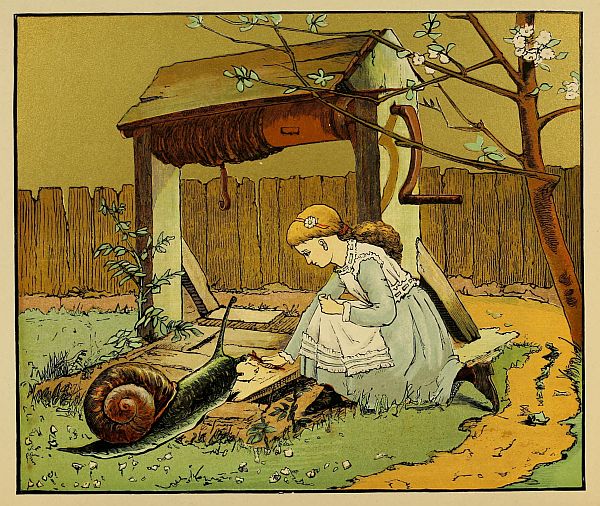
The Snail

The Snail

Poor little Snail,
How very pale,
Your cheek is blanched with fear!
What horrid dread
Has made you shed
So many a slimy tear?

Come! faster crawl
Along the wall,
Leave care behind,—all’s well!
That seeming pack
Upon your back
Is near an empty shell.

As always, this and all the other books couldn’t have been produced without the help of all the volunteers that have given their time to Distributed Proofreaders during those 13 years. Thank you all!


The Boy Craftsman by A. Neely Hall

May 14, 2013

I want to make a doll’s house. And a miniature theatre. And fireworks. And a desk and shelves. And … and….

I’ve been reading a book published over a hundred years ago that would never see the light of day in today’s risk-averse society. Back then, it seems, the best present you could get for your twelve year old boy was a small axe and a selection of sharp blades—together with dangerous chemicals and other toxic substances. It was a time when boys and girls had different pastimes and every boy carried a small folding knife with him.

The Boy Craftsman, subtitled Practical and Profitable Ideas for a Boy’s Leisure Hours, was one of a series of similar books, and it starts with things a boy can make to earn money. These range from household items such as a display rack for plates for the dining room, to snow ploughs and newspapers. It’s lavishly illustrated with diagrams, photographs and templates for some of the parts. The instructions for all the projects are very detailed and the whole thing is inspirational. The author was enthusiastic about his subject and he wrote in a clear style, because the book was aimed at children. Judging by the illustrations, the boys in question were in the 11-16 age range, so well able to undertake the projects in the book.

After money-making ideas, Mr Hall moves on to discuss outdoor activities, the list of chapters suggesting building up to leaving the poor boy stranded in the great outdoors. It seems he’s being taught to make a shelter, transport and then how to catch his own food.

How to build a log-cabin
How to build a canvas canoe
Home-made traps
Toy guns, targets, and bows and arrows

Log Cabin

Even though I know things were different then, it’s impossible to shake off my 21st century sensibilities. Every time the book mentions yet another sharp implement, or painting things with white lead (enamel paint is suggested as an alternative), I suffer a moment of shock that children were given these things. The basic tools for a workshop are listed as “A hatchet, hammer, saw, plane, chisel, jack-knife, bit and bit-stock, screw-driver, and square”.

And here’s a chapter you’d never find in a book for teenagers these days,

Work to do with a knife

There are instructions for maintaining and sharpening your tools, for developing photographs, for making a bow and arrow (including metal arrowheads), setting up your own printing press, for making animal traps of various kinds, for creating “safe” fireworks.

A toy pistol, that will fire a piece of cardboard has a piece of advice that I think would have been good to repeat later when making arrows. “It is advisable to keep this pistol out of range of your companions’ faces.

Really? You think?

Physical activity isn’t forgotten, an outdoor gymnasium is constructed with everything you could need in 1905—including a punching bag platform and a vaulting pole. Pole vaulting for children? Where are my smelling salts, I think the shock’s getting too much for me.

The final section is given over to indoor pastimes, the first of which is creating a miniature theatre complete with scenery, props and mechanical effects. If that doesn’t appeal, you could always make a toy railway or clockwork cars. I noted with amusement the advice to boys about to dismantle an old clockwork mechanism for cleaning.

Before taking a set of works apart, it is well to examine it carefully and note the positions of the various springs and wheels, so it will be possible to put them together again properly should you wish to do so. Without taking notice of this, you are likely to have a handful of wheels as a result, with which you can do nothing except perhaps convert them into tops.

Have you ever sat and watched as an impatient person takes a mechanism apart without looking and then sits scratching their head at the piece left over when they’ve reassembled it? Seems it’s not a new phenomenon.

I think one of the most amazing things about so many of the books I read, is that they still have relevance now. The basic techniques and tools here still hold good and I can think of worse things than undertaking some of these projects with older children. Just imagine the quality time spent together—because there’s no way we’d leave them unsupervised with these things nowadays. Some of the projects might need a little thought (the doll’s houses use a lot of cigar boxes, for which an alternative would need to be identified) and some are no longer possible (creating a dark room for developing photographs from glass plates).

On the whole though, here’s a wide range of creative and constructive projects of varying sizes that I think kids (and their parents) would still enjoy doing. Why not download this book and try one or two? Perhaps not the log cabin, though.

See you later—I’m off to see what my own workshop contains.


The Salem witchcraft, The planchette mystery, and Modern spiritualism

March 13, 2013

Some time ago I worked on a few pages of  The Salem witchcraft, The planchette mystery, and Modern spiritualism, a collection of articles reprinted by the Phrenological Journal.

It got me intrigued, so when I was notified the other week that it was available for smooth reading, I downloaded it.

The book contains three articles, as indicated in the title. The first article: The Salem Witchcraft, was what got me so intrigued back then. I had heard of the Salem witches, but never actually knew what happened there, so this was my chance to find out.

The article is a review of the work of Charles W. Upham. I think it is adequate to say that it is a summary of his work, although I am not (yet) familiar with his books.

The article neatly describes what happened in Salem in the 17th Century, tries to explain how and why things took the dreadful course they took. If you are curious to get the whole picture, you are in luck, because you can find Upham’s work on Project Gutenberg, too:

Salem witchcraft; with an account of Salem village and a history of opinions on witchcraft and kindred subjects. Volume 1 and 2

and

Salem Witchcraft and Cotton Mather

But back to the article: it certainly gives you a very good idea of the people, the circumstances and the goings on in Salem and surrounding areas. You can use it as an introduction to the Upham books, or as a good overview if you don’t have the time or inclination to go into too much detail. It certainly left me counting my lucky stars that I didn’t live there and then.

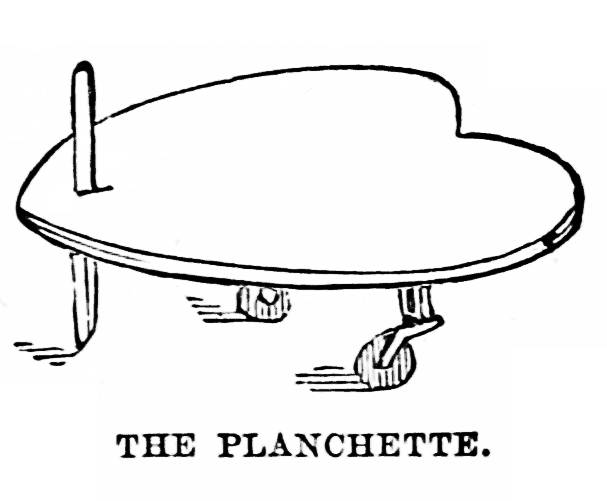
The Planchette

The planchette mystery had me in stitches. It was a welcome distraction after the Salem horrors.

The author tries to lift the mystery of the Planchette. If, like me, you don’t know what a Planchette is, you’ll be a lot wiser by the end of the article. I got to know where it got its name, what it does, even how to use it.

The author of the articles goes to great lengths to show the flaws in theories which don’t fit his conviction, demanding proof of them, while at the same time failing to give a single proof himself.

However, he lists lots of examples of the wondrous results when using a planchette. It must indeed be a tiny miracle. You can have a nearly philosophical discussion with it, and it will answer you (well, it answered the author) in intelligible sentences up to 300 words of length. Go figure. I want a planchette now.

The article about Modern Spiritualism, written by Harriet Beecher Stowe of  Uncle Tom’s Cabin fame, rounds the book off. Mrs Beecher Stowe is a devout Christian and as such has a word or two to say about spiritualism. She laments that the churches don’t go back to their roots and have no comfort to offer, thus involuntarily helping bereft people to search solace in spiritualism. She compares the beliefs and traditions of the primitive Christians of the beginning of Christianity with the Christians of the (her) present day and shows how spiritualism wouldn’t stand a chance if only people still knew that there were angels, Satan and miracles, as Jesus and the Apostles knew. Nobody would ever have to lament a beloved one who died because … but read for yourself.

At first, I thought it was an odd compilation of articles, but on second thoughts I realised the ingenuity of it.

You have one example for the horrors caused by overzealous Christians; one example glorifying phrenology and mesmerism, and one condemning spiritualism and promoting Christianity. All of the phenomena discussed in the book above have one common denominator:

They have no proof.


Mendelssohn in Italy

February 3, 2013

Sometimes we DP volunteers wonder whether anyone actually reads or uses the e-books we produce. After all, with most of the world’s best-known works already posted to Project Gutenberg, nowadays we tend to labor on the somewhat obscure.

Mendelssohn

Felix Mendelssohn in 1839

But the books we produce are being read and used every day, by readers, students, teachers, scholars, and even musicians. Here’s a real-life example: Last year, my husband, an orchestra conductor, asked me to put together some program notes for one of his concerts. His idea was to have me be a sort of narrator, reading the notes to the audience before each piece. One of the pieces was to be Felix Mendelssohn’s Symphony No. 4, the “Italian.”

Because the notes were to be given live, I wanted to make sure they’d be especially interesting to a general audience.

Technical details about the music were not going to do the trick. With the Italian Symphony, I was in luck twice over. First, in the course of my research, I learned that it had been inspired by Mendelssohn’s first trip to Italy in 1830, when he was just 21. Second, better yet, I remembered a book then in progress at DP and since posted to PG: the Letters of Felix Mendelssohn Bartholdy from Italy and Switzerland. I decided to take appropriate excerpts from the letters and read one before each movement of the symphony.

These exuberant letters to Mendelssohn’s parents, brother, and sisters back home in Berlin express the manifold wonders he experienced on his journey. The ruined glory of the Roman Forum and the Colosseum, the stunning loveliness of the hills, the romantic palazzi and canals of Venice, all spoke to his deepest sense of beauty.

Here is young Mendelssohn, newly arrived in Venice, eagerly writing to his parents on October 10, 1830:

Italy at last! And what I have all my life considered as the greatest possible felicity is now begun, and I am basking in it.

You can hear this youthful enthusiasm in the exciting opening bars of the Italian Symphony, which he began writing on this trip. As he wrote to his sister Fanny from Rome on February 22, 1831:

I have once more begun to compose with fresh vigour, and the Italian symphony makes rapid progress; it will be the most sportive piece I have yet composed, especially the last movement.

Except for the last movement, which is based on a lively Italian dance called the saltarello, there is nothing particularly Italian about the music itself. Rather, it evokes the impressions of an awestruck tourist, impressions he shared with his family in his letters home.

The stately tone of the symphony’s second movement is reflected in this letter to his parents, from Rome, November 8, 1830:

Just as Venice, with her past, reminded me of a vast monument: her crumbling modern palaces, and the perpetual remembrance of former splendour, causing sad and discordant sensations; so does the past of Rome suggest the impersonation of history; her monuments elevate the soul, inspiring solemn yet serene feelings, and it is a thought fraught with exultation that man is capable of producing creations, which, after the lapse of a thousand years, still renovate and animate others.

The third movement of the symphony, a graceful minuet, puts one in mind of Botticelli’s lovely painting, Primavera. It hangs in the Uffizi Gallery in Florence, where Mendelssohn immersed himself in the glories of Italian art, as he wrote to his sisters, June 25, 1831:

I have to-day passed the whole forenoon, from ten till three, in the gallery; it was glorious!… I wandered about among the pictures, feeling so much sympathy, and such kindly emotions in gazing at them. I now first thoroughly realized the great charm of a large collection of the highest works of art. You pass from one to the other, sitting and dreaming for an hour before some picture, and then on to the next…. I could not help meditating on all these great men, so long passed away from earth, though their whole inner soul is still displayed in such lustre to us, and to all the world.

The symphony’s rushing, leaping saltarello finale may have been inspired by something like the festival Mendelssohn saw in Florence, as he described it to his sisters on June 26, 1831:

It was Midsummer’s day, and a celebrated fête was to take place in Florence the same evening…. I heard a tumult, and looking out of the window I saw crowds, both young and old, all hurrying in their holiday costumes across the bridges. I followed them to the Corso, and then to the races; afterwards to the illuminated Pergola, and last of all to a masked ball in the Goldoni Theatre…. I recalled to myself the various occurrences of the day, and the thoughts that had chased each other through my mind, and resolved to write them all to you. It is in fact a reminiscence for myself, for it may not be so suggestive to you, but it will one day be of service to me, enabling me to recall various scenes connected with fair Italy.

It was indeed of service to him. The memories and inspirations of the trip, recorded in his letters, enabled him to finish the symphony quickly upon his return to Germany, and he himself conducted the premiere in London in 1833. Although he was never entirely happy with it, it deservedly remains one of the most popular works in the symphonic repertoire.

And, thanks to DP, the audience at my husband’s concert, hearing Mendelssohn’s own words accompany his music, cheered loud and long.

This post was contributed by Linda Cantoni, a Distributed Proofreaders volunteer.


Notes of Founding Fathers

January 14, 2013

In the recent electoral campaigns in America, and in the discussions occurring after the recent shootings, there has been much talk about what the Founding Fathers would have wanted. The implied premise was that the Founding Fathers were an homogenous group of men with a common consensus on what they believed and wanted for America. James Madison‘s notes of the Constitutional Convention indicates otherwise.

The proceedings of the Constitutional Convention were secret at the time, but Madison kept comprehensive notes. Others took notes too, but his notes are the most complete.

Madison bequeathed these notes to his wife, the government bought them for $30,000 in 1837, and three years later they were published in The Papers of James Madison Purchased by Order of Congress, edited by Henry D. Gilpin.

In 1908, these notes were reprinted in the two volumes of The Journal of the Debates in the Convention Which Framed The Constitution of the United States May-September, 1787, edited by Gaillard Hunt. Volume one covered the convention through July 18th, and volume two covered the rest of the convention. This work included not only Madison’s notes but also those of Robert Yates (delegate from New York), Rufus King (delegate from Massachusetts), and William Pierce (delegate from Georgia).

Pierce’s notes included sketches of the delegates, including the following:

Mr. Madison is a character who has long been in public life; and what is very remarkable every Person seems to acknowledge his greatness. He blends together the profound politician, with the Scholar. In the management of every great question he evidently took the lead in the Convention, and tho’ he cannot be called an Orator, he is a most agreeable, eloquent, and convincing Speaker. From a spirit of industry and application which he possesses in a most eminent degree, he always comes forward the best informed Man of any point in debate. The affairs of the United States, he perhaps, has the most correct knowledge of, of any Man in the Union. He has been twice a Member of Congress, and was always thought one of the ablest Members that ever sat in that Council. Mr. Maddison is about 37 years of age, a Gentleman of great modesty,—with a remarkable sweet temper. He is easy and unreserved among his acquaintance, and has a most agreeable style of conversation.

Mr. Yates is said to be an able Judge. He is a Man of great legal abilities, but not distinguished as an Orator. Some of his Enemies say he is an anti-federal Man, but I discovered no such disposition in him. He is about 45 years old, and enjoys a great share of health.

Mr King is a Man much distinguished for his eloquence and great parliamentary talents. He was educated in Massachusetts, and is said to have good classical as well as legal knowledge. He has served for three years in the Congress of the United States with great and deserved applause, and is at this time high in the confidence and approbation of his Country-men. This Gentleman is about thirty three years of age, about five feet ten inches high, well formed, an handsome face, with a strong expressive Eye, and a sweet high toned voice. In his public speaking there is something peculiarly strong and rich in his expression, clear, and convincing in his arguments, rapid and irresistible at times in his eloquence but he is not always equal. His action is natural, swimming, and graceful, but there is a rudeness of manner sometimes accompanying it. But take him tout en semble, he may with propriety be ranked among the luminaries of the present Age.

Dr. Franklin is well known to be the greatest phylosopher of the present age;—all the operations of nature he seems to understand,—the very heavens obey him, and the Clouds yield up their Lightning to be imprisoned in his rod. But what claim he has to the politician, posterity must determine. It is certain that he does not shine much in public Council,—he is no Speaker, nor does he seem to let politics engage his attention. He is, however, a most extraordinary Man, and he tells a story in a style more engaging than anything I ever heard. Let his Biographer finish his character. He is 82 years old, and possesses an activity of mind equal to a youth of 25 years of age.

What is most striking about reading these two volumes is the radical differences in thought among basically good men.

One major difference was what the delegates feared to be the biggest danger of abuse. Some thought that danger lay in the Executive, others the Legislature.

Some thought the Executive power should be lodged in three men because if the power was lodged in a single person, that person would be an elective king. Others thought that the Executive power should be lodged in a single person.

Some thought the Executive should serve one set term and be ineligible for reelection, and others thought the executive should serve “during good behavior”.

Some thought the Executive should be elected by the Legislature. Others thought the Executive should be elected through state conventions.

Dr. Franklin proposed that the Executive should receive no salary, stipend fee or reward whatsoever for services.

Some thought that the final power rested in the people through their state legislatures. Others thought the states should be eliminated and replaced by districts answerable to the Legislature.

Some thought that only people who owned land should be qualified to serve in the Legislature. Others thought that this qualification was a scheme of the landed against the monied interests, “whose aids may be essential in particular emergencies to the public safety.”

There was major controversy between having the Legislature based primarily upon population (which favoured the large states) and upon equal power for each state (which favoured the small states). There was even controversy about whether or not the power of the current Atlantic states should be protected from Western states that would be added later. George Clymer thought “the encouragement of the Western Country was suicide on the old States.”

This controversy between large states and small paled in comparison to the controversy on the issue of slavery. That difference almost scuttled the convention.

Gouverneur Morris called domestic slavery “a nefarious institution,” “the curse of heaven on the States where it prevailed.”

Charles Pinkney warned that if the Committee should fail to insert some security to the Southern States against an emancipation of slaves he would have to vote against the plan.

In a way, the issue of slavery could have been a deal breaker. The Southern states did not get security that slaves would never be emancipated, but they did get enough political power (e.g., slaves being partly counted in determining the number of representatives) that they prevented emancipation for almost eighty years.

Some of these differences among our Founding Fathers were minor but many were major, and they all debunk the myth that they were an homogenous group of men with a common consensus on what they believed and wanted for America.