Because We Remember

November 11, 2014

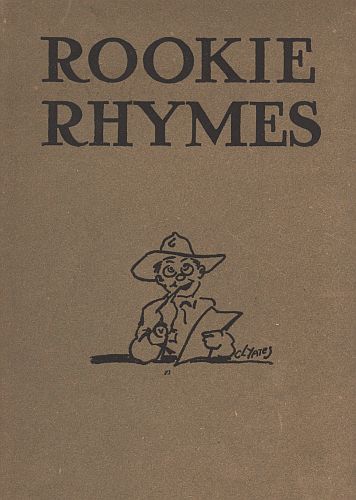
Rookie Rhymes cover

At Distributed Proofreaders we are all about preserving history. We believe in saving the classic, the good, the dry, the funny, and even the bad. A few years ago, it was my honor to pick up Rookie Rhymes to post-process for Veteran’s Day.

Written by The Men of the 1st. and 2nd. Provisional Training Regiments, Plattsburg, New York, May 15—August 15 1917, it is a short book. Some of these poems and songs are funny:

STANDING IN LINE

When I applied for Plattsburg I stood for hours in line
To get a piece of paper which they said I had to sign;
When I had signed I stood in line (and my, that line was slow!)
And asked them what to do with it; they said they didn’t know.

And when I came to Plattsburg I had to stand in line,
To get a Requisition, from five o’clock till nine;
I stood in line till night for the Captain to endorse it;
But the Q. M. had one leggin’ left; I used it for a corset.

We stand in line for hours to get an issue for the squad;
We stand in line for hours and hours to use the cleaning-rod;
And hours and hours and hours and hours to sign the roll for pay;
And walk for miles in double files on Inoculation day.

Oh, Heaven is a happy place, its streets are passing fair,
And when they start to call the roll up yonder I’ll be there;
But when they start to call that roll I certainly will resign
If some Reserve Archangel tries to make me stand in line.

They are poignant:

GO!

Your lips say “Go!”
Eyes plead “Stay!”
Your voice so low
Faints away
To nothing, dear—
God keep me here!

God end the war,
And let us two
Travel far
On Love’s road, you
And I in peace,
Never to cease.

Your lips say “Go!”
Eyes plead “Stay”—
Ah, how I know
What price you pay.

and

EUREKA

It may be from hot Tallahassee,
It may be from cold northern Nome,
But there’s nothing that can be compared with
That BIG little letter from home.

They are even dark at times, with a glimpse of the blackness of war, with temptations such as desertion found in “The Ballad of Montmorency Gray,” and far worse found in “The Three,” and falling beneath what you know is right. (But he doesn’t.)

These men opened their notebooks and let the rest of the world see their thoughts, their fears, and their strength. Because of men and women like these, most of us do not have to face these same fears. So, thank you men of the Regiment, thank you those who are willing to stand, thank you for facing your fears so that I can whine about the cost of eggs, the weather, and kiss those I love goodnight every night. We remember.

This post was contributed by a DP volunteer.


Wilson’s Tales of the Borders and of Scotland

October 22, 2014

Wilson's Tales

Distributed Proofreaders has posted the last of the 24 volumes of Wilson’s Tales of the Borders and of Scotland: Historical, Traditionary, and Imaginative. The original 66 stories were collected by John MacKay Wilson (1804-1835). He began publishing them weekly in 1834 as editor of the “Berwick Advertisor.” His unexpected death at age 31 the following year left a widow with an inadequate income. The executors of the estate and friends of the family then gathered a further 233 tales, which were published for her support. Alexander Leighton, one of the major contributors of stories, published the collection in the 24-volume set which is now complete at Project Gutenberg.

The short stories of these collections paint vivid pictures of life in the Borders — deaths and marriages, shipwrecks and celebrations, the ordinary and extra-ordinary events in the lives of people living on the edge of both Scotland and England. These details and more about the tales and the editors of the collections can be found at The Wilson’s Tales Project.

Hundreds of Distributed Proofreaders volunteers collaborated for over ten years to ensure the wide availability of these delightful and historical tales. The first volume was posted in February of 2004, and the last in September of 2014. There were several challenges facing the DP team in their effort to accurately render the tales as the editors intended. In addition to period spelling and grammar, the tales are full of words from the local dialect and dialogue modified to help the reader hear the border speech patterns. These contribute significantly both to the charm and the historicity of the tales, but also caused thousands of words in each volume to fail traditional spell-checkers and to need verification, sometimes with research. Congratulations to the Distributed Proofreaders team, who have continued the work of Mr. Wilson to preserve these stories for future generations to enjoy.

This post was contributed by a DP volunteer who worked on Wilson’s Tales.


Typesetting

October 8, 2014

Typesetting is a topic close to the hearts of many DPers, and the foundation on which the books we work on were built.

I learnt typewriting on a manual typewriter when I was at school. A classmate secured a job as an editor with a magazine based on the skills she learnt in the course we were doing. I was so envious! Editor on a magazine, with no work experience, and no qualification. A few years earlier, when asked by a teacher what I wanted to be, I replied I wanted to be a journalist, not because I wanted to be a writer, but because I wanted to work on newspapers, with those monstrous printing presses and the glorious smell of ink, and fiddly bits of lead.

I did manage to become a journalist and editor, but the huge presses were ageing, and typesetting was becoming regarded as no more than wordprocessing on a computer. I remember being chastised for the miles of galley paper that spewed out of the printer one time when I forgot to close off the heading command properly and ended up with a whole article in 72-point Times, a somewhat expensive mistake as rolls of galley proof paper were not cheap.

setting type

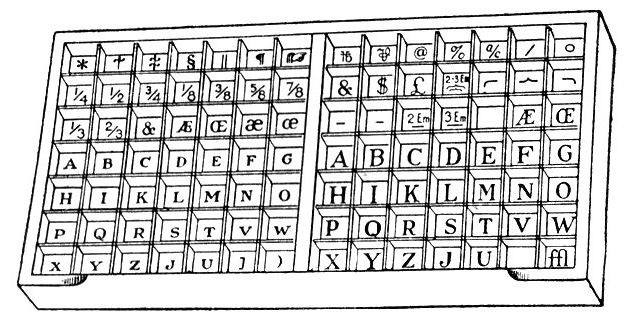
Working on the book, Typesetting, by A. A. Stewart, for Project Gutenberg, I couldn’t help but reflect and wish I could have been an apprentice hand compositor and daydream about what the publishing industry must have been like when each character had to be manually placed in the composing stick; when the characters of each font were housed in separate type cases; when measurements for line lengths, page sizes, and margins, had to be mentally calculated quickly and accurately; when justification of lines was achieved by manually placing a mix of different space widths characters (and even resorting to “pieces of paper or thin card” if metal thin spaces were not at hand).

type case

Imagine being able to set type and be able to read the text upside down; to have the dexterity to take a piece of type from the case and place it in the case; to proofread the lines of type and correct mistakes before justifying the lines.

upside down

How arduous the correction process, where “Simple errors like the exchanging of one type for another of the same width, the turning of an inverted character, or the transposition of letters or words, are corrected by pressing the line at both ends to lift it up about one-third of its height and picking out the wrong types with the finger and thumb. The line is then dropped in place and the right types put in.”

Not to mention having to wash the type and placing each character back into the proper slots in the proper cases, so that the type pieces could be used over and over.

Sitting at my computer, selecting fonts, messing about with HTML and CSS coding, I still want to be an apprentice hand compositor. “Typesetting, a primer of information about working at the case, justifying, spacing, correcting, making-up, and other operations employed in setting type by hand”, is an excellent training manual that gives me an insight into what I would have been doing had I been able to achieve my dream.

This post was contributed by a DP volunteer.


Wednesday the Tenth: A Tale of the South Pacific by Grant Allen

September 10, 2014

Picture of Book Cover

I wanted to tell you about an excellent adventure story, published in 1890, that I read recently.

The book is Wednesday the Tenth: A Tale of the South Pacific by Grant Allen. To be honest, I picked it up because it was short and I wanted something that would be easier and quicker to read than my usual fare. I’m glad I did, though, because it was an exciting and suspenseful tale that had me enthralled to the end.

It starts with a rescue, when two boys in an open rowboat are discovered in the middle of the Pacific Ocean by a steam yacht plying its trade among the islands (yes, I know that’s a sailing boat on the cover, but it is definitely a steam vessel in the book). They are the children of missionaries and they tell a harrowing tale of slave traders who get the locals drunk and rouse them up against the family, after the father thwarts the slave traders’ attempts to get the locals to sell people to them.

The family are taken prisoner and held by the locals who plan to kill them—and then eat them. The boys manage to escape and set to sea in the rowboat, in the hope of finding help.

In this excerpt, the boys have just been picked up by the yacht and the crew have given them a small amount of food and water (not too much as they are literally starving). The older boy is already lying unconscious on a bunk and the younger is about to follow him, but manages to utter a few words:

“Steer for Makilolo … Island of Tanaki … Wednesday the tenth … Natives will murder them … My mother—my father—Calvin—and Miriam.”

Then it was evident he could not say another word. He sank back on the pillow breathless and exhausted. The color faded from his cheek once more as he fell into his place. I poured another spoonful of brandy down his parched throat. In three minutes more he was sleeping peacefully, with long even breath, like one who hadn’t slept for nights before on the tossing ocean.

I looked at Jim and bit my lips hard. “This is indeed a fix,” I cried, utterly nonplussed. “Where on earth, I should like to know, is this island of Tanaki!”

“Don’t know,” said Jim. “But wherever it is, we’ve got to get there.”

Wednesday the tenth of the month is when the sacrifice is scheduled to happen. The boys are convinced it’s Friday, but the sailors on the yacht are equally convinced it’s Saturday. Even so, the yacht’s captain gives orders to make for the island at full speed, sure they’ll make it in time.

Now, obviously, all doesn’t go as smoothly as anticipated or there wouldn’t be a book to read. As they get close to their destination they run aground on a reef that isn’t where the charts say it should be.

… Jim, looking up from in front, with a cool face as usual, called out at the top of his voice, but with considerable annoyance, “By Jove, we’re aground again!”

And so we were, this time with a vengeance.

“Back her,” I called out, “back her hard, Jenkins!” and they backed her as hard as the engines could spurt; but nothing came of it. We were jammed on the reef about as tight as a ship could stick, and no power on earth could ever have got us off till the tide rose again.

Well, we tried our very hardest, reversing engines first, and then putting them forward again to see if we could run through it by main force; but it was all in vain. Aground we were, and aground we must remain till there was depth of water enough on the reef to float us.

They get off the reef, but the yacht’s damaged, and they’re running out of time. Between engine troubles, the tide and a contrary wind will they make it before the missionaries are killed and eaten?

You’ll have to read it yourself to find out.


Across America by Motor-Cycle

August 21, 2014

I proofed a lot of Across America by Motor-Cycle, by C.K. Shepherd, but from time to time other pesky proofreaders would grab some pages, so I was happy when it was posted to Project Gutenberg and I could at last read the entire book.  The author was an Englishman who decided just after World War I to ride “across America by motor-cycle,” going from New York to San Francisco. Not something that would raise too many eyebrows these days, but back then there were very few paved roads. “Ninety-five per cent. or more, however, of America’s highways are dirt roads, or what they are pleased to call ‘Natural Gravel.’ In many cases they comprise merely a much worn trail, and as often as not a pair of ruts worn in the prairie. Very often, instead of being a single pair of ruts, there are five or six or perhaps ten, where individual cars have manifested their own personality. When this multiplicity of ruts crosses and re-crosses in a desperate attempt to achieve the survival of the fittest, the resultant effect on the poor motor-cyclist is somewhat disconcerting.”

Things aren’t much better in the cities: “I have seen places in Broadway where the tram-lines wander six or seven inches above the surface of the road and where the pot-holes would accommodate comfortably quite a family of dead dogs within their depths.”

“There are two classes of roads and two only. They are good roads and bad roads. Any road, anywhere, in the whole of the United States of America (and, I presume, her Colonies as well) is a ‘good’ road if you can ‘get through.’ The remainder are bad.”

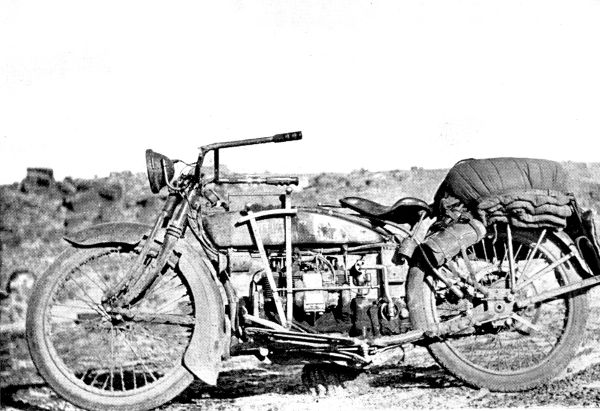
Lizzie

“Lizzie” in the Petrified Forest, Arizona

Of course these roads were a little rough on his motor-cycle (nicknamed “Lizzie”). He bought it new in New York: “The machine was entirely overhauled on four occasions between the Atlantic and the Pacific, and on three of these by the recognized agents of the manufacturers. The engine cut-out switch was the only part of the machine that did not break, come loose, or go wrong sooner or later. I was thrown off 142 times, and after that I stopped counting! Apart from that I had no trouble.”

Protective gear? “I dispensed entirely with the use of goggles from beginning to end, and except at stops in large towns on the way I wore no hat.” No, they hadn’t heard of helmets back then!

The book describes his journey across country, and makes very entertaining reading, although the author does state, “The journey was comparatively uneventful. I never had to shoot anybody and nobody shot me! In spite of the relative wildness and barrenness of the West, there were always food and petrol available in plenty. I spent most nights at the side of the road and experienced neither rheumatism nor rattlesnakes.”

This post was contributed by rpc, a DP volunteer.


Celebrating 28,000 Titles

August 16, 2014

Celebrating 28.000 titles posted to Project Gutenberg by Distributed Proofreaders.

Distributed Proofreaders has posted its 28,000th title to Project Gutenberg, The Mystery of Choice, an 1897 collection of short stories by Robert W. Chambers.

Thy Mystery of Choice - CoverChambers, who was born in Brooklyn, New York, began his career as an artist, and spent his early twenties in Paris, where his work was exhibited at the 1889 Salon. He came back to New York and found work as a magazine illustrator, but soon turned his hand to writing. He had his first and best success with The King in Yellow, a collection of supernatural tales that is said to have influenced H.P. Lovecraft and other noted writers of the horror genre.

The Mystery of Choice continues the horror theme with seven tales of murder and the macabre, some set in the atmospheric Brittany region of France. The collection also contains some of Chambers’s poetry, and concludes with a florid love-poem, “Envoi.”

Congratulations to the Distributed Proofreaders team who made this milestone possible!

This post was contributed by Linda Cantoni, a Distributed Proofreaders volunteer.


Invaders from the Infinite

August 7, 2014

On May 14, 2014, my adventure into a renewed interest in science fiction began. A Distributed Proofreaders volunteer had started a forum thread that requested information about the title of a science fiction book about dog-like invaders of earth. He could not remember the title of the book. Now, I forget titles too, especially to old songs and books of ancient (well, 30 to 50 years ago) fame. I guess this happens to other people too, because there were several posts from people who tried to help. Finally another volunteer answered with a post saying to try Invaders from the Infinite, by John Campbell. The first volunteer answered that it wasn’t the right book, but that he was adding it to his reading list. That settled it: if the book was good enough for them, it was certainly good enough for me.

Invaders cover

The adventure began. I downloaded the book in Kindle form and put it on my Kindle on May 25, 2014. By May 27, I had read it; and in it I traveled from earth to the far end of the galaxy, and then beyond the present universe as we know it to a distant, far distant place of huge suns and planets.

The story begins innocently enough. An earth-guard space ship is approached by an alien ship whose occupants are telepathic creatures who have evolved from a canine race. They gather information from the pilot about earth and streak on to New York City. There they meet the trio of Arcot, Morey, and Wade, who happen to have a research ship that can also be made into a first-class fighting vessel. It turns out that the world of the telepathic people is being attacked by aliens who also have the location of earth and another world in its war plans. Can earth help? And instead of waiting for the politicians to OK an expedition, the Triumvirate decides to go themselves.

The planet of the telepathic people is preparing for war with the only weapon they have. Arcot and his companions help to improve the weapon and duplicate it, so that they can leave the world to help other planets and search for more weapons with which to fight an almost invincible enemy who seems intent on eliminating all intelligent life other than their own. Their adventure takes them to the far corners of the galaxy and immerses them in a dirty war, which forces them to develop their own weapons to a point where they can build a new and more powerful ship that can harness the energy of the universe.

Invaders from the Infinite was released to Project Gutenberg on December 20, 2006, as e-book #20154. I would recommend the book to anyone with an interest in physics, cosmology, or just science fiction.

This post was contributed by Quentin Johnson, a DP volunteer.


Novanglus and Massachusettensis

July 4, 2014

Many people have a vague idea that the battle for American independence from Great Britain began with the Declaration of Independence on July 4, 1776. But the battle really began much earlier—almost a decade earlier, when American colonists first began protesting “taxation without representation” in the British Parliament. Unrest turned to violence in 1770, when a crowd of angry Boston colonists surrounded a group of British soldiers, who fired into the crowd and killed three people in what became known as the Boston Massacre. In 1773 came the Boston Tea Party, during which saboteurs dressed as Mohawks dumped over 300 chests of British tea into Boston Harbor. Punishment was swift: the British government closed Boston Harbor and passed the “Intolerable Acts,” which, among other things, stripped the Massachusetts Bay Colony of its right to self-government.

The battle wasn’t just waged in the streets or in the harbor. A bitter war of words erupted among the intellectual elite of the colonies, who were split in their opinions of Parliament’s actions. Among the combatants was a feisty Boston lawyer named John Adams (1735-1826), a future Founding Father and President of the United States. Adams, ironically, represented several of the British soldiers involved in the Boston Massacre, and his strong self-defense arguments resulted in acquittals. But Adams was no less of a patriot for that. He simply understood how important it was for the American cause to ensure that the soldiers had a fair trial.

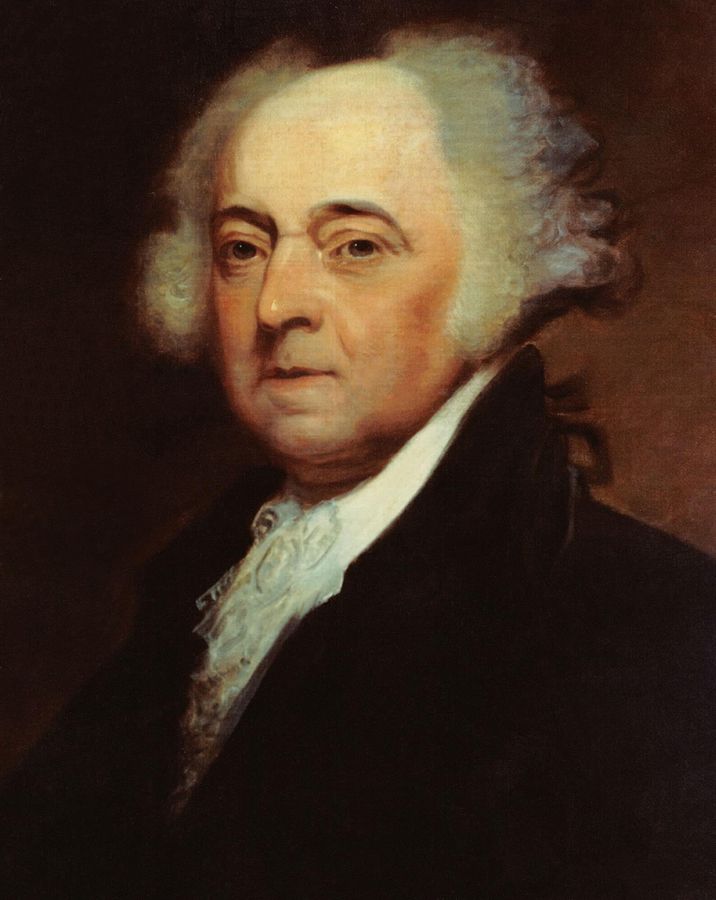
Adams

John Adams

A few years later, as American-British relations deteriorated, Adams employed his brilliant legal skills to respond to a series of pro-British letters, by someone calling himself “Massachusettensis,” published in a Loyalist Boston newspaper beginning in December 1774. Writing as “Novanglus,” Adams set forth his argument that the colonies were not answerable to the British Parliament.  In 1819, these letters were collected in a volume entitled Novanglus, and Massachusettensis; or Political Essays, Published in the Years 1774 and 1775, on the Principal Points of Controversy, between Great Britain and Her Colonies. The edition that DP volunteers used to prepare the Project Gutenberg e-book was the presentation copy to John Adams from the printers.

In 1775—more than a year before the Declaration of Independence—Adams was not yet arguing for independence from Britain; he expressly disclaimed such a treasonous view. Instead, he stuck to the more subtle argument that the colonies might be subject to the will of the Crown, but they were not subject to Parliament, because they were self-governing. He argued extensively from British statutes and cases involving the similar status of Ireland and Wales.

Adams’s arguments were brilliant, but his opponent “Massachusettensis” was every bit a match for him, arguing his Loyalist views with equal vigor and skill.  Indeed, because “Massachusettensis” was the better writer, his arguments can seem more compelling than Adams’s “huge pile of learning,” as “Massachusettensis” sneeringly called Adams’s scholarly legal citations.

The exchange between “Novanglus” and “Massachusettensis” came to an abrupt halt in April, 1775, with the Battles of Lexington and Concord. The revolution had begun, and there was no going back.

The 1819 edition identifies “Massachusettensis” as Adams’s onetime friend Jonathan Sewall, the last King’s Attorney General for Massachusetts, and Adams himself long believed it was Sewall. But “Massachusettensis” was actually Taunton lawyer and Loyalist Daniel Leonard, another friend from whom Adams later became irrevocably estranged in the turmoil of the Revolution. Leonard was forced to flee America when the British evacuated Boston in 1776; he later became chief justice of Bermuda and then retired to London. When the letters were published in London in 1822, he revealed himself to be “Massachusettensis.”

The 1819 edition of Novanglus, and Massachusettensis also features letters that Adams wrote to various friends and colleagues later in life, recounting the events leading up to the American Revolution. John Adams died on July 4, 1826, at the age of 90. His last words were said to be, “Thomas Jefferson survives”—but the author of the Declaration of Independence had also passed away that very day.

Today, July 4, 2014, is the 238th anniversary of American independence.

This post was contributed by Linda Cantoni, a Distributed Proofreaders volunteer.


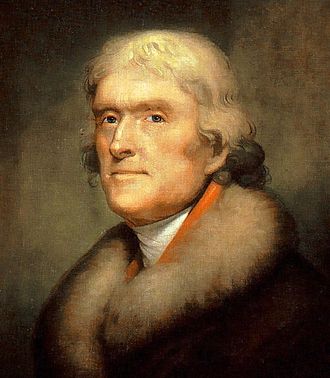
Thomas Jefferson’s Writings

May 26, 2014

I recently did a partial smooth-read of a book with a weighty title: The Writings of Thomas Jefferson: Being His Autobiography, Correspondence, Reports, Messages, Addresses, and Other Writings, Official and Private. Volume 1.

Jefferson

I have long been interested in Thomas Jefferson’s writings. Of course, we all know him as the author of the American Declaration of Independence. (Well, most of us know that; I’m not sure this is still taught in public schools in the United States.) So, to have the opportunity to smooth-read Volume One of this work was something I considered a privilege.

Several years ago, I smooth-read some of the diplomatic correspondence that was written during the Revolutionary War. Thomas Jefferson’s perspective on the problems American diplomats faced during the Revolution gave me new insight into this time in the history of the U.S. Of course, European countries had grave doubts about supporting the upstart Colonies. The struggles that American representatives endured while trying to convince European countries to support the Colonies’ need to separate from Great Britain are fascinating to read about.

I learned a great deal about the early movement toward the Revolution, and about how the Declaration of Independence arrived in its final form. Most people today think that Thomas Jefferson was in favor of slavery. He was not, and fully intended to free his own slaves. He included a scathing denunciation of slavery in the original draft of the Declaration of Independence, including pointing out how Great Britain was heavily engaged in the slave trade. But other statesmen would not allow this denunciation to remain in the final edition of the Declaration.

In this book, some of the correspondence is from the days before T.J. was famous. He was just a young man studying law, and engaged in romances with several different young women. Much of the early correspondence included in this volume has to do with his pursuit of one or two special young women. He teased his fellow students about their romantic problems, and I thoroughly enjoyed the glimpse into the younger T.J.’s life. He must have been an interesting companion!

Jefferson's signature

I wish that I had been able to read the entire volume. I look forward to the time that Volume 2 enters the Smooth-reading Pool, and I fully intend to read it.

My husband owns a 6-volume biography of Thomas Jefferson, written by Dumas Malone. Dr. Malone had access to the original documents that are in the Library of Congress, when he wrote his biography. I’m thrilled that I’m getting to read the same documentation, although in digital form, as was used to write the definitive biography of Thomas Jefferson.


A Diplomat in Japan: A British view of the Meiji Restoration

May 3, 2014

Every country has at least one historical era that forms the basis of much of its books, film, and television. The United States has the Wild West, and Japan has the Meiji Restoration.

The Meiji Restoration has the makings of great drama. Sparked by Commodore Perry’s opening of Japan, there was dramatic conflict between the Southern Coalition demanding the expulsion of “the barbarians” from Japan, and the Tokugawa Shogunate trying to placate everybody. In that conflict were lies and intrigue; plots, conspiracies, and assassinations; masterless samurai and royalty; and crimes of passion and honor.

There was also a story-book hero: Saigo Takamori. While he helped overthrow the Shogunate and form a modern government, he then led a rebellion against that government when it threatened the samurai class. He came to symbolize a romanticized samurai culture, and the Tom Cruise movie “The Last Samurai” presented a fictionalized version of his story.

Most of the stories about the Meiji Restoration focus on the internal conflict within Japan. The foreigners were mainly treated like secondary characters whose function was comical relief. In woodblock prints, foreigners were represented by grotesque caricatures of ape-like creatures with large noses and red cheeks.

After decades of knowing the story from the Japanese point of view, it was interesting to read A Diplomat in Japan, a recollection of incidents from the viewpoint of the secretary of the British legation in Tokyo. This story is told many years later, in 1903, after Ernest Satow became Sir Ernest.

Sir Ernest based his account upon diaries and letters written at the time of the events described. He did not rely on his memory of what happened decades before. For that I commend him.

In one instance, he wrote:

“My diary contains no further entry until the middle of May, and letters I wrote to my parents narrating the incidents which befel us at Kiôto have not been preserved.”

He states the foreign community has been described by an English diplomat as “the scum of Europe,” but said:

 “No doubt there was a fair sprinkling of men who, suddenly relieved from the restraints which social opinion places upon their class at home, and exposed to the temptations of Eastern life, did not conduct themselves with the strict propriety of students at a theological college. That they were really worse than their co-equals elsewhere is unlikely.”

Describing Yokohama society:

“There were few ladies in the settlement. Japan was a long way from Europe, with no regular steam communication, and the lives of foreigners were supposed to be not very safe at the hands of the arm-bearing classes.”

The danger of the arm-bearing classes is shown in the killing of foreigners, like a merchant named Richardson who was riding with friend when they met with a train of a daimiô’s retainers, who bid them stand aside.

“They passed on at the edge of the road, until they came in sight of a palanquin, occupied by Shimadzu Saburô, father of the Prince of Satsuma. They were now ordered to turn back, and as they were wheeling their horses in obedience, were suddenly set upon by several armed men belonging to the train, who hacked at them with their sharp-edged heavy swords.”

After the Richardson murder, the British demanded satisfaction. The Shogunate cooperated, but the Satsuma clan did not, so British ships attacked the clan in Kagoshima and burnt much of the city.

“The Admiral in his report, which was published in the London ‘Gazette,’ took credit for the destruction of the town, and Mr. Bright very properly called attention to this unnecessary act of severity in the House of Commons; whereupon he wrote again, or Colonel Neale wrote, to explain that the conflagration was accidental. But that I cannot think was a correct representation of what took place, in face of the fact that the “Perseus” continued to fire rockets into the town after the engagement with the batteries was at an end, and it is also inconsistent with the air of satisfaction which marks the despatch reporting that £1,000,000 worth of property had been destroyed during the bombardment.”

The bombardment convinced the Satsuma clan of the superiority of Western weapons, and Sir Ernest eventually became friends with the leaders of the clan.

Later, a conflict with the Choushûu resulted in naval operations against their Shimonoseki batteries. The Choushûu clan also learned the superiority of Western weapons, and Sir Ernest eventually became friends with the leaders of that clan as well.

This led to the situation where Great Britain was friendly with the Southern Coalition while the French were friendly with the Tokugawa Shogunate. The book speaks much of this rivalry between Great Britain and France.

Subsequently the writer witnessed the execution of two murderers by decapitation, and says:

“It was a horrible sight to see the attendants holding the headless corpse down to the hole, and kneading it so as to make the blood flow more readily into the hole, and I left the spot in all haste, vowing that mere curiosity should never induce me to witness another execution.”

There were other incidents, including times when his life was in danger, partly by his own recklessness. He was a bold man, sometimes more reckless than prudent. He was also a good storyteller, but part of the story that he told (maybe unintentionally) was the ignoble role that the European forces played in Japanese society. The British weren’t there for noble reasons, but then neither were the French, Dutch, Americans, North-Germans and Italians. They were all there for the great adventure, and the thrill of the chase for wealth.