Fiction Writers on Fiction Writing

May 1, 2020

coverA big benefit of post-processing books for Distributed Proofreaders is discovering bewitching books that I probably won’t have seen otherwise. Such books include a biography of the writer Lafcadio Hearn, The Journal of the Debates in the Convention which Framed the Constitution, and Breaking into the Movies, a 1921 guide to breaking into silent movies.

My latest find is Fiction Writers on Fiction Writing, printed in 1923, in which the editor, Arthur Sullivant Hoffmann, asked 116 authors a set of questions about fiction writing. The authors included Sinclair Lewis and Booth Tarkington.

The book includes some very interesting answers. For instance, in answer to the question:

What is the genesis of a story with you–does it grow from an incident, a character, a trait of character, a situation, setting, a title, or what?

Samuel Hopkins Adams said:

“usually from an incident, sometimes from a single phrase which illuminates a character; never from a title.”

William Ashley Anderson said:

“No definite principle can be laid down as to the inspiration of a story. It may be based on an actual occurrence; a striking tradition; a strange custom. Or an argument may suggest a point to be proved by a story. An extraordinary character, an unusual scene, an atmosphere even (fog, storm, scorching heat). I think one of the basic principles is the desire to tell something unusual about things that are commonplace, or to tell something commonplace about things that are extraordinary.”

I will be posting questions and partial answers from the book to Twitter about once a week, with the hash #FWFW. The longer answers will be in the comments below.

This post was contributed by Ernest Schaal, a Distributed Proofreaders volunteer.


A Diplomat in Japan: A British view of the Meiji Restoration

May 3, 2014

Every country has at least one historical era that forms the basis of much of its books, film, and television. The United States has the Wild West, and Japan has the Meiji Restoration.

The Meiji Restoration has the makings of great drama. Sparked by Commodore Perry’s opening of Japan, there was dramatic conflict between the Southern Coalition demanding the expulsion of “the barbarians” from Japan, and the Tokugawa Shogunate trying to placate everybody. In that conflict were lies and intrigue; plots, conspiracies, and assassinations; masterless samurai and royalty; and crimes of passion and honor.

There was also a story-book hero: Saigo Takamori. While he helped overthrow the Shogunate and form a modern government, he then led a rebellion against that government when it threatened the samurai class. He came to symbolize a romanticized samurai culture, and the Tom Cruise movie “The Last Samurai” presented a fictionalized version of his story.

Most of the stories about the Meiji Restoration focus on the internal conflict within Japan. The foreigners were mainly treated like secondary characters whose function was comical relief. In woodblock prints, foreigners were represented by grotesque caricatures of ape-like creatures with large noses and red cheeks.

After decades of knowing the story from the Japanese point of view, it was interesting to read A Diplomat in Japan, a recollection of incidents from the viewpoint of the secretary of the British legation in Tokyo. This story is told many years later, in 1903, after Ernest Satow became Sir Ernest.

Sir Ernest based his account upon diaries and letters written at the time of the events described. He did not rely on his memory of what happened decades before. For that I commend him.

In one instance, he wrote:

“My diary contains no further entry until the middle of May, and letters I wrote to my parents narrating the incidents which befel us at Kiôto have not been preserved.”

He states the foreign community has been described by an English diplomat as “the scum of Europe,” but said:

 “No doubt there was a fair sprinkling of men who, suddenly relieved from the restraints which social opinion places upon their class at home, and exposed to the temptations of Eastern life, did not conduct themselves with the strict propriety of students at a theological college. That they were really worse than their co-equals elsewhere is unlikely.”

Describing Yokohama society:

“There were few ladies in the settlement. Japan was a long way from Europe, with no regular steam communication, and the lives of foreigners were supposed to be not very safe at the hands of the arm-bearing classes.”

The danger of the arm-bearing classes is shown in the killing of foreigners, like a merchant named Richardson who was riding with friend when they met with a train of a daimiô’s retainers, who bid them stand aside.

“They passed on at the edge of the road, until they came in sight of a palanquin, occupied by Shimadzu Saburô, father of the Prince of Satsuma. They were now ordered to turn back, and as they were wheeling their horses in obedience, were suddenly set upon by several armed men belonging to the train, who hacked at them with their sharp-edged heavy swords.”

After the Richardson murder, the British demanded satisfaction. The Shogunate cooperated, but the Satsuma clan did not, so British ships attacked the clan in Kagoshima and burnt much of the city.

“The Admiral in his report, which was published in the London ‘Gazette,’ took credit for the destruction of the town, and Mr. Bright very properly called attention to this unnecessary act of severity in the House of Commons; whereupon he wrote again, or Colonel Neale wrote, to explain that the conflagration was accidental. But that I cannot think was a correct representation of what took place, in face of the fact that the “Perseus” continued to fire rockets into the town after the engagement with the batteries was at an end, and it is also inconsistent with the air of satisfaction which marks the despatch reporting that £1,000,000 worth of property had been destroyed during the bombardment.”

The bombardment convinced the Satsuma clan of the superiority of Western weapons, and Sir Ernest eventually became friends with the leaders of the clan.

Later, a conflict with the Choushûu resulted in naval operations against their Shimonoseki batteries. The Choushûu clan also learned the superiority of Western weapons, and Sir Ernest eventually became friends with the leaders of that clan as well.

This led to the situation where Great Britain was friendly with the Southern Coalition while the French were friendly with the Tokugawa Shogunate. The book speaks much of this rivalry between Great Britain and France.

Subsequently the writer witnessed the execution of two murderers by decapitation, and says:

“It was a horrible sight to see the attendants holding the headless corpse down to the hole, and kneading it so as to make the blood flow more readily into the hole, and I left the spot in all haste, vowing that mere curiosity should never induce me to witness another execution.”

There were other incidents, including times when his life was in danger, partly by his own recklessness. He was a bold man, sometimes more reckless than prudent. He was also a good storyteller, but part of the story that he told (maybe unintentionally) was the ignoble role that the European forces played in Japanese society. The British weren’t there for noble reasons, but then neither were the French, Dutch, Americans, North-Germans and Italians. They were all there for the great adventure, and the thrill of the chase for wealth.


Notes of Founding Fathers

January 14, 2013

In the recent electoral campaigns in America, and in the discussions occurring after the recent shootings, there has been much talk about what the Founding Fathers would have wanted. The implied premise was that the Founding Fathers were an homogenous group of men with a common consensus on what they believed and wanted for America. James Madison‘s notes of the Constitutional Convention indicates otherwise.

The proceedings of the Constitutional Convention were secret at the time, but Madison kept comprehensive notes. Others took notes too, but his notes are the most complete.

Madison bequeathed these notes to his wife, the government bought them for $30,000 in 1837, and three years later they were published in The Papers of James Madison Purchased by Order of Congress, edited by Henry D. Gilpin.

In 1908, these notes were reprinted in the two volumes of The Journal of the Debates in the Convention Which Framed The Constitution of the United States May-September, 1787, edited by Gaillard Hunt. Volume one covered the convention through July 18th, and volume two covered the rest of the convention. This work included not only Madison’s notes but also those of Robert Yates (delegate from New York), Rufus King (delegate from Massachusetts), and William Pierce (delegate from Georgia).

Pierce’s notes included sketches of the delegates, including the following:

Mr. Madison is a character who has long been in public life; and what is very remarkable every Person seems to acknowledge his greatness. He blends together the profound politician, with the Scholar. In the management of every great question he evidently took the lead in the Convention, and tho’ he cannot be called an Orator, he is a most agreeable, eloquent, and convincing Speaker. From a spirit of industry and application which he possesses in a most eminent degree, he always comes forward the best informed Man of any point in debate. The affairs of the United States, he perhaps, has the most correct knowledge of, of any Man in the Union. He has been twice a Member of Congress, and was always thought one of the ablest Members that ever sat in that Council. Mr. Maddison is about 37 years of age, a Gentleman of great modesty,—with a remarkable sweet temper. He is easy and unreserved among his acquaintance, and has a most agreeable style of conversation.

Mr. Yates is said to be an able Judge. He is a Man of great legal abilities, but not distinguished as an Orator. Some of his Enemies say he is an anti-federal Man, but I discovered no such disposition in him. He is about 45 years old, and enjoys a great share of health.

Mr King is a Man much distinguished for his eloquence and great parliamentary talents. He was educated in Massachusetts, and is said to have good classical as well as legal knowledge. He has served for three years in the Congress of the United States with great and deserved applause, and is at this time high in the confidence and approbation of his Country-men. This Gentleman is about thirty three years of age, about five feet ten inches high, well formed, an handsome face, with a strong expressive Eye, and a sweet high toned voice. In his public speaking there is something peculiarly strong and rich in his expression, clear, and convincing in his arguments, rapid and irresistible at times in his eloquence but he is not always equal. His action is natural, swimming, and graceful, but there is a rudeness of manner sometimes accompanying it. But take him tout en semble, he may with propriety be ranked among the luminaries of the present Age.

Dr. Franklin is well known to be the greatest phylosopher of the present age;—all the operations of nature he seems to understand,—the very heavens obey him, and the Clouds yield up their Lightning to be imprisoned in his rod. But what claim he has to the politician, posterity must determine. It is certain that he does not shine much in public Council,—he is no Speaker, nor does he seem to let politics engage his attention. He is, however, a most extraordinary Man, and he tells a story in a style more engaging than anything I ever heard. Let his Biographer finish his character. He is 82 years old, and possesses an activity of mind equal to a youth of 25 years of age.

What is most striking about reading these two volumes is the radical differences in thought among basically good men.

One major difference was what the delegates feared to be the biggest danger of abuse. Some thought that danger lay in the Executive, others the Legislature.

Some thought the Executive power should be lodged in three men because if the power was lodged in a single person, that person would be an elective king. Others thought that the Executive power should be lodged in a single person.

Some thought the Executive should serve one set term and be ineligible for reelection, and others thought the executive should serve “during good behavior”.

Some thought the Executive should be elected by the Legislature. Others thought the Executive should be elected through state conventions.

Dr. Franklin proposed that the Executive should receive no salary, stipend fee or reward whatsoever for services.

Some thought that the final power rested in the people through their state legislatures. Others thought the states should be eliminated and replaced by districts answerable to the Legislature.

Some thought that only people who owned land should be qualified to serve in the Legislature. Others thought that this qualification was a scheme of the landed against the monied interests, “whose aids may be essential in particular emergencies to the public safety.”

There was major controversy between having the Legislature based primarily upon population (which favoured the large states) and upon equal power for each state (which favoured the small states). There was even controversy about whether or not the power of the current Atlantic states should be protected from Western states that would be added later. George Clymer thought “the encouragement of the Western Country was suicide on the old States.”

This controversy between large states and small paled in comparison to the controversy on the issue of slavery. That difference almost scuttled the convention.

Gouverneur Morris called domestic slavery “a nefarious institution,” “the curse of heaven on the States where it prevailed.”

Charles Pinkney warned that if the Committee should fail to insert some security to the Southern States against an emancipation of slaves he would have to vote against the plan.

In a way, the issue of slavery could have been a deal breaker. The Southern states did not get security that slaves would never be emancipated, but they did get enough political power (e.g., slaves being partly counted in determining the number of representatives) that they prevented emancipation for almost eighty years.

Some of these differences among our Founding Fathers were minor but many were major, and they all debunk the myth that they were an homogenous group of men with a common consensus on what they believed and wanted for America.


Love and Hatred

June 7, 2011

“Oh, but this is terrible—”

Laura Pavely did not raise her voice, but there was trembling pain, as well as an almost incredulous surprise, in the way she uttered the five words which may mean so much—or so little.

The man whose sudden, bare avowal of love had drawn from her that low, protesting cry, was standing just within the door of the little summer-house, and he was looking away from her, straight over the beautiful autumnal view of wood and water spread out before him.

He was telling himself that five minutes ago—nay, was it as long as five minutes?—they had been so happy! And yet, stop—he had not been happy. Even so he cursed himself for having shattered the fragile, to him the already long perished, fabric, of what she no doubt called their “friendship.”

Thus begins a tale of unrequited love, jealousy, and murder. The book is Love and Hatred, written by Mrs. Belloc Lowndes and published in 1917. The setting is the English countryside.

It is not a fun read (since the characters are basically good people in a bad situation with bad consequences), but it is a fascinating read. What makes it fascinating is the full characterization of the people described.

The recipient of the undesired avowal of love is Laura Pavely, who first appears to be merely a cold woman placed upon a pedestal by admirers, but first impressions are often wrong. It is not that she is incapable of love, she loves her daughter deeply.

The maker of the avowal of love is Oliver Tropenell, a neighbor and family friend. He befriends Laura’s husband to please Laura, but hates the inability of her husband to make her happy and thinks she deserves someone better (i.e., himself).

The third party of this triangle is the husband, Godfrey Pavely, who also places Laura on a pedestal, but has a jealous mistress (the banking profession). He is better at banking than he is at satisfying the unstated needs of his wife, and his customers hold him in high esteem.

The fourth party of this triangle is Godfrey’s good friend (and past lover), Katty Winslow:

It is a great mistake to think that coldness and calculation always go together. Katty Winslow was calculating, but she was not cold. For once she had been quite honest when writing that odd little postscript to her letter of thanks for Godfrey Pavely’s wedding present. Godfrey had, in very truth, been her first love, and she had suffered acutely in her heart, as well as in her pride, when he had run away. Even now, she felt as if there were a strong, secret, passionate link between them, and there was no day when she did not tell herself that she would have made the banker a perfect, and yes—a very happy wife.

Life would have been so much simpler if Godfrey had married Katty, instead of Laura. Godfrey could communicate with Katty in a way that he couldn’t communicate with his wife, and Laura could communicate with Oliver in a way that she couldn’t communicate with her husband. But then, we don’t always make the right decisions, and these are responsible people who honor their commitments, even when the commitments were unwisely made.

Viewing all this is Oliver’s mother, whose joy is “to fall in with even the least reasonable of her son’s wishes.” And yet, she feels a vague, exasperating sense of restlessness and unease about what she sees. It is as if she is the only one seeing that two approaching trains are on the same track.

Train wrecks can be morbidly interesting, and emotional train wrecks can be fascinating when caused by tragic flaws in characters we care about. Love and Hatred presents such an emotional train wreck.


The status of Working Women of Japan

March 22, 2011

A Japanese proverb from the WWII post-war period says:「戦後強くなったのは女性と靴下。」It translates as “After the war, two things became stronger: women and socks.” Women had gotten stronger thanks to new laws that granted them the right to vote, and other rights. The socks had gotten stronger because of nylon.

To see how much has changed, read Sidney L. Gulick’s “Working Women of Japan.” It shows what the life of working Japanese women was like in 1915 and the years before.

The purpose of this book is to give some information as to conditions prevailing among working women, which conditions have called for the establishment of institutions whose specific aim is the amelioration of the industrial and moral situation. Two classes of workers have not been considered—school-teachers and nurses.

Specifically treated were farm workers, workers in domestic industries, silk workers, wives of artisans and merchants, baby-tenders, household domestics, hotel and tea-house girls, factory workers, geisha, and licensed prostitutes. None of these were fun occupations. The hours were long, the conditions were harsh, and the pay was small.

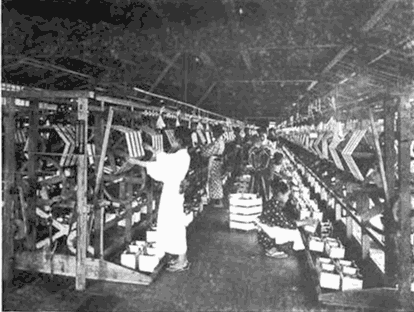
For instance, he gives this description of conditions of a cotton thread spinning factory in Matsuyama, on the island of Shikoku.

Silk Factory

Factory Workers in a Silk Factory

In 1901, when Mr. Omoto began to work in the factory, he was amazed to see how many were the children taking their turns in work along with the older girls by day and by night. Large numbers ranged from seven to twelve years old, the majority, however, being from fifteen to twenty. They worked in two shifts of twelve hours each, but as they were required to clean up daily they did not get out till six-thirty or seven, morning and night. The only holidays for these poor little workers came two or three times a month, when the shifts changed; but even then there was special cleaning, and the girls who had worked all night were kept till nine and even ten in the morning. He was also deeply impressed with their wretched condition and immoral life. The majority of them could neither read nor write; their popular songs were indecent, and they were crowded together in disease-spreading and vermin-breeding, immoral boarding-houses, where they were deliberately tempted. Some of the landlords were also brothel keepers.

As a missionary in Japan for twenty-five years, the author’s distaste for the “native religions” was evident in passages such as this:

The reader will naturally ask what the native religions have done to help women meet the modern situation. The answer is short; practically nothing. They are seriously belated in every respect. For ages the native religions have served by doctrine and practise to hold women down rather than to elevate them. The doctrine of the “triple obedience” to father, to husband, and when old to son, has had wide-reaching and disastrous consequences. It has even been utilized for the support of the brothel system.

Also evident was his distaste for the “loose morality” of the Japanese culture. Speaking of prostitution, he wrote:

while in Occidental Christian lands no girl can voluntarily enter this sphere of life without being conscious of its shame and immorality, many of the girls of Japan may have no adequate knowledge of these inevitable consequences until their fate has been sealed.

Finally, also evident was his strong conviction that adoption of the Christian system of beliefs was necessary for Japan to become an ethical and moral country. This led him to be a tad dismissive of the strengths of native culture.

This book is not an objective look at the role of working women in Japan, instead it was a call for support of the missionary movement. That movement was not a general success, with only about 1 to 2% of the Japanese becoming Christian. Still, the book does have insights into the situation that did exist at one point in time in Japan, viewed through the mindset of a missionary living there.


Uncle Sam’s Place and Prospects (1899)

February 15, 2011

In Barbara Tuchman’s The Proud Tower, there is a chapter (“End of a Dream”) about America’s decision to become a colonial power. At the time, we had just won the Spanish-American war and there was a major political conflict between those that believed that America was destined to become an imperial power (the pro-imperialism forces) and those that believed that becoming an imperial power would destroy America’s principals of self-government and isolation (the anti-imperialism forces). The pro-imperialism forces won.

The political paper “Outlook: Uncle Sam’s Place and Prospects in International Politics” gives a feel for the nature of that political conflict. That paper was read by Newton MacMillan before The Fortnightly Club (Oswego, N. Y.) on May 2, 1899.

In that paper, Mr. MacMillan argued for colonization of the Philippines, in part, because it was needed to protect our interests in capturing the Chinese market. He cited statistics about the value of our exports to China and talked of conspiracies of other foreign powers to shut us out of that market.

But how long is this to continue? With our experience of tariffs we need not be reminded that low prices do not command markets. Continental Europe does not like us. We saw that during the Spanish war, and we have heard it since in various impatient declarations of hostility, at Berlin or Vienna, far more significant than official assurances of distinguished consideration. Indeed, if Germany, or France, or Russia does not openly break with us, it is because fear or prudence is stronger than inclination. The moment any one or all of them combined feels able to slam the door in our face without fear of reprisals, the door will be slammed.

He argued for setting up a base for operations against any attempts to shut us out of China.

So, in great measure, the Philippines mean for us a foothold in the East and a strong leverage on China. Would our co-operation be sought at this time, as it has been, not only by England but by Germany, if George Dewey had not sailed his ships into the harbor of Manila on the night of the 30th of April, 1898, dodging the sunken mines and torpedoes, that he might on the morrow fire “the shot heard round the world?” On that day and since then the world learned that we are a nation not only of shopkeepers and money-grabbers, but also of fighters; that in a prolonged war we stand unconquerable, irresistable. A year and a day ago we were a nation; to-day we are a power, and have only to assert ourselves as such.

Then, after arguing that we must subject the Philippines to our rule for economic reasons, he argued that colonization was needed to “make us less corrupt”:

But if, on the other hand, we set up good government in the colonies, how long shall we be content with misrule at home? Not long, I promise you. “It is one of the most beautiful compensations of this life,” says the wise man, “that no man can sincerely try to help another without helping himself.” No less true is this of nations. The eyes of the world are upon us and the conscience of civilization will hold us strictly accountable. As we deal with those ignorant wards whom the God of Battles has given into our keeping, even so shall we be dealt with. And in uplifting them from barbarism so shall we be uplifted.

He even stated that:

I believe the present low tone of our internal politics to be due to the long and peaceful isolation of the Republic.

In other words, peaceful isolation is bad, but colonizing foreign lands will save our soul. Interesting arguments.


Englishman from Paris: A Farce

January 20, 2011

One of the benefits of working on older books for Distributed Proofreaders is that they give glimpses into the popular culture of their time. Judging from the English farce The Englishman from Paris by Arthur Murphy, the year 1756 was a time of effeminate fops in France and xenophobic hooligans in Britain. No one looked good in this farce, but then that is normal for farces.

The play was made available to us through The Augustan Reprint Society, which reprinted the play in 1969, along with an introduction by Simon Trefman. That introduction tells about the checkered past of this play that had its “first and last performance at Drury Lane on 3 April 1756.”

He was going to write a sequel to one of Foote’s plays, The Englishman in Paris (C. G. 24 March 1753), a popular farce that satirized the boorish antics of a English squire in a country where politeness is the mode. Murphy’s idea was to show this blood returned to England as a Frenchified effeminate fop at odds with his family and former friends. Foote listened closely as Murphy gave him the plot and even some of the dialogue. Then, thinking that no one had a better right to a sequel than the author of the original, Foote, keeping his own counsel, wrote The Englishman Return’d From Paris in time for the new season.

Simon Trefman discusses how, despite similarities that cause Murphy to accuse Foote of plagiarism, there were substantial differences between the two plays.

Interestingly enough, Murphy’s sequel is based on different characters from those appearing in Foote’s play, but it is closer in spirit to the original than Foote’s own sequel. Murphy’s is an ironic and gentle comedy that at first glance seems to be chauvinistically anti-French and pro-English, reflecting public sentiment prior to the outbreak of the Seven-Years’ War with France. Though the climax of the plot is the fop’s rejection of French affectations (and Murphy made sure that the French dogs did not get the best of it), English brutality and intolerance are also exposed; and care is taken that nothing irrevocable is done so that there is room for reformation on both sides.

So how was the play as comedy? It is hard to tell from the printed page. Comedy is best seen acted, instead of read on a printed page or on a computer screen. There are moments where I could see what a good set of actors could do with this material. For instance, there is the Philosopher/teacher who plots against his student:

Florid. (Alone) I have already fixed a ridiculous Aposiation of Ideas in my young Pupil’s Mind concerning Marriage. If I can bring him to decline it, I shall see whether I can’t awaken Miss Harriet’s Affections in my own behalf—I have almost finish’d a short Treatise upon Beauty, which I shall dedicate to her. I must make all I can of this family; and then the pleasures of Imagination will strike the Internal Sense with a finer Impulse, when some Ideas of Property concur.

There is the Country Squire who discounts the advantages of foreign travel with the comment:

Quicksett. I don’t know that Sir Robert; I have seen a great many hopefull, promising young Men, come home such mere Ragouts. I’ll tell you what, Sir Robert—I was hugely pleas’d with one Inscription I once read in a country church-yard. “Here lies John Trott, an honest Man who was never out of his own Country.”

And there is the “hero” Jack, who spouts:

Jack. This Eyebrow is very obstinate today, here La Fleur, arch my Eyebrow. Tell my Lady Betty that I am so deranged by these People, that I must now go and take the Air to recover my Spirits—and tell my Lady Betty if she will come to the Park, we will entertain ouselves with a little Raillery upon the Mob of English Gentlemen. It is well observed by one of the wits of France that few People know how to take a walk, I’ll shew them how to walk. Plus belle que l’Aurora.

Of course, right after this, the mob doesn’t react with the admiration and respect he was expecting, and he barely escapes an angry mob only because they are diverted with beating up on a pickpocket.

And of course there is the unbelievable change in character, as the hero gives up his foolishness:

Jack. You must, Sir, and when you are arriv’d, divest yourself of your Prejudices; don’t follow the Example of Voltaire and Abbé Le Blanc, but dare to speak the Truth. Tell your countrymen you heard here of a King determin’d to prosecute a vigorous War, but more desirous of an honorable Peace—tell ’em we have Ministers who understand the true Interest of their country, and are determin’d to maintain the just rights of Great Britain—tell ’em that plain good Sense, honor, honesty, and a regard for our word, are the characteristicks of the English Nation—and tell ’em the most ridiculous object you saw in this country is a Frenchify’d Englishman.


Child’s Own Books

January 13, 2011

Book coverUsually, it is easier to develop short books for Project Gutenberg than it is to develop longer books, but sometimes short books can pose their own intellectual challenges. One such series of short books is the “CHILD’S OWN BOOK of Great Musicians” series (1915) by Thomas Tapper. These books have a couple of pages of illustrations so that the child can cut and paste those illustrations into the appropriate places to make a book and other places where the child can write a story about the musician.

Recently, we posted four books from this series. One book was on Bach (Johann Sebastian Bach: The story of the boy who sang in the streets). Another was on Haydn (Franz Joseph Haydn: The Story of the Choir Boy who became a Great Composer). Still another was on Mozart (Mozart: The story of a little boy and his sister who gave concerts). The fourth was on Beethoven (Beethoven: The story of a little boy who was forced to practice).

In each of these books, we produced an HTML file that shows what the finished workbook looks like, and a MIDI file that corresponded to an illustration of sheet music in the book (e.g., this minuet by Mozart). The MIDI files were produced by the DP Music Team.

The Mozart book project and the Beethoven book project have something that the other two book projects do not: a PDF file that shows what the workbook probably looked like before being finished, and that PDF file can be printed out to make a workbook that a child can fill in, just like the books sold almost a hundred years ago. Creating that PDF file was an interesting and challenging experience. The reason why the Mozart book and the Beethoven book project have a PDF and the others do not, is that these projects differ from the other two in that they had the two sheets of illustrations intact.

All in all, it has been an interesting challenge, especially the production of the PDF file, which was created in Microsoft Word. I learned a lot from it. Still, I am looking forward to working with longer, less challenging books.


An ex-maid’s maid.

December 8, 2010

"Why, she's going to ask me down there, too, to one of her week-end parties!"

“A Romance of Love and Fortune,” that is the subtitle of a light romance about a woman who becomes the maid of her ex-maid. The book is Miss Million’s Maid (1915) by Berta Ruck (Mrs. Oliver Onions).  In addition to love and fortune, it includes class snobbery, Irish royalty, theater, crime, and the Great War.

My story begins with an incident that is bound to happen some time in any household that boasts—or perhaps deplores—a high-spirited girl of twenty-three in it.

It begins with “a row” about a young man.

My story begins, too, where the first woman’s story began—in a garden.

It was the back garden of our red-roofed villa in that suburban street, Laburnum Grove, Putney, S.W.

Now all those eighty-five neat gardens up and down the leafy road are one exactly like the other, with the same green strip of lawn just not big enough for tennis, the same side borders gay with golden calceolaria, scarlet geranium, blue lobelia, and all the bright easy-to-grow London flowers. All the villas belonging to the gardens seem alike, too, with their green front doors, their white steps, their brightly polished door-knockers and their well-kept curtains.

From the look of these typically English, cheerful, middle-class, not-too-well-off little homes you’d know just the sort of people who live in them. The plump, house-keeping mother, the season-ticket father, the tennis-playing sons, the girls in dainty blouses, who put their little newly whitened shoes to dry on the bathroom window-sill, and who call laughing remarks to each other out of the window.

“I say, Gladys! don’t forget it’s the theatre to-night!”

“Oh, rather not! See you up at the Tennis Club presently?”

“No; I’m meeting Vera to shop and have lunch in Oxford Street.”

“Dissipated rakes! ‘We don’t have much money, but we do see life,’ eh?”

Yes! From what I see of them, they do get heaps of fun out of their lives, these young people who make up such a large slice of the population of our great London. There’s laughter and good-fellowship and enjoyment going on all up and down our road.

Except here. No laughter and parties and tennis club appointments at No. 45, where I, Beatrice Lovelace, live with my Aunt Anastasia. No gay times here!

Thus begins the tale of the great-granddaughter of Lady Anastasia. In the days of her great-grandmother the family lived in Lovelace Court. Since that time, the family has “come down in the world” and our heroine lives with her aunt as hermits, because the aunt believes “Better no society than the wrong society.”

Beatrice’s only friend is a naive maid. So when the maid inherits a fortune from a distant relative, our heroine decides to flee her hermitage by entering the employment of her maid. What follows then is a series of adventures as our heroine tries to protect her friend and show her the advantages of her new-found wealth. And, of course, what follows is also romance and plenty of humor along the way.


The Real plays of Little Women

December 4, 2010

In the first chapter of Little Women, there was a description of the plays that the March family performed for each other:

“I don’t mean to act any more after this time. I’m getting too old for such things,” observed Meg, who was as much a child as ever about ‘dressing-up’ frolics.

“You won’t stop, I know, as long as you can trail round in a white gown with your hair down, and wear gold-paper jewelry. You are the best actress we’ve got, and there’ll be an end of everything if you quit the boards,” said Jo. “We ought to rehearse tonight. Come here, Amy, and do the fainting scene, for you are as stiff as a poker in that.”

“I can’t help it. I never saw anyone faint, and I don’t choose to make myself all black and blue, tumbling flat as you do. If I can go down easily, I’ll drop. If I can’t, I shall fall into a chair and be graceful. I don’t care if Hugo does come at me with a pistol,” returned Amy, who was not gifted with dramatic power, but was chosen because she was small enough to be borne out shrieking by the villain of the piece.

“Do it this way. Clasp your hands so, and stagger across the room, crying frantically, ‘Roderigo! Save me! Save me!'” and away went Jo, with a melodramatic scream which was truly thrilling.

Amy followed, but she poked her hands out stiffly before her, and jerked herself along as if she went by machinery, and her “Ow!” was more suggestive of pins being run into her than of fear and anguish. Jo gave a despairing groan, and Meg laughed outright, while Beth let her bread burn as she watched the fun with interest. “It’s no use! Do the best you can when the time comes, and if the audience laughs, don’t blame me. Come on, Meg.”

Then things went smoothly, for Don Pedro defied the world in a speech of two pages without a single break. Hagar, the witch, chanted an awful incantation over her kettleful of simmering toads, with weird effect. Roderigo rent his chains asunder manfully, and Hugo died in agonies of remorse and arsenic, with a wild, “Ha! Ha!”

“It’s the best we’ve had yet,” said Meg, as the dead villain sat up and rubbed his elbows.

“I don’t see how you can write and act such splendid things, Jo. You’re a regular Shakespeare!” exclaimed Beth, who firmly believed that her sisters were gifted with wonderful genius in all things.

“Not quite,” replied Jo modestly. “I do think The Witches Curse, an Operatic Tragedy is rather a nice thing, but I’d like to try Macbeth, if we only had a trapdoor for Banquo. I always wanted to do the killing part. ‘Is that a dagger that I see before me?” muttered Jo, rolling her eyes and clutching at the air, as she had seen a famous tragedian do.

If you are interested in learning more about these plays, you can actually read them in Comic Tragedies Written by ‘Jo’ and ‘Meg’ and Acted by The ‘Little Women’. At first, when I was working on the post processing of this book, I thought it was written by Louisa May Alcott after writing Little Women, with her writing the plays in the style as if it were written by “Jo” and “Meg”. Later reading Little Women Letters from the House of Alcott,  I discovered that the plays were really written by Louisa May Alcott and her sister Anna in their youth.

How were the plays? Well, they were interesting, both historically and as works of young women who had yet to really know romance. The term “Tragedies” was probably a misnomer; they were more like romantic melodramas. Still, melodramas can be fun.