Real “Little Women” Letters

November 20, 2010

For all those who have ever read Little Women and loved it, Little Women Letters from the House of Alcott shows how much of Little Women was based upon Louisa May Alcott’s own family.  What makes this biography special is that it is primarily told in the letters that the Alcott family wrote each other, including a letter from five year old Anna telling her mother that “You have a splendid husband”.

I don’t know if Bronson Alcott was that splendid of a husband (he was a failure as a businessman, and his family lived in poverty most of their childhood), but he definitely was a “splendid” father.

Here is what he wrote Elizabeth on her fifth birthday:

Page of letter to Elizabeth on her 5th birthday

Page of letter to Elizabeth on her 5th birthday

1840

I    I    I    I    I    Years
one two three four five
birth-day
in the
cottage

My very dear little girl,

You make me very happy every time I look at your smiling pleasant face—and you make me very sorry every time I see your face look cross and unpleasant. You are now five years old. You can keep your little face pleasant all the time, if you will try, and be happy yourself, and make everybody else happy too. Father wants to have his little girl happy all the time. He hopes her little friends and her presents and plays will make her happy to-day; and this little note too. Last birthday you were in Beach Street, in the great City, now you are at your little cottage in the country where all is pretty and pleasant, and you have fields and woods, and brooks and flowers to please my little Queen, and keep her eyes, and ears, and hands and tongue and feet, all busy. This little note is from

FATHER,

who loves his little girl very much, and knows that she loves him very dearly.

Play, play,
All the day,
Jump and run
Every one,
Full of fun,
All take
A piece of cake,
For my sake.

Unfortunately, having him as a father had its downside, including the Fruitlands experiment and its failure that was immortalized by Louisa Alcott in her “Transcendental Wild Oats.”

The detail of it is thus described by a friend of the Alcott family, who had the story from Bronson Alcott himself:

The crop failures necessitated the community living on a barley diet, as anything animal was not allowed, not even milk and eggs. Now and then they gave a thought as to what they should do for shoes when those they had were gone; for depriving the cow of her skin was a crime not to be tolerated. The barley crop was injured in harvesting, and before long want was staring them in the face. The Alcotts remained at Fruitlands till mid-winter in dire poverty, all the guests having taken their departure as provisions vanished. Friends came to the rescue, and, Mr. Alcott concluded with pathos in his voice, “We put our little women on an ox-sled and made our way to Concord! So faded one of the dreams of my youth. I have given you the facts as they were; Louisa has given the comic side in ‘Transcendental Wild Oats’; but Mrs. Alcott could give you the tragic side.”

Indeed, it was always Mrs. Alcott who could have given the tragic side, skillfully as she kept her worries hidden. Her own family, indignant because Bronson Alcott could not better provide the material needs for his family, on more than one occasion besought the faithful wife to leave him.

Reading this book, I am struck by how strong an impact the father had on that family. Bronson Alcott was an idealist, with strongly-held views of the world, and he passed those strongly held views to his children with love and tender care.

Strongly-held views taught with love and tender care are not necessarily correct. For instance, I doubt my daughters would agree with the sentiment of a young Louisa Alcott that “love of cats” is a vice. Having Bronson Alcott as a father definitely was a mixed bag, the type of life that makes great source material for a novel.


Letters of a Lunatic

November 3, 2010

Letters of a Lunatic: A Brief Exposition of My University Life, During the Years 1853-54. The title says it all. The author was Professor George J. Adler, the date of publication was 1854, and the situation was reminescent of the old quote: “Even a paranoid can have enemies.”

Prof. Adler was a noted lexicographer of his time, made famous for his dictionary of the German and English languages. Until 1854, he was chair of German Language at the University of the City of New-York. In 1854, he was found insane and was committed to the Bloomingdale Insane Asylum, where he subsequently died. Letters of a Lunatic was a short tract written by him stating his side of the story of what happened.

My main object was of course to vindicate and defend my character, my professional honor and my most sacred rights as a rational man and as a public educator, against the invasions of narrow-minded and unjust aggressors, whose machinations have for several years been busily at work in subverting what other men have reared before them, in retarding and impeding what the intelligence of our age and country is eager to accelerate and to promote.

The tract includes letters from him to the head of his university, to the mayor of New York, and to others unnamed. In addition to that, there are: a letter supposedly from the head of his university, comments on some of the letters, and a section outlining the Law of Intellectual Freedom. Revealing are his comments that:

The scum of New-York in the shape of Negroes, Irishmen, Germans, &c., were hired, in well-organized gangs, to drop mysterious allusions and to offer me other insults in the street, (and thus I was daily forced to see and hear things in New-York, of which I had never dreamt before,) while a body of proselyting religionists were busy in their endeavors to make me a submissive tool of some ecclesiastical party or else to rob me of the last prospect of eating a respectable piece of bread and butter.

and that:

A night or week of such proceedings would be enough to set a man crazy. What must be their effect if they continue for months? And yet expressions like the following were perpetually ringing in my ears:—”Go on!” “You are the man!” “You are not the man!” “Go on! no, stop!” (by the same voice in the same breath.) “Out of the Institution with that man!” (by the laurelled valedictorian of last year.), “Stand up!” (by Prof. C——, close to my door.) “He started with nothing!” (by the same voice in the same place). “Pray!” (by ditto.) “You have finished!” “Go away!” “Thank God, that that man is out of the Institution!” (by a lady member of a certain religious fraternity, on terms of intimacy with a certain prominent politician of the neighborhood.) “Pursue him, worm that never d-i-e-s!” (theatrically shrieked by the same voice.) “You are a dead man! Dead, dead, dead, dead!” (by the voice of a certain popular preacher. ) “He is deceived, he is deceived!” (by the spokesman of a body of theological students in front of the neighboring Seminary, as I was passing.) And at times even: “Die!” “Break!” (on the supposition that I was in embarrassed circumstances.) “Whore!” even was one of the delectable cries! To these I should add the mysterious blowings of noses (both within sight and hearing,) frightfully significant coughs, horse-laughs, shouts and other methods of demonstration, such as striking the sidewalk in front of my windows with a cane, usually accompanied with some remark: “I understand that passage so!” for example.

There might have been a powerful conspiracy, or he might have been delusional, or both. No matter what was the truth, it was a fascinating read.


Story for Halloween: The Corpse-Rider”

October 31, 2010

This appeared in Lafcadio Hearn’s Shadowings, which is now available for smooth reading and will be posted to Project Gutenberg in early November. Enjoy.

THE body was cold as ice; the heart had long ceased to beat: yet there were no other signs of death. Nobody even spoke of burying the woman. She had died of grief and anger at having been divorced. It would have been useless to bury her,—because the last undying wish of a dying person for vengeance can burst asunder any tomb and rift the heaviest graveyard stone. People who lived near the house in which she was lying fled from their homes. They knew that she was only waiting for the return of the man who had divorced her.

At the time of her death he was on a journey. When he came back and was told what had happened, terror seized him. “If I can find no help before dark,” he thought to himself, “she will tear me to pieces.” It was yet only the Hour of the Dragon; but he knew that he had no time to lose.

He went at once to an inyoushi and begged for succor. The inyoushi knew the story of the dead woman; and he had seen the body. He said to the supplicant:—”A very great danger threatens you. I will try to save you. But you must promise to do whatever I shall tell you to do. There is only one way by which you can be saved. It is a fearful way. But unless you find the courage to attempt it, she will tear you limb from limb. If you can be brave, come to me again in the evening before sunset.” The man shuddered; but he promised to do whatever should be required of him.

At sunset the inyoushi went with him to the house where the body was lying. The inyoushi pushed open the sliding-doors, and told his client to enter. It was rapidly growing dark. “I dare not!” gasped the man, quaking from head to foot;—”I dare not even look at her!” “You will have to do much more than look at her,” declared the inyoushi;—”and you promised to obey. Go in!” He forced the trembler into the house and led him to the side of the corpse.

The dead woman was lying on her face. “Now you must get astride upon her,” said the inyoushi, “and sit firmly on her back, as if you were riding a horse…. Come!—you must do it!” The man shivered so that the inyoushi had to support him—shivered horribly; but he obeyed. “Now take her hair in your hands,” commanded the inyoushi,—”half in the right hand, half in the left…. So!… You must grip it like a bridle. Twist your hands in it—both hands—tightly. That is the way!… Listen to me! You must stay like that till morning. You will have reason to be afraid in the night—plenty of reason. But whatever may happen, never let go of her hair. If you let go,—even for one second,—she will tear you into gobbets!”

The inyoushi then whispered some mysterious words into the ear of the body, and said to its rider:—”Now, for my own sake, I must leave you alone with her…. Remain as you are!… Above all things, remember that you must not let go of her hair.” And he went away,—closing the doors behind him.

Hour after hour the man sat upon the corpse in black fear;—and the hush of the night deepened and deepened about him till he screamed to break it. Instantly the body sprang beneath him, as to cast him off; and the dead woman cried out loudly, “Oh, how heavy it is! Yet I shall bring that fellow here now!”

Then tall she rose, and leaped to the doors, and flung them open, and rushed into the night,—always bearing the weight of the man. But he, shutting his eyes, kept his hands twisted in her long hair,—tightly, tightly,–though fearing with such a fear that he could not even moan. How far she went, he never knew. He saw nothing: he heard only the sound of her naked feet in the dark,—picha-picha, picha-picha,—and the hiss of her breathing as she ran.

At last she turned, and ran back into the house, and lay down upon the floor exactly as at first. Under the man she panted and moaned till the cocks began to crow. Thereafter she lay still.

But the man, with chattering teeth, sat upon her until the inyoushi came at sunrise. “So you did not let go of her hair!”—observed the inyoushi, greatly pleased. “That is well … Now you can stand up.” He whispered again into the ear of the corpse, and then said to the man:—”You must have passed a fearful night; but nothing else could have saved you. Hereafter you may feel secure from her vengeance.”

Halloween is traditionally celebrated big time around DP. Lots of scary books to proof, format or smooth read. Have fun celebrating!

Halloween Bash 2010


Momotaro

October 20, 2010

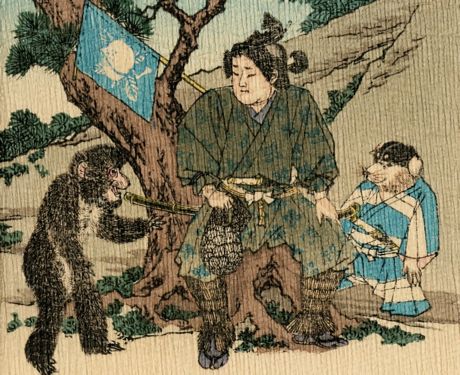
Momotaro and retainers

In the same way that the classic fairy tale “Cinderella” has become part of Western culture, the fairy tale “Momotaro” has become ubiquitous in Japanese culture, with references to it cropping up in comic strips, movies, comedy shows, posters, anime, manga, advertisements, toys, and even government propaganda. There is even a Hello Kitty anime version of the tale available on DVD.

One illustrated telling of that story is Momotaro or Little Peachling, found in the Japanese Fairy Tale Series. This book tells the tale of an old couple that finds a peach, and from that peach pops up a little boy. They adopt him and he grows up strong and goes off to the island of the devils to take their riches. Joining him are three animals:

Then first a dog came to the side of the way and said; “Momotaro! What have you there hanging at your belt?” He replied: “I have some of the very best Japanese millet dumplings.” “Give me one and I will go with you,” said the dog. So Momotaro took a dumpling out of his pouch and gave it to the dog. Then a monkey came and got one the same way. A pheasant also came flying and said: “Give me a dumpling too, and I will go I along with you.” So all three went along with him.

There is a battle with a great multitude of the devil’s retainers, and then with the chief of the devils, called Akandoji. At the end Momotaro triumphs and returns to his adopted parents. There is a happy ending for everyone, except for the devils.

I had heard about the story for decades. This was the first time that I actually read it. Reading it as an adult, I had qualms about the legality of Momotaro’s actions. But then children don’t normally concern themselves with the property rights of devils.


Taxing the American Colonies

October 16, 2010

One of the follies listed in Barbara Tuchman’s The March of Folly: From Troy to Vietnam is “The British Lose America.” A major reason for this “folly” was the attempt to shift to the American colonies the burden of the high debts resulting from a recent war with France.

While, in hindsight, that attempt was “folly”; at the time, some thought it seemed like a good idea. That is shown in the political tract The Justice and Necessity of Taxing the American Colonies, Demonstrated Together with a Vindication of the Authority of Parliament, printed for J. Almon in London in 1766.

Americans are called insolent, undutiful, and disobedient. Addressing the colonies, the author states:

But let me tell thee that the money raised by the stamp act, being all necessary for paying the troops within thy own territories, must center wholly in thyself, and therefore cannot possibly drain thee of thy bullion.

It is true, this act will hinder thee from sucking out the blood of thy mother, and gorging thyself with the fruit of her labour. But at this thou oughtest not to repine, as experience assures us that the most certain method of rendering a body politick, as well as natural, wholesome and long-lived, is to preserve a due equilibrium between its different members; not to allow any part to rob another of its nourishment, but, when there is any danger, any probability of such a catastrophe, to make an immediate revulsion, for fear of an unnatural superfetation, or of the absolute ruin and destruction of the whole.

All countries, unaccustomed to taxes, are at first violently prepossessed against them, though the price, which they give for their liberty: like an ox untamed to the yoke, they show, at first, a very stubborn neck, but by degrees become docile, and yield a willing obedience. Scotland was very much averse to the tax on malt; but she is so far from being ruined by it, that it has only taught her to double her industry, and to supply, by labour, what she was obliged to give up to the necessities of the state. Can America be said to be poorer, to be more scanty of money than Scotland? No. What then follows? America must be taxed.

As to the claim by the Americans that they are not represented in parliament:

True; you are not; no more is one twentieth of the British nation; but they may, when they become freeholders, or burgesses: so may you; therefore complain not; for it is impossible to render any human institution absolutely perfect. Were the English animated by your spirit, they would overturn the constitution to-morrow.

Think of this as 18th century spin-doctoring. All in all, it was a good read. The book provides an interesting glimpse into that era.


Come Out of the Kitchen

October 9, 2010

One of the joys of proofreading for Distributing Proofreaders is finding a book that keeps you proofreading beyond your daily goal because you want to find out what happens next. Come Out of the Kitchen by Alice Duer Miller was one such book. Even more fun was post-processing the book later on because then I got to read the whole book and I got to see the illustrations and photos that were missing during the proofreading phase.


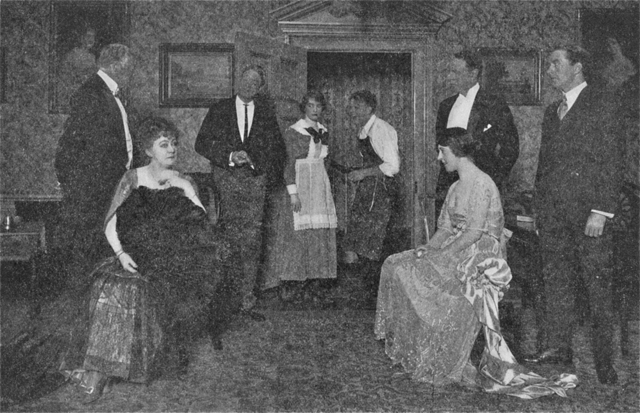
Scene from Act I of the 1916 play


Apparently, this story first appeared in Harper’s Bazar in 1915. It was then made into a comedy by A. E. Thomas that became a hit on Broadway, opening on October 1916 at the Cohan Theatre and playing for 224 performances. The play starred Ruth Chatterton, who twenty years later played the selfish wife in William Wyler’s classic film Dodsworth.

The novel was published in 1916, with photos from the play and illustrations. Later, there was also a film version of Come Out of the Kitchen in 1919, and a 1925 musical called The Magnolia Lady (47 performances) with Ruth Chatterton and her newly-aquired husband (Ralph Forbes).

The story is of a rich young man from the North who rents a Revelly Hall in the South. One condition that he made in renting the mansion was that servants be provided. The servants that came with the house included “an excellent cook, a good butler, a rather inefficient housemaid, and a dangerous extra boy,” none of whom were what they appeared to be, as shown in this segment early in the book:

On her the eyes of her future employer had already been fixed since the door first opened, and it would be hardly possible to exaggerate the effect produced by her appearance. She might have stepped from a Mid-Victorian Keepsake, or Book of Beauty. She should have worn eternally a crinoline and a wreath of flowers; her soft gray-blue eyes, her little bowed mouth, her slim throat, should have been the subject of a perpetual steel engraving. She was small, and light of bone, and her hands, crossed upon her check apron (for she was in her working dress), were so little and soft that they seemed hardly capable of lifting a pot or kettle.

Mrs. Falkener expressed the general sentiment exactly when she gasped:

“And you are the cook?”

The cook, whose eyes had been decorously fixed upon the floor, now raised them, and sweeping one rapid glance across both her employer and the speaker, whispered discreetly:

“Yes, ma’am.”

“What is your name?”

And at this question a curious thing happened. The butler and Reed answered simultaneously. Only, the butler said “Jane,” and Reed, with equal conviction, said “Ellen.”

Ignoring this seeming contradiction, the cook fixed her dove-like glance on Mrs. Falkener and answered:

“My name is Jane-Ellen, ma’am.”

Add to this mix: an amorous real estate man, a lecherous lawyer (who wanted to get the cook fired so she would work for him), Mrs. Falkener (who wanted the cook fired because she was too beautiful to have around the man she wanted as a son-in-law), at least one hat, and a cat. The result was a nice, fun read.