Two titans of Romantic-era literature meet in Thomas Carlyle‘s translation of Johann Wolfgang von Goethe‘s Wilhelm Meister’s Apprenticeship and Travels (Volume I and Volume II). The result is an eminently readable English version of the famous Bildungsroman (education novel) that is true to Goethe’s style. Thanks to the volunteers at Distributed Proofreaders and Project Gutenberg, the e-book version of this classic two-volume set is now complete.
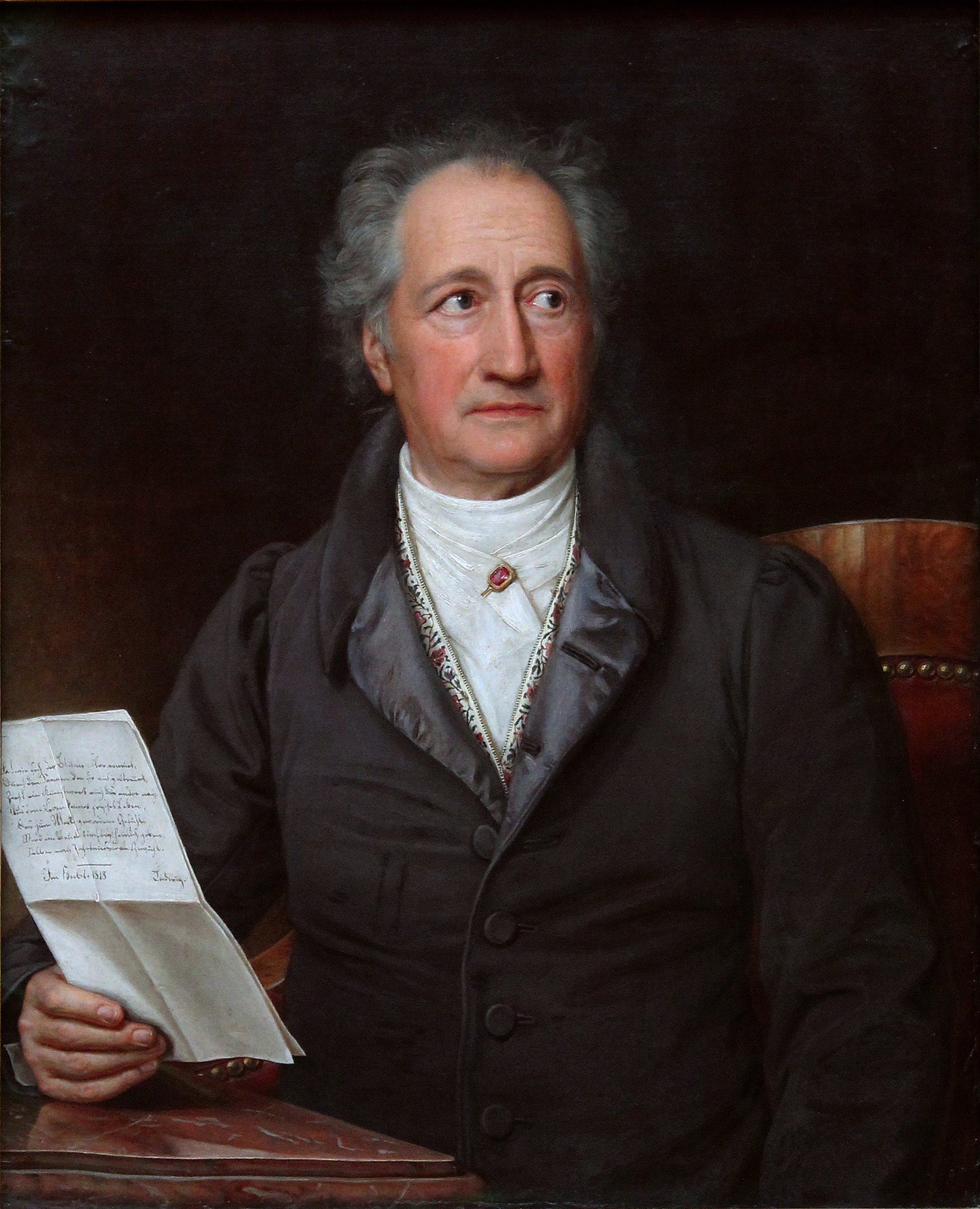
by Joseph Carl Stieler
Goethe (1749-1832) was a tremendously influential German writer, critic, and scientist. His first novel, The Sorrows of Young Werther (1774), was wildly popular and remains a model of the Sturm und Drang (“storm and stress”) artistic movement. Its success sparked a distinguished career that produced masterpieces such as the epic verse-drama Faust (available in numerous editions and translations at Project Gutenberg), as well as a host of plays, poems, novels, and scientific and other nonfiction works.
Goethe wrote the first of the two Wilhelm Meister novels, Wilhelm Meister’s Apprenticeship, in 1795. Wilhelm is a young merchant who is tired of the business world and becomes entranced by the theatre. On a business trip, he encounters a circus troupe. Among them is a 13-year-old girl, Mignon, who had been kidnapped by the troupe. Wilhelm is fascinated by her; she looks upon him as a father-figure. He decides to leave his dull bourgeois life to form his own theatre group with Mignon and others. They perform throughout Germany, particularly the plays of Shakespeare, whom Wilhelm idolizes (as did Goethe). They experience a host of adventures and tragedies along the way.
The sequel, Wilhelm Meister’s Travels, was published much later, in 1821. It is less a novel than a hodgepodge of short stories, letters, dialogues, poems, and philosophical ponderings. In the framing story, Wilhelm now has a young son, Felix, with whom he wanders on foot, never staying in one place for more than three days. He seeks enlightenment through art, science, nature, religion, and philosophy. They encounter many challenges and meet many strange characters, including, among others, a family of religious hermits, an astronomer, a geologist, a painter, and members of a utopian society where Wilhelm leaves Felix to be educated. Perhaps because of its unusual format, it was not as successful as Wilhelm Meister’s Apprenticeship, which was very popular in its day and has inspired composers, artists, writers, and filmmakers for two centuries.
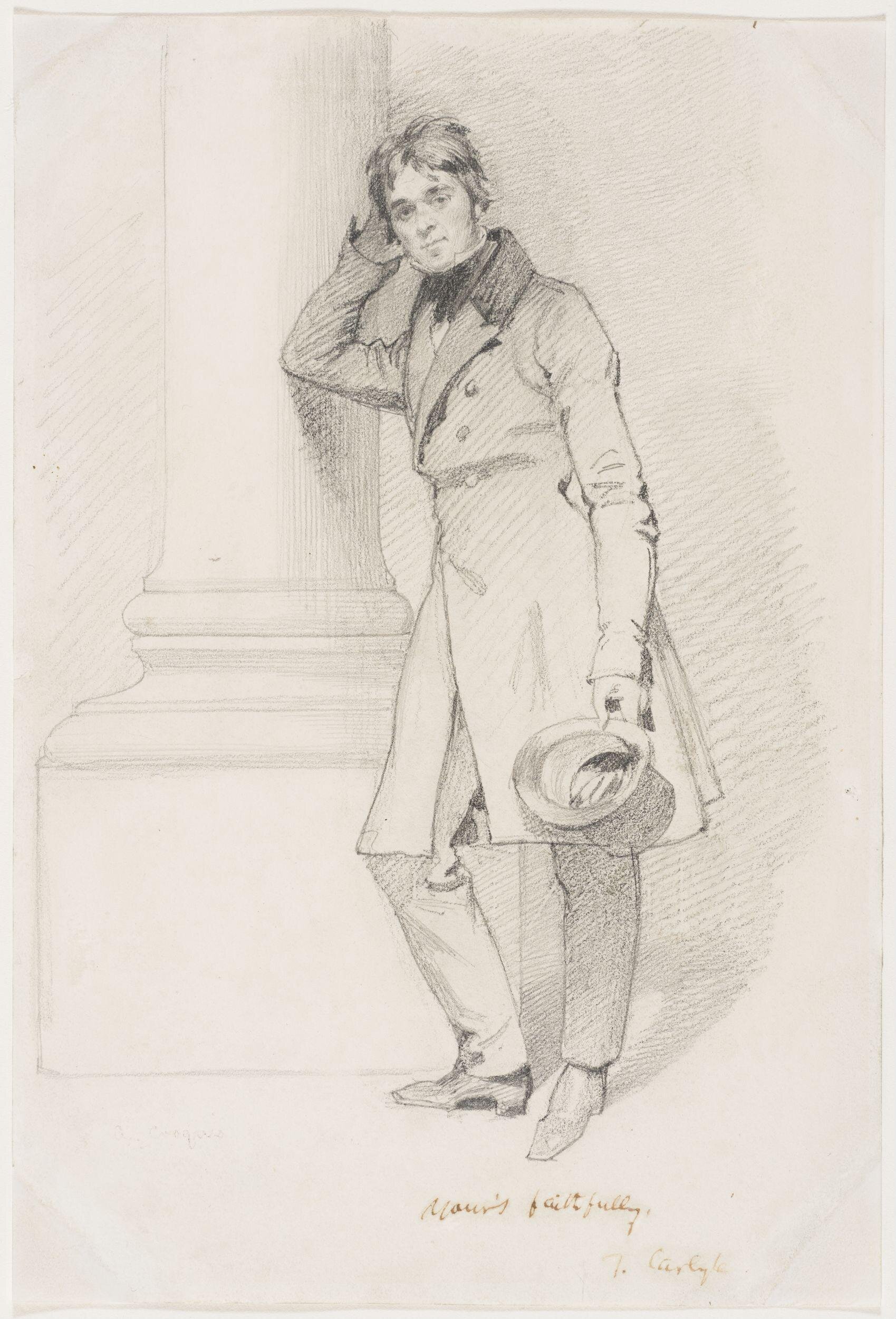
The breadth of human experience in the Wilhelm Meister novels so struck the young Scottish writer Thomas Carlyle (1795-1881) that he felt compelled to introduce them to the English-speaking world with his translations in 1824 and 1825. They made his reputation and were the first works to enable him to make a living as a writer, historian, and thinker. When his translation of the Apprenticeship was first published, he sent a copy to Goethe, who was delighted with it. The two corresponded for the rest of Goethe’s life, and Goethe warmly supported Carlyle’s career, even writing an introduction to the German edition of Carlyle’s The Life of Friedrich Schiller.
In 1839, a second edition of Carlyle’s translation of the Wilhelm Meister novels was republished in two volumes, from which the e-book versions at Project Gutenberg were produced. Goethe had expanded the Travels considerably a decade earlier. But Carlyle did not take the opportunity to translate the expansion, explaining in a note to the reader that the Travels “continues a fragment like the first,” and that “for the mere English reader, there are probably in our prior edition of the ‘Travels’ already novelties enough; for us, at all events, it seemed unadvisable to meddle with it further at present.” Despite this veiled criticism, Carlyle retained his admiration for Goethe: “A genuine seer and speaker, under what conditions soever, shall be welcome to us: has he not seen somewhat of great Nature our common mother’s bringing forth,—seen it, loved it, laid his heart open to it and to the mother of it, so that he can now rationally speak it for us? He is our brother, and a good, not a bad, man: his words are like gold, precious, whether stamped in our mint, or in what mint soever stamped.”
Through the work of Distributed Proofreaders and Project Gutenberg volunteers, you can now enjoy Goethe’s golden words in an admirable English translation for free. (The original German versions, Wilhelm Meisters Lehrjahre and Wilhelm Meisters Wanderjahre, are also available at Project Gutenberg.)
This post was contributed by Linda Cantoni, a Distributed Proofreaders volunteer.


 Posted by LCantoni


