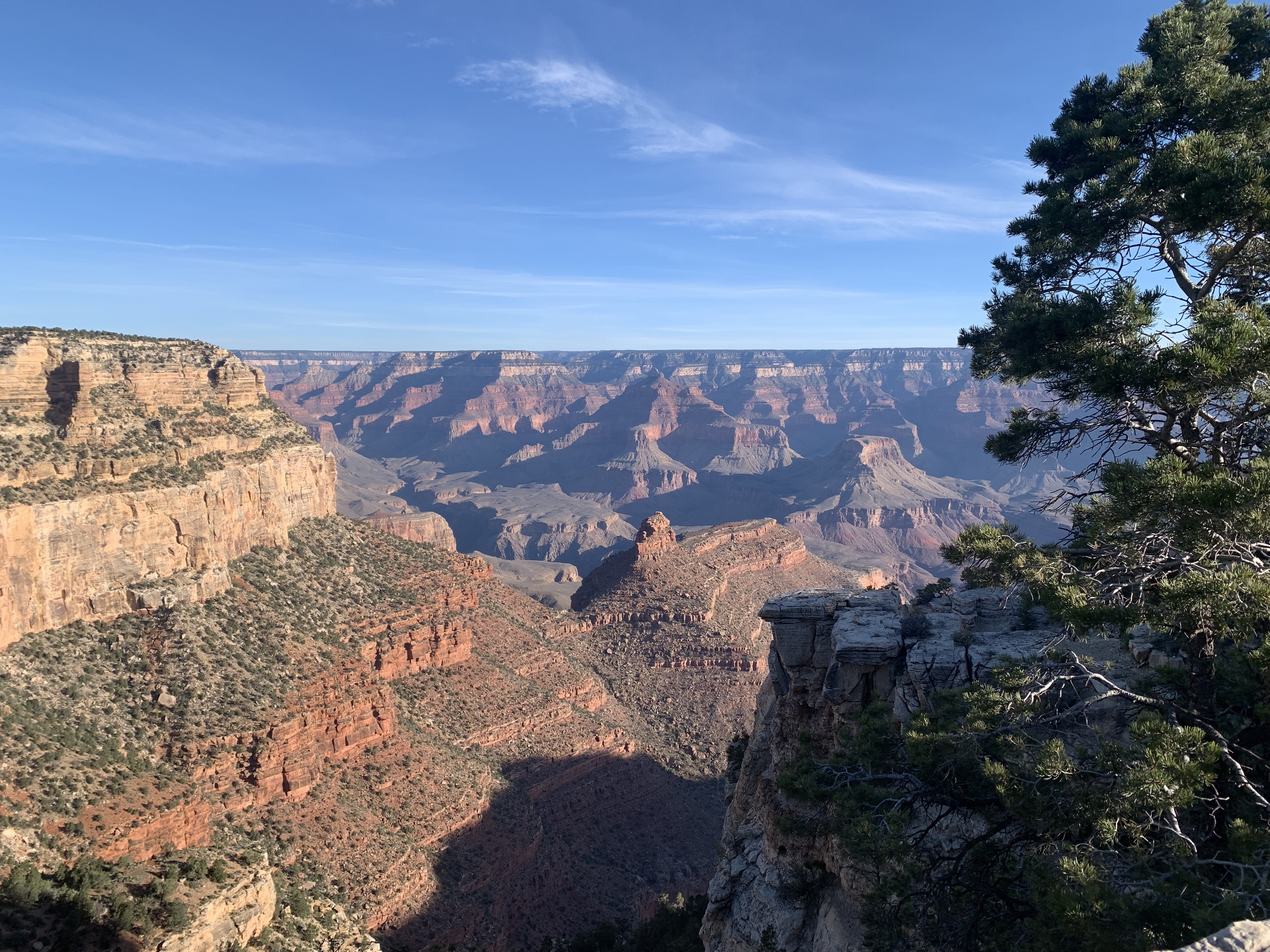
I first learned of Ellsworth and Emery Kolb this past March when I visited the Grand Canyon in Arizona for the first time. I was overwhelmed by the size of the Canyon. I had seen pictures of it, of course, but no picture can do justice to how SMALL one feels standing at the edge of one of the rims or on a trail to the bottom. From the south rim to the north, it is 10 to 12 miles across the canyon. The canyon walls in places are 1,500 feet deep. One 5’4” tall human is nothing in this vastness.
When I learned about the Kolb studio on the south rim, I wondered, “Is there anything on Project Gutenberg about this?” Well, yes, there was: Through the Grand Canyon from Wyoming to Mexico, by Ellsworth Kolb. But the original ebook was first posted in the early days of Distributed Proofreaders, when the main focus was still on producing plaintext versions. It was later converted to an HTML version, but it unfortunately lacked the photographs, most of which had been taken by Ellsworth and Emery. An historical appendix was also missing. A matching edition on The Internet Archive was identified so the photos and appendix could be added. Now the ebook version of this historic work is complete and available for anyone to read or download for free. (This version of the ebook also incorporates features to make it accessible to visually impaired readers.)
I read the book at least three times in the process of preparing it to submit to Project Gutenberg. I was enthralled by it, in part because I recognized many of the places along the south rim that the Kolbs had photographed. Geology can change over several thousand years, but not much changes in 100 years! The story of the Kolbs’ journey was fascinating to read. In 1901, Ellsworth Kolb arrived at the Grand Canyon. A year later, he was joined by his younger brother, Emery.
In 1906, they built a small studio on the south rim of the Grand Canyon to support their budding photography business. For years, they wanted to document the canyon with photographs to encourage visitors and increase their business. Their plans came together in autumn 1911, when they traveled to Green River City, Wyoming. There, they started a trip down the Green and Colorado Rivers heading towards Needles, California, and the Gulf of California. The total length of the trip was 1,600 miles, with a vertical drop of 6,045 feet. To record their trip, they took five still cameras and a motion picture camera (a new technology at the time), plus a supply of film, plates, a cloth darkroom, and chemicals to develop film.
The book is short on details of what items they packed in the boats, other than cameras, tents, and sleeping bags. At one point, they noted their supplies consisted of: “5 pounds of flour, partly wet and crusted. 2 pounds mildewed Cream of Wheat. 3 or 4 cans (rusty) of dried beef. Less than one pound of sugar.” They used custom-built rowboats – no mechanical or engine support – only what they could provide using human power. They caught fish from the river, and started the trip with a rifle and shotgun for hunting game.
Further details of what they ate and food they transported are scanty. Mostly, the book focuses on the local geology, people they met along the way, birds and plants, how they wanted to tackle the day’s rapids, how to photograph those events, and how they dealt with adversity, compensating when things didn’t go as planned.
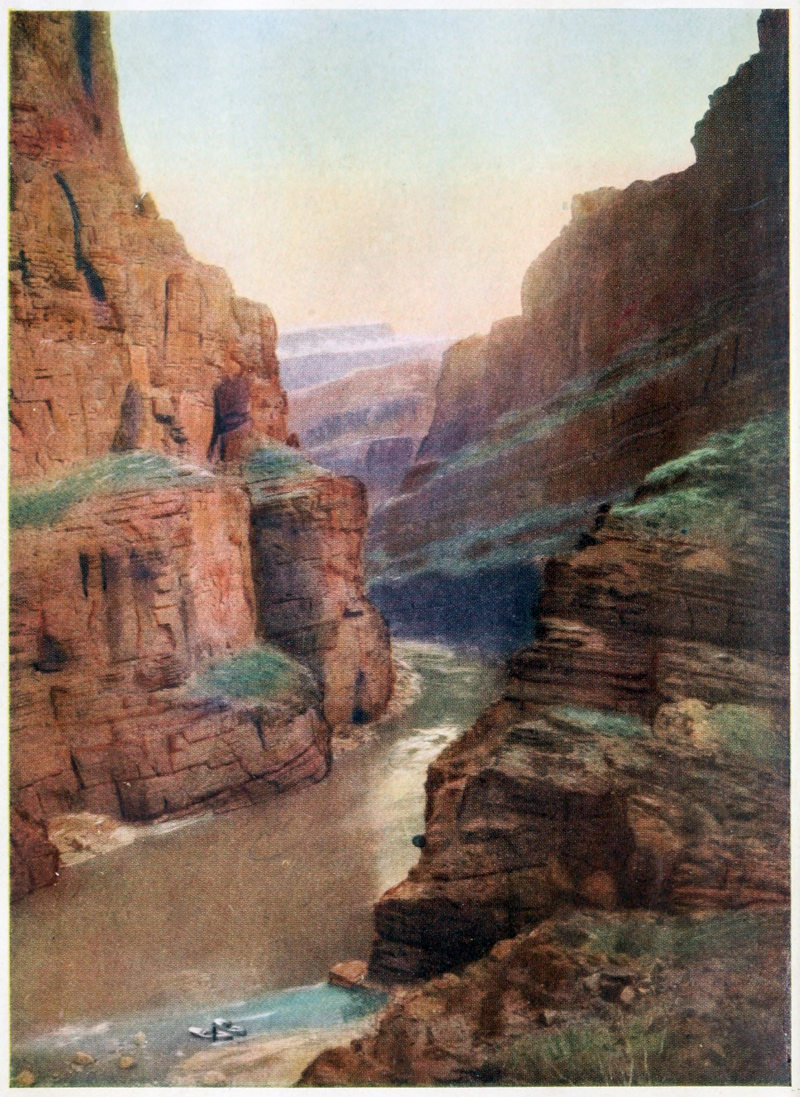
From Wyoming to their home in the Grand Canyon took three months. The descriptions of their rides through the rapids are thrilling. They met with adversity the entire length of the trip. After a month to recover and restock, they headed towards California. In the lower Grand Canyon, in late December, Ellsworth Kolb described the scene:
“There is nothing on earth to which this gorge can be compared. Storm-clouds lowered into the chasm in the early morning. The sky was overcast and threatening. We were travelling directly west again, and no sunlight entered here, even when the sun shone. The walls had lost their brighter reds, and what colour they had was dark and sombre, a dirty brown and dark green predominating. The mythology of the ancients, with their Inferno and their River Styx, could hardly conjure anything more supernatural or impressive than this gloomy gorge.”
By January 13, 1912, the Kolbs were out of the Canyon, and they covered the remaining 175 miles to Needles in five days. Ellsworth Kolb finished the trip from Needles to the Gulf the following year, running the Colorado River in flood stage in eight days. In 1914, he documented the trip in Through the Grand Canyon From Wyoming to Mexico. In 1915, a new edition was published with additional photographs and a foreword by the famous novelist Owen Wister; this is the edition at Project Gutenberg.
The Kolbs’ trip was not the first exploration of the Canyon, nor the first writing about it. There were earlier, shorter documented trips between 1825 and 1909, including two well-documented trips by Major J.W. Powell in 1869 and 1871. Some trips were not completed, as one or more of the participants were injured, drowned, or killed.
The U.S. National Park Service provides a brief history of the Kolbs at the Grand Canyon and their contentious relationship with the National Forest Service and private contractors working at the Grand Canyon in the early 1900’s. Ellsworth died in 1960. After Emery’s death in 1976, the National Park Service acquired the Kolb studio. The Grand Canyon Association maintains it and has carried out restoration work on it in recent years. Before he died, Emery gave his papers, photographs, and films to Northern Arizona University. The Emery Kolb Collection also includes a 45-minute film narrated by Emery; it was shown at their studio for more than 60 years.
Both Emery and Ellsworth Kolb are buried in the Grand Canyon Pioneer Cemetery.
This post was contributed by Carol Brown, a Distributed Proofreaders volunteer who post-processed Through the Grand Canyon from Wyoming to Mexico.


 Posted by LCantoni


