Distributed Proofreaders is proud to have contributed Project Gutenberg’s 80,000th title, The Birds of America, volume 1, 1840 edition, by the ornithologist John James Audubon. The full set of seven volumes (volumes 2 through 7 are in progress at Distributed Proofreaders) contains 500 beautiful color plates of Audubon’s original paintings and drawings of American birds.
Audubon was born in Haiti in 1785 to a French privateer and sugar planter who later served in the American Revolutionary War. Slave uprisings led the elder Audubon to sell his Haiti plantation and move with his family back to France, where young Audubon began his lifelong fascination with birds. At 18, he came to the United States and settled on his father’s Pennsylvania farm, which was the ideal place for him to observe, draw, and paint birds. Over the years he traveled all over America to study and record more species.
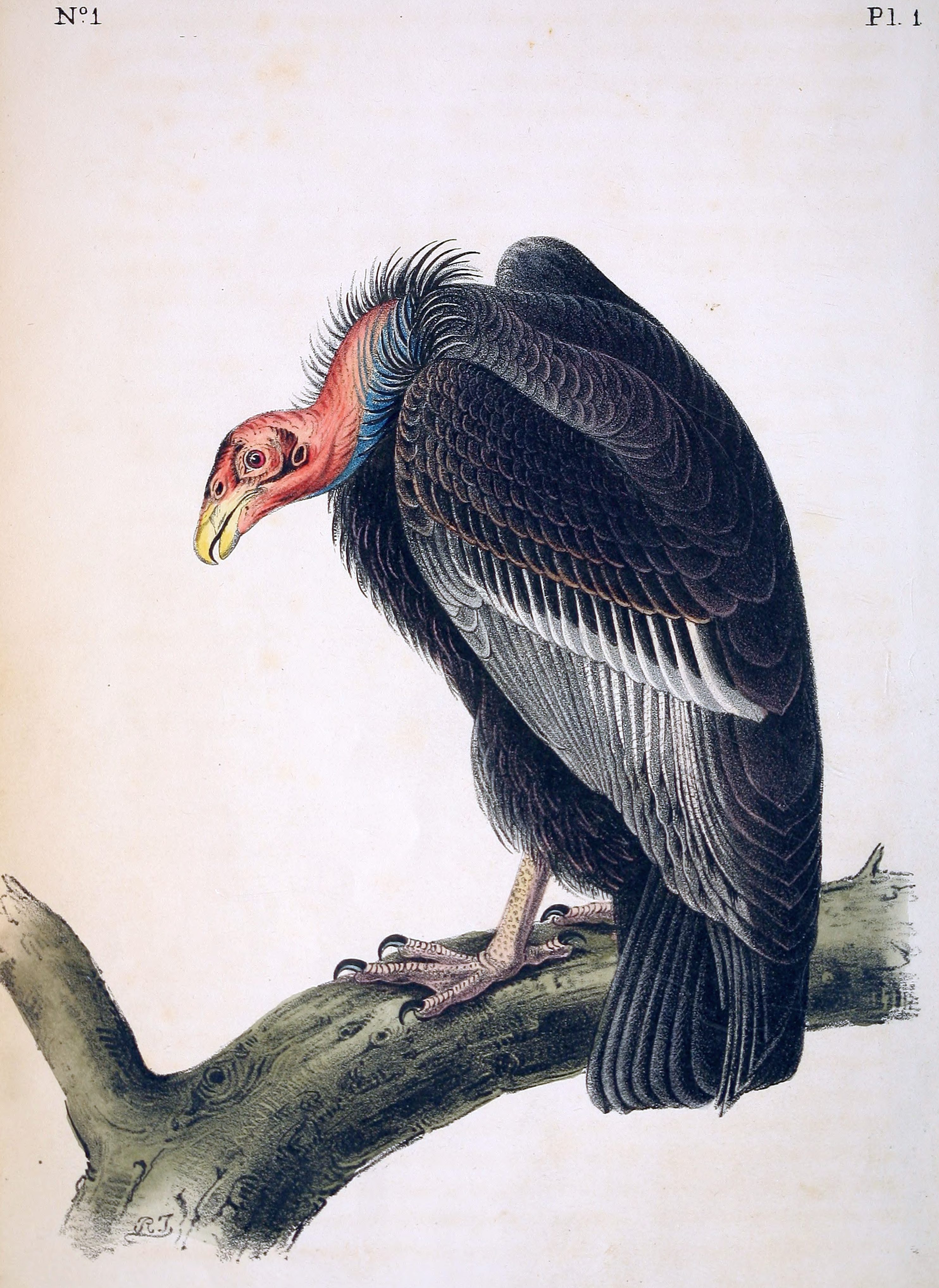
By the 1820s, Audubon was ready to self-publish his work, and he found the support for it in England. The original edition of The Birds of America was released in installments in 1827-1828 in a huge “double elephant folio” edition, measuring about 39″ tall by 28″ wide, printed on handmade paper. It contained 435 hand-colored plates of life-sized birds. Subscription fees of $1,000 (nearly $39,000 today) funded the enormous printing costs. Audubon touted his work to potential buyers with lecture tours throughout the United Kingdom and France. (Today, a complete set of this rare edition, of which only about 120 copies are known to exist, commands millions of dollars at auction.)
As Audubon wanted to evade the British law requiring free copies of his expensive book to be supplied to libraries, he did not include his text commentaries in the original edition. Instead, in the 1830s, he published them separately in his five-volume Ornithological Biography. Four of the volumes are currently available at Project Gutenberg.
Realizing that, due to the subscription cost, the audience for the first edition of The Birds of America was rather limited, Audubon conceived the idea of publishing a smaller and cheaper edition, with 65 additional plates. This “royal octavo” edition, sized at about 10″ tall by 6″ wide, was published in seven volumes from 1840 to 1844, and is the edition used for the Project Gutenberg e-book of the first volume. The entire set cost subscribers $100 (equivalent to nearly $3,900 today, so still not exactly cheap). The lithograph plates may be smaller, but they are still quite beautiful, elegantly drawn, and vividly hand-colored. This edition also incorporates the commentaries that had been separately published in Ornithological Biography. The first volume covers eight families of birds, from vulturinæ (vultures) to muscicapinæ (flycatchers).
The Birds of America is not perfect. Some of the drawing details have been found to be inaccurate. Some birds were misidentified as different species when they were in fact juvenile versions of the same species. And there are some “mystery birds” that modern ornithologists have not been able to identify, or that have perhaps become extinct since Audubon’s time.
Then there are the flaws in Audubon himself. Like his father, he was a slaveowner who thought abolition was a bad idea. And some critics believe he lied about his background and some of his work, referring to him as “Fraudubon.”
But The Birds of America remains a masterwork in both art and ornithology. Congratulations to the volunteers at Distributed Proofreaders and Project Gutenberg who made this 80,000th Project Gutenberg title possible.
This post was contributed by Distributed Proofreaders volunteers Robert Tonsing, who post-processed The Birds of America, vol. 1, and Linda Cantoni.


 Posted by LCantoni


