Post-Processing Fornander’s Hawaiian Antiquities

March 1, 2024

When searching for works to prepare as e-books at Distributed Proofreaders, I always try to find works that are still interesting today, add some diversity to Project Gutenberg’s collection, or are of significant cultural or historical importance.

Another criterion is that the works should be manageable by the volunteers here at Distributed Proofreaders, and in this, I like to explore the edges of what is possible. Each e-book on the site goes through multiple proofreading and formatting rounds, with volunteers carefully reviewing the images of each page with the computer-generated text generated from the images. Once all the pages have completed these steps, a post-processor carefully assembles them into an e-book.

Collections of folklore are always popular and interesting. They are timeless and offer an insight into the culture of a people. Over the years, I’ve added a couple of books with Hawaiian folklore from various authors, and, while digging deeper for more, I hit upon the mother-lode of many of these works: the Fornander Collection of Hawaiian Antiquities and Folk-Lore, a huge collection of material collected in the late 19th Century by Abraham Fornander, published between 1916 and 1920, in three large volumes, by the Bishop Museum Press in Honolulu.

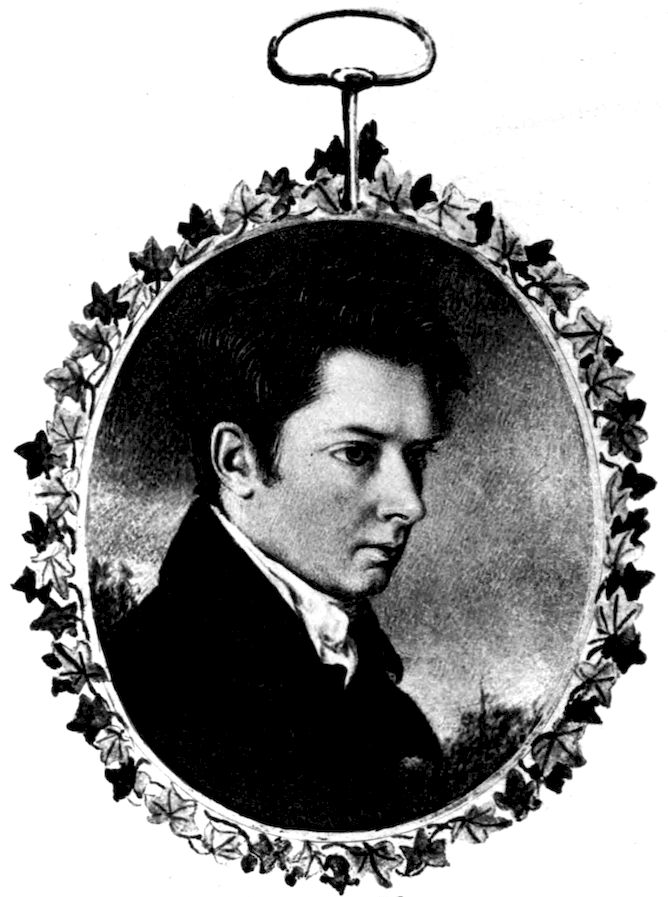
Abraham Fornander was born in Sweden, on the island of Öland, on 4 November 1812, the son of a clergyman. He studied theology at the University of Uppsala, but dropped out and left Sweden to became a whaler. In 1838, he arrived on Hawaii. Here, he became a coffee planter, land-surveyor, and journalist. He also officially became a citizen of the (then still independent) Kingdom of Hawaii, and married Pinao Alanakapu, a Hawaiian chiefess. He started to promote public education and took up various official roles as inspector, governor, and judge. This allowed him to travel on the Hawaiian islands and collect a lot of information about Hawaiian mythology and the Hawaiian language. He used much of his collected materials to publish his Account of the Polynesian Race (a work I hope to tackle at some later date). After his death, he left a massive collection of notes and papers. These ended up in the Bernice P. Bishop Museum and ultimately were published, together with English translations, from 1916 to 1920. The first volume of Fornander’s collection is now available on Project Gutenberg (the following two volumes are still in progress at Distributed Proofreaders at the time of writing).

The volumes are bilingual, with the English translation on the left and Hawaiian original on the right. Since the Hawaiian language, as written at that time, used only standard letters and no diacritics, it is not that difficult for non-speakers to deal with. In fact, the Hawaiian alphabet is surprisingly short, with just 13 letters: five vowels: a e i o u (each with a long pronunciation and a short one, but here not distinguished); eight consonants: h k l m n p w; and the glottal stop (not shown in this text). Since all syllables in Hawaiian are a single consonant followed by a vowel or diphthong, to non-natives some words may appear long and repetitious, and in particular names can become pretty long — although there are also plenty of very short words to compensate.

Like many indigenous languages, Hawaiian is an endangered language. It was still widely spoken in the 19th Century, when the Hawaiian islands were an independent kingdom that maintained diplomatic relations with many countries. The Hawaiian Kingdom’s constitution was written in Hawaiian. Literacy was promoted and newspapers were regularly printed. However, through the machinations of American businessmen, the government of Queen Liliʻuokalani was overthrown in 1893, and after being run as a “Republic” for a short while, the territory was annexed by the United States in 1898. This led to the demise of the Hawaiian language. In 1896, English was made the sole official language, and the use of Hawaiian in schools was systematically suppressed. Only in the 1950’s did this trend slowly begin to reverse, with renewed interest in the language and indigenous culture, though Hawaii became a U.S. state in 1959. Hawaiian dictionaries were published, and a revival movement gained traction in the 1970’s, with schools once again teaching children the language. However, it is still spoken by only a small fraction of the current population of Hawaii.

Having Fornander’s collection easily accessible will be very valuable to learners of the language (even though the language used is probably archaic and the spelling differs a bit from modern Hawaiian) and to students of its folklore and history. The collection starts off, appropriately, with a mythological description of the discovery of the islands and the origins of the Hawaiian people. The first volume further includes, among many others, the popular story of Umi, a fifteenth-century chief or king, who usurped the throne from his older half-brother, then ruled for about 35 years and united the Hawaiian islands into a single kingdom.

Since today only about 24,000 speakers of Hawaiian remain, the hope of finding enough native speakers to help us out with this project was limited. We needed to ask non-Hawaiian-speaking volunteers to work on Hawaiian pages, even if they didn’t know a single word. Hawaiian is an Austronesian language, remotely related to languages such as Malay or Tagalog, so speakers of those might occasionally recognize a word, although it will often require some linguistic training to see the relationship (and that really is no help in proofreading those pages). Hawaiian is more closely related to Polynesian languages such as Tongan, Samoan, or Tahitian, and speakers of those languages can probably get some of the gist of the stories (but speakers of those languages are also not easily found).

So how to deal with such a massive and complex work?

Well, first, praise where praise is due: The many volunteers at Distributed Proofreaders dutifully ploughed through the Hawaiian pages and fixed a lot of errors left behind by the optical character recognition process (which turns scanned images into editable text). When I received the work to post-process, most of the hard work had already been done.

Still, post-processing a work like this is a considerable challenge. Post-processors have to create both text and HTML files for Project Gutenberg and make them both easily readable. First, I needed to untwine the English and Hawaiian text (which in the original book were on alternating pages), such that both the English and Hawaiian text became continuous texts, at least at the chapter level. To do this I simply made two copies of the text file, and then removed the English part of the text. Then I recombined them, so that the Hawaiian follows the corresponding English chapter.

Once the untwining was done, I started to add tags to demarcate chapter headings, poetry, tables, and footnotes, convert quotation marks to their proper curly shapes, etc., and deal with the issues the proofreaders noted. Then I came to the task of checking the entire text for remaining spelling issues, and that in a language I do not speak, without the help of a spelling-checker, and in an obsolete spelling.
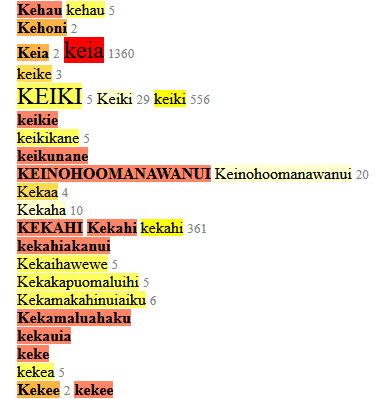
Luckily, I’ve done this a few times before, and developed a few tools to help me make this easier. During my preparation, I tagged each fragment of text in my file with the language it is written in. This enables me to create word-lists, which I can inspect. Words that occur many times can be safely ignored, but those that are rare or unique may need some further inspection. Since I color-code by frequency, rare words jump out.

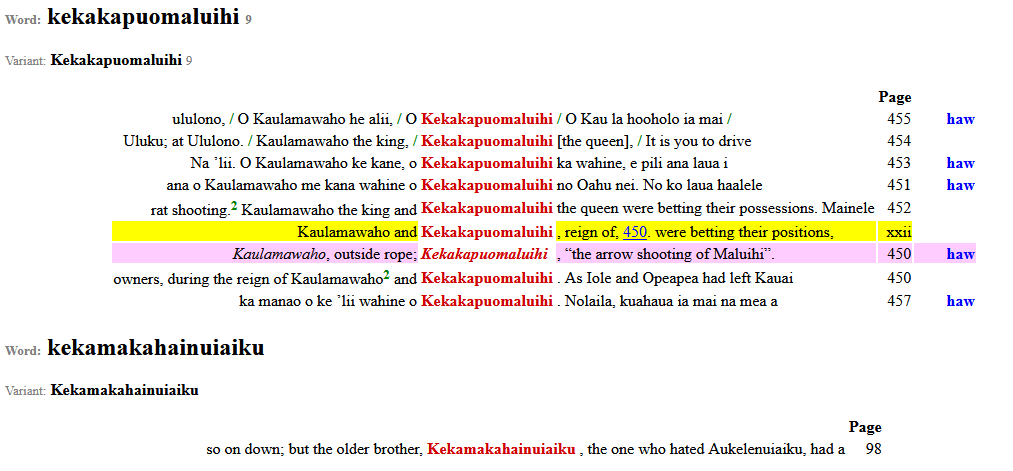
Using the word-list, I can identify suspect words, but that doesn’t always help. Then I can turn to a another tool and generate a KWIC (Keyword in Context) index. This allows me to see how each word is used, and, based on that, I can often decide how to deal with it.

The illustration below show how this works for the name Kekakapuomaluihi. At a glance, I can see this is used in Hawaiian and English. It is mentioned in the index (yellow background), pointing to the page it can actually be found, and its meaning is explained in a footnote (pink background).
Finally, I wanted to align the text in parallel columns, such that the English and Hawaiian could be read side-by-side, as in the original. This is less straightforward than it sounds, because sometimes a paragraph on the left is the equivalent of two on the right, and sometimes paragraph boundaries do not match. To make this work, I give all paragraphs in one language a label, and give the matching paragraphs in the other language the same label. This way, my software knows which paragraphs to place next to each other.

Having gone through all those steps, I was at last able to submit the work to Project Gutenberg. Now the first volume of Fornander’s monumental collection is freely available to all those interested in Hawaiian culture. At the time of writing, volume two is almost ready as well, and volume three is in the final formatting round at Distributed Proofreaders.

This post was contributed by Jeroen Hellingman, a Distributed Proofreaders volunteer who was the Project Manager and Post-Processor for the Fornander Collection.


The Collected Works of William Hazlitt

February 1, 2024

William Hazlitt (1775-1830) was a renowned English essayist, literary critic, painter, and philosopher, known for his sharp wit, insightful observations, and passionate prose. Now, thanks to the volunteers at Distributed Proofreaders and Project Gutenberg, after six years of preparation, all 12 volumes of the 1902-1906 edition of his Collected Works (plus an index volume) are available to the public for free.

Hazlitt’s works span a wide range of topics, including literature, art, politics, philosophy, and personal reflections. Here are some highlights.

Literary Criticism: Hazlitt’s contributions to literary criticism are particularly noteworthy. His essays on Shakespeare, Milton, Wordsworth, and other literary giants are insightful and thought-provoking, offering fresh perspectives on their works. He was also a keen observer of contemporary literature, providing critical evaluations of emerging writers and trends.

Philosophical Writings: Hazlitt’s philosophical writings explore themes of human nature, morality, and politics. His “Essay on the Principles of Human Action,” in Volume Seven, delves into the motivations behind human behavior, while his political essays reflect his liberal and revolutionary sympathies.

Art Criticism: Hazlitt’s passion for art is evident in his essays on painting, sculpture, and architecture. He was a strong advocate for the appreciation of art in everyday life, believing that it could enrich one’s understanding of the world and oneself.

Personal Essays: Hazlitt’s essays offer a glimpse into his thoughts, experiences, and sensibilities. His reflections on love, friendship, and the human condition are poignant and relatable, providing a glimpse into the mind of a brilliant and sensitive individual. One of his most famous essays, “The Fight,” in Volume Twelve, relates his brilliant observations about a boxing match he attended in 1821.

Overall, The Collected Works of William Hazlitt is a treasure trove of intellectual riches, showcasing the breadth and depth of Hazlitt’s genius. His essays are a delight to read, offering a stimulating blend of intellectual insight, literary appreciation, and personal reflection. Hazlitt’s legacy as a writer and thinker continues to inspire and inform readers today.

This post was contributed by Richard Tonsing, a Distributed Proofreaders volunteer who was both the Project Manager and the Post-Processor for all 13 volumes of The Collected Works of William Hazlitt.

The Collected Works of William Hazlitt

Volume One
The Round Table
Characters of Shakespear’s Plays
A Letter to William Gifford, Esq.

Volume Two
Memoirs of Thomas Holcroft
Liber Amoris
Characteristics

Volume Three
Free Thoughts on Public Affairs
Political Essays
Advertisement, etc., from The Eloquence of the British Senate

Volume Four
A Reply to Malthus
The Spirit of the Age
Etc.

Volume Five
Lectures on the English Poets and on the
Dramatic Literature of the Age of Elizabeth Etc.

Volume Six
Table Talk and
Conversations of James Northcote, Esq., R.A.

Volume Seven
The Plain Speaker
Essay on the Principles of Human Action
Etc.

Volume Eight
Lectures on the English Comic Writers
A View of the English Stage
Dramatic Essays from ‘The London Magazine’

Volume Nine
The Principal
Picture-Galleries in England
Notes of a Journey through France and Italy
Miscellaneous Essays on the Fine Arts

Volume Ten
Contributions to the Edinburgh Review

Volume Eleven
Fugitive Writings

Volume Twelve
Fugitive Writings

Index


Celebrating 47,000 Titles

December 20, 2023

This post celebrates the 47,000th unique title Distributed Proofreaders has posted to Project Gutenberg: the Betty Crocker Picture Cooky Book. Congratulations and thanks to all the Distributed Proofreaders and Project Gutenberg volunteers who worked on it!

Everybody loves cookies! So proclaims the fictional Betty Crocker in the introduction to the seminal 1948 booklet on baking them, the Betty Crocker Picture Cooky Book. Thanks to the volunteers at Distributed Proofreaders – especially the Cookbook Lovers team – you can re-create the delicious goodies that post-World War II American housewives made for the growing Baby Boom generation.

This early version of the Betty Crocker Picture Cooky Book is only a 46-page booklet, but it crams in “128 of the most popular tested recipes from her collection … with 70 ‘how-to-do’ tips, 50 success pointers and 175 illustrations.” All that for just 25 cents, if you sent it to Betty at General Mills, the Minnesota food conglomerate behind the icon. Later editions in full-size book form – particularly the classic 1963 edition – were greatly expanded to include hundreds of recipes. And, of course, some recipes were modernized based on changing tastes and eating habits. But the goal remained the same: to make it easy for busy homemakers to bring the comforting, nostalgic aromas and flavors of cookies to their families.

Snickerdoodles baked by Lisa Corcoran

This milestone is particularly meaningful because the booklet was contributed by a Distributed Proofreaders volunteer, Lisa Corcoran (Leebot). It belonged to her mother, and Lisa still bakes from it. She recalls:

“My mom collected lots of these promotional cookbooklets through the years, as well as recipes from various TV and cooking shows. She cooked and baked from scratch. My sister and I loved coming home from school to a batch of chocolate chip or peanut butter cookies, or Snickerdoodles (the recipe in the photo). At Christmas she made many types of cookies, many of which she’d assemble into gift boxes for neighbors and friends. The Berliner Kranser (little wreaths) recipe remains a favorite.”

Lisa prefers to substitute real butter for shortening in these recipes. She advises, “If you do substitute butter, make a couple of test cookies first as you may need to adjust the ratio of flour. If they spread out and are too buttery, work more flour into the dough until you get the right consistency.”

Distributed Proofreaders is proud to celebrate its 47,000th title with this very special cookbook. Many thanks to everyone who made it possible. And Happy Holidays to all!

This post was contributed by Linda Cantoni, a Distributed Proofreaders volunteer, with contributions from Lisa Corcoran (Leebot), leader of the Distributed Proofreaders Cookbook Lovers team.


The Box of Whistles

December 1, 2023

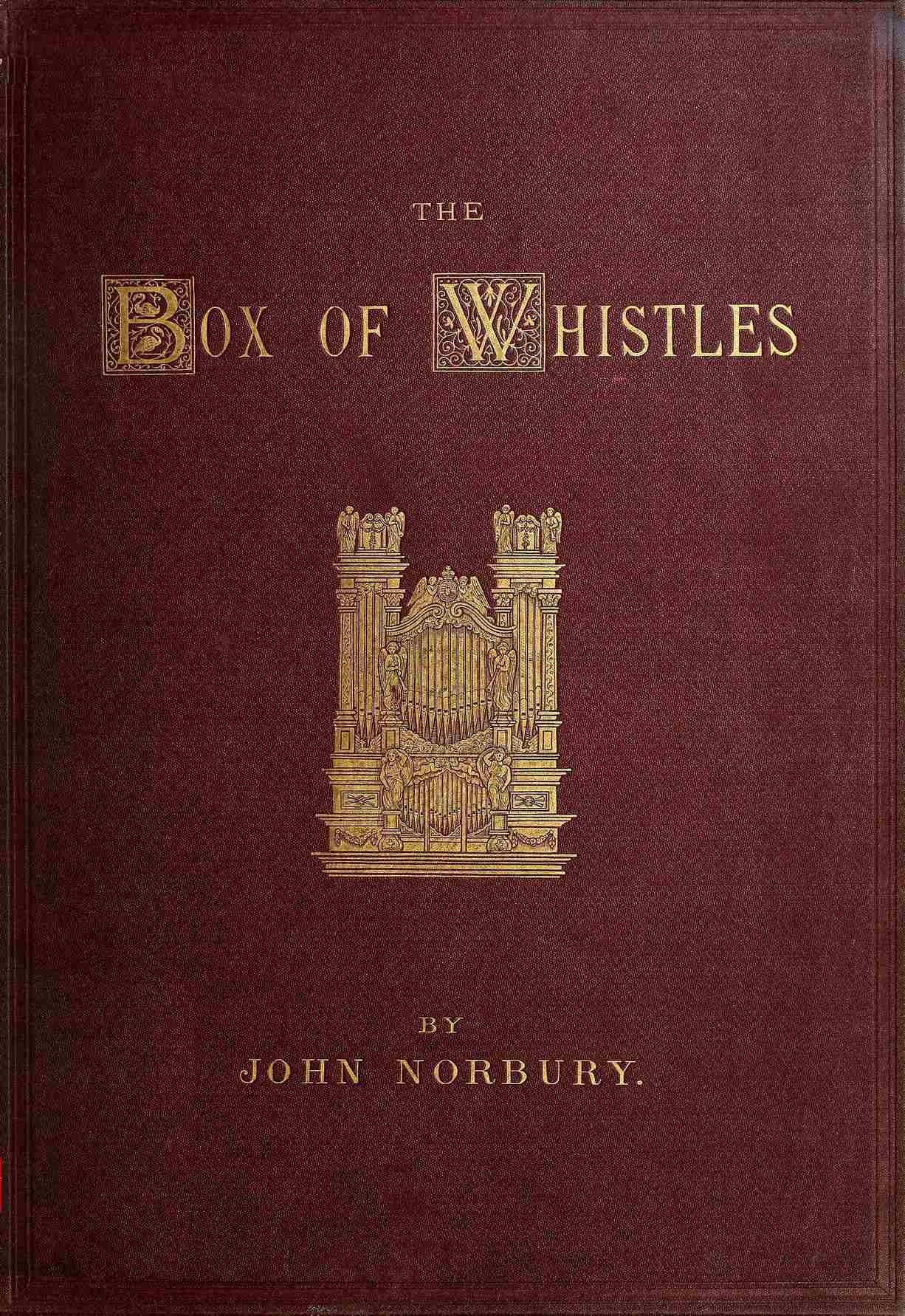
Among the many delights of being a volunteer for Distributed Proofreaders is having the privilege of working on some very beautiful and unusual old books. One such book is The Box of Whistles (1877), a short but fascinating study of the most exquisite pipe organ cases in Europe.

Author John Norbury, who did not actually play the organ but had long been fascinated by it, explains the title: “The Box of Whistles! what a quaint title! Yes, but a good one, I think, for this book, as the old organ of Father Smith’s in St. Paul’s, ‘The Box of Whistles,’ as Sir Christopher Wren contemptuously called it, was the first organ I ever saw, and which gave me my bent in the liking of things pertaining to the organ.” A color lithograph of Norbury’s own sketch of the original Smith organ in St. Paul’s Cathedral, London (now the much-renovated Grand Organ), is the frontispiece to the book.

The first part of The Box of Whistles provides an overview of the different types of organ cases. Norbury then gives his opinion on what constitutes a good organ case, fearing that he “may a little shock some persons with my views,” perhaps because he did not believe that the organ case should necessarily match the church’s architectural period, as long as it is of high quality. He touches on the number and arrangement of pipes and the use of separate choir cases. And he expresses definite opinions on how organ lofts should be arranged and what accessories they should have: “A looking-glass, which should be a part of the organ, and not a shaving-glass hung up with string and nails, should be fixed so that the player can see down the church; and something better than fastening with a pin to the side of the desk a shabby bit of paper with the list of music, &c., might be arranged.”

Then comes the true delight of The Box of Whistles: Norbury’s notes on various organ cases in England and on the Continent, with 20 color illustrations from his sketches. He reserves the highest praise for the organ case at St. Janskirk (St. John’s Cathedral) in ‘s-Hertogenbosch, The Netherlands, which he describes as “perhaps the finest in Europe.” It is indeed impressive – a monumental 17th-Century case in rich, dark wood, with elaborate carvings and a clock at its summit.

The Box of Whistles is a delightful tour of lesser-known but truly lovely works of art. Thanks to the volunteers at Distributed Proofreaders and Project Gutenberg, you can join that tour for free, anywhere, any time.

This post was contributed by Linda Cantoni, a Distributed Proofreaders volunteer.


The King’s Justice

November 1, 2023

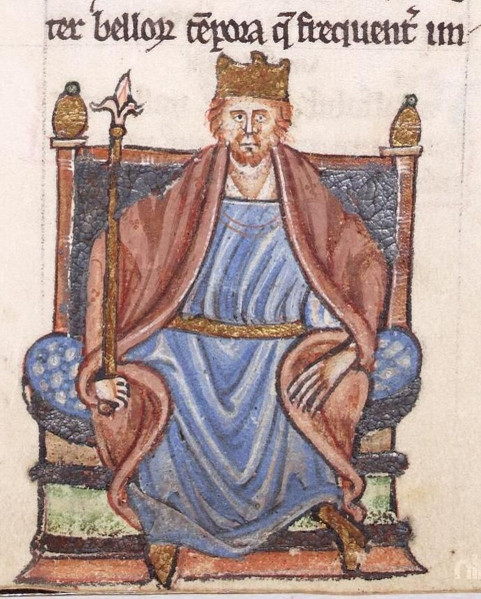
When William the Conqueror took the throne of England in 1066, he brought with him a body of legal principles and procedures that had been developed in Normandy over the preceding centuries. Norman law was then adapted on an ad-hoc basis to suit English conditions and customs. But over the next century, it became clear that this inefficient patchwork of laws and conflicting judicial authorities was neither viable nor just. By the time of Henry II, who took the throne in 1154, it was clear that reform was necessary.

Henry II consolidated the courts into a centralized system of King’s Courts with uniform rules of procedure. This was not entirely an altruistic act – he wanted to consolidate royal power by making judges answerable to him. He also sought to reduce the influence of the Church by cutting back on the jurisdiction of the ecclesiastical courts. But the result of Henry’s reforms was a much fairer and more consistent judicial process. And it provided a firm foundation for the modern common-law systems of the United Kingdom and those nations (such as the United States and the British Commonwealth countries) that derive their own legal principles from English law.

In order to promulgate these reforms, Ranulf de Glanvill (or Ranulph de Glanville), Chief Justiciar of England under Henry II, put together a compendium of the new legal rules (in Latin, the scholarly language of the day) for the edification of judges and lawyers. The Tractatus de legibus et consuetudinibus regni Angliae (Treatise on the Laws and Customs of the Kingdom of England) was written in 1187-1189 and is considered to be the earliest treatise on English law. Thanks to the volunteers at Distributed Proofreaders and Project Gutenberg, a 19th-Century English version, A Translation of Glanville, is available for those who are curious about justice in 12th-Century England.

The translation, by English barrister John Beames, is copiously annotated, comparing Glanville’s work with the legal developments that grew out of it. Being a product of the Middle Ages, Glanville’s treatise describes some rather primitive procedures and ideas. People classed as “villeins” – essentially slaves – had very limited rights, as did women. Although the jury system was beginning to gain traction, some lawsuits could still be determined by a trial by combat (i.e., a duel) as an alternative to court proceedings. Even a judge accused of giving a false judgment could be tried by a duel!

Another barbaric practice of the time was the trial by ordeal, which was still very much a part of the 12th-Century criminal justice system, though beginning with Henry II’s reforms it began to fade slowly. The accused was subjected to some extremely painful experience, on the presumption that if the person was innocent, God would preserve him or her from lasting harm. Common ordeals included holding or walking over red-hot irons, or plunging the accused’s hand into boiling water. Glanville notes that, in a case of “Mayhem” (defined as “the breaking of any bone, or injuring the head, either by wounding or abrasion”), the accused had to prove his or her innocence “by the Ordeal, that is, by the hot Iron, if he be a free Man—by water, if he be a Rustic.” If the resulting injury seemed to be healing within a few days, the accused was declared innocent; if it festered, the accused was declared guilty and subjected to whatever dreadful punishment was prescribed for the crime.

Among the most important and immediate reforms Glanville described, however, were the new procedures for bringing a civil lawsuit in the new King’s Courts. The treatise gives meticulous attention to what the plaintiff must allege, when the parties must appear, and how many “essoins,” or postponements, they could get, so that lawsuits could not be dragged on indefinitely. Glanville also discussed property issues, such as when and how a tenant can be removed from land – without the landlord resorting to forcible self-help – and how lawsuits regarding inheritances ought to proceed. These new rules brought order and fairness to what were once disorderly, arbitrary, and even violent processes.

The reforms Glanville expounded in his treatise brought England’s legal system out of the dark ages, making it fairer and more efficient, and led to the more enlightened legal systems of today. Distributed Proofreaders and Project Gutenberg are proud to make this Translation of Glanville freely available to all.

This post was contributed by Linda Cantoni, a Distributed Proofreaders volunteer.


Fire!!

October 1, 2023

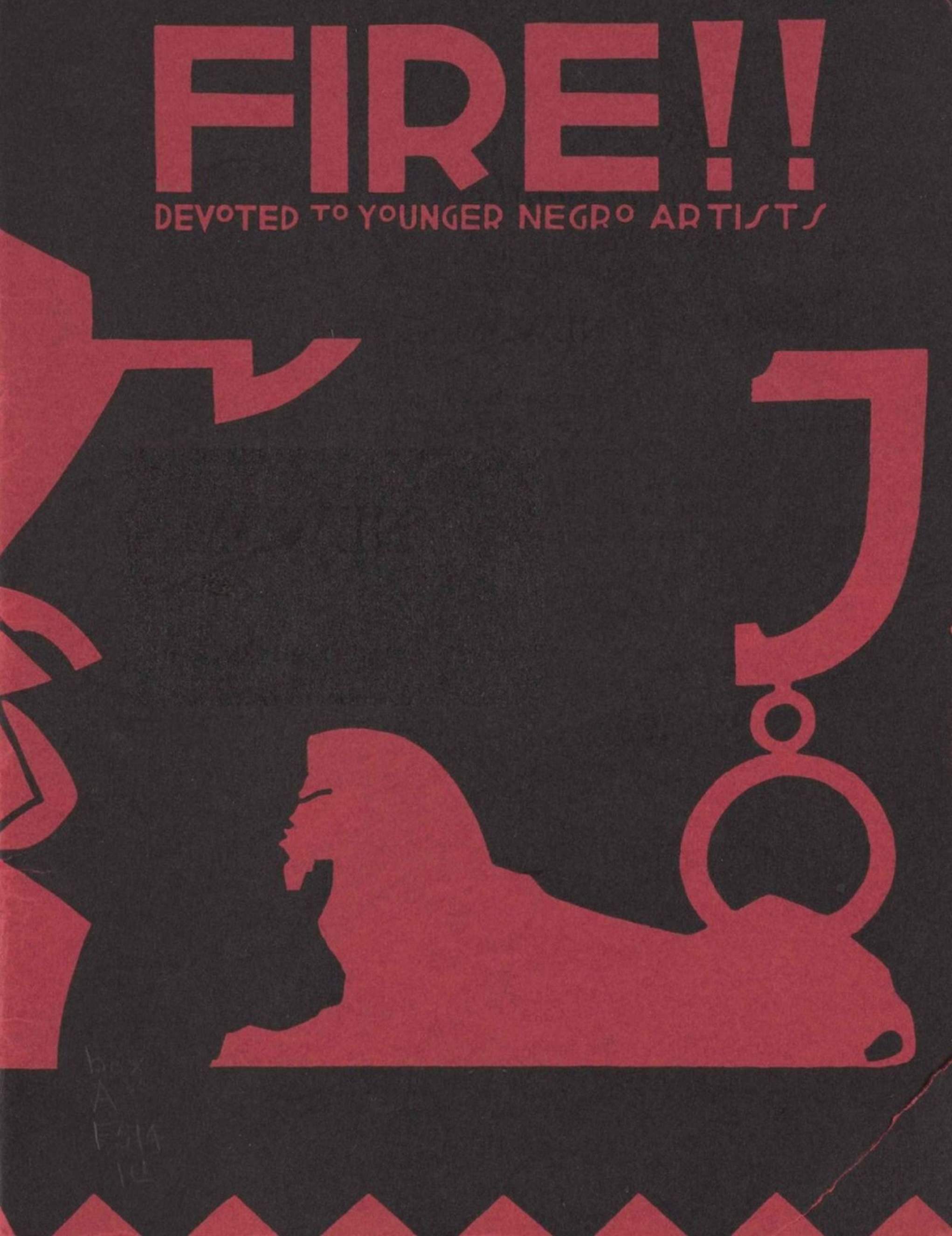
“FIREflaming, burning, searing, and penetrating far beneath the superficial items of the flesh to boil the sluggish blood.”

This is how the legendary magazine Fire!! begins. Some of the best and brightest African-American artists of the Harlem Renaissance created their stories, poems, plays, artwork, and essays to stir your blood. They didn’t want you to just read but also to feel their art!

The Harlem Renaissance was a rebirth of African-American culture that lasted mainly between 1920 and 1930. It began in Harlem, New York City, but it influenced Black artists in other places like Paris. It embraced every art form, from music to literature to art.

Fire!! was founded by many of the artists that were featured in its pages. They wanted to challenge the older ideas and give a place for new ones. These artists included poet Langston Hughes, novelist and playwright Zora Neale Hurston, novelist Wallace Thurman (also the editor), and poet Countee Cullen. The American painter Aaron Douglas created all of the artwork, including the cover above.

One of the poems by Hughes is “Elevator Boy,” which focuses on the reality of African-American employment at that time.

I got a job now
Runnin’ an elevator
In the Dennison Hotel in Jersey,
Job aint no good though.
No money around.
Jobs are just chances
Like everything else.
Maybe a little luck now,
Maybe not.
Maybe a good job sometimes:
Step out o’ the barrel, boy.
Two new suits an’
A woman to sleep with.
Maybe no luck for a long time.
Only the elevators
Goin’ up an’ down,
Up an’ down,
Or somebody else’s shoes
To shine,
Or greasy pots in a dirty kitchen.
I been runnin’ this
Elevator too long.
Guess I’ll quit now.

Hurston shares a short play (“Color Struck”) and a story (“Sweat”). Both of these explore relationship dynamics. The play also looks at intra-racial bias within the African-American community.

Part of Fire!!‘s fame lies in the fact that there was only one issue. Sales for it were low, and reception was poor. Some found it offensive because a few pieces dealt with prostitution and homosexuality. Other people disliked the use of Black slang (found in Hurston’s contributions). Probably the final, and ironic, nail in the coffin for Fire!! was that its headquarters went up in flames. Perhaps the magazine was just too hot for the times.

We are lucky to have it.

This post was contributed by Carla Foust, a Distributed Proofreaders volunteer.


Copyright Renewals

September 1, 2023

You may wonder why the free e-books that Distributed Proofreaders provides to Project Gutenberg are primarily older ones. That’s because they can make only public domain books available to the public. “Public domain” means that anyone can legally use the work for any purpose without having to get a copyright holder’s permission or to pay royalties. Karyn A. Temple, former United States Register of Copyrights, described the public domain as “part of copyright’s lifecycle, the next stage of life for that creative work. The public domain is an inherent and integral part of the copyright system. . . . It provides authors the inspiration and raw material to create something new.”

In the United States, copyright protection generally lasts for a period of 95 years for books published prior to 1978. This means that works published in 1927 and earlier are, as of this writing, automatically in the public domain. For works published in the United States before January 1, 1964, however, copyright renewal – a legal process that extends copyright protection for an additional 28 years – was required. Works published before that date whose copyrights were not renewed by the end of their 28th year entered the public domain.

As an example, if a work was published on December 1, 1963, a copyright extension could be granted to November 30, 1991. If the extension was not renewed, the work would enter the public domain on December 1, 1991.

There are a few exceptions to the copyright renewal requirement. For example, works published by the United States Government are not subject to copyright, so renewal is unnecessary. Additionally, works published by authors who died before the end of the 28th year from the work’s publication date are automatically renewed from the date of their death for 28 years, for the benefit of their heirs. And copyright renewal does not affect the automatic public domain status of works published more than 95 years ago.

For works published before January 1, 1964, but after the current 95-year public domain date, the Copyright Renewal summaries produced by Distributed Proofreaders and posted to Project Gutenberg can help determine whether a work’s copyright was not renewed, placing the work in the public domain. That enables Distributed Proofreaders and Project Gutenberg to make the work freely available to the public, like Margaret Sanger: An Autobiography, by Margaret Sanger, published in 1938, and All in the Day’s Work: An Autobiography, by Ida M. Tarbell, published in 1939, whose copyrights were not renewed.

Copyright renewal summaries have also proven valuable to other important cultural repositories. HathiTrust, a large nonprofit digital library, recently asked Distributed Proofreaders to prepare a series of artwork copyright renewals from 1965 to 1977. Their team started the process by providing an initial round of proofreading and were extremely grateful for Distributed Proofreaders’ help in preparing these renewal summaries for posting to Project Gutenberg. Among the lovely works that HathiTrust was able to release based on that renewal information are Four Seasons in Your Garden, by John C. Wister, illustrated by Natalie Harlan Davis (1938), and Flipper: A Sea-Lion, by Irma S. Black, illustrated by Glen Rounds (1940).

As with all copyright issues, there are complexities to copyright renewals. In order to make certain that a work is in the public domain, Project Gutenberg has established requirements for copyright clearances based on non-renewal, termed “Rule 6 clearances.” Volunteers seeking clearance under this rule must thoroughly research several things:

  • the author’s nationality, pen name, date of death if applicable, and other biographical information;
  • the date and location the work was first published and other details such as serialization, alternate titles, inclusion in collections, etc.;
  • whether and when there were any copyright renewals.

Complete information about this and all of Project Gutenberg’s copyright rules can be found on their Copyright How-To page.

All the U.S. copyright renewal volumes that Distributed Proofreaders volunteers have created, proofread, and posted to Project Gutenberg can be found here.

This post was contributed by Richard Tonsing, a Distributed Proofreaders volunteer.


What Are You Waiting For? (A Poem)

August 1, 2023

Are you enthralled with challenges that exercise the mind?
And do you feel some comfort with the literary kind?

Then let me tell you ‘bout this place where you’ll feel right at home.
Come join us for this worthy cause; there’s no more need to roam.

This place is called DP for short because the name is long,
And if I could, I’d add some notes and sing it like a song.

The worthy cause will bring some books to many folks indeed,
And you could play a key role in providing what they need.

If you’ve been told or know yourself that you’ve got special skills,
Then don’t wait ‘round; put them to use and reap in all the thrills.

Please take a seat so I may share the features of DP;
I think you’ll see your time spent here is better than TV.

There’s lots to put your brain to work while feeling so sublime,
Plus knowing all the good it does makes worthy all your time.

Have you been told that you excel at picking out details?
Then proofing might be just the thing to open up your sails.

Sail free and wide through punctuation, noting scanned mistakes.
Your bounty comes with knowing that your brain is all it takes!

Then share the funny, weird, inspired phrases that you find
On the friendly, helpful, worldwide forum where great minds are aligned.

Our forums are a gathering place for questions and support,
But socializing does take place, I’m happy to report!

Your questions are most welcome so feel free to post your plea;
We do not want you feeling you’re completely lost at sea.

Take one step more and join a team; there’re many you can choose.
So find a team that makes you smile and complements your views.

I have to say without a doubt, Team Diehards is my fave.
Those hard, forgotten projects are the ones we try to save.

If you like organizing things displayed all nice and square,
Your joy may be to format books, come try it if you dare.

You’ll use a nice assortment of some very nifty tags
To mark the words and wordy parts so well you’ll want to brag.

Our managers and processors pull everything together.
This type of work may suit you fine no matter what the weather.

Come rain or shine, this type of work is certainly rewarding,
Enough to make you jump from bed all fresh to start your morning.

And last, not least, there is a space where folks enjoy Smooth Reading.
Please sit right down and read a book; it’s key to us succeeding!

So if you love a challenge for your literary mind
And working with an online group whose goals are quite aligned,

Please join us at DP today; there’s so much to explore.
The final question without doubt: What are you waiting for?

This poem was contributed by Susan E., a Distributed Proofreaders volunteer.


Celebrating 46,000 Titles

July 3, 2023

This post celebrates the 46,000th unique title Distributed Proofreaders has posted to Project Gutenberg: the fifth and final volume of The English and Scottish Popular Ballads by Francis James Child. Congratulations and thanks to all the Distributed Proofreaders and Project Gutenberg volunteers who worked on these interesting and complex projects!

The 19th Century saw a great resurgence of interest in old English and Scottish folk songs. Fearing that these songs might be forgotten, a number of scholars, amateur and professional, sought to preserve them as best they could. Today we celebrate these efforts in our 46,000th title, the final volume of The English and Scottish Popular Ballads, a monumental five-volume study edited by Harvard professor Francis James Child, collectively known as the Child Ballads.

Published from 1882 to 1898, the Child Ballads are a fascinating collection of 305 traditional English and Scottish ballads that Child compiled along with their American variants. These ballads contain the roots of much of English-language folk music, and many have inspired and been recorded by modern folk artists.

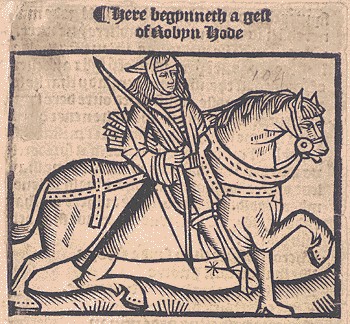
From a 16th-Century edition of A Gest of Robyn Hode (Child Ballad 117)

Child, being a specialist in English poetry, focused primarily on the lyrics of the ballads. But he did include, in the fifth volume, an index of published ballad music, along with an appendix containing the tunes of 55 of the ballads. (You can play these tunes as mp3 files in the HTML version of the e-book at Project Gutenberg.) Child also drew on the work of English musicologists, acknowledging his debt to the Reverend Sabine Baring-Gould, who famously compiled both the music and the lyrics of songs from Devon and Cornwall in Songs of the West.

Child’s scholarly work introduces and thoroughly annotates each ballad, closely examining textual variations in the various sources. Famous ballads include “Sir Patrick Spens” (Ballad 58, 18 versions) and “Bonny Barbara Allan” (Ballad 84, three versions). Several dozen of the ballads concern the adventures of the legendary Robin Hood.

Many Distributed Proofreaders volunteers have worked hard since 2007 on the varied challenges of the Child Ballad volumes. We are proud to celebrate the concluding volume of this important work as our 46,000th title posted to Project Gutenberg.

This post was contributed by Linda Cantoni, a Distributed Proofreaders volunteer.


The Child Ballads at Project Gutenberg

Volume I (Ballads 1-53)
Volume II (Ballads 54-113)
Volume III (Ballads 114-188)
Volume IV (Ballads 189-265)
Volume V (Ballads 266-305, plus indices and appendices)


The Heathery

June 1, 2023

“I’m sure I should be myself were I once among the heather on those hills.” — Cathy in Wuthering Heights

England’s Yorkshire moorland can be a wild, windy, and wet place, but in late summer it bursts into a breathtaking sea of the purple heather that Cathy yearned for as she lay dying and pining for Heathcliff. A fragrant evergreen, heather is the subject of an important and beautiful series of monographs, The Heathery, by early 19th-Century botanist H.C. Andrews. Thanks to the volunteers at Distributed Proofreaders and Project Gutenberg, all six volumes are now available to enjoy online.

Andrews was not just a botanist. He was also a talented artist who drew, colored, and engraved the illustrations for his works, and even published his books himself. The Heathery series, filled with his marvelously detailed color illustrations, was originally published between 1804 and 1812. It was so well regarded that a second edition, “corrected and enlarged,” was published in 1845; that is the edition at Project Gutenberg.

Several varieties of heather are native to the British Isles, the most common being ling or Scotch heather. But in The Heathery Andrews gives special attention to the many varieties in the genus Erica that had recently been imported to Britain from the Cape of Good Hope in South Africa. Andrews mentions in his introduction to The Heathery that there were about 137 identified varieties. He notes, however, “This is certainly far short of the number at present cultivated in Britain; … we may fairly conjecture that the Genus is by no means bounded by the species we at present possess.” He was right: today there are over 850 identified species of Erica.

Andrews took a scientific approach in his monograph. Each description in The Heathery is presented in Latin and English. And, in his richly-colored illustrations, Andrews depicted not only the entire plant, but also its constituent parts, such as leaves and blossoms, in magnified form.

Distributed Proofreaders volunteers have contributed to Project Gutenberg several other botanical works written and illustrated by Andrews:

  • Coloured Engravings of Heaths, published in four volumes from 1794-1830. Volumes 2 through 4 are available at Project Gutenberg; Volume 1 is in progress at Distributed Proofreaders.
  • The Botanist’s Repository, a 10-volume work on “new and rare plants,” published from 1797-1812. Volumes 1 and 2 (combined in one volume) are available at Project Gutenberg; the remaining volumes are in progress at Distributed Proofreaders. Andrews’s father-in-law, John Kennedy, of the prominent Lee and Kennedy plant nursery, helped him with the descriptions of the plants.
  • A lovely monograph on Roses, published from 1805-1828.

Distributed Proofreaders and Project Gutenberg are proud to have preserved, for the free use of anyone anywhere, these exquisite works of botany.

This post was contributed by Linda Cantoni, a Distributed Proofreaders volunteer.