A Day at Waterloo

January 7, 2015

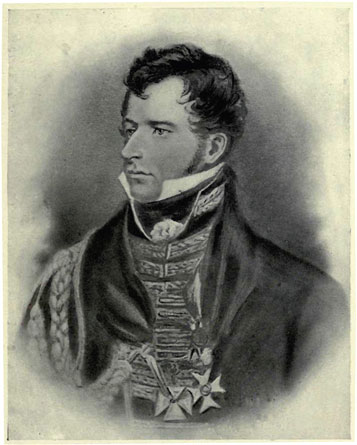
Early last year I downloaded A Week at Waterloo in 1815, by Lady Magdalene De Lancey, from Project Gutenberg. I was soon caught by the story, written by the widow of Colonel Sir William Howe De Lancey.

De Lancey

Col. Sir William Howe De Lancey

Sir William was mortally wounded in a skirmish, the day before the big battle at Waterloo, when he was riding at Wellington’s side. He was hit in his side by a cannonball that threw him off his horse. He was not killed immediately, but survived his wound for six days. When his men saw he wasn’t dead yet, they moved him to a barn, where he was left for several hours, till the fight was over, and he could be transported to a nearby farm.

When his wife, who was staying in Antwerp, heard that he was wounded, or maybe dead, she didn’t hesitate to look for transport that would bring her to her husband. When she finally got there, after much trouble, she was relieved to find him still alive.

The cannonball left a gigantic bruise on Sir William’s side. In those circumstances, nobody could really tell the severity of his wound. Lady De Lancey nursed her husband, never leaving his side. But he didn’t make it. After his death, examination revealed that the cannonball had broken several ribs, which had penetrated his lung.

I was very much touched by this story. Sir William seemed to have been a good man, and his comrades, his superiors, and his family speak very highly of him in this memoir. You can find a full review of it here.

Now to my own story. A few weeks after I read the book, my dog died. I was very sad, and so was my son. We felt lost in the house. We decided it would do us good to get out and make a day-trip. I proposed that we should go to Waterloo, as it is only an hour’s drive from our place, but I had never been there. So the next Saturday we went.

memorial

Waterloo Memorial at Evere

First we visited the cemetery in Evere, where the British casualties are entombed, and there is a beautiful memorial monument on top of the tomb. The illustration is on page 118 of the book. If you look at it, you can see on the left stairs going down. This is where you enter the tomb, and inside there are niches containing the remains of the officers. I soon found William De Lancey’s last resting place, and stood a few minutes in silence, honouring this brave man, and his fellow officers and soldiers. (The soldiers with lower rank are also buried there, outside the tomb, but within the outer walls that you can see around the monument.)

Afterwards we went to Waterloo, where we visited the Wellington Museum, located in the house where Wellington had his headquarters. On a wall in one of the rooms was a newspaper page, and in the bottom right corner I could read amongst the names of the casualties: William De Lancey, mortally wounded.

We also climbed the stairs to the top of the Waterloo Lion, from where we had a view over the entire battlefield. Later we also visited Napoleon’s last headquarters.

This day was a very interesting experience, being at the place where so many gave their lives. But it was William De Lancey and his wife who touched my heart.

Thank you, all the members of the Distributed Proofreaders team, who worked so hard to make this book available for the world!

This post was contributed by Eevee, a DP volunteer.


Christmas: Then and Now

December 10, 2014

Copyright restrictions prevent Distributed Proofreaders from working with recent publications so, by the very nature of what we do, we constantly look back towards the past and compare our present circumstances with reports of similar experiences from times gone by.

Now that the Christmas season is upon us, I wonder if the Christmas spirit has been the same in past times, if people a hundred and fifty years ago had a similar spirit or performed similar practices in their Christmas festivities as we do today.

cover

This came to my mind when post-processing Christmas Stories from French and Spanish Writers, by Antoinette Ogden, an anthology published originally in Chicago, in 1892, containing nine French and six Spanish tales, translated into English, and written several decades earlier. In these fifteen stories I found features that were similar to, and others that were a bit different from, our present way of celebrating Christmas.

Religious practices, Catholicism being the main religion of both France and Spain, are evident in most of these tales. Where religion is not present, Christmas appears more like a social event. In the French tale “I Take Supper with My Wife,” by Gustave Droz, the central point is how charming it is to have a quiet Christmas dinner at home, when it was expected to be had outside in a social gathering. And in the delightful story of Alphonse Daudet, “The Three Low Masses,” the crux is the clash between religious observance and gluttony.

In fact, Christmas is a traditional time for gluttony. Food is present in most of the French tales, but not in the Spanish ones, which usually depict less affluent people. Gift giving is not central in any tale, and there are many in which the idea of gift giving is totally absent (what a difference from the consumerism of our own times!). Christmas trees are not to be found, except very tangentially in a Spanish tale when describing the habits of an upper-class family. Christmas mangers are far more common, and even the yule log is to be found in the very title of the French tale “The Yule Log,” by Jules Simon, and also mentioned in the Provençal form of cacho fio, in Daudet’s sad tale, “Salvette and Bernadou.”

One thing that surprised me is the deep dramatic content in tales that are expected to be gentle, full of optimism, and suitable for children. In half of the tales of this collection, death is present, usually at the end. But in Benito Pérez Galdós’s “The Mule and the Ox,” it is present at the very beginning, most of the tale happening around a child’s coffin. Nevertheless it is a gentle story, where fantasy and dream, the more child-like properties of a tale, do soften and brighten the raw sadness of the scene.

Fantasy and dream play a principal part in many of the other stories too. “A Christmas Supper in the Marais,” by Daudet, is no more than a dream of what a Christmas Eve party would have been in pre-Revolution times among the French nobility. Star characters in “A Tragedy,” by Antonio Maré, and “The Princess and the Ragamuffin,” by Galdós, feature figurines and puppets interacting with humans. And the innards of heaven and hell make their appearance as a result of the fiasco in “The Three Low Masses.”

In all these stories Christmas Eve is more important than Christmas Day, just as in present times. Christmas Eve is pictured as a warm familiar gathering for those in deprived classes, evolving into a more social and public gathering when we move to an upscale world. This is the central point of “The Poet’s Christmas Eve” by the Spanish author Pedro Antonio de Alarcón, where the poet, unwilling to go to the conventional party he is expected to attend, takes refuge in a café where he reflects, to the lyrics of a seasonal carol, on the differences between his childhood and his present adult life.

Being Spanish myself, I was amused to find that the very same carol I used to sing at Christmas when I was a child was in use almost two centuries earlier. In reading the English translation I was able to recall, and hum, the Spanish words:

To-night is Christmas eve;
To-morrow is Christmas day.
Maria, fetch the jug of wine;
Let’s be merry while we may.

Esta noche es Nochebuena
y mañana Navidad,
dame la bota, María,
que me voy a emborrachar.

and:

Christmas comes,
Christmas goes;
But soon we all shall be of those
Who come back — never!

La Nochebuena se viene,
la Nochebuena se va,
y nosotros nos iremos
y no volveremos más.

In my early years, we sang this last stanza with other children in the street as a plea for some coins. The meaning was, “Tip us and we won’t come back again,” that is, we won’t annoy you any more, but the poet makes a very different reading of these last verses:

But soon we all shall be of those
Who come back — never!

Horrible thought! Cruel sentence, the definite meaning of which was like a summons to me,—death beckoning me from the shadows of the future. Before my imagination a thousand Christmas Eves filed by, a thousand hearths were extinguished, a thousand families that had supped together ceased to exist,—other children, other joys, other songs, lost forever; the loves of my grandparents, their antiquated mode of dress, their remote youth, the memories thereof that crowded upon them; my parents’ childhood, the first Christmas celebration in our home, all the happiness that had preceded me! Then I could imagine, I could foresee, a thousand more Christmas Eves recurring periodically and robbing us of our life and hope,—future joys in which we should not all take part together, my brothers scattered over the earth, my parents naturally dying before us, the twentieth century following upon the nineteenth!

How depressing! However, if we use Christmas time to reflect on our own lives, to remember the past, to foresee what is to come, especially if it is not good or amiable, when the future comes it may find us prepared, aware and resolute.

Considered globally, the Christmas festivities in these stories are not so different from ours, even if there are some differences in the detail. What these stories show is that they are not Christmas tales for children, but for grown-ups. That they are not, most of them, tales to be read to the family around a Christmas tree or a Christmas manger, but literary works to be savoured alone; tales not only to be enjoyed but to be reflected upon.

The main components of the Christmas spirit — hope, good will, forgiveness, fair-play with men and God, attention to the weak and the poor, generosity and unselfishness — are indeed present as a central theme. Christmas is a time of year to show the best of ourselves. It was already so in the 19th century. It should be so in the 21st century.

My best wishes for a merry (and thoughtful) Christmas to all members of Distributed Proofreaders.

rpajares (with thanks to jjz for overseeing my English)


Because We Remember

November 11, 2014

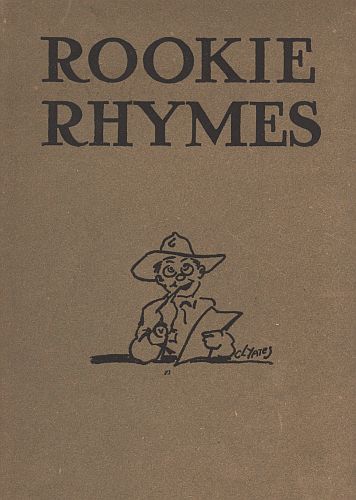
Rookie Rhymes cover

At Distributed Proofreaders we are all about preserving history. We believe in saving the classic, the good, the dry, the funny, and even the bad. A few years ago, it was my honor to pick up Rookie Rhymes to post-process for Veteran’s Day.

Written by The Men of the 1st. and 2nd. Provisional Training Regiments, Plattsburg, New York, May 15—August 15 1917, it is a short book. Some of these poems and songs are funny:

STANDING IN LINE

When I applied for Plattsburg I stood for hours in line
To get a piece of paper which they said I had to sign;
When I had signed I stood in line (and my, that line was slow!)
And asked them what to do with it; they said they didn’t know.

And when I came to Plattsburg I had to stand in line,
To get a Requisition, from five o’clock till nine;
I stood in line till night for the Captain to endorse it;
But the Q. M. had one leggin’ left; I used it for a corset.

We stand in line for hours to get an issue for the squad;
We stand in line for hours and hours to use the cleaning-rod;
And hours and hours and hours and hours to sign the roll for pay;
And walk for miles in double files on Inoculation day.

Oh, Heaven is a happy place, its streets are passing fair,
And when they start to call the roll up yonder I’ll be there;
But when they start to call that roll I certainly will resign
If some Reserve Archangel tries to make me stand in line.

They are poignant:

GO!

Your lips say “Go!”
Eyes plead “Stay!”
Your voice so low
Faints away
To nothing, dear—
God keep me here!

God end the war,
And let us two
Travel far
On Love’s road, you
And I in peace,
Never to cease.

Your lips say “Go!”
Eyes plead “Stay”—
Ah, how I know
What price you pay.

and

EUREKA

It may be from hot Tallahassee,
It may be from cold northern Nome,
But there’s nothing that can be compared with
That BIG little letter from home.

They are even dark at times, with a glimpse of the blackness of war, with temptations such as desertion found in “The Ballad of Montmorency Gray,” and far worse found in “The Three,” and falling beneath what you know is right. (But he doesn’t.)

These men opened their notebooks and let the rest of the world see their thoughts, their fears, and their strength. Because of men and women like these, most of us do not have to face these same fears. So, thank you men of the Regiment, thank you those who are willing to stand, thank you for facing your fears so that I can whine about the cost of eggs, the weather, and kiss those I love goodnight every night. We remember.

This post was contributed by a DP volunteer.


DP on Twitter

November 7, 2014

logo

Distributed Proofreaders is on Twitter! Now you can keep up with DP’s milestones, new blog posts, and other news. Just follow @DProofreaders to stay in the know.


Wilson’s Tales of the Borders and of Scotland

October 22, 2014

Wilson's Tales

Distributed Proofreaders has posted the last of the 24 volumes of Wilson’s Tales of the Borders and of Scotland: Historical, Traditionary, and Imaginative. The original 66 stories were collected by John MacKay Wilson (1804-1835). He began publishing them weekly in 1834 as editor of the “Berwick Advertisor.” His unexpected death at age 31 the following year left a widow with an inadequate income. The executors of the estate and friends of the family then gathered a further 233 tales, which were published for her support. Alexander Leighton, one of the major contributors of stories, published the collection in the 24-volume set which is now complete at Project Gutenberg.

The short stories of these collections paint vivid pictures of life in the Borders — deaths and marriages, shipwrecks and celebrations, the ordinary and extra-ordinary events in the lives of people living on the edge of both Scotland and England. These details and more about the tales and the editors of the collections can be found at The Wilson’s Tales Project.

Hundreds of Distributed Proofreaders volunteers collaborated for over ten years to ensure the wide availability of these delightful and historical tales. The first volume was posted in February of 2004, and the last in September of 2014. There were several challenges facing the DP team in their effort to accurately render the tales as the editors intended. In addition to period spelling and grammar, the tales are full of words from the local dialect and dialogue modified to help the reader hear the border speech patterns. These contribute significantly both to the charm and the historicity of the tales, but also caused thousands of words in each volume to fail traditional spell-checkers and to need verification, sometimes with research. Congratulations to the Distributed Proofreaders team, who have continued the work of Mr. Wilson to preserve these stories for future generations to enjoy.

This post was contributed by a DP volunteer who worked on Wilson’s Tales.


Typesetting

October 8, 2014

Typesetting is a topic close to the hearts of many DPers, and the foundation on which the books we work on were built.

I learnt typewriting on a manual typewriter when I was at school. A classmate secured a job as an editor with a magazine based on the skills she learnt in the course we were doing. I was so envious! Editor on a magazine, with no work experience, and no qualification. A few years earlier, when asked by a teacher what I wanted to be, I replied I wanted to be a journalist, not because I wanted to be a writer, but because I wanted to work on newspapers, with those monstrous printing presses and the glorious smell of ink, and fiddly bits of lead.

I did manage to become a journalist and editor, but the huge presses were ageing, and typesetting was becoming regarded as no more than wordprocessing on a computer. I remember being chastised for the miles of galley paper that spewed out of the printer one time when I forgot to close off the heading command properly and ended up with a whole article in 72-point Times, a somewhat expensive mistake as rolls of galley proof paper were not cheap.

setting type

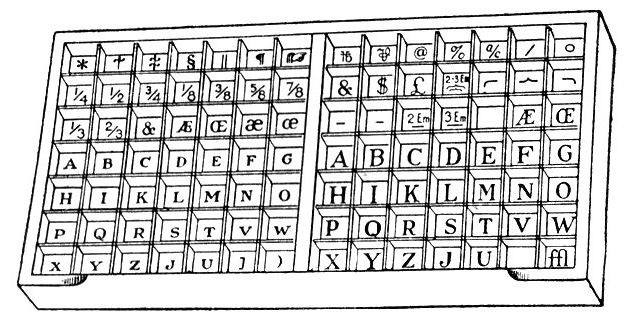
Working on the book, Typesetting, by A. A. Stewart, for Project Gutenberg, I couldn’t help but reflect and wish I could have been an apprentice hand compositor and daydream about what the publishing industry must have been like when each character had to be manually placed in the composing stick; when the characters of each font were housed in separate type cases; when measurements for line lengths, page sizes, and margins, had to be mentally calculated quickly and accurately; when justification of lines was achieved by manually placing a mix of different space widths characters (and even resorting to “pieces of paper or thin card” if metal thin spaces were not at hand).

type case

Imagine being able to set type and be able to read the text upside down; to have the dexterity to take a piece of type from the case and place it in the case; to proofread the lines of type and correct mistakes before justifying the lines.

upside down

How arduous the correction process, where “Simple errors like the exchanging of one type for another of the same width, the turning of an inverted character, or the transposition of letters or words, are corrected by pressing the line at both ends to lift it up about one-third of its height and picking out the wrong types with the finger and thumb. The line is then dropped in place and the right types put in.”

Not to mention having to wash the type and placing each character back into the proper slots in the proper cases, so that the type pieces could be used over and over.

Sitting at my computer, selecting fonts, messing about with HTML and CSS coding, I still want to be an apprentice hand compositor. “Typesetting, a primer of information about working at the case, justifying, spacing, correcting, making-up, and other operations employed in setting type by hand”, is an excellent training manual that gives me an insight into what I would have been doing had I been able to achieve my dream.

This post was contributed by a DP volunteer.


Introducing . . . Harrison Ford! (1918 Edition)

September 24, 2014

cover

I was looking for an online copy of The Cruise of the Make-Believes by Tom Gallon to find out if a certain bit of punctuation was a colon or semi-colon (semi-colon, by the way), and, as one does when Googling, I found other links with the same title: one was to Turner Classic Movies and another to the Internet Movie Database. Yes! My book was turned into a movie in 1918. A silent movie!

I pointed the link out to a friend, and she noted who one of the leading men was: Harrison Ford. Now we both knew that in 1918, it wasn’t Han Solo or Indiana Jones or the President. Time for more searching.

This not-at-all make-believe Harrison Ford was born in 1884 in Kansas City, Missouri. He started in the theater on the east coast before moving to Hollywood in 1915. He was in over forty films. His final was his only talkie, Love in High Gear, which was released in 1932. He then took his career back to the stage and also began directing there. During World War II, he toured with the USO. He died in 1957, without having had children, and is no relation to that other Harrison Ford.

Harrison Ford

One of his hobbies was collecting old books . . . a man after DP’s own heart. I’ve no idea why this book was chosen to be made into a movie. It seems no better nor worse than any of our other romances. Old books, you just never know where they will take you. This one took me on a hunt to find the first dreamy Harrison Ford.

You can read more about this Harrison Ford here or here or here, all of which I used for my information with gratitude.

This post was contributed by a DP volunteer.


Across America by Motor-Cycle

August 21, 2014

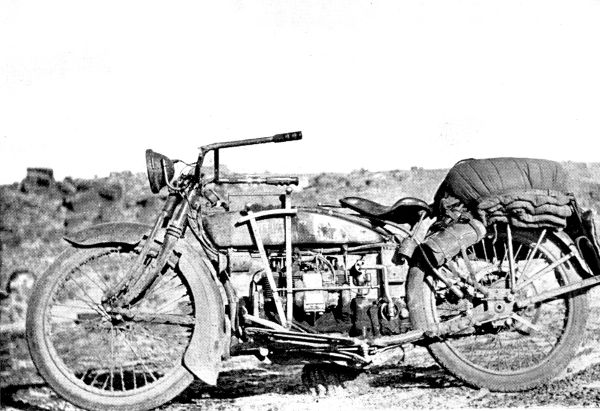
I proofed a lot of Across America by Motor-Cycle, by C.K. Shepherd, but from time to time other pesky proofreaders would grab some pages, so I was happy when it was posted to Project Gutenberg and I could at last read the entire book.  The author was an Englishman who decided just after World War I to ride “across America by motor-cycle,” going from New York to San Francisco. Not something that would raise too many eyebrows these days, but back then there were very few paved roads. “Ninety-five per cent. or more, however, of America’s highways are dirt roads, or what they are pleased to call ‘Natural Gravel.’ In many cases they comprise merely a much worn trail, and as often as not a pair of ruts worn in the prairie. Very often, instead of being a single pair of ruts, there are five or six or perhaps ten, where individual cars have manifested their own personality. When this multiplicity of ruts crosses and re-crosses in a desperate attempt to achieve the survival of the fittest, the resultant effect on the poor motor-cyclist is somewhat disconcerting.”

Things aren’t much better in the cities: “I have seen places in Broadway where the tram-lines wander six or seven inches above the surface of the road and where the pot-holes would accommodate comfortably quite a family of dead dogs within their depths.”

“There are two classes of roads and two only. They are good roads and bad roads. Any road, anywhere, in the whole of the United States of America (and, I presume, her Colonies as well) is a ‘good’ road if you can ‘get through.’ The remainder are bad.”

Lizzie

“Lizzie” in the Petrified Forest, Arizona

Of course these roads were a little rough on his motor-cycle (nicknamed “Lizzie”). He bought it new in New York: “The machine was entirely overhauled on four occasions between the Atlantic and the Pacific, and on three of these by the recognized agents of the manufacturers. The engine cut-out switch was the only part of the machine that did not break, come loose, or go wrong sooner or later. I was thrown off 142 times, and after that I stopped counting! Apart from that I had no trouble.”

Protective gear? “I dispensed entirely with the use of goggles from beginning to end, and except at stops in large towns on the way I wore no hat.” No, they hadn’t heard of helmets back then!

The book describes his journey across country, and makes very entertaining reading, although the author does state, “The journey was comparatively uneventful. I never had to shoot anybody and nobody shot me! In spite of the relative wildness and barrenness of the West, there were always food and petrol available in plenty. I spent most nights at the side of the road and experienced neither rheumatism nor rattlesnakes.”

This post was contributed by rpc, a DP volunteer.


Celebrating 28,000 Titles

August 16, 2014

Celebrating 28.000 titles posted to Project Gutenberg by Distributed Proofreaders.

Distributed Proofreaders has posted its 28,000th title to Project Gutenberg, The Mystery of Choice, an 1897 collection of short stories by Robert W. Chambers.

Thy Mystery of Choice - CoverChambers, who was born in Brooklyn, New York, began his career as an artist, and spent his early twenties in Paris, where his work was exhibited at the 1889 Salon. He came back to New York and found work as a magazine illustrator, but soon turned his hand to writing. He had his first and best success with The King in Yellow, a collection of supernatural tales that is said to have influenced H.P. Lovecraft and other noted writers of the horror genre.

The Mystery of Choice continues the horror theme with seven tales of murder and the macabre, some set in the atmospheric Brittany region of France. The collection also contains some of Chambers’s poetry, and concludes with a florid love-poem, “Envoi.”

Congratulations to the Distributed Proofreaders team who made this milestone possible!

This post was contributed by Linda Cantoni, a Distributed Proofreaders volunteer.


Invaders from the Infinite

August 7, 2014

On May 14, 2014, my adventure into a renewed interest in science fiction began. A Distributed Proofreaders volunteer had started a forum thread that requested information about the title of a science fiction book about dog-like invaders of earth. He could not remember the title of the book. Now, I forget titles too, especially to old songs and books of ancient (well, 30 to 50 years ago) fame. I guess this happens to other people too, because there were several posts from people who tried to help. Finally another volunteer answered with a post saying to try Invaders from the Infinite, by John Campbell. The first volunteer answered that it wasn’t the right book, but that he was adding it to his reading list. That settled it: if the book was good enough for them, it was certainly good enough for me.

Invaders cover

The adventure began. I downloaded the book in Kindle form and put it on my Kindle on May 25, 2014. By May 27, I had read it; and in it I traveled from earth to the far end of the galaxy, and then beyond the present universe as we know it to a distant, far distant place of huge suns and planets.

The story begins innocently enough. An earth-guard space ship is approached by an alien ship whose occupants are telepathic creatures who have evolved from a canine race. They gather information from the pilot about earth and streak on to New York City. There they meet the trio of Arcot, Morey, and Wade, who happen to have a research ship that can also be made into a first-class fighting vessel. It turns out that the world of the telepathic people is being attacked by aliens who also have the location of earth and another world in its war plans. Can earth help? And instead of waiting for the politicians to OK an expedition, the Triumvirate decides to go themselves.

The planet of the telepathic people is preparing for war with the only weapon they have. Arcot and his companions help to improve the weapon and duplicate it, so that they can leave the world to help other planets and search for more weapons with which to fight an almost invincible enemy who seems intent on eliminating all intelligent life other than their own. Their adventure takes them to the far corners of the galaxy and immerses them in a dirty war, which forces them to develop their own weapons to a point where they can build a new and more powerful ship that can harness the energy of the universe.

Invaders from the Infinite was released to Project Gutenberg on December 20, 2006, as e-book #20154. I would recommend the book to anyone with an interest in physics, cosmology, or just science fiction.

This post was contributed by Quentin Johnson, a DP volunteer.