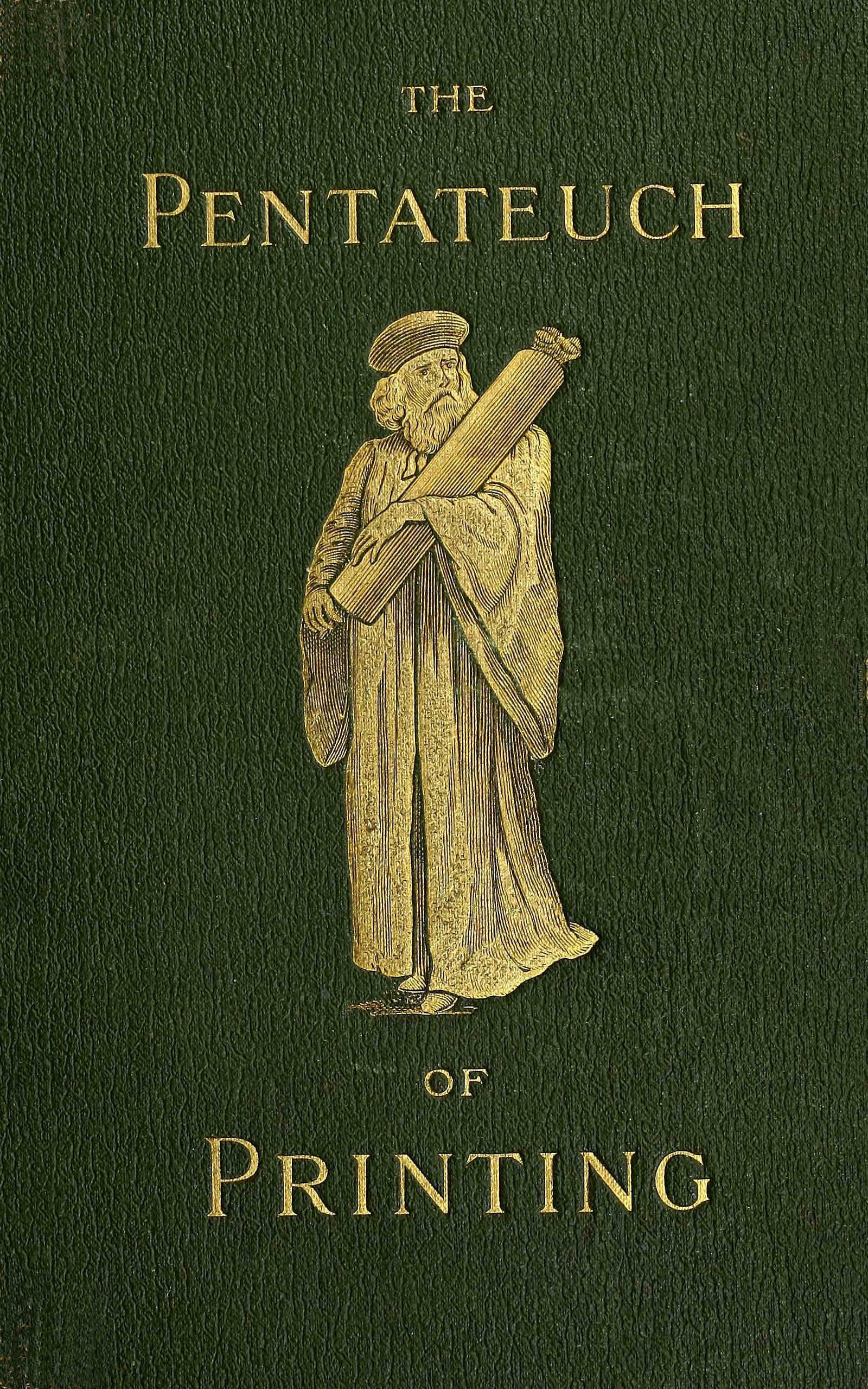
Distributed Proofreaders is 26 years old today, and Hot off the Press is celebrating with a fitting contribution to Project Gutenberg: The Pentateuch of Printing by English typographer William Blades.
This generously illustrated book covers the history of Western typography and printing from ancient times to the late 19th Century. It is fancifully arranged like the Pentateuch (first five books) of the Bible, with five chapters headed “Genesis,” “Exodus,” “Leviticus,” “Numbers,” and “Deuteronomy,” plus a bonus section headed “A Chapter on Judges,” connecting these chapter titles metaphorically to various aspects of printing’s history.
Blades poses the question, “Who invented Printing?” He cites the controversy as to whether it was Johannes Gutenberg or Laurens Coster, both 15th-Century European printers (though the claim for Coster is now considered legend rather than fact). What Blades doesn’t acknowledge is that printing with woodblocks and, later, moveable type had been invented centuries earlier in Asia. Blades credits the Chinese only with the invention of paper.
Europeans simply didn’t know yet about Asian printing. As Eric Marshall White notes in his recent book, Johannes Gutenberg: A Biography in Books, “even Marco Polo famously neglected to mention Chinese printing.” Gutenberg and other printers of his time were working in the dark, which made them genuine pioneers in the field. The more accurate question would be, “Who invented the printing press?” And the answer is certainly Gutenberg, whose true crowning achievement was to invent a mechanized process with moveable (and durable) metal type, making it easier to produce multiple copies, thus revolutionizing the world of books by making them widely available.
This limitation aside, Blades provides a detailed account of typography and printing. He begins the “Genesis” chapter with the development of writing in the ancient world, citing stamped clay tablets, stone engravings, styli and wax tablets, and ink on papyrus. Then, in 14th-Century Europe, came “block books,” in which images and text were carved into wood and coated with an ink made from lampblack (carbon) and oil, then stamped on parchment or paper. And illuminated manuscripts, mainly created by monks, were copied and decorated by hand and disseminated to the wealthy.
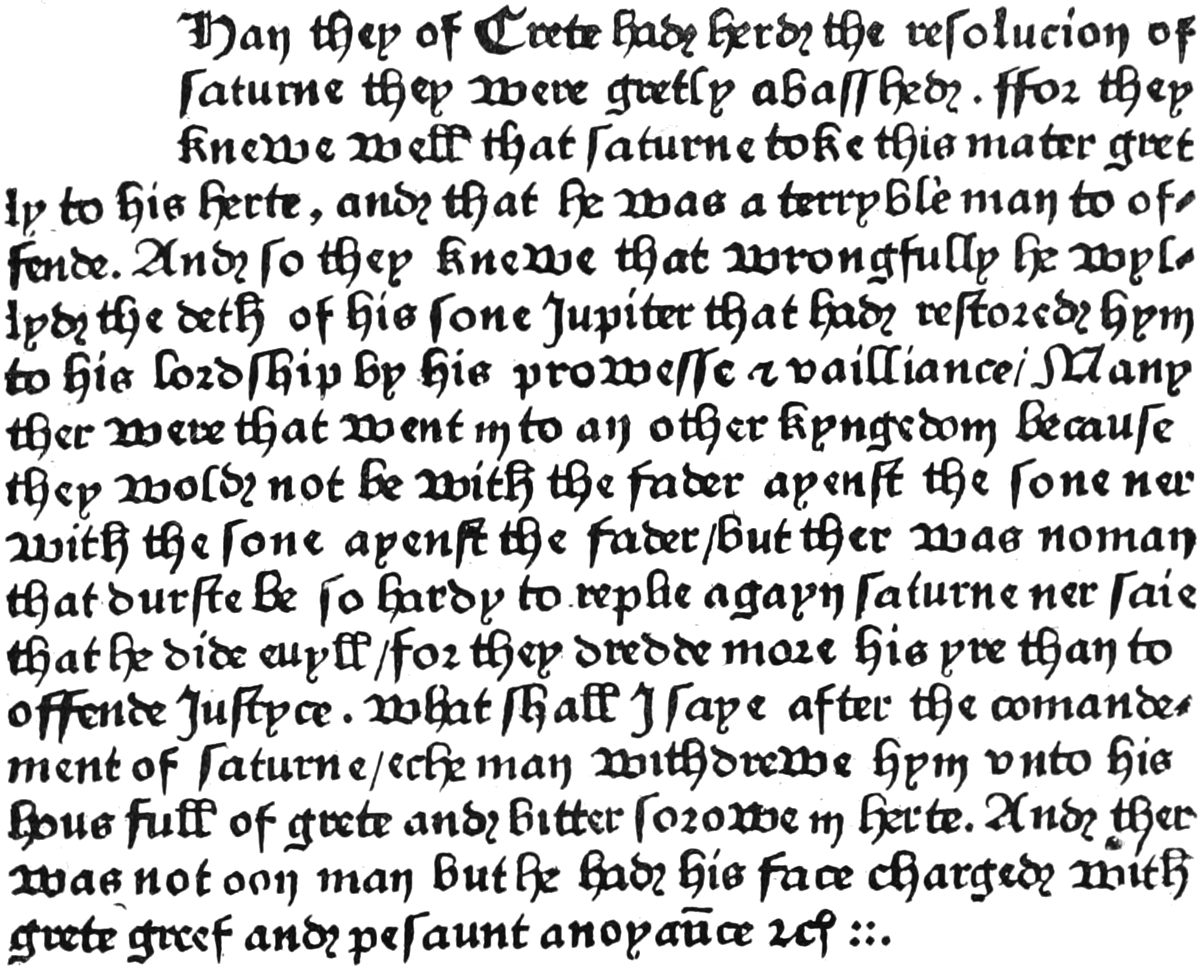
Caxton’s typeface for his 1474 book The Recuyell of the Histories of Troye, the first book printed in English
In the “Exodus” chapter, Blades describes how, thanks to Gutenberg, printing presses proliferated throughout continental Europe in the 15th Century, and then to Britain. Blades places special focus on William Caxton – Blades had published a book about him in 1861 – believed to have been the first printer in England and the first seller of printed books there. Blades notes that printing later made it to the New World, with the first press in the Americas established in Mexico City in about 1539; and a century later the first press in British North America, in Cambridge, Massachusetts (whose first publication was the famous Bay Psalm Book in 1640).
The “Leviticus” chapter is a fascinating overview of the process of printing, including type-foundry – the creation of typefaces on moveable metal type. Blades discusses how the early presses worked and the practical challenges they posed to printers of the time, as they required two men to operate: “One ‘beat’ the ‘form,’ that is, he dabbed two big, soft balls covered with ink over all the type; the other placed the white paper on the ‘tympan,’ and ran the whole, by means of a winch, beneath the ‘platen,’ and then made a strong pull at the bar.”
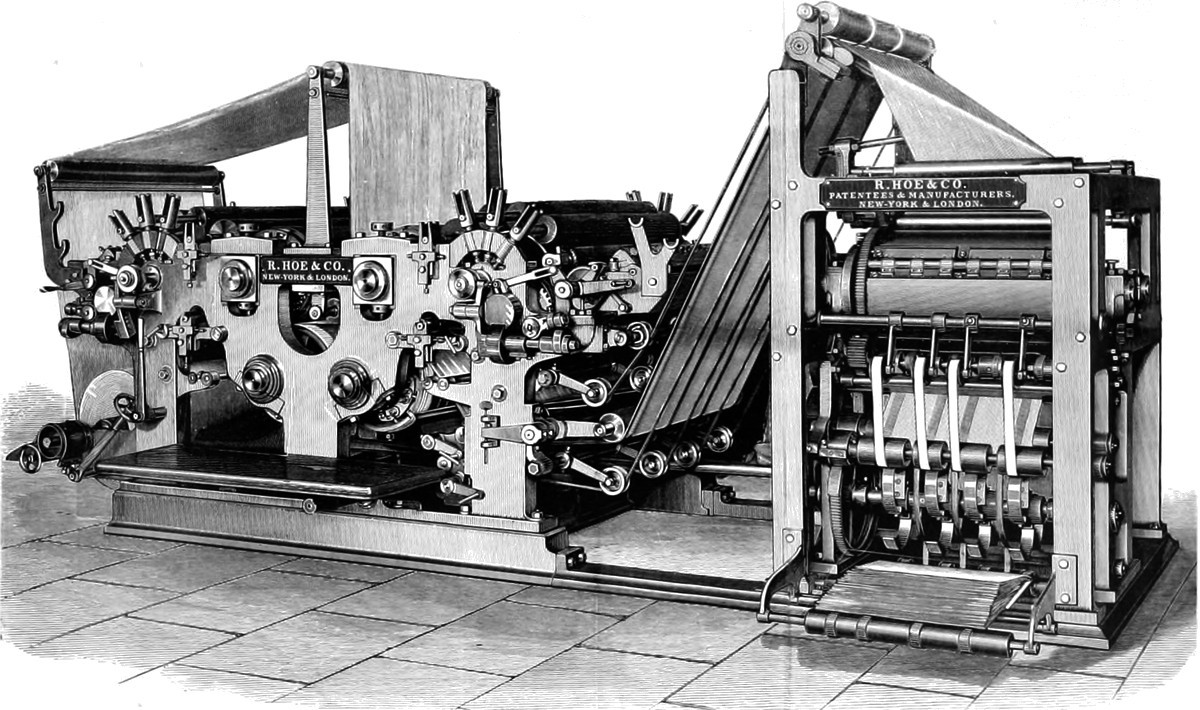
Blades expands the discussion to modern methods in “Deuteronomy.” The invention of a steam-powered press by Friedrich Koenig, patented in 1810, revolutionized the industry. It had a huge impact on the newspaper business, because thousands of copies could be rapidly and cheaply printed and disseminated to the public. As Blades describes it,
“Few sights are more impressive than the machine-room of one of our daily papers in the small hours of the morning…. At one end of the machine is a heavy reel of paper, sufficient to make about 6,000 complete papers. It is wound round a core like that used for a garden-hose, and forms a solid mass, which unwinds rapidly when the machine grips it. A knife with unerring precision cuts off each paper as soon as printed, and delivers it onto a collecting board. Soon after No. 1 machine gets to work, No. 2 is supplied with plates and started; so with the other machines, until eight or nine are all printing at once, each delivering about 12,000 complete copies an hour, so that with eight machines the delivery would be 96,000 per hour.”
A 19th-Century newspaper printing press
Blades turns his attention to “great and noble men who have served God and their country as printers” in the “Numbers” chapter. This contains mini-biographies of famous printers throughout Europe, like Gutenberg and Caxton, including a mention of the American Founding Father Benjamin Franklin, who began his career as a printer. Finally, the chapter on “Judges” gives an extensive bibliography of books on typography and printing.
Blades, who himself wrote a number of works on these subjects (several of which are available at Project Gutenberg), left The Pentateuch of Printing unfinished at his death in 1890. It was completed by his friend, the author Talbot Baines Reed, a popular English writer of fiction for boys. (A number of Reed’s books are also available at Project Gutenberg.) Reed contributed a “Memoir” of Blades that reflects not only Blades’s scholarship, but also the respect he enjoyed among his colleagues.
Thanks to the volunteers at Distributed Proofreaders and Project Gutenberg, Blades’s expertise is available to all for free.
This post was contributed by Linda Cantoni, a Distributed Proofreaders volunteer.
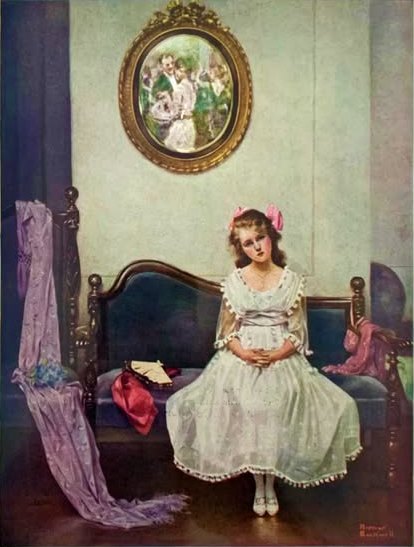
The Wallflower, a Life magazine cover by Norman Rockwell (1920)
Most people have experienced being a wallflower at some point or another in their social lives. You might have been the shy kid at a party afraid to ask someone to dance. Or maybe you’re the insecure grownup at a gathering where you don’t know anybody, have no idea how to start a conversation with a random guest, and wouldn’t want to start one even if you did know how. You cling to the wall like an Erysimum capitatum (Western wallflower) so as not to mingle, thereby eliminating – you hope – the risk of making a fool of yourself.
Fear not: Thanks to the volunteers at Distributed Proofreaders and Project Gutenberg, introverts can get free help from How Not to Be a Wallflower, by John Woodworth. It’s a short tome giving tongue-in-cheek advice, part of the long-running “Little Blue Book” series of booklets published from 1919 to 1978. (For more information on the series, see our blog post on Life of John Brown).
Woodworth’s sly humor is entertaining and a bit risqué at times. How Not to Be a Wallflower was written in 1928, so it’s a slight surprise to read detailed advice on how a young lady should perform her toilette: “Another good practice after a bath is to stand before a mirror and give yourself a good once-over.” He recounts that a young lady of his acquaintance once showed him (though he does not describe the circumstances) a “very beautiful” three-piece satin lingerie outfit – bra, panties, and slip. He suggests that “the Bible is just as naughty as anything that has been written in the last ten years.” Times had definitely changed after World War I – just a decade or so earlier, few would have dared to write so frankly about such things for a general audience.
The booklet pokes fun equally at female and male wallflowers, dividing each category into several types. On the female side, there is, for example, “The Elderly Ingenue” at a dance for young people: “From this distance one would judge her to be a very nice young lady but when you get closer you find that she is not at all what you expected her to be. She is a perennial.” On the male side, there is “The Lewd Dancer,” who “attracts attention by the gyrations of his hips and the avid appearance of his face,” no doubt while doing something like the Charleston or the shimmy – in a corner by himself. Probably the most hilarious type is “The Drunk,” who attends a costume party dressed as John the Baptist’s head on a platter, with chaotic results.
How Not to Be a Wallflower contains numerous references to trends of the 1920s. It talks about flappers and college boys whose jalopies are covered with “queer, crazy labels.” Hot topics like Prohibition and companionate marriage crop up, as do celebrated Jazz Age figures like Edna St. Vincent Millay, F. Scott Fitzgerald, and Pablo Picasso. It’s an entertaining slice of life from a century ago that can nonetheless still raise a chuckle today.
This post was contributed by Linda Cantoni, a Distributed Proofreaders volunteer.
I’m a Content Provider for Distributed Proofreaders, the volunteer project that produces ebooks for Project Gutenberg. Apart from using books from mainstream publishers, I also enjoy providing works from less traditional publishers. One example is the advertising picture card albums that became hugely popular in the Netherlands during the first half of the twentieth century. During that period, hundreds of titles were published by manufacturers of coffee and tea, tobacco, chocolate, biscuits, soap, and other everyday consumer goods. Customers collected small picture cards—or coupons that could be exchanged for them—that were packed with the products. The goal was to encourage customer loyalty by motivating people to complete the albums.
Most albums required between 100 and 144 plates, making completion a lengthy process. New albums would be released at regular intervals, to keep interest going. There was considerable competition between various companies to make those albums as pretty and desirable as possible; professional artists and renowned authors were hired to provide the plates and accompanying text, and the Dutch public embraced them en masse. Apart from the company name on the cover, and a mention in the preface, they are mostly devoid of further advertising (although some would smuggle in a few more mentions).
At the time, high-quality color printing was still relatively expensive, making these richly illustrated albums remarkable publications for ordinary households. People spent a lot of time collecting and exchanging plates, and gluing them into the albums. They often became family heirlooms, and, until recently, were quite expensive to obtain. However, in recent years their price has dropped considerably, probably because the third or fourth generation no longer appreciates the considerable effort that parents or grandparents put into getting them complete.
Today these albums offer a fascinating snapshot of early twentieth-century Dutch culture. Besides their artistic merit, they reflect contemporary ideas about education, nature, history, geography, and everyday life. Among the most famous of these albums were the nature-albums published by the biscuit company Verkade. Between 1903 and 1940, the company published thirty albums. The first three were just colorful cards without accompanying text, but after that, they hired the renowned naturalist Jac. P. Thijsse to produce a narrative to accompany the images, and professional designers to make the albums attractive. Of these, I have already added eight to the Project Gutenberg collection, with several more in the works.
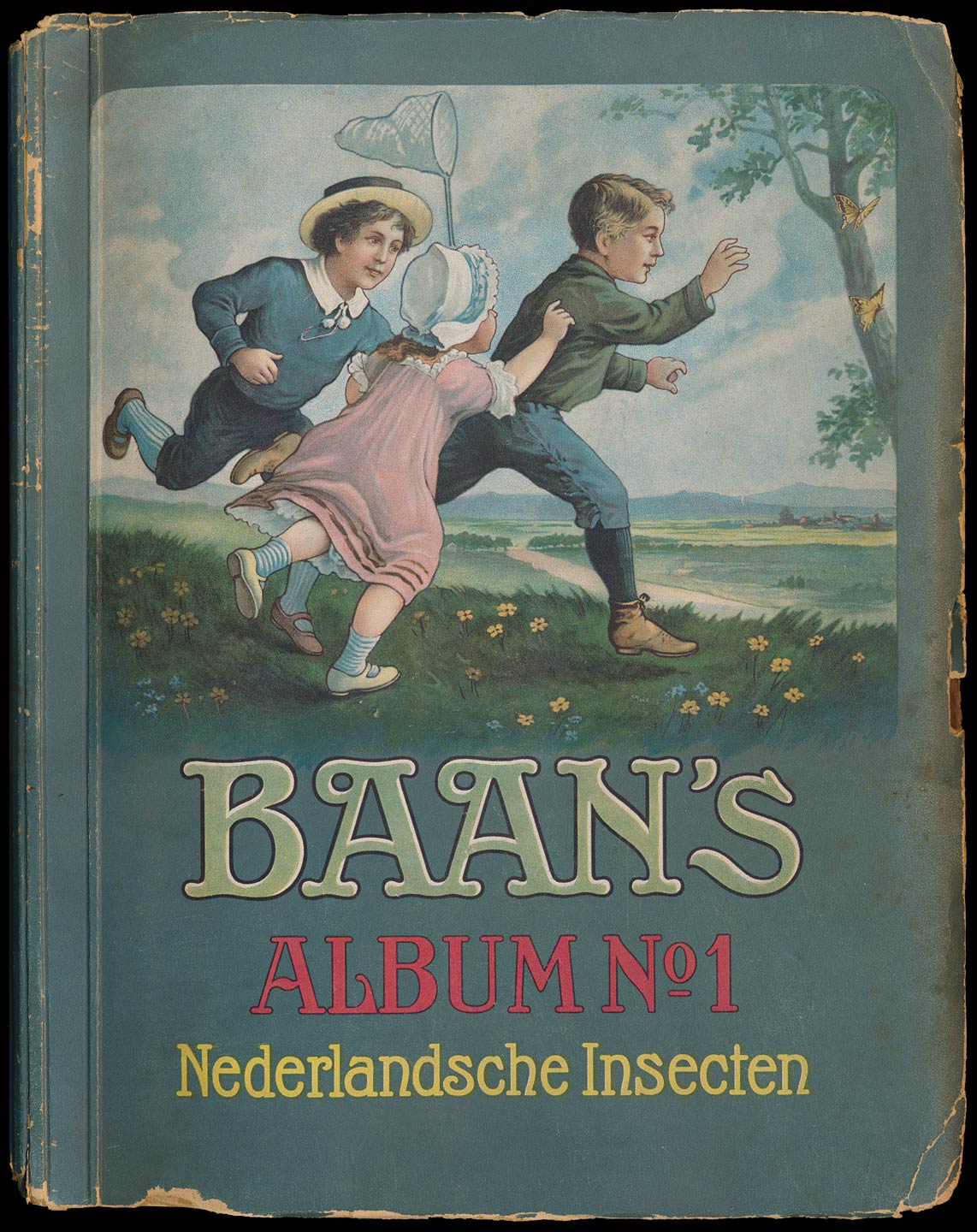
Another stunning album is Nederlandsche Insecten (Dutch Insects), which was published in 1915 by the J.C. Baan company from the town of Alkmaar, trading in coffee and tea. This album required no fewer than 180 small colored plates of insects to be collected. The empty album itself could be purchased for 50 cents, including postage (roughly €6.39 in today’s money).
The author, P. Teunissen, was the agricultural and horticultural editor of the Amsterdam newspaper Het Nieuws van den Dag (The News of the Day). He wrote a substantial text consisting of a general introduction to insects—their anatomy, life cycles, reproduction, and their benefits or harm to humans—followed by detailed descriptions of each of the insects illustrated.
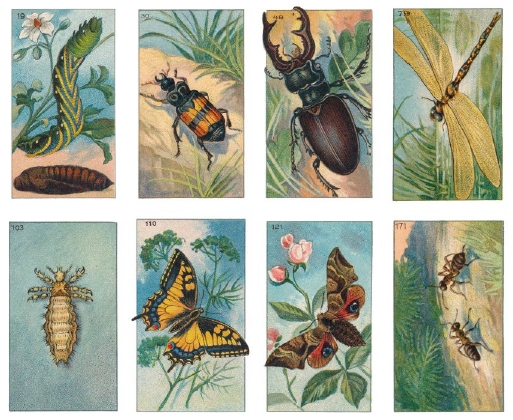
The painted illustrations themselves were originally printed with chromolithography, and were most likely produced in Germany. The artist is unknown. They are about 36 by 60 mm in size, and are all to be mounted vertically, regardless of the actual orientation of the image. The front cover shows three children playing with a butterfly net, and the back cover shows a mother with children collecting the cards, but despite this, it should not be mistaken for a children’s book.
Dutch advertising cards from Nederlandsche Insecten (Dutch Insects)
Unfortunately, the production quality of the book was not that good, so most copies that have survived to this day are in poor condition, with issues like brittle covers. But the plates are sometimes damaged as well—by the very class of creatures it describes: insects, which appear to have developed a taste for either the paper or the glue used to mount the plates. This makes it quite a challenge to digitize them. To get the album complete, with all pictures in reasonable quality, I had to purchase two copies from the Dutch equivalent of eBay, Marktplaats.
After obtaining the albums, the first thing I do is scan the illustrations. For some albums, the plates are attached only at the corners, and I carefully remove them to scan both the front and back (which does contain advertising or explanatory text). But in the case of Nederlandsche Insecten they were glued, so I could scan only the front. I scan the plates at 600 DPI. After that, I scan the text pages at a lower resolution, and prepare them for proofreading at Distributed Proofreaders. Since the text is in Dutch, the pages don’t proceed quickly through the rounds because we have only a limited number of Dutch proofreaders on the site, but that is not a major concern for me, because in the meantime, I too have a lot of work to do.
Each scanned illustration has to be cleaned, that is, cropped, color-corrected, and cleared of minor imperfections using photo editing software. When those images have a white border, I will retain that border, and make it fully white. Per image, that can take five to 15 minutes, depending on their state.
The front and back cover of Nederlandsche Insecten posed some special challenges. First of all, it was too large for my scanner, which meant I had to scan it in parts, and then stitch the parts together (which is quite tricky), and then it was also heavily scratched, so I had a lot of scratch removal to do.
My goal is not to make the album look brand new, although I do want to remove disfiguring scratches and stains while preserving the aged character of the original object. Given the large number of scratches in Nederlandsche Insecten, this alone took me several hours.
At the same time that I was processing the images, every page of the text went through multiple rounds of volunteer proofreading and formatting. Once that process was complete, I combined the text and images in HTML format and uploaded it to Project Gutenberg, where it is available for free in various formats.
This post celebrates the 51,000th unique title Distributed Proofreaders has posted to Project Gutenberg: The Zoology of the Voyage of H.M.S. Beagle(Part V: Reptiles), by Thomas Bell, edited by Charles Darwin. Congratulations and thanks to all the Distributed Proofreaders and Project Gutenberg volunteers who helped us reach this major milestone!
In December 1831, 22-year-old Charles Darwin, fresh from Cambridge University, boarded H.M.S. Beagle as a “gentleman naturalist.” The Royal Navy ship was to conduct a two-year survey of the coasts of South America, including the Galápagos Islands. The voyage actually lasted five years and was the foundation for Darwin’s revolutionary work on natural selection and evolution.
On that voyage, Darwin, who had been an easily distracted and at times indifferent student, found his true calling. His primary interest at the time was in geology. As the ship charted the coasts, Darwin went ashore to study the land, but he became fascinated by the native flora and fauna, and by the many fossils he discovered. He collected numerous specimens, many of which eventually found their way into the Natural History Museum in London and the Museum of Zoology at Cambridge University, among others. Early in the trip, he used a plankton net to capture sea creatures and was astounded by how beautiful they were, as he recorded in his diary: “Many of these creatures so low in the scale of nature are most exquisite in their forms & rich colours. — It creates a feeling of wonder that so much beauty should be apparently created for such little purpose.”
Darwin made copious notes about his observations. When he got back to England in 1836, he sought to have them published but didn’t have the financial means to do so. As he relates in the Preface to Part I of The Zoology of the Voyage of H.M.S. Beagle, he applied to the British government, which granted him £1,000 to publish his notes, with engravings, “in a convenient form, and at a cheap rate” and “in such a manner as to be most advantageous to the Public at large.”
Realizing that he was not an expert in zoology, Darwin engaged the help of several prominent scientists in the field to write up and enhance his reports. These included ornithologist John Gould, author of The Birds of Australia, the third volume of which was the 38,000th title Distributed Proofreaders contributed to Project Gutenberg. Gould’s wife Elizabeth Coxen Gould provided the lovely illustrations for that and for Part III of the Beagle reports. All five scientists who worked on the project were credited as authors, with Darwin as editor.
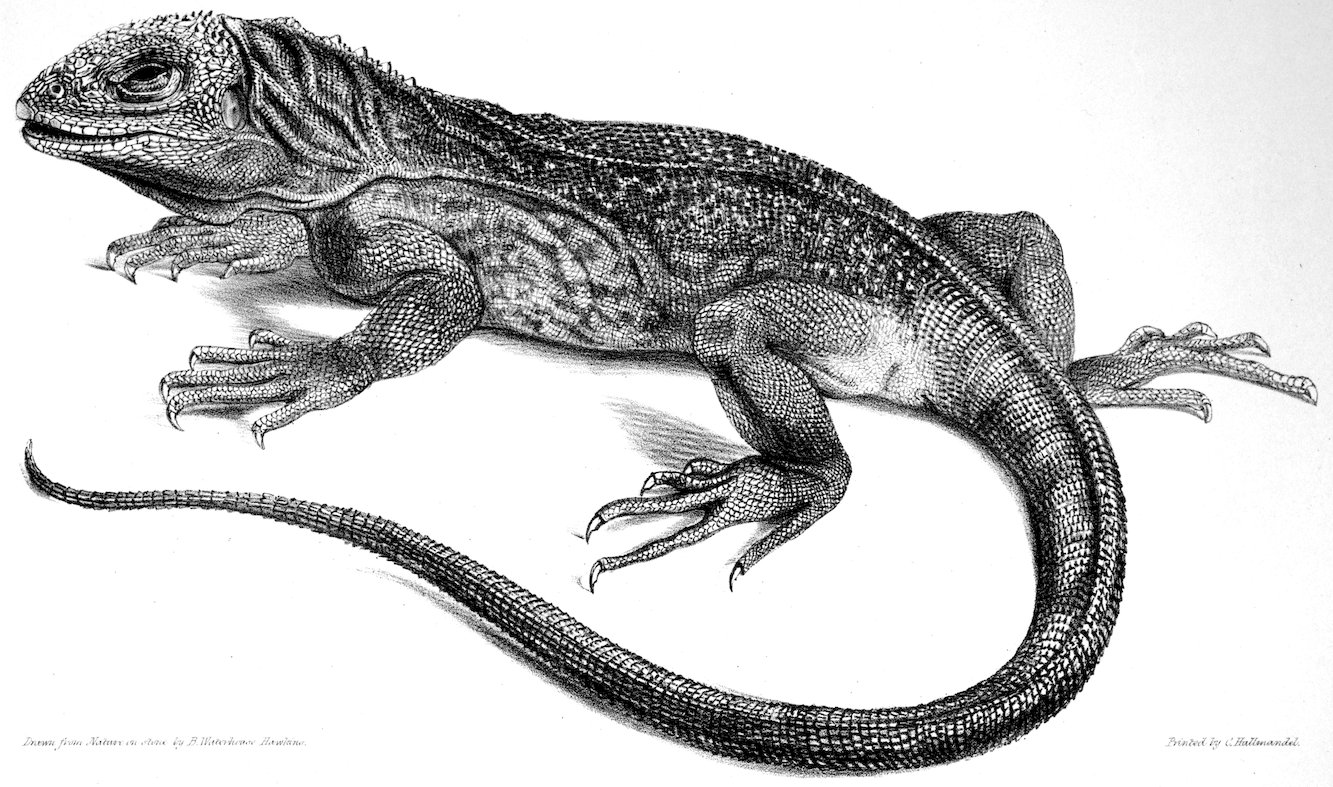
An engraving of a Galápagos land iguana, from The Zoology of the Voyage of the H.M.S. Beagle – Part V: Reptiles
The reports were initially published in 19 unbound parts from 1838 to 1843, priced at 8s. apiece, and then released as five bound volumes from 1839 to 1843, all copiously illustrated with engravings. Our 51,000th title, Part V: Reptiles, completes the set at Project Gutenberg. Oddly, it doesn’t mention the giant tortoises Darwin found on the Galápagos Islands, but it does discuss the iguanas. It was authored by Thomas Bell, a dental surgeon who became a zoology professor at King’s College, London. Ironically, Bell is notorious for having been blind to the monumental significance of Darwin’s natural selection theory. Darwin presented his theory at a meeting of the Linnean Society in 1858. Bell, who was the chairman, did not consider it important enough to mention in his annual report, stating, “The year which has passed has not, indeed, been marked by any of those striking discoveries which at once revolutionize, so to speak, the department of science on which they bear.”
Thanks to the volunteers at Distributed Proofreaders and Project Gutenberg, the many wonders that Darwin discovered on his groundbreaking voyage are available to all for free.
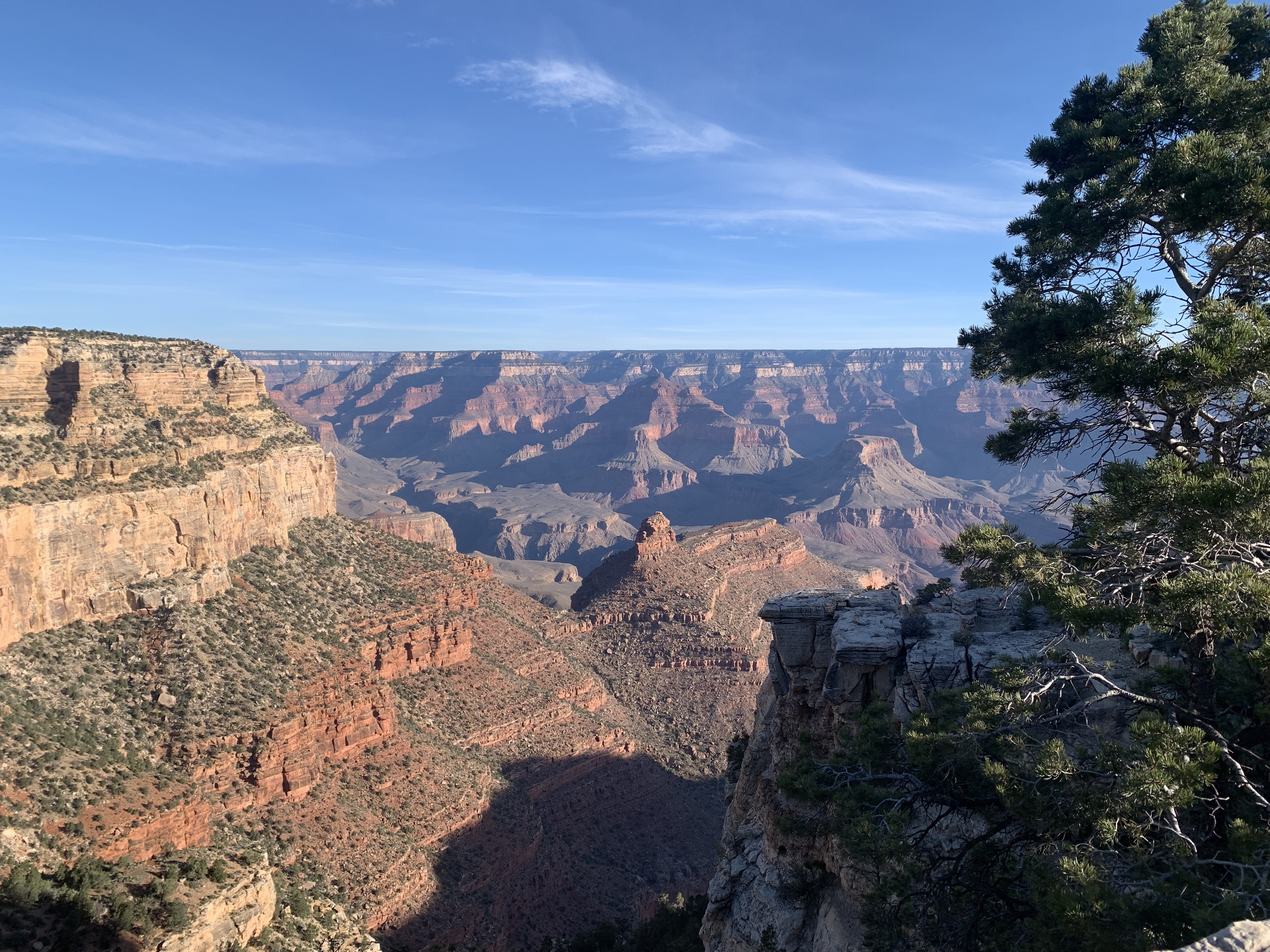
I first learned of Ellsworth and Emery Kolb this past March when I visited the Grand Canyon in Arizona for the first time. I was overwhelmed by the size of the Canyon. I had seen pictures of it, of course, but no picture can do justice to how SMALL one feels standing at the edge of one of the rims or on a trail to the bottom. From the south rim to the north, it is 10 to 12 miles across the canyon. The canyon walls in places are 1,500 feet deep. One 5’4” tall human is nothing in this vastness.
The Grand Canyon in 2026. Photo by Carol Brown.
When I learned about the Kolb studio on the south rim, I wondered, “Is there anything on Project Gutenberg about this?” Well, yes, there was: Through the Grand Canyon from Wyoming to Mexico, by Ellsworth Kolb. But the original ebook was first posted in the early days of Distributed Proofreaders, when the main focus was still on producing plaintext versions. It was later converted to an HTML version, but it unfortunately lacked the photographs, most of which had been taken by Ellsworth and Emery. An historical appendix was also missing. A matching edition on The Internet Archive was identified so the photos and appendix could be added. Now the ebook version of this historic work is complete and available for anyone to read or download for free. (This version of the ebook also incorporates features to make it accessible to visually impaired readers.)
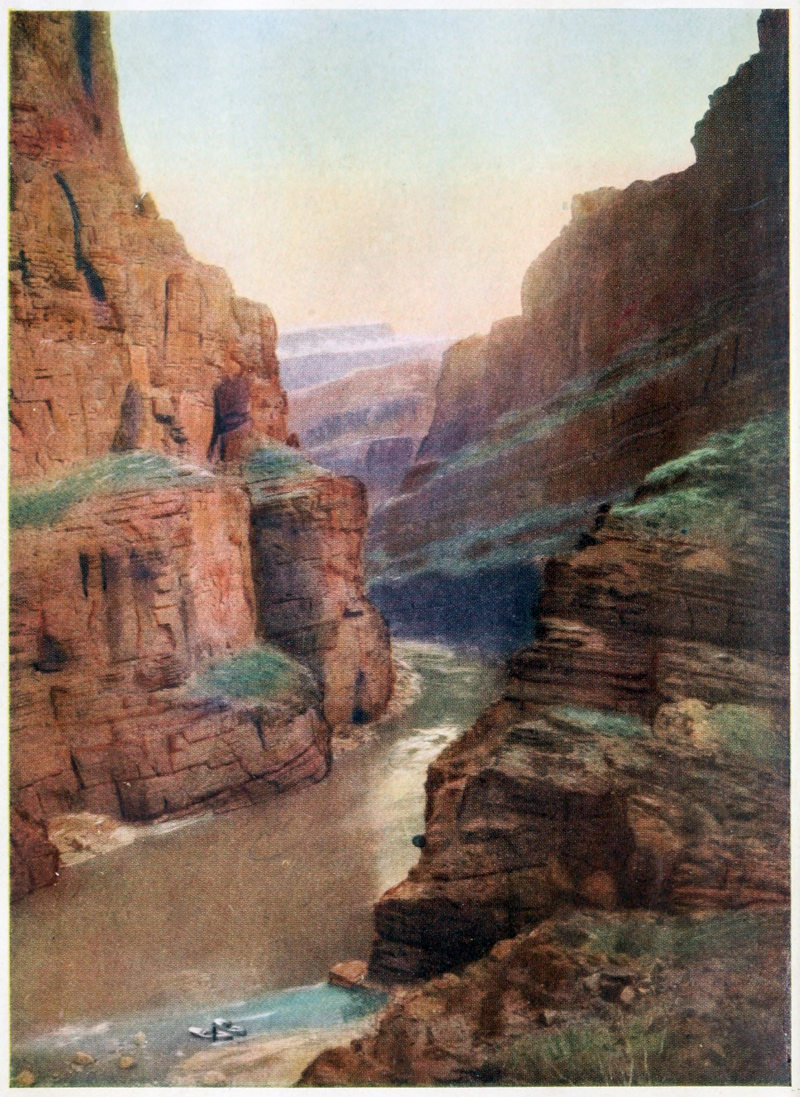
Frontispiece to Through the Grand Canyon from Wyoming to Mexico
I read the book at least three times in the process of preparing it to submit to Project Gutenberg. I was enthralled by it, in part because I recognized many of the places along the south rim that the Kolbs had photographed. Geology can change over several thousand years, but not much changes in 100 years! The story of the Kolbs’ journey was fascinating to read. In 1901, Ellsworth Kolb arrived at the Grand Canyon. A year later, he was joined by his younger brother, Emery.
In 1906, they built a small studio on the south rim of the Grand Canyon to support their budding photography business. For years, they wanted to document the canyon with photographs to encourage visitors and increase their business. Their plans came together in autumn 1911, when they traveled to Green River City, Wyoming. There, they started a trip down the Green and Colorado Rivers heading towards Needles, California, and the Gulf of California. The total length of the trip was 1,600 miles, with a vertical drop of 6,045 feet. To record their trip, they took five still cameras and a motion picture camera (a new technology at the time), plus a supply of film, plates, a cloth darkroom, and chemicals to develop film.
The book is short on details of what items they packed in the boats, other than cameras, tents, and sleeping bags. At one point, they noted their supplies consisted of: “5 pounds of flour, partly wet and crusted. 2 pounds mildewed Cream of Wheat. 3 or 4 cans (rusty) of dried beef. Less than one pound of sugar.” They used custom-built rowboats – no mechanical or engine support – only what they could provide using human power. They caught fish from the river, and started the trip with a rifle and shotgun for hunting game.
Further details of what they ate and food they transported are scanty. Mostly, the book focuses on the local geology, people they met along the way, birds and plants, how they wanted to tackle the day’s rapids, how to photograph those events, and how they dealt with adversity, compensating when things didn’t go as planned.
From Wyoming to their home in the Grand Canyon took three months. The descriptions of their rides through the rapids are thrilling. They met with adversity the entire length of the trip. After a month to recover and restock, they headed towards California. In the lower Grand Canyon, in late December, Ellsworth Kolb described the scene:
“There is nothing on earth to which this gorge can be compared. Storm-clouds lowered into the chasm in the early morning. The sky was overcast and threatening. We were travelling directly west again, and no sunlight entered here, even when the sun shone. The walls had lost their brighter reds, and what colour they had was dark and sombre, a dirty brown and dark green predominating. The mythology of the ancients, with their Inferno and their River Styx, could hardly conjure anything more supernatural or impressive than this gloomy gorge.”
By January 13, 1912, the Kolbs were out of the Canyon, and they covered the remaining 175 miles to Needles in five days. Ellsworth Kolb finished the trip from Needles to the Gulf the following year, running the Colorado River in flood stage in eight days. In 1914, he documented the trip in Through the Grand Canyon From Wyoming to Mexico. In 1915, a new edition was published with additional photographs and a foreword by the famous novelist Owen Wister; this is the edition at Project Gutenberg.
The Kolbs’ trip was not the first exploration of the Canyon, nor the first writing about it. There were earlier, shorter documented trips between 1825 and 1909, including two well-documented trips by Major J.W. Powell in 1869 and 1871. Some trips were not completed, as one or more of the participants were injured, drowned, or killed.
The U.S. National Park Service provides a brief history of the Kolbs at the Grand Canyon and their contentious relationship with the National Forest Service and private contractors working at the Grand Canyon in the early 1900’s. Ellsworth died in 1960. After Emery’s death in 1976, the National Park Service acquired the Kolb studio. The Grand Canyon Association maintains it and has carried out restoration work on it in recent years. Before he died, Emery gave his papers, photographs, and films to Northern Arizona University. The Emery Kolb Collection also includes a 45-minute film narrated by Emery; it was shown at their studio for more than 60 years.
Both Emery and Ellsworth Kolb are buried in the Grand Canyon Pioneer Cemetery.
This post was contributed by Carol Brown, a Distributed Proofreaders volunteer who post-processed Through the Grand Canyon from Wyoming to Mexico.
For nearly 20 years, Distributed Proofreaders volunteers have worked on a special “Motion Pictures and Filmstrips” project, digitizing thirteen printed volumes of U.S. copyright registrations for educational films, documentaries, industrial films, and theatrical releases from 1912 to 1978. Thanks to their efforts, the series is complete, and these previously hard-to-access volumes are now all available online in searchable form.
Before 1978, the U.S. Copyright Office did not keep electronic copyright records. They were available only in hard-to-search printed catalogs at major libraries, making access to the data difficult.
Distributed Proofreaders volunteers began work on the series in 2008. The project even attracted interest beyond the proofreading community: A group of colleges and libraries, including the Prelinger Library in San Francisco, had been waiting for these catalogs to become available in digital form so the data could be imported into their research databases. These copyright records are official, primary source material (as opposed to non-official sources such as the Internet Movie Database), providing definitive copyright information about older films, including many films that are now lost.
The Distributed Proofreaders “Motion Pictures and Filmstrips” project fills a critical gap in the history of film, finally making an abundance of reliable data available online at Project Gutenberg for film historians, scholars, and archivists anywhere in the world.
Catalogs of Copyright Entries at Project Gutenberg
Two titans of Romantic-era literature meet in Thomas Carlyle‘s translation of Johann Wolfgang von Goethe‘s Wilhelm Meister’s Apprenticeship and Travels (Volume I and Volume II). The result is an eminently readable English version of the famous Bildungsroman (education novel) that is true to Goethe’s style. Thanks to the volunteers at Distributed Proofreaders and Project Gutenberg, the e-book version of this classic two-volume set is now complete.
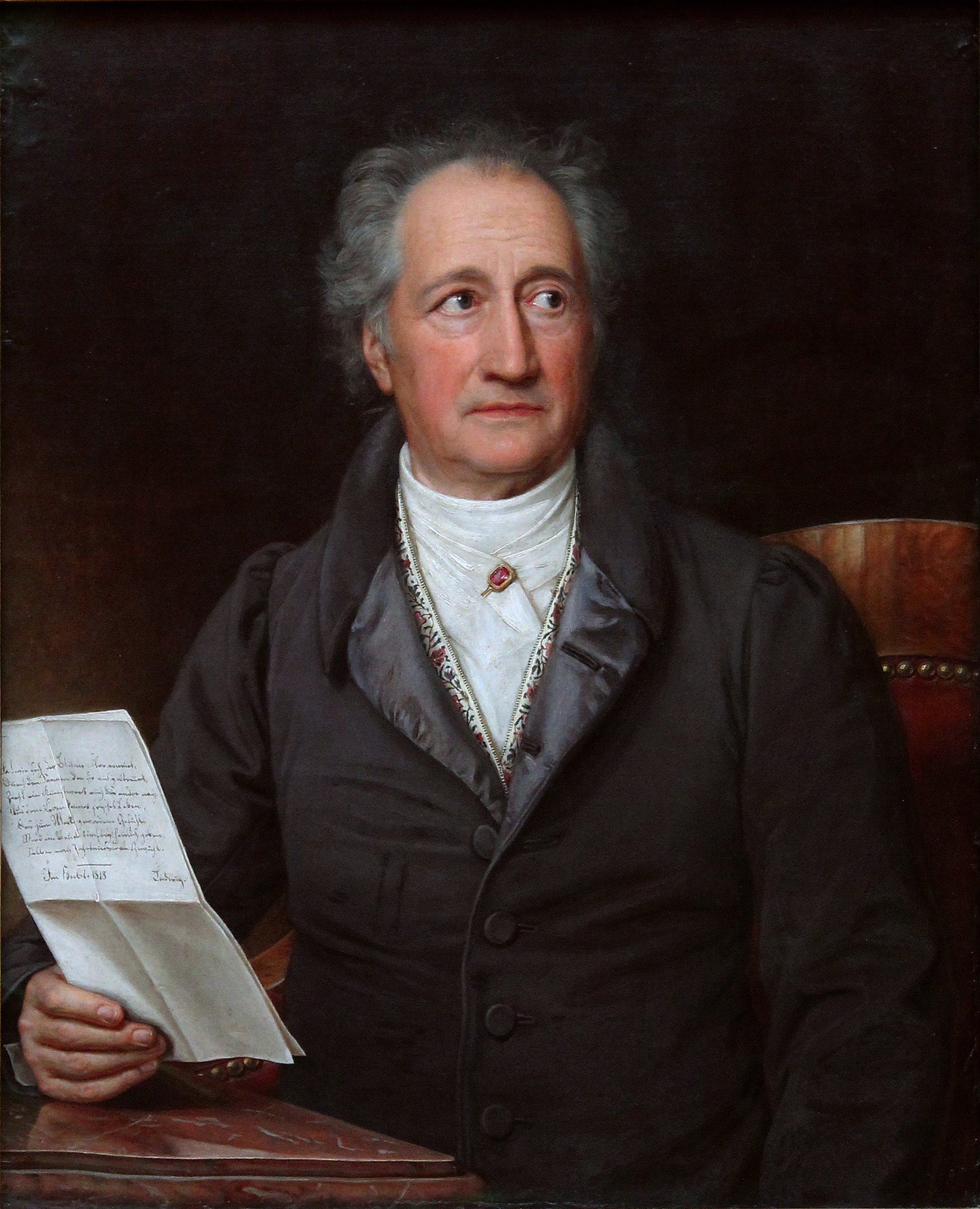
Portrait of Goethe in 1828 by Joseph Carl Stieler
Goethe (1749-1832) was a tremendously influential German writer, critic, and scientist. His first novel, The Sorrows of Young Werther (1774), was wildly popular and remains a model of the Sturm und Drang (“storm and stress”) artistic movement. Its success sparked a distinguished career that produced masterpieces such as the epic verse-drama Faust (available in numerous editions and translations at Project Gutenberg), as well as a host of plays, poems, novels, and scientific and other nonfiction works.
Goethe wrote the first of the two Wilhelm Meister novels, Wilhelm Meister’s Apprenticeship, in 1795. Wilhelm is a young merchant who is tired of the business world and becomes entranced by the theatre. On a business trip, he encounters a circus troupe. Among them is a 13-year-old girl, Mignon, who had been kidnapped by the troupe. Wilhelm is fascinated by her; she looks upon him as a father-figure. He decides to leave his dull bourgeois life to form his own theatre group with Mignon and others. They perform throughout Germany, particularly the plays of Shakespeare, whom Wilhelm idolizes (as did Goethe). They experience a host of adventures and tragedies along the way.
The sequel, Wilhelm Meister’s Travels, was published much later, in 1821. It is less a novel than a hodgepodge of short stories, letters, dialogues, poems, and philosophical ponderings. In the framing story, Wilhelm now has a young son, Felix, with whom he wanders on foot, never staying in one place for more than three days. He seeks enlightenment through art, science, nature, religion, and philosophy. They encounter many challenges and meet many strange characters, including, among others, a family of religious hermits, an astronomer, a geologist, a painter, and members of a utopian society where Wilhelm leaves Felix to be educated. Perhaps because of its unusual format, it was not as successful as Wilhelm Meister’s Apprenticeship, which was very popular in its day and has inspired composers, artists, writers, and filmmakers for two centuries.
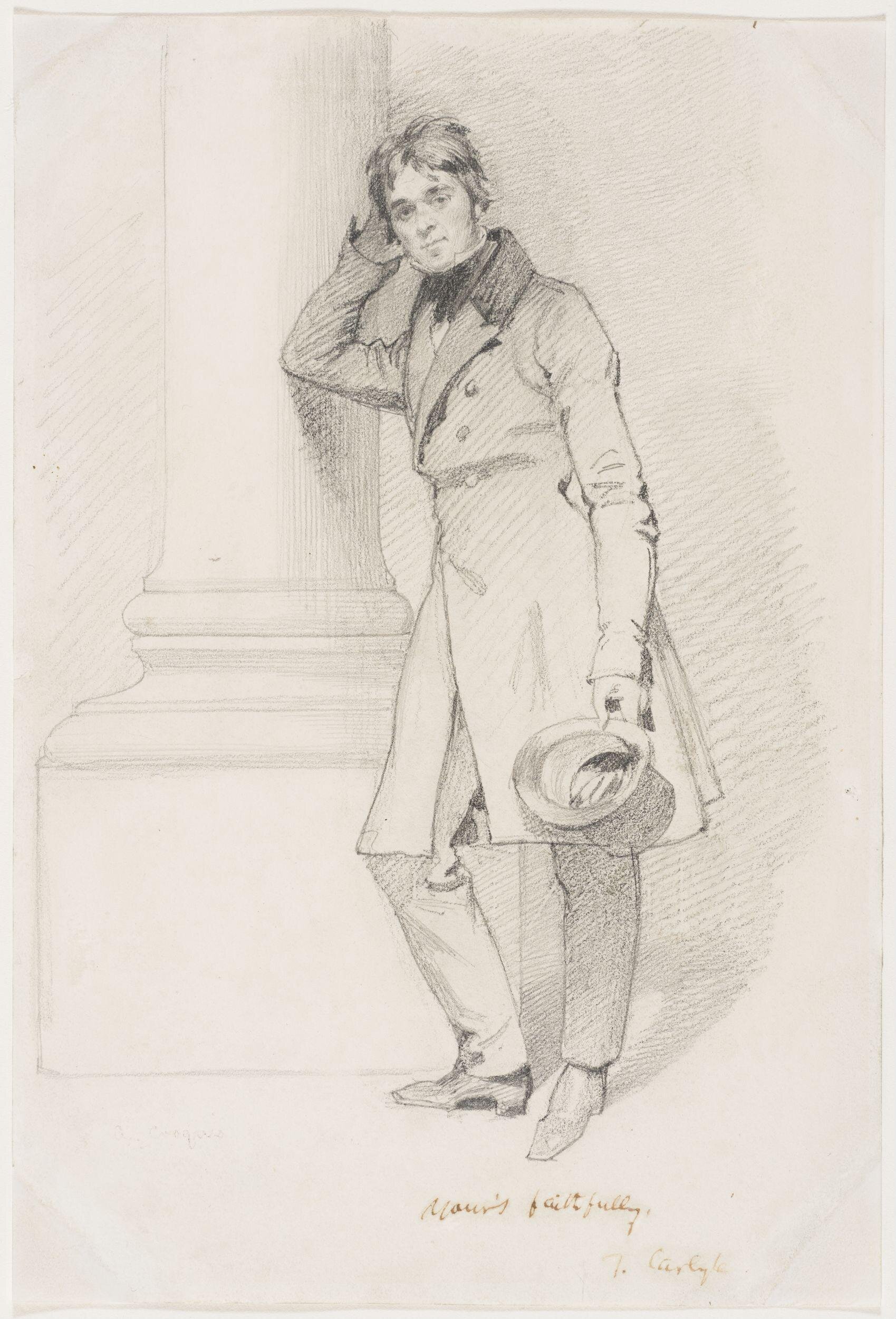
Sketch of Thomas Carlyle by Daniel Maclise, 1833
The breadth of human experience in the Wilhelm Meister novels so struck the young Scottish writer Thomas Carlyle (1795-1881) that he felt compelled to introduce them to the English-speaking world with his translations in 1824 and 1825. They made his reputation and were the first works to enable him to make a living as a writer, historian, and thinker. When his translation of the Apprenticeship was first published, he sent a copy to Goethe, who was delighted with it. The two corresponded for the rest of Goethe’s life, and Goethe warmly supported Carlyle’s career, even writing an introduction to the German edition of Carlyle’s The Life of Friedrich Schiller.
In 1839, a second edition of Carlyle’s translation of the Wilhelm Meister novels was republished in two volumes, from which the e-book versions at Project Gutenberg were produced. Goethe had expanded the Travels considerably a decade earlier. But Carlyle did not take the opportunity to translate the expansion, explaining in a note to the reader that the Travels “continues a fragment like the first,” and that “for the mere English reader, there are probably in our prior edition of the ‘Travels’ already novelties enough; for us, at all events, it seemed unadvisable to meddle with it further at present.” Despite this veiled criticism, Carlyle retained his admiration for Goethe: “A genuine seer and speaker, under what conditions soever, shall be welcome to us: has he not seen somewhat of great Nature our common mother’s bringing forth,—seen it, loved it, laid his heart open to it and to the mother of it, so that he can now rationally speak it for us? He is our brother, and a good, not a bad, man: his words are like gold, precious, whether stamped in our mint, or in what mint soever stamped.”
Through the work of Distributed Proofreaders and Project Gutenberg volunteers, you can now enjoy Goethe’s golden words in an admirable English translation for free. (The original German versions, Wilhelm Meisters Lehrjahre and Wilhelm Meisters Wanderjahre, are also available at Project Gutenberg.)
This post was contributed by Linda Cantoni, a Distributed Proofreaders volunteer.
As a new Distributed Proofreaders post-processor finalizing proofread and formatted texts into ebooks for Project Gutenberg, I wanted to pick a simple project suitable for beginners, and was drawn to the 1924 book Life of John Brown by Michael Gold. I had proofread parts of this book in earlier stages, and thought it would be great to have an additional hand in preserving this piece of history. This is not Project Gutenberg’s only book on abolitionist John Brown (1800-1859): there are already other books by activists, Civil War veterans, and more. However, Life of John Brown is currently the only entry in the collection written by an avowed communist – one who has been neglected in historical appraisals of American literature, but whose background provides necessary context to this book.
Michael “Mike” Gold (1893-1967) was the pen name of Jewish-American writer Itzhok Isaak Granich, a prolific writer, editor, and literary critic of the American proletarian literature movement in the 1930s and 1940s. In April 1914, he was beaten by a police officer while attending an anti-capitalist speech in Union Square, New York City; he bought his first issue of the socialist journal The Masses the very next day, and became a lifelong communist. He eventually rose to the position of editor and frequent contributor of the Marxist periodical New Masses. Besides his commitment to communism, the American Civil War also was a great influence on his work: His pen name was supposedly lifted from a Jewish Union army veteran, Life of John Brown was his first published book, and he later wrote a play, Battle Hymn, based on Brown’s life. Despite his significant literary contributions and fame (his only novel, Jews without Money, went through eleven reprints in its first year alone), he was a marginalized figure during the McCarthy era due to the persecution of communists both real and perceived.
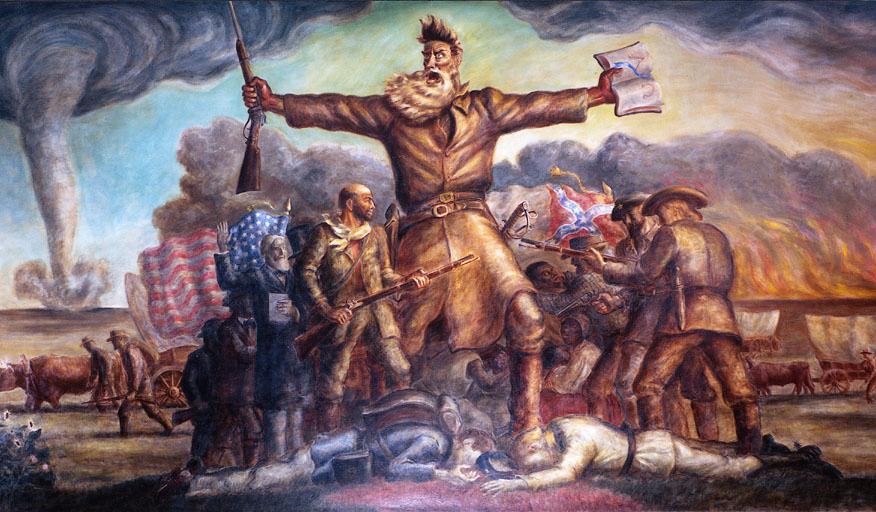
Life of John Brown covers Brown’s childhood up until his execution for the 1859 raid on Harpers Ferry. According to Gold’s sources, Brown was an honest and hardworking man struck by the injustices of racism and slavery from an early age. This later led him to move to Kansas to defend abolitionists from the pro-slavery border ruffians in the clashes that became known as Bleeding Kansas. Brown was determined to prevent Kansas from becoming a slave state, and quickly emerged as a militant leader on the side of the abolitionists, also known as Jayhawkers or Free-Staters. Unsurprisingly, Gold also tries to claim Brown as a leftist or anti-capitalist, a prototype of the communist revolution to come. This assertion is probably wishful thinking on Gold’s part, as Brown’s last courtroom speech suggests he was motivated more by deep Christian convictions than anything else. The book also does not mention him participating in any of the utopian socialist experimental communities of his era, such as Brook Farm, as he spent most of his life as a regular farmer who happened to be involved in armed conflict. Still, none of this has stopped leftists from claiming Brown as an inspirational figure, as shown by the existence of left-wing gun clubs (or “community defense organizations”) named after him. As Gold concludes in the final chapter:
Who knows but that some time in America the John Browns of today will be worshipped in like manner? The outlaws of today, the unknown soldiers of freedom.
In this light, Life of John Brown is one of a litany of examples of how the American left would come to appropriate Brown’s uprising as a predecessor of their own struggles for racial and economic justice.
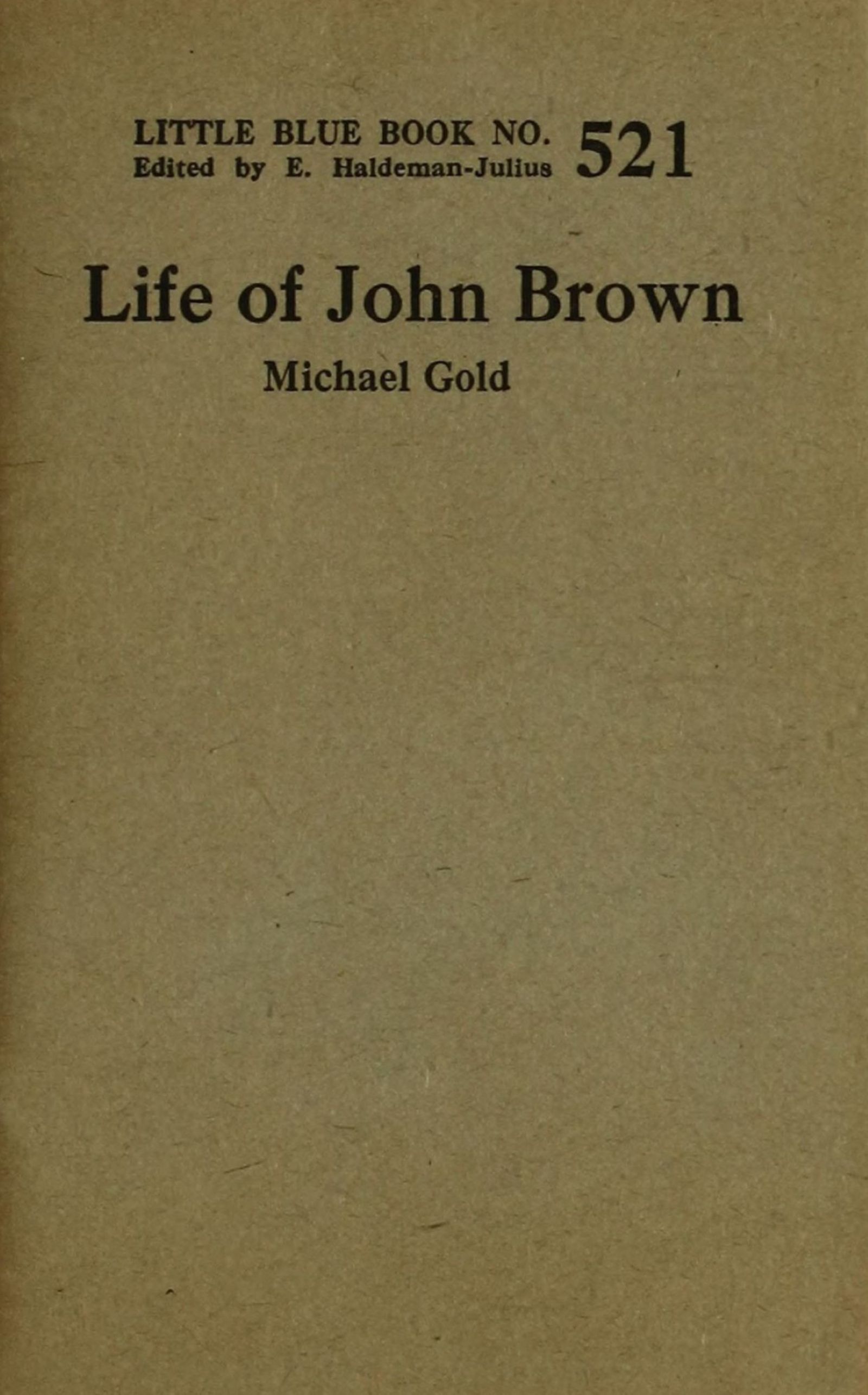
Haldeman-Julius Publications had a socialist slant and, as a company based in Kansas, had an interest in publishing books like this. After Emanuel Haldeman-Julius (1889-1951) took over the printing press of socialist newspaper The Appeal to Reason in 1922, he focused on the mass production of paperback books, many of which had socialist and atheist themes. These Little Blue Books, of which Life of John Brown was number 521, circulated in the hundreds of millions, but their cheap production value (even the covers were just paper) meant that many of them did not survive history’s wear-and-tear. Haldeman-Julius’s publishing also drew the critical eye of the FBI, and he died a month after a federal jury convicted him for tax evasion. Fortunately, some of these books have been preserved and found their way into the hands of Tim Miller, another Distributed Proofreaders volunteer who provides content for us to work on. Many of these Little Blue Books have never been available on the internet. You can help with this historical preservation project (and get a sneak peak at what made the FBI so mad) by joining Distributed Proofreaders today!
This post was contributed by Sam Lamb, a Distributed Proofreaders volunteer. Librarian Dani Rowland (University of Washington Bothell) and Professor Tim Miller (Labette Community College) assisted with research and proofreading for this blog post.
Further Reading
Bleeding Kansas, Bleeding Missouri: The Long Civil War on the Border – edited by Jonathan Earle and Diane Mutti Burke (University Press of Kansas, 2014)
His Soul Goes Marching On: Responses to John Brown and the Harpers Ferry Raid – edited by Paul Finkelman (University Press of Virginia, 1995)
John Brown Speaks: Letters and Statements from Charlestown – Louis DeCaro Jr. (Rowman & Littlefield, 2015)
John Brown, Abolitionist: The Man Who Killed Slavery, Sparked the Civil War, and Seeded Civil Rights – David S. Reynolds (Alfred A. Knopf, 2005)
Michael Gold: The People’s Writer – Patrick Chura (SUNY Press, 2020)
Publisher for the Masses, Emanuel Haldeman-Julius – R. Alton Lee (University of Nebraska Press, 2018)
When I signed up on 18 January 2001 on a new and exciting website with the then-unfamiliar name Distributed Proofreaders, I couldn’t imagine I would still be there 25 years later, with over 1200 ebooks posted to Project Gutenberg. That is almost one per week, over the entire period.
The basic Distributed Proofreaders ebook production model is simple: Using scanned page images and OCR text provided by a Content Provider, volunteers proofread and format one page at a time in three proofreading rounds and two formatting rounds. Then a Post-Processor assembles the completed pages into an ebook that is submitted to the Project Gutenberg collection. My primary roles at Distributed Proofreaders are Content Provider and Post-Processor.
Instead of talking about all the niceties of the process, let me delve into the dilemmas I have faced while working as a volunteer for such a long time.
What content to provide
Obtaining interesting books to process into ebooks can be a real challenge. Although in most cases we are forced to work with books that are about a century old or older, I often try to find books that have a link with current events. When a calamity hits a certain region, I often try to find books about that region, especially if that book provides some background to the events. The earthquake in Haiti prompted me to look up some books about that island nation’s curious history. The Russian invasion of Ukraine inspired me to collect a range of works on that embattled country, such as Ukraine, the Land and Its People.
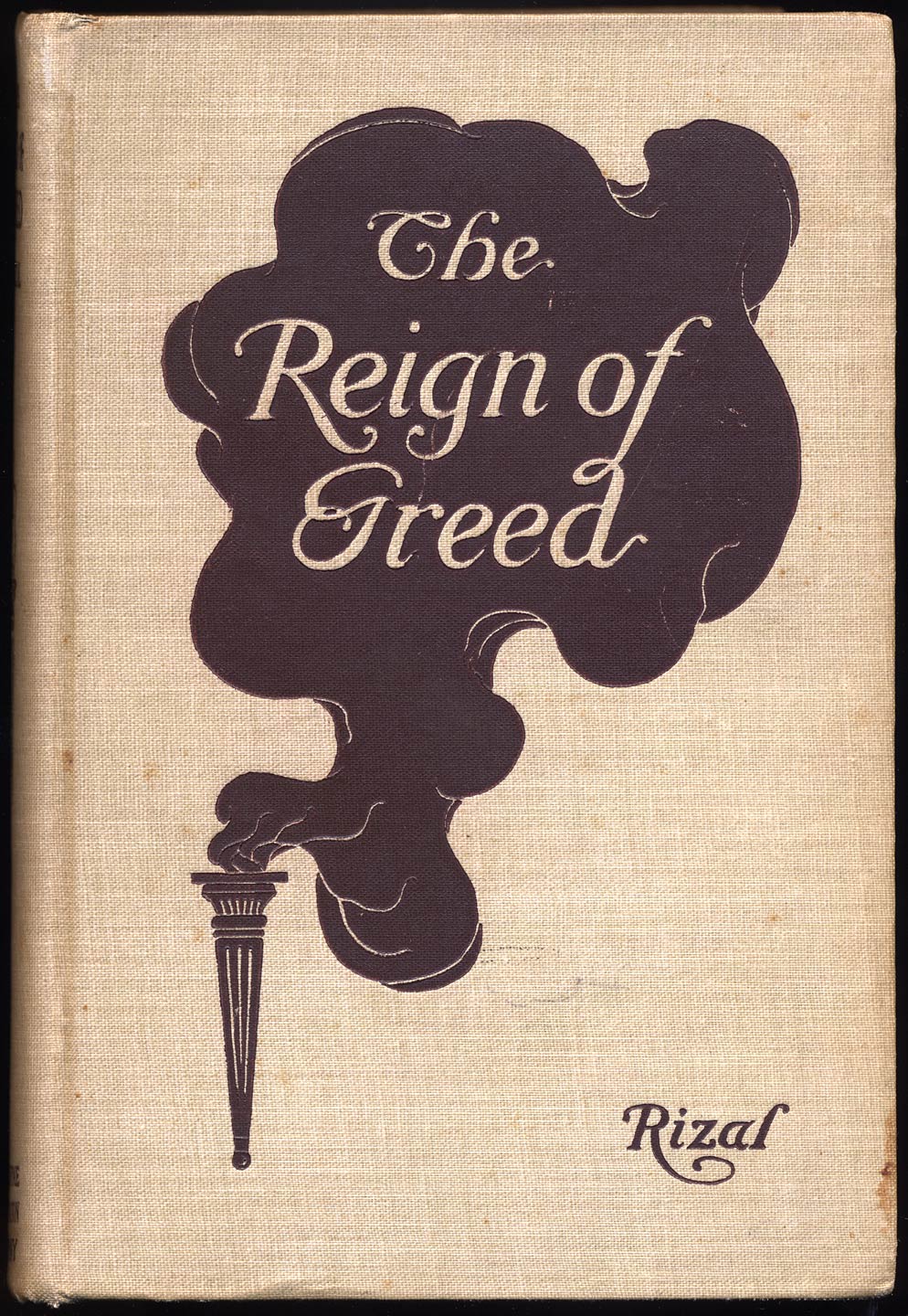
Apart from that, I often turn to my long-time favorites: exploration, anthropology, folklore, nature, and science in general, and works related to India or the Philippines in particular, including The Reign of Greed, an English translation of the powerful 1887 novel by Filipino nationalist José Rizal, which remains required reading in Filipino schools. (I also provided the ebook version of the Dutch translation of this important work, Noli me tangere: Filippijnsche roman.)
To buy or not to buy
Antique books can be expensive, so buying books to scan and run at Distributed Proofreaders is often out of the question. My most significant source of physical books over the years has been thrift stores, but what you can buy there is often very limited. Good finds are rare, but not impossible, and require a regular quick scan. About five or six thrift shops are within half an hour’s cycling distance from my home or office in the Netherlands, which makes them reachable during a lunch break. The second most important source are online classifieds. Books from that source tend to be cheaper than professional book stores. My normal strategy is not to look for a particular title, but to go through the book racks or online classifieds and ask myself, is this eligible (clears copyright, no duplicate), is this doable, and does it add value to the Project Gutenberg collection? If so, I will buy the book, mostly for just a few euros.
Unfortunately, certain categories of books are far more likely to end up in thrift stores. Nice old illustrated books on nature are a rare find, whereas old children’s books are relatively common. Classic (or former classic) novels take a middle position, and a large bulk are religious texts, which I normally don’t run.
To scan or to download
In the early days, before large archives of scans like the Internet Archive appeared online, just downloading a scan-set wasn’t an option: everything had to be scanned by hand. Over the years, I think I’ve owned more than six or seven different scanners, all with their own quirks and abilities. Next to the books themselves, they are the biggest investment, and most aren’t made to last many thousands of pages.
Scanning takes a lot of time. However, the benefit of self-scanning is twofold. Obviously, if a book has not been scanned before, you have no choice, and you can truly make something more available immediately. But even with previously scanned books, having the illustrations available in high resolution, and without the compression artifacts or vignetting caused by the overhead scanners used for the large projects, helps to get a better end-result.
It may be a surprise for some, but the most time spent on preparing ebooks does not go into correcting or formatting text, but rather in the processing of scanned illustrations. Since I like heavily illustrated works, and some individual images can take up to an hour to clean up, those images add up to more hours than any other activity.
Dutch or English or …
My native language is Dutch and I like to prepare Dutch books for processing at Distributed Proofreaders. Having enough material available for Dutch volunteers, and having enough Dutch volunteers for those books, is always a bit of a catch-22. Without books, the volunteers won’t come, and without volunteers, the books will stall in the rounds. For now, I try to balance them out, half Dutch, half English, and a small sprinkling of other languages in between. When I run a Dutch book, I will try to find an English edition of the same work, and run them close to each other. My special interest goes to English translations of Dutch works.
To duplicate effort or not
In the early days, Project Gutenberg was one of the few places that offered fully digitized ebooks. You had a few other sites, often with just a few texts, concentrating on one subject or author. This too has changed. Large government-subsidized repositories have been created. For Dutch, we have the Digital Library of Dutch Literature (DBNL), which includes full-text transcriptions of thousands of books. It seems quite pointless to duplicate that work at Distributed Proofreaders. However, there are several reasons I would still sometimes pick up a book that has already been done elsewhere:
Legal. Project Gutenberg has a very liberal terms-of-use license that places almost no restrictions on reuse, whereas other archives may dubiously claim copyright or (in the EU) database rights on the texts they offer. It is nice to have a copy of an ebook available without such encumbrances.
Accessibility. Project Gutenberg has some strict rules that make ebooks more accessible: a single HTML and plain text file, only using mature and stable technology, and without active components. This is a big boon for accessibility, and linked to that is:
Durability. Project Gutenberg has been around for over half a century, and probably will remain around for an even longer time. I have seen many ebook projects come and go, and disappear completely from the net.
Quality. The ebooks at Project Gutenberg that were prepared by Distributed Proofreaders are often of better quality than those available at other collections. For a few works I’ve duplicated from other ebook repositories, I’ve used software to find all relevant differences between ours and theirs, and I collected pretty exact statistics on errors in both versions. It was satisfying to find far fewer errors in the Distributed Proofreaders versions, demonstrating the care our volunteers take in the five proofreading and formatting rounds.
Hard or easy
As long-timers at Distributed Proofreaders will know, I don’t shy away from difficult works, such as the Fornander Collection of Hawaiian Antiquities and Folk-Lore (see this blog post for details on how this challenging ebook was prepared). The value added by manually proofreading difficult works is often much higher than for straightforward texts like novels. On the other hand, it is also good to have easy works like novels available. Those are great for beginning volunteers and are easy to post-process, so they allow me to regularly complete works, while the hard works slowly progress through the rounds and later through post-processing.
To finish the old or to start something new
I am a hopeless procrastinator. Having over 100 projects in the rounds at Distributed Proofreaders, I still have plenty of urges to start new projects, as new interesting books cross my path and more subjects need exploration. At the same time, I know several large projects are languishing in post-processing. They are hard, often needing a few final but boring steps to get up to my quality standards. Being a perfectionist, I often have to remind myself of that saying of Voltaire, “Le mieux est l’ennemi du bien,” the perfect is the enemy of the good. Then I try to make the ebook good enough and get it posted. Any remaining issues can better be seen and solved by the eyes and hands of the collective when it is out in the open. Still, it took me years to consider my posted texts fully ready for public consumption, as there still might be some comma confused for a period hiding in a text, or some odd OCR confusion surviving in the deep catacombs of a book.
Hobby or family
Finally, perhaps the biggest dilemma of all: to spend time on Distributed Proofreaders, or with my family. The kids are grown up now and have found their own place, but still want to get some assistance from their father once in a while, and my wife won’t appreciate being a “computer widow,” so joint activities are always on the table. And, of course, the elephant in the room: the bills need to be paid, so a full-time job is needed as well. Those high priorities are not dilemmas at all.
What motivates me…
All these dilemmas are practical ones, but after 25 years the more interesting question may be why I keep returning to this work at all.
All human beings, in a way, crave some kind of recognition, and most people build their own little cathedrals in one form or another. There is a short story by Tolkien, “Leaf by Niggle,” which explores some themes of that trait. In it, an artist paints a large tree, but his work is neither understood nor appreciated, and work on it is often frustrated by everyday needs. In the end, only one small leaf remains, framed and hung in the corner of a local museum. That already is more than most people will ever achieve. Nomen est omen, and my own name being derived from that of St. Jerome, the patron saint of librarians, it is perhaps obvious that my little cathedral would be a library.
We live in a world where text is often deemed outdated or superfluous, swamped by the flood of images and sounds that modern technology spews upon us at an unprecedented rate. I believe that idea is mistaken. Text is fixed speech: condensed, polished, and refined. It is the closest we can come to immortalizing our thoughts. The act of writing not only fixes those thoughts in a medium, but also forces us to rethink them, confronts us with their inconsistencies, and makes them available for others to scrutinize, critique, and improve. That is why I believe text is not going away, and why reading will remain an important activity.
Thoughts are dangerous. Thoughts are infectious: they motivate us, empower others, and as a result have often been suppressed. Libraries collect thoughts—condensed into text, bundled into books. Libraries are, in a sense, the antithesis of suppression. They are built to share thoughts, to collect often conflicting ideas and allow them to stand side by side, so that other minds can absorb them, scrutinize them, see their contradictions, and produce something new from the result. Libraries may even inspire and help movements to end injustice and bring social change.
Access to knowledge should not be a privilege. Underprivileged communities should be able to access historical works that are hard to find, works that hold their own heritage but are locked away in expensive tomes, stored in imposing buildings, and located in faraway countries. Page scans only go halfway in that respect, as fully proofread texts are far more accessible—an aspect that is particularly important for disabled people. Digitization is not only about preserving cultural heritage; it is about making it accessible, affordable, and ubiquitous, and in doing so keeping culture, and cultural diversity, alive.
My selection of texts is impulsive, as explained above, but little by little the library is growing—and I am learning and enjoying the work. Even better, I am not alone. For 25 years, I have shared this effort with the many wonderful volunteers at Distributed Proofreaders. That, too, is a great motivation: to be part of a community of like-minded individuals working toward a common goal, while holding widely diverging opinions on many other subjects—more like a bazaar than a cathedral.
This post was contributed by Jeroen Hellingman, a Distributed Proofreaders volunteer.
Famous Old Receipts isn’t a book of store receipts, but a book of recipes (“receipt” being an old word for “recipe”) – specifically recipes “used a hundred years or more in the kitchens of the North and South,” as the subtitle tells us. First published in 1906, the collection brings together a huge variety of recipes, some of them dating back to 17th-Century America. You can try these historic recipes for free, thanks to the volunteers at Project Gutenberg and Distributed Proofreaders.
Many of the contributors to Famous Old Receipts are from socially prominent families whose ancestors handed down their “receipt books.” The Cadwalader family of Philadelphia, for example, is represented by philanthropist John Cadwalader, who wrote the introduction, and his wife, both of whom contributed a number of recipes. Another member of the family, Mrs. Cadwalader Jones, was Edith Wharton‘s sister-in-law, herself an author and a patron of the arts, who contributed an ice cream recipe. You’ll also find a recipe for spice cake from First Lady Edith Roosevelt, and one for chili con carne from an unnamed Mexican Ambassador, contributed by a member of the Loring family (friends of the Roosevelts).
Famous Old Receipts is, of course, a product of its time and the social class of its compilers. The introduction laments that “the colored ‘Aunties’ have disappeared under the changed conditions at the South.” A cringeworthy recipe from “Aunt” Mary Sharp, described as an “old Maryland cook,” is written in what purports to be black dialect. It is painful to reflect that “Aunt” Mary was probably either enslaved or the descendant of enslaved people. At least she got some credit for her cooking.
And this was not a cookbook for the housewife on a budget. Many of the recipes involve rather expensive ingredients, like caviar, lobster, truffles, and champagne. Still, there’s something here for everyone, from breads to entrees to desserts and more. There are even home remedies, some scary, like the one for lockjaw (tetanus), which directs the reader simply to “Apply beef gall at once” – not a staple of pantries today, and certainly not a cure for a serious bacterial infection.
The most striking aspect of these recipes to the modern eye is that, as in many old cookbooks, the directions are vague, to say the least. For example, what exactly does it mean, when scrambling eggs, to “Respect their integrity to the last”? Very few recipes give pan sizes, cooking times, or precise temperatures, using instead terms like “slow fire” or “quick oven.” And while modern equivalents of some old-fashioned measurements, like a “teacup” or a “gill,” can be looked up online, items like “a suspicion of onion” are left to the imagination.
It was, therefore, with some trepidation that I tried one of the simpler recipes, for a longtime favorite of mine, Indian pudding. This New England classic – essentially sweetened cornmeal mush – can be made numerous ways, nowadays enriched with spices and eggs. But the Pilgrims who invented it in 17th-Century Massachusetts had little or no access to spices, and saved their precious eggs for more important dishes. “Mrs. Otis’ Directions for a Common Indian Pudding” reflects that economy:
“Take half pint of fine Indian meal, in a clean pan, and pour on it one quart of boiling milk. Stir it well, put one spoonful of salt, and one gill of molasses. The pan for baking must be well buttered when the pudding is put into it, and when in the pan, and ready for baking, pour on it a teacup of milk, sweetened with molasses. It must bake five or six hours, slowly.”
“Indian meal” is cornmeal, which Native Americans introduced to the Pilgrims as a substitute for scarce wheat flour. I interpreted “one spoonful” as a teaspoon. Internet sources told me that a “gill” is about 1/2 cup and a “teacup” is about 3/4 cup. To maintain authenticity, I didn’t change any of the ingredients, measurements, or methods, except that, not wanting to keep my oven on for six hours, I took the advice of a food website to try three hours at 300°F. I used a 9x9x3″ baking dish.
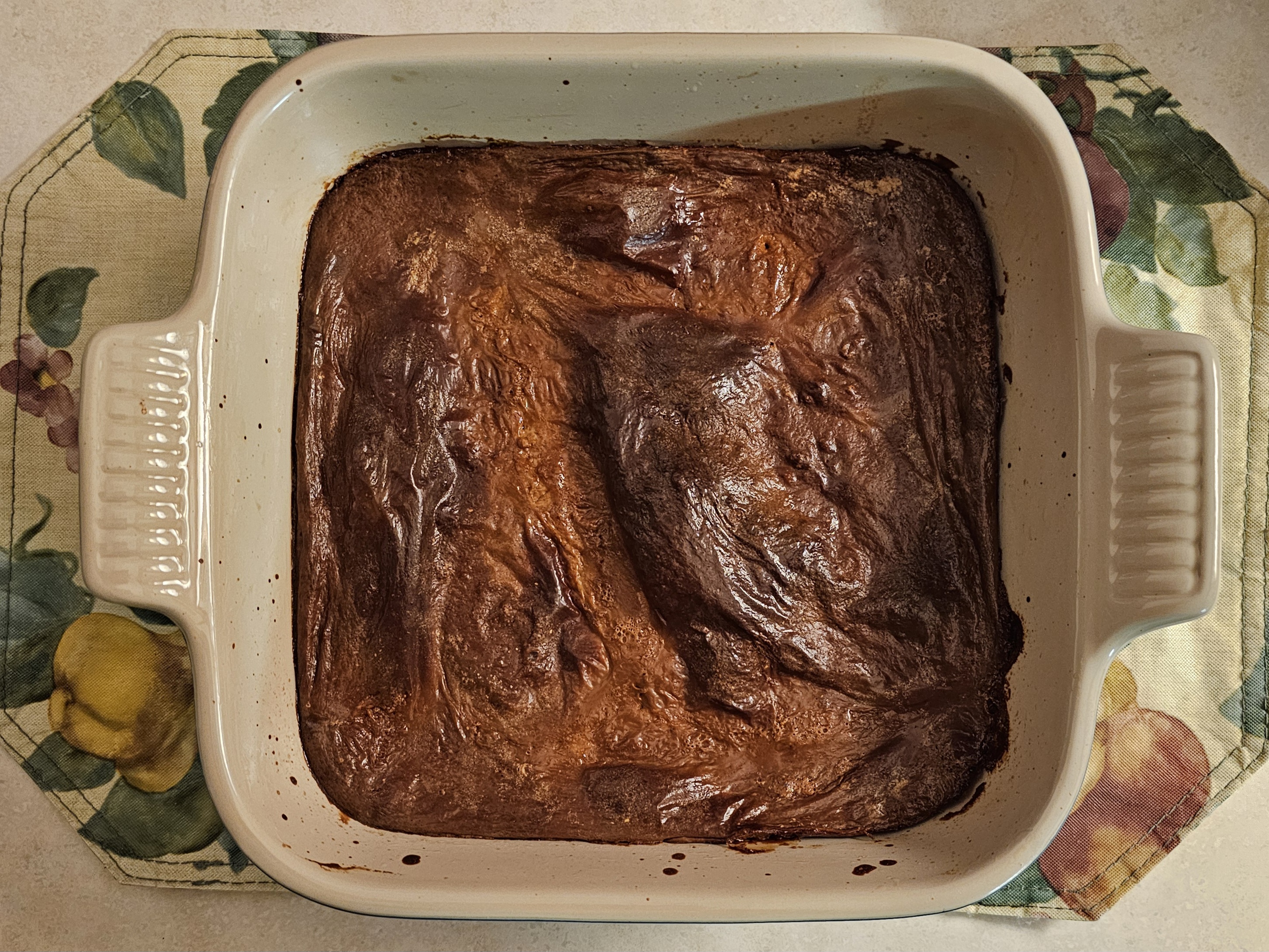
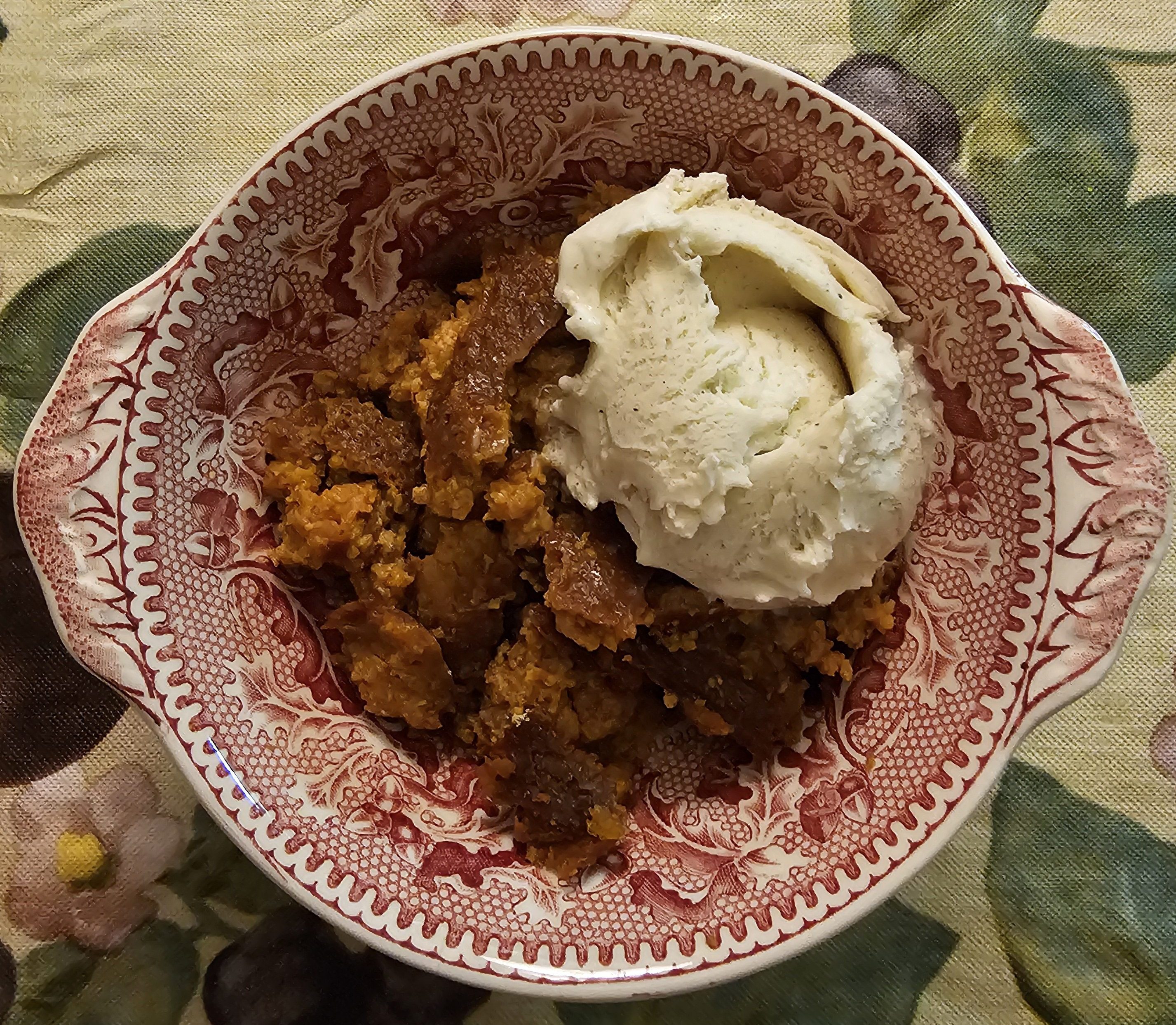
The result, while neither spectacular nor pretty, was not bad at all. While the pudding was baking, the aroma of molasses and corn was heavenly. I took it out after two hours and 20 minutes. It was not as moist as I would have liked, so maybe I should have baked it only two hours and at a lower temperature, and/or used a smaller baking dish.
But it was still mighty tasty with a sprinkle of cinnamon and a scoop of vanilla ice cream.
At least it couldn’t possibly have turned out as badly as would the so-called “Perfect Italian Macaroni Dish,” which directs the cook to boil the macaroni for an hour and 15 minutes. “This will be a revelation to lovers of good macaroni,” says the recipe. Indeed.
Happy cooking!
This post was contributed by Linda Cantoni, a Distributed Proofreaders volunteer.


 Posted by LCantoni