Celebrating 50,000 Titles

December 7, 2025

This post celebrates the 50,000th unique title Distributed Proofreaders has posted to Project Gutenberg: A Dictionary of the Art of Printingby William Savage. Congratulations and thanks to all the Distributed Proofreaders and Project Gutenberg volunteers who helped us reach this major milestone!

The first book printed in England using the moveable-type technology invented by Johannes Gutenberg was published by William Caxton in 1473. Ironically, the considerable skills needed to manufacture paper, inks, type-metal letters in foundries, and mechanical printing presses were handed down only orally for more than two centuries.

It fell to Joseph Moxon to publish the first treatise describing many of these skills, Mechanick Exercises, or The Doctrine of Handy-Works Applied to the Art of Printing, in 1683/4. He himself was a master printer, and his book was intended to be a practical manual for the printing trade. Clearly the art of printing in his time was not for the faint-hearted. Preparation of ink involved boiling varnish in a cauldron, with a real danger of the fumes catching fire and “Firing the Place it is made in.” Casting the type-metal letters (fonts) in a foundry produced “Poysonous Fumes” from the antimony used in the process.
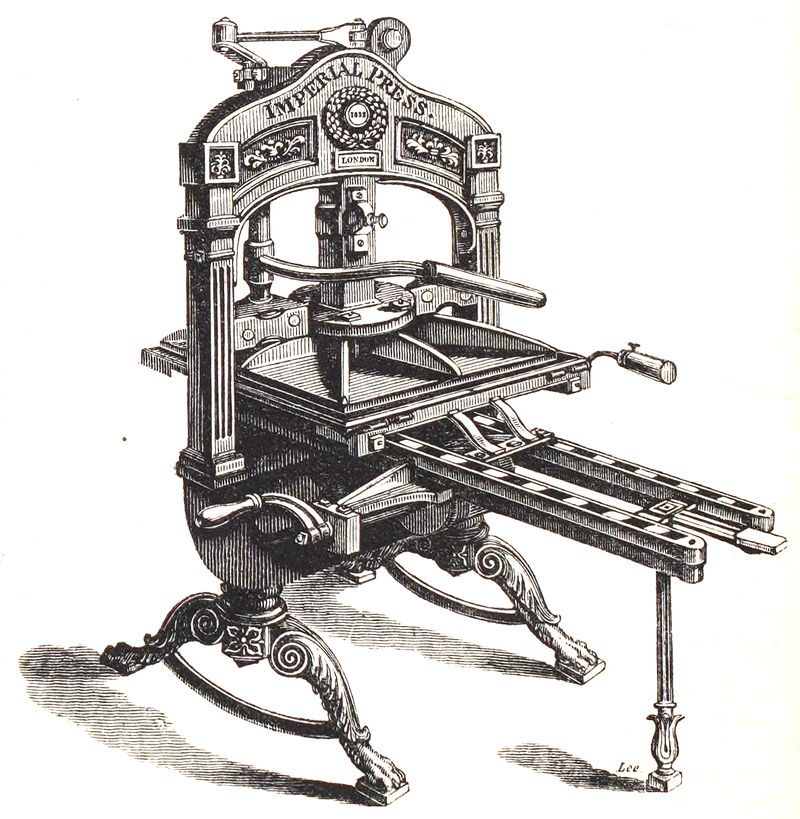
Sherwin and Cope's Imperial Press

Another 160 years would pass until William Savage, also a printer by trade, published A Dictionary of the Art of Printing. It was intended as an update to Moxon’s manual, reflecting the current (as of 1840) state of moveable-type technology. He chose the structure of a dictionary to describe detailed “how-to” segments on every aspect of printing and binding a book. He widened the scope to explain all the colorful jargon of the trade, and included alphabet tables and grammatical summaries of almost every language produced by the many British type-metal foundries of that time, from Arabic and Armenian to Sanskrit and Saxon.

What does “Upper case” really mean? See “Case.” How does one fold an octavo sheet? See “Imposing.” What is a “Galley Slave”? What is a “Gathering”? What is “Brevier”? What size is diamond, pearl, emerald, or pica font? See “Types”. How much was a compositor paid for composing 1,000 letters? See “Scale of Prices.”

Savage’s dictionary has many quotes from Moxon’s manual showing how relevant it remained two centuries later, even as the technology advanced. He also acknowledges the future electrotype technology, which was starting to revolutionize the printing industry globally. (See “Galvanism.”) Although printing technology has continued to advance beyond electrotyping to lithography and phototypesetting and digital printing, it is remarkable how much of the early printing terminology remains in our language today.

The volunteers at Distributed Proofreaders are very proud to have A Dictionary of the Art of Printing as their 50,000th unique title for Project Gutenberg.

This post was contributed by jandac, a Distributed Proofreaders volunteer who post-processed A Dictionary of the Art of Printing.


On the Beauty of Women

December 1, 2025

When Distributed Proofreaders recently celebrated its 25th Anniversary, its volunteers were given a rich array of special projects to work on involving the number 25. Among these projects is a fascinating booklet published circa 1525: Here foloweth a lytell treatyse of the beaute of women.

Lytell treatyse title

This Lytell Treatyse states that it is a translation from a French book, “la beaute de femmes,” by an unnamed author. Not much is known about its English translator/printer/publisher, Richard Fawkes, whose last name is spelled in various sources as Faques and Fakes. We do know that he had a bookshop in Durham Rents in London, behind Durham House, then a Tudor royal residence on the Strand.

The Lytell Treatyse is rendered entirely in rhymed verse, with, as was customary at the time, little punctuation and lots of variant spellings. It begins with an invocation to Mary, the mother of Jesus, in whom both beauty and goodness “were perfaytely assembled.” He begs her to guide his hand so that the unidentified gentleman who asked him to do the translation is happy with it. He claims to be inexperienced with women himself, so he will “folow the sentence” of the French book rather than give his own opinions. He names pairs of classical lovers, such as Troilus and Cressida, Helen of Troy and Paris, and Tristan and Isolde, whose love affairs were sparked by the woman’s beauty, “what euer foloweth of the consequence” (a reference to the fact that these affairs ended in disaster).

During this era, some writers came up with aesthetic criteria in the form of “triads” of female attributes constituting beauty. The Lytell Treatyse begins with a triad of “Symple [i.e., modest] manyer and countenaunce” (how she acts), “Symple regade” (how she looks at others), and “Symple answer” (how she talks). It touches upon a woman’s physical form, praising “hygh” points such as a high forehead, a head held high “The better therwyth hyr hat she doeth vpholde,” and “brestes hygh fayre and rounde wyth fyne gorgias well and fayre couert” (i.e., well covered with fine material). It also notes “lowe” points, such as “lowe laughying,” a “lowely regarde” (harking back to the “Symple regade” mentioned earlier), and “whan she shall neese [sneeze] to make the sounde but lowe.” In all, the author lists eight sets of three attributes comprising ideal beauty.

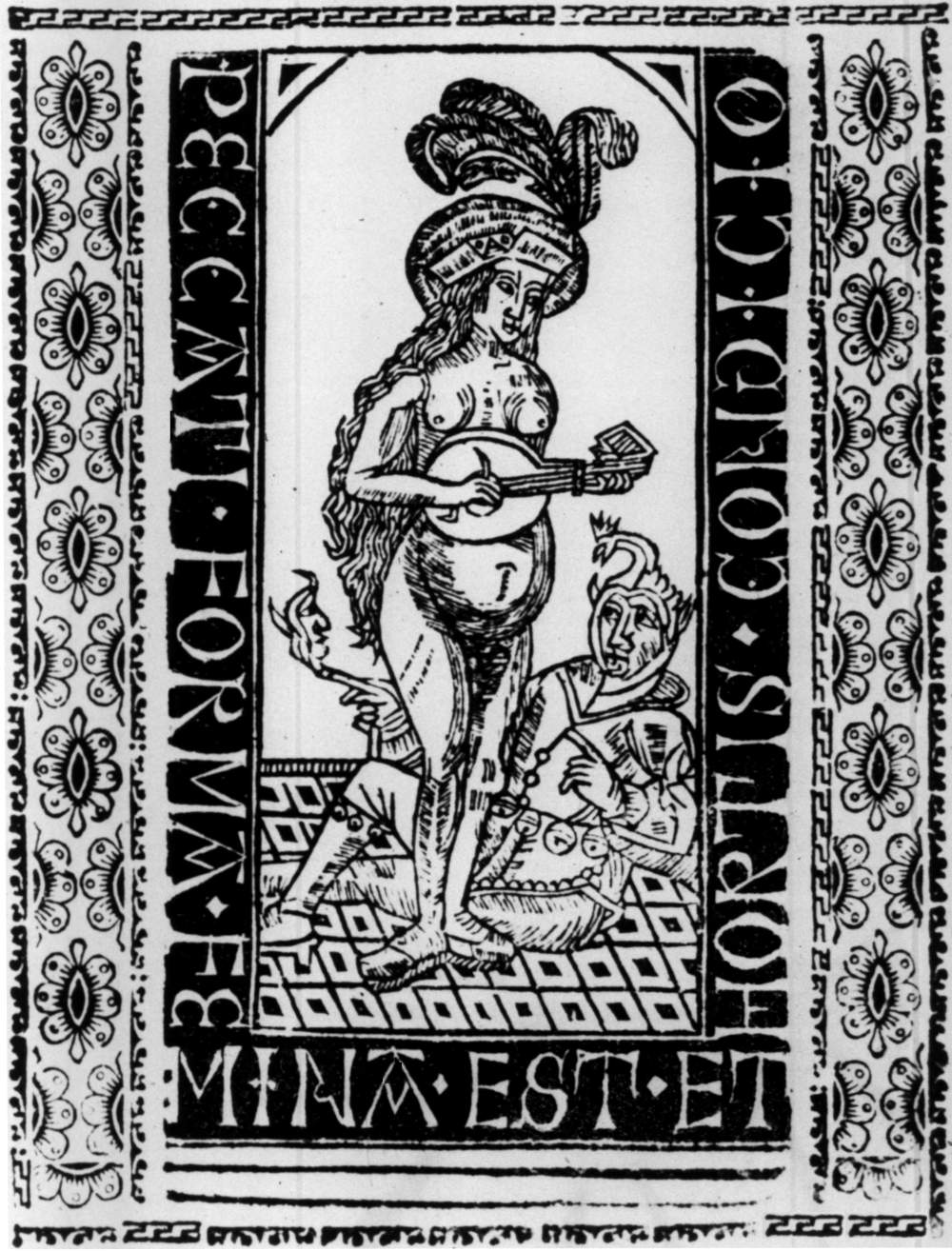
But in the final stanzas the author repeats, three times, the French moral of the story: “Beaulte sans bonte ne vault rien” (beauty without goodness is worth nothing.) And that brings us to the rather odd woodcut adorning the Lytell Treatyse. It depicts a voluptuous woman wearing nothing but a fancy plumed hat and slippers, playing a lute to a jester sitting at her feet. The Latin inscription in its border, “Peccati forma femina est et mortis condicio,” can be translated roughly as, “Sin and death take the shape of woman.” This apparent reminder that men can be fools for beautiful women seems to contradict the praise of beauty in the Lytell Treatyse, but perhaps it was meant as a counterpoint to its conclusion that “beaulte with bonte assembled in a place / Gyue demonstrance of an especyall grace.”

This blog post was contributed by Linda Cantoni, a Distributed Proofreaders volunteer.