In 1890, the New York Times said of Herman Melville, “There are more people to-day who believe Herman Melville dead than there are those who know he is living.” He was alive, but his writing career was not. Unbeknownst to the world, he spent his final few years working on his great novella, Billy Budd. It would not be published until 1924, 33 years after his death. Thanks to the volunteers at Distributed Proofreaders and Project Gutenberg, you can read the very first publication of it for free.
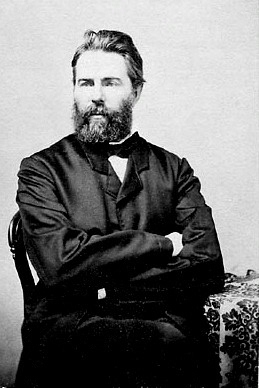
Melville had a brilliant start in 1846 with a best-selling novel, Typee, and its equally popular sequel, Omoo, both based on his escapades in the South Seas after he jumped ship on a whaling voyage. Undeterred by the mediocre sales of his next few novels, in 1850 he bought a farm, Arrowhead, in the Berkshire Hills of western Massachusetts, to concentrate on what he believed would be his masterpiece, Moby Dick. But it was the most dismal failure of his career.
He wrote several more novels and story collections, but he never had another success. No longer able to support his family on his writing alone, in 1863 he moved to New York City to work as a customs inspector, fitfully publishing articles and poetry. After his death in 1891, his papers, stored in an old tin breadbox, eventually went to his granddaughter, Eleanor Melville Metcalf.
In 1919, Raymond Weaver, an English professor at Columbia University, was asked to write an article for the centenary of Melville’s birth. Prof. Weaver was astonished to find that nothing had ever been written about Melville’s life. He located Mrs. Metcalf and discovered that she had not only a trove of family papers, but also the hitherto unknown and unfinished Billy Budd manuscript and other writings. The family papers enabled Weaver to publish the very first full Melville biography, Herman Melville: Mariner and Mystic, in 1921. And in 1924, working with Mrs. Metcalf to sift through, decipher, and edit the manuscript, Billy Budd was finally made known to the world in Volume XIII of the first collection of Melville’s works, which includes other short writings and is the edition available at Project Gutenberg. (Because of the disordered and often contradictory state of Melville’s manuscript, several different versions of Billy Budd followed Prof. Weaver’s edition.)
Billy Budd is the story, set in 1797, of a young sailor who has been impressed into service with the Royal Navy on board H.M.S. Indomitable (Bellipotent in later editions). Handsome and good-natured, he is popular with the crew, but not with the unpopular and sadistic Master-at-Arms, Claggart, whose envy (and, according to some interpretations, homoerotic attraction) leads him to hate Billy. He falsely accuses Billy of conspiracy to mutiny. The result is a tragedy that forces the sympathetic Captain Vere to make a decision, based on his view of British naval law of the time, that is still the subject of scholarly legal debate.
Prof. Weaver’s discoveries sparked a Melville Revival that continues to this day. At last this once-obscure writer of sea-stories was recognized as the greatest American novelist. Adaptations of Billy Budd for stage and screen abound, among them an opera by Benjamin Britten and a film by Peter Ustinov starring Terence Stamp as Billy. Just last month, a new audiobook version of Billy Budd, narrated by Paul Giamatti, was published by the Berkshire County Historical Society, which preserves Arrowhead as a museum. Distributed Proofreaders and Project Gutenberg – which has many of Melville’s works in its library – have helped make it possible for everyone to participate in the revival.
This post was contributed by Linda Cantoni, a Distributed Proofreaders volunteer and a member of the Board of Directors of the Berkshire County Historical Society.


 Hot off the Press
Thank you for this nice write up on Herman Melville and his troubled career. It’s amazing how his fame was left to posterity, as if he were far ahead of his time. The same for Emily Dickinson, who never saw fame in her lifetime. Also, regarding Melville, his books always did better in the UK than domestically. I always thought it peculiar. Thanks again and I hope your weekend is very nice.
Thank you so much – I’m so glad you enjoyed the blog post, and thanks for your insight on how his books sold better in the UK – curious! I’ve been immersed in Melville’s life and works for a few years now (I live near Arrowhead), and I’ve always felt the poignancy of his failed career compared to his posthumous success. Enjoy the rest of the weekend!