On the Beauty of Women

December 1, 2025

When Distributed Proofreaders recently celebrated its 25th Anniversary, its volunteers were given a rich array of special projects to work on involving the number 25. Among these projects is a fascinating booklet published circa 1525: Here foloweth a lytell treatyse of the beaute of women.
Lytell treatyse title

This Lytell Treatyse states that it is a translation from a French book, “la beaute de femmes,” by an unnamed author. Not much is known about its English translator/printer/publisher, Richard Fawkes, whose last name is spelled in various sources as Faques and Fakes. We do know that he had a bookshop in Durham Rents in London, behind Durham House, then a Tudor royal residence on the Strand.

The Lytell Treatyse is rendered entirely in rhymed verse, with, as was customary at the time, little punctuation and lots of variant spellings. It begins with an invocation to Mary, the mother of Jesus, in whom both beauty and goodness “were perfaytely assembled.” He begs her to guide his hand so that the unidentified gentleman who asked him to do the translation is happy with it. He claims to be inexperienced with women himself, so he will “folow the sentence” of the French book rather than give his own opinions. He names pairs of classical lovers, such as Troilus and Cressida, Helen of Troy and Paris, and Tristan and Isolde, whose love affairs were sparked by the woman’s beauty, “what euer foloweth of the consequence” (a reference to the fact that these affairs ended in disaster).

During this era, some writers came up with aesthetic criteria in the form of “triads” of female attributes constituting beauty. The Lytell Treatyse begins with a triad of “Symple [i.e., modest] manyer and countenaunce” (how she acts), “Symple regade” (how she looks at others), and “Symple answer” (how she talks). It touches upon a woman’s physical form, praising “hygh” points such as a high forehead, a head held high “The better therwyth hyr hat she doeth vpholde,” and “brestes hygh fayre and rounde wyth fyne gorgias well and fayre couert” (i.e., well covered with fine material). It also notes “lowe” points, such as “lowe laughying,” a “lowely regarde” (harking back to the “Symple regade” mentioned earlier), and “whan she shall neese [sneeze] to make the sounde but lowe.” In all, the author lists eight sets of three attributes comprising ideal beauty.

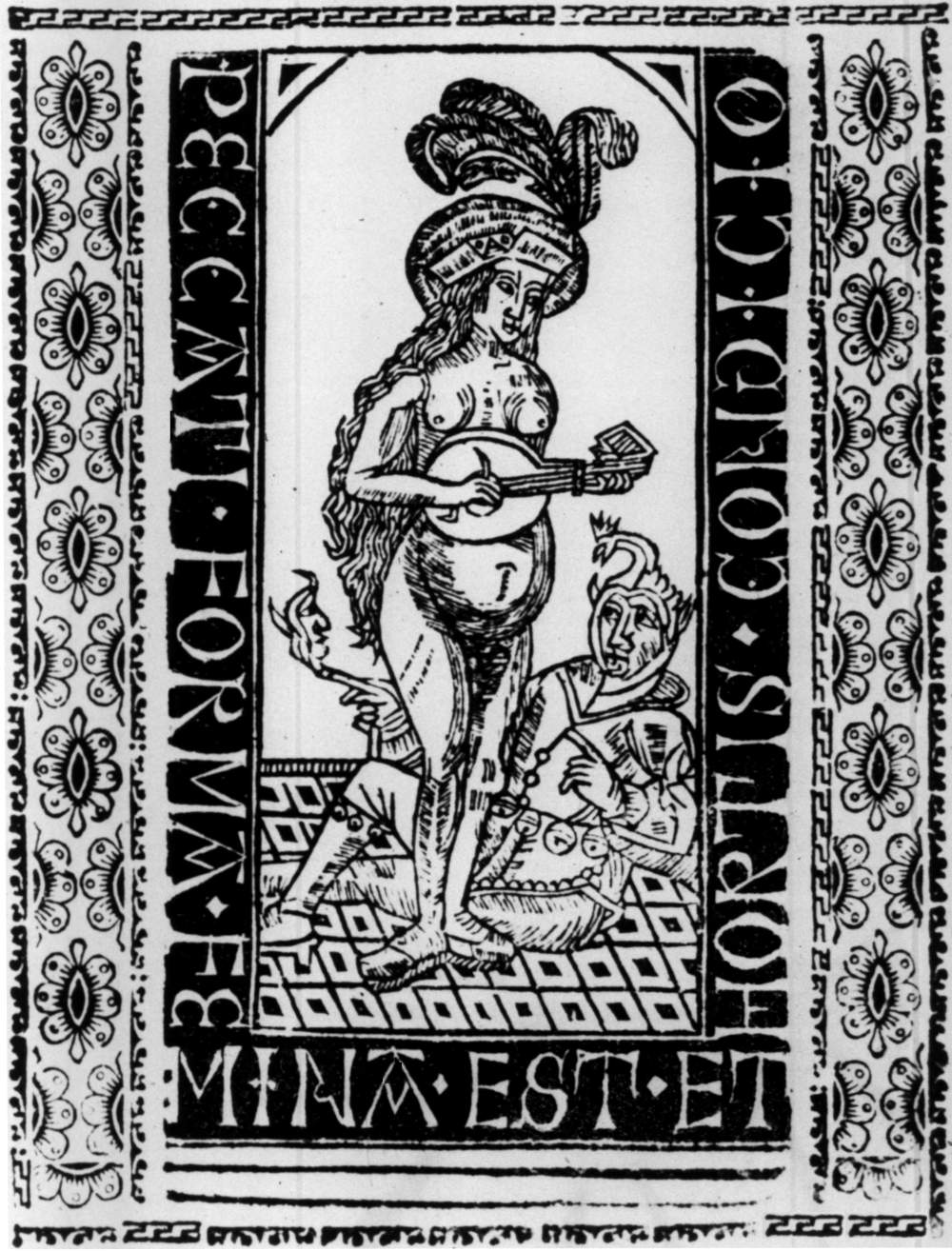
But in the final stanzas the author repeats, three times, the French moral of the story: “Beaulte sans bonte ne vault rien” (beauty without goodness is worth nothing.) And that brings us to the rather odd woodcut adorning the Lytell Treatyse. It depicts a voluptuous woman wearing nothing but a fancy plumed hat and slippers, playing a lute to a jester sitting at her feet. The Latin inscription in its border, “Peccati forma femina est et mortis condicio,” can be translated roughly as, “Sin and death take the shape of woman.” This apparent reminder that men can be fools for beautiful women seems to contradict the praise of beauty in the Lytell Treatyse, but perhaps it was meant as a counterpoint to its conclusion that “beaulte with bonte assembled in a place / Gyue demonstrance of an especyall grace.”

This blog post was contributed by Linda Cantoni, a Distributed Proofreaders volunteer.


Celebrating Women’s History Month

March 23, 2014

March is Women’s History Month and whilst most of the attention tends to be centred on 8 March, International Women’s Day, here at Distributed Proofreaders we like to spend the whole month inviting volunteers to focus their attention on books by women or about them and their achievements.

One of those books is one we posted in August last year, A Book of Bryn Mawr Stories by Harriet Jean Crawford et al. I wanted to talk about it because I feel that it fits well with this year’s theme—Celebrating Women of Character, Courage, and Commitment—as well as with the theme for International Women’s Day—Equality for Women is Progress for All.

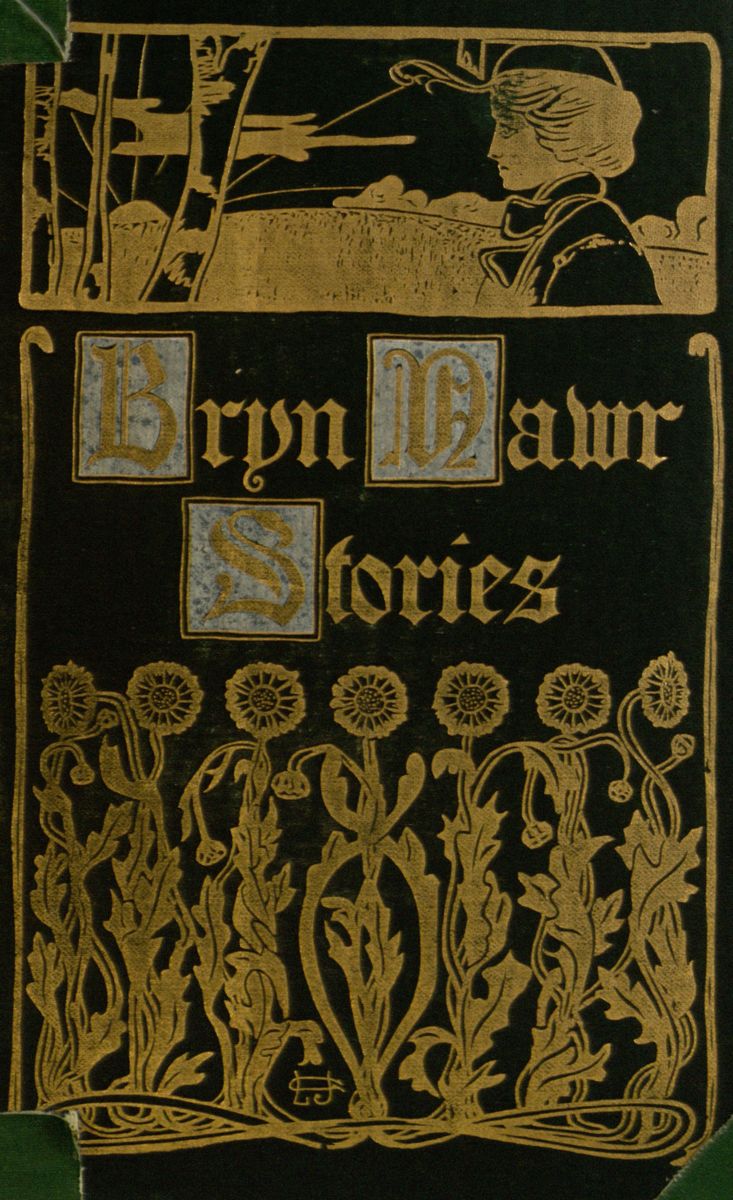
Bryn Mawr College in Philadelphia was founded in 1885 and was one of the first higher education institutions to offer graduate degrees to women. 129 years later it is still going strong, and it still has a strong focus on promoting educational access, equality and opportunity for women. Initially affiliated with the Quakers, by the time this collection of stories was published in 1901 it had become non-denominational.Book cover - Bryn Mawr Stories

The book is a collection of stories written by students of the college.  In the opening story, Ellen, the central character, has been asked to give a speech on The Educational Value of College Life. Struggling to come up with inspiration, she visits fellow graduates of Bryn Mawr for ideas. When she parts from one of them, the other woman says, by way of advice:

“I should certainly deal with the practical value of college life, taking up some line of thought that will show its power to make women effective citizens in the broad sense of the word.”

And this is a recurrent theme in the book: how educating women, far from making them unfit for the place society has designated for them, actually makes them more fit.

I remember when they passed equal opportunities employment legislation here in the U.K. It seemed like the world opened up. I could do anything. It made you dizzy with the new possibilities. All right, I was fourteen and naive and unaware that legislation is one thing and changing the mindset of a whole country is another. It didn’t stop me visualising all sorts of possible futures that I would never have even considered before.

Those early women scholars must have felt a bit like that. At a time when it was still seriously believed by men of science that if a woman had to think about “man things” (like politics, economics, science, etc.) then her brain would literally overheat dangerously, the introduction of degree courses for women was revolutionary.

There were many critics of teaching women to this level. They said that it wasn’t necessary, after all a woman’s place was in the home as a wife and mother. They said it was dangerous, making women dissatisfied with their lot and leading them to disagree with men. It seems very strange, here in the U.K. slightly more than a century later, but it was the way things were back then.

Many of the characters in the stories sound slightly stilted and preachy to the modern ear. This is understandable when you remember that they were written in 1901, a time of great change, and at the height of the struggle for women’s suffrage and improved rights for women. They argue the point that educating women does not make them unwomanly, unfit for matrimony or other feminine pursuits. That it is good for women to be able to think and to be aware of the issues of the day. I am one of the many beneficiaries of the fight for women’s rights and I appreciate it every day. Although I live somewhere that has come a long way from where the students writing these stories were living, there are still places where women do not have the same rights as men, where they do not have the same access to education, property ownership, work and money. There are still societies where the fight fought by Bryn Mawr and other groundbreaking institutions like it is ongoing.

This book was inspirational and, more importantly, aspirational, and I, for one, hope that some day all women (and men) will be seen as equal, with the same rights and responsibilities, the same economic and political power.

Maybe, a century from now, we won’t need a special day or month to celebrate women and their contribution to the societies in which they live.

Here’s hoping.