Project Gutenberg Celebrates 75,000 Titles

December 30, 2024

Distributed Proofreaders is proud to have contributed Project Gutenberg’s 75,000th title, Folk Tales from Tibet, collected and translated by Captain W.F. O’Connor, and published in 1906.

Captain (later Sir William) O’Connor was an Irish diplomat and British army officer who served from the 1890s until his retirement in 1925. He spent many years on military missions in India, Tibet, and other South Asian countries, as well as Iran and Siberia, and was even a captive of the Persian army for a time. He was first posted to Tibet in 1903 as part of the Younghusband Expedition, which was essentially a military invasion designed to prevent the Dalai Lama from allying Tibet with Russia.

In his preface, O’Connor doesn’t mention this invasion, recounting only that he spent two years in Tibet, where he “made many friends amongst all classes of Tibetans – high and low, rich and poor” from whom he “learned that there exists amongst this fascinating and little-known people a wealth of folk-lore, hitherto inaccessible to the outside world.” He included 22 stories in Folk Tales from Tibet, and did his best to include only those that he believed were genuinely Tibetan, rather than those that had been “imported bodily” from Indian or Chinese sources.

Illustration for “How the Hare Got His Lip Split”

The stories are filled with folk wisdom very similar to that in Western stories, serving as cautionary tales about hubris, foolhardiness, greed, and other human foibles. Many of the stories feature anthropomorphized animals, as is common in folklore the world over. In one, “How the Hare Got His Lip Split,” a wily hare plays a series of nasty tricks on a tiger, a man and his horses, some ravens, and a shepherd boy and his sheep. Among the human characters are a quarreling king and queen, a set of thieves, an old Lama and his servant, and a deformed boy. O’Connor tantalizingly notes in the preface that “some of the very best and most characteristic stories are unfit for publication in such a book as this,” leading one to wonder if there might have been an Arabian Nights quality to them. (He does assure the reader that he has separately preserved omitted stories that “possess any scientific interest.”)

The collection’s subtitle notes that it includes “illustrations by a Tibetan artist and some verses from Tibetan love-songs.” The Tibetan artist is not named, but his or her artwork is richly colored and quite striking, despite O’Connor’s misgivings that the illustrations are “somewhat weak in details” because he was “unable personally to superintend their execution.” But O’Connor does not spare himself; he modestly apologizes for the “crudeness and lack of artistic finish” of his translations of the love songs, which are rendered in a very English rhyme-scheme.

Congratulations to the volunteers at Distributed Proofreaders and Project Gutenberg who made this 75,000th Project Gutenberg title possible!

This post was contributed by Linda Cantoni, a Distributed Proofreaders volunteer.


50 Years at Project Gutenberg

July 4, 2021

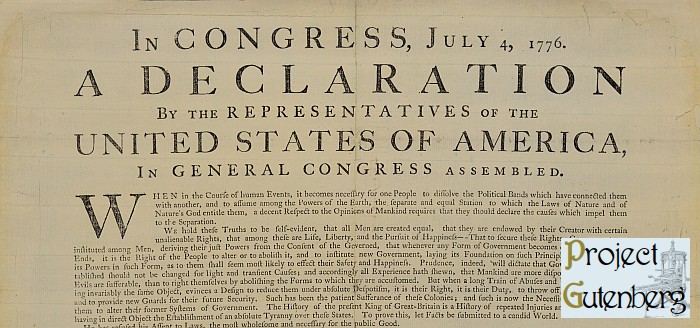
On July 4, 1971, Michael S. Hart, who had been given access to a mainframe computer at the University of Illinois, typed the United States Declaration of Independence into the machine and sent it off to about 100 users via ARPANET – the infant Internet. And so the first e-book was born, along with Hart’s vision of making literature “as free as the air we breathe”: Project Gutenberg. Half a century later, PG offers readers over 65,000 free e-books in the U.S. public domain, available in a wide variety of formats and languages.

In the first couple of decades, Michael typed in most of the books himself in his spare time. The 10th e-book, released in 1989, was the King James Bible. By 1994, there were 100 books at PG – the 100th e-book was The Complete Works of William Shakespeare. Just three years later came the 1000th e-book, Dante’s Divina Commedia in Italian. By this time, Michael had the help of a cadre of dedicated volunteers – the key to PG’s success to this day.

By 2000, PG’s online library had become large enough and popular enough to warrant a more formal organization to ensure its smooth operation. So the non-profit Project Gutenberg Literary Archive Foundation (PGLAF) was founded. In the same year, one of PG’s volunteers, Charles Franks, founded Distributed Proofreaders (DP) to produce a larger number of high-quality e-books by means of an early use of crowdsourcing. The DP system divided the workload into individual pages, so that many volunteers could work on a book at the same time, thereby speeding up the creation process – essentially “preserving history one page at a time.” By 2001, DP had become the most productive single source of PG e-books – in fact, earlier this year, DP celebrated its 41,000th title posted to PG, and in 2019 it had the honor of producing PG’s 60,000th e-book, The Living Animals of the World. PG also has a sizable contingent of devoted independent e-book producers who provide the rest. “Because of Project Gutenberg, a massive store of literature, poetry, history and philosophy in many languages is available for free download on the Internet and forms a significant entertainment and educational resource,” said DP General Manager Linda Hamilton. “We at Distributed Proofreaders are proud to partner with Project Gutenberg on this important mission. Happy 50th Birthday!”

PG loves to improve its collection. A dedicated errata team fixes typos, replaces straight quotes with curly quotes, updates HTML, and so forth. PG has gone well beyond the plain-text formats of the early years, and nearly every title is offered in text, HTML, epub, and mobi (Kindle) formats.

With the rise in PG’s popularity and the influx of new volunteers, it became important to regularize its minimum formatting guidelines to ensure that the e-books were truly accessible to everyone. Beyond that, PG gives its e-book producers wide latitude in producing an e-book. Unlike outlets like Google Books and the Internet Archive, PG doesn’t produce scanned facsimiles of printed books: PG books are true e-books with fully searchable and resizable text that has been carefully checked for scanning errors. PG e-books provide an enriching reading experience by ensuring accuracy and attractive presentation (including, in many cases, illustrations and audio files), and providing a variety of formats for reading on a wide array of devices. While automation technology helps tremendously with this task, at bottom it takes human beings to do all that.

The crux of PG’s mission is freedom to read. To that end, it provides its e-books free of charge; it grants a broad license for free redistribution; and, as noted, it makes its e-books accessible in many formats. But even more importantly, PG imposes no restrictions on content. It subscribes to the American Library Association’s Freedom to Read Statement, which holds that “free communication is essential to the preservation of a free society and a creative culture.”

Sadly, Michael Hart passed away in 2011 at the age of 64, but his legacy is as vigorously alive as ever. PG has become a worldwide phenomenon. There are sister sites in Australia and Canada. Projekt Gutenberg-DE is dedicated to German literature, and Project Runeberg to Nordic literature.

The marvel of Project Gutenberg is that it has accomplished all this without charging for its books. While PGLAF does take donations to help with expenses, the e-books are and always will be completely free of charge, created by the tens of thousands of volunteers in the last half-century whose only compensation – as it was for Michael Hart – is the sheer joy of literature. Congratulations and thanks to all of them for giving the world 50 years of free e-books.

This post was contributed by Dr. Gregory Newby, Director and CEO of the Project Gutenberg Literary Archive Foundation, and Linda Cantoni, a Distributed Proofreaders volunteer. You can read more about PG’s history and philosophy in Dr. Newby’s article, “Forty-Five Years Of Digitizing Ebooks.”