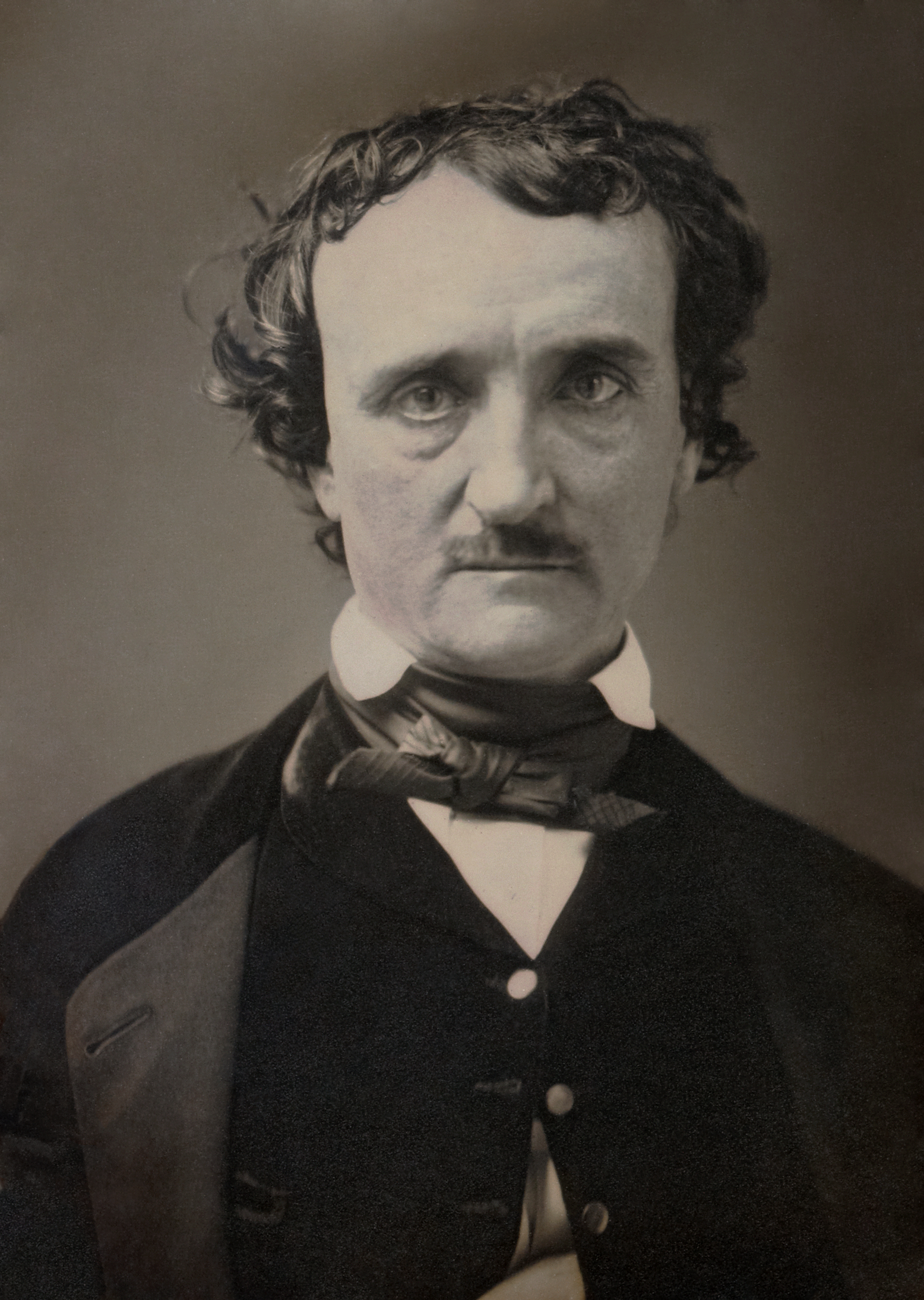
On October 3, 1849, a disheveled, delirious man claiming to be Edgar Allan Poe was found at a tavern in Baltimore, Maryland. An acquaintance confirmed his identity but said that the dirty, ill-fitting clothes Poe was wearing did not appear to be his own. After four days of suffering delirium tremens in the intoxication ward of a local hospital, Poe died. His last words were, “Lord help my poor Soul.” He was only 40 years old, but, as can be seen from a photo taken a few months before his death, he looked rather older, no doubt due to his longtime alcoholism. How Poe came to be in that tavern in someone else’s clothes is as mysterious and dark a secret as those in his stories and poems.
It was an ignominious end to the life of a man who, though he failed to achieve consistent fame in his lifetime, is now celebrated as one of the most influential writers of America’s Romantic era. His Gothic stories, masterworks of psychological horror, are shocking even today, giving rise to an enduring fiction and film genre. But his first love was poetry, and the breadth and depth of his poetic output is evident from The Poems of Edgar Allan Poe, now available at Project Gutenberg thanks to the efforts of Distributed Proofreaders volunteers.
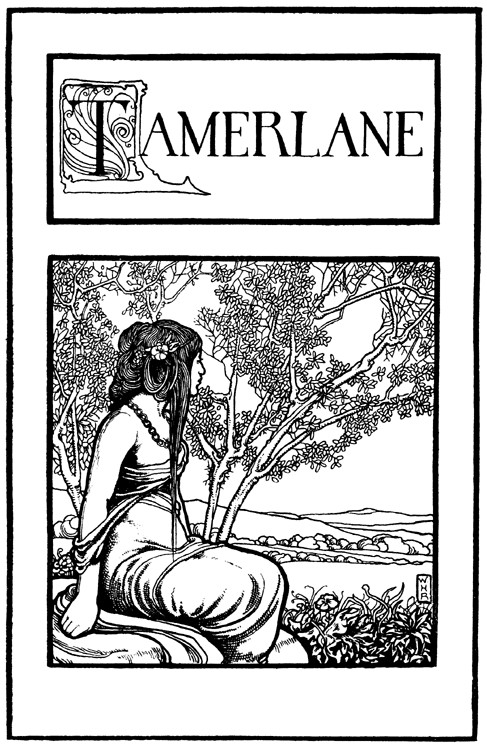
This collection, published in 1900, is a treasure trove of Poe’s verse, containing all 49 of his poems, beautifully illustrated with ornate pen-and-ink drawings by W. Heath Robinson. It includes Poe’s first published poem, “Tamerlane,” which appeared in 1827 when Poe was only 18. It was not a success. (The first edition is so rare today that it is known as the “Black Tulip”; a copy sold in 2024 for US$420,000.)
Poe’s early poems are floridly romantic, but they began to take a dark turn in the 1830s, after he was expelled from West Point and disowned by his foster-father. “The Sleeper,” for example, written in 1831, is the heart-cry of a young man grieving over the corpse of his beloved (“Strange is thy pallor! strange thy dress!”).
But the height of Poe’s Gothic poetry is undoubtedly “The Raven.” It was an instant hit when it was published in a New York newspaper in 1845. Its opening lines are among the most famous in American poetry:
Once upon a midnight dreary, while I pondered, weak and weary,
Over many a quaint and curious volume of forgotten lore…
“The Raven” expresses the familiar theme in Poe’s poetry of grief over the death of a beloved woman, the narrator’s “sorrow for the lost Lenore.” Poe richly invokes the gloom of the “midnight dreary,” the “bleak December,” and the mysterious “ebony bird.” The raven comes in from the outer darkness to perch on the narrator’s “pallid bust of Pallas” (Athena, the ancient Greek goddess of wisdom), a contrast of dark and light, madness and reason. The narrator questions the raven’s purpose and begs to know whether there is “balm in Gilead” to ease his sorrow, but he is driven nearly mad by the bird’s insistent refrain of “Nevermore”: “Take thy beak from out my heart, and take thy form from off my door!” “The Raven” is deservedly considered Poe’s best poem.
The Poems of Edgar Allan Poe contains a valuable bonus in the form of Poe’s essay on “The Philosophy of Composition,” in which he details his creative process in writing “The Raven.” Among other interesting extras are his early “Essay on the Poetic Principle,” as well as scenes from his unfinished play, Politian, a strange work set in 16th-Century Italy but inspired by a sensational Kentucky murder case. Thanks to Distributed Proofreaders and Project Gutenberg, you can delve into this fascinating corner of Poe’s oeuvre for free.
This post was contributed by Linda Cantoni, a Distributed Proofreaders volunteer who post-processed The Poems of Edgar Allan Poe. The e-book is dedicated to our late and much-missed colleagues Chris Curnow and Turgut Dincer, who made substantial contributions to its preparation.


 Posted by LCantoni

 Hot off the Press