Among the Forest People

January 26, 2011

Among the Forest People, by Clara Dillingham Pierson, is a charming book. Filled with small tales of denizens of a forest, the book teaches young children lessons on selfishness, bullying, kindness, humility, and other excellent values. Yet, in most instances, the stories are not preachy or overdrawn.

There were two stories which I found particularly amusing. The first one, “Mrs. Mourning Dove’s Housekeeping,” tells us that all of the other birds are aghast that Mrs. Mourning Dove’s nest is so untidy and seemingly unsafe:

“Really,” said one of the Blackbirds, who had flown over from the swamp near by, “I never should think of calling that thing a nest! It is nothing but a few twigs and sticks laid together. It is just as flat as a maple-leaf, and what is to keep those poor little Doves from tumbling to the ground I can’t see.”

There was much discussion amongst the birds and other forest denizens as to whether Mrs. Mourning Dove’s eggs would survive. And then the rumors started: the eggs had fallen through the nest; the eggs were on the forest floor; the eggs had been eaten up; there were no baby doves!

The story ends happily, with the neighbors admitting that Mrs. Dove is not a good housekeeper, which she freely admits herself, but that she is a lovely bird and is raising her children to be polite and proper. In the end, everyone is friends.

In “The Red Squirrels Begin Housekeeping,” we have a love story. Mr. Red Squirrel had been kept in a cage, but one day he was able to get free. He had no skill or training in how to live in the wild, and he was beginning to be very hungry, when PLOP came an acorn on top of his head. He was sitting under a maple tree, which of course did not make acorns! So Red quickly ate the acorn. He had barely finished that when from nowhere came a walnut down in front of him! He ate that, and these were rapidly followed by other nuts:

Next came a hazelnut, then a butternut, and last of all a fat kernel of yellow corn. He knew now that some friend was hidden in the branches above, so he tucked the corn in one of his cheek-pockets, and scampered up the maple trunk to find out who it was. He saw a whisking reddish-brown tail, and knew that some other Red Squirrel was there. But whoever it was did not mean to be caught, and such a chase as he had! Just as he thought he had overtaken his unknown friend, he could see nothing more of her, and he was almost vexed to think how careless he must have been to miss her. He ran up and down the tree on which he last saw her, and found a little hollow in one of its large branches. He looked in, and there she was, the same dainty creature whom he had so often watched from his cage. He could see that she was breathless from running so fast, yet she pretended to be surprised at seeing him.

A few paragraphs later, after Red Squirrel chatted with his benefactress, he asked her to marry him. She agreed, they set up housekeeping, and raised a family. Then in the fall, they began gathering nuts again, to get through the winter.

“Don’t stop to think how many you need,” said the little mother to her children. “Get every nut you can. It may be a very long winter.”

“And if you don’t eat them all,” said their hard-working father with a twinkle in his eyes, “you may want to drop a few down to some poor fellow who has none. That was your mother’s way.”

“When was it her way? What makes you smile when you say it? Mother, what does he mean?” cried the young Red Squirrels all in a breath.

And Mr. Gray Squirrel, a neighbor, tells the little red squirrels that their mom saved their dad’s life! it’s just a really cute story with a little moral about kindness.

Each tale in this book has a point, and most are made with care. Instead of being preachy, the book teaches with humor and by making the stories fun to read. I know that in today’s world it is not fashionable to give animals human voices and characteristics. However, that very technique is an effective teaching tool for small children, as I learned from personal experience. My children were much more willing to listen to a story about animals finding out how to behave than they were to hear me telling them not to be selfish, or to be kind, or to learn to think.

This would be an excellent book for a grandparent to share with a grandchild, or a parent to share with a child. It’s fun, funny, and charming.


An ex-maid’s maid.

December 8, 2010

"Why, she's going to ask me down there, too, to one of her week-end parties!"

“A Romance of Love and Fortune,” that is the subtitle of a light romance about a woman who becomes the maid of her ex-maid. The book is Miss Million’s Maid (1915) by Berta Ruck (Mrs. Oliver Onions).  In addition to love and fortune, it includes class snobbery, Irish royalty, theater, crime, and the Great War.

My story begins with an incident that is bound to happen some time in any household that boasts—or perhaps deplores—a high-spirited girl of twenty-three in it.

It begins with “a row” about a young man.

My story begins, too, where the first woman’s story began—in a garden.

It was the back garden of our red-roofed villa in that suburban street, Laburnum Grove, Putney, S.W.

Now all those eighty-five neat gardens up and down the leafy road are one exactly like the other, with the same green strip of lawn just not big enough for tennis, the same side borders gay with golden calceolaria, scarlet geranium, blue lobelia, and all the bright easy-to-grow London flowers. All the villas belonging to the gardens seem alike, too, with their green front doors, their white steps, their brightly polished door-knockers and their well-kept curtains.

From the look of these typically English, cheerful, middle-class, not-too-well-off little homes you’d know just the sort of people who live in them. The plump, house-keeping mother, the season-ticket father, the tennis-playing sons, the girls in dainty blouses, who put their little newly whitened shoes to dry on the bathroom window-sill, and who call laughing remarks to each other out of the window.

“I say, Gladys! don’t forget it’s the theatre to-night!”

“Oh, rather not! See you up at the Tennis Club presently?”

“No; I’m meeting Vera to shop and have lunch in Oxford Street.”

“Dissipated rakes! ‘We don’t have much money, but we do see life,’ eh?”

Yes! From what I see of them, they do get heaps of fun out of their lives, these young people who make up such a large slice of the population of our great London. There’s laughter and good-fellowship and enjoyment going on all up and down our road.

Except here. No laughter and parties and tennis club appointments at No. 45, where I, Beatrice Lovelace, live with my Aunt Anastasia. No gay times here!

Thus begins the tale of the great-granddaughter of Lady Anastasia. In the days of her great-grandmother the family lived in Lovelace Court. Since that time, the family has “come down in the world” and our heroine lives with her aunt as hermits, because the aunt believes “Better no society than the wrong society.”

Beatrice’s only friend is a naive maid. So when the maid inherits a fortune from a distant relative, our heroine decides to flee her hermitage by entering the employment of her maid. What follows then is a series of adventures as our heroine tries to protect her friend and show her the advantages of her new-found wealth. And, of course, what follows is also romance and plenty of humor along the way.


The Show Goes On and On

November 6, 2010

Vaudeville was big entertainment in the U.S. during the late 19th and early 20th century. For one price you could buy a ticket and see a combination of singers, dancers, comedians, acrobats, etc.  Many of the entertainers went on to do movies, radio and TV such as The Marx Brothers, Charlie Chaplin, Sammy Davis, Jr., James Cagney, and Bing Crosby. However, so many of the lesser known acts have been lost forever.

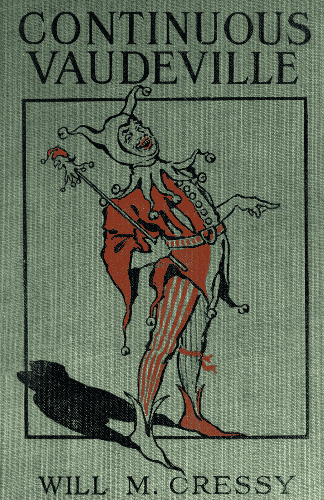
With Continuous Vaudeville, author Will M. Cressy gives the reader jokes and humorous stories. But they are jokes and stories about the performers, the acts, the staff of the theaters, and the audience. It is just a little peek into the world of vaudeville.

James J. Corbett was indulging in one of his semi-annual attacks of acting, and it came along to a place where the villain was to say—

“Then die, you dog,” and shoot Jim, who fell, wounded, to the floor.

Upon this occasion the villain spoke the line, pulled the trigger, and Jim fell. But the gun did not go off. Instantly Jim raised himself on his elbow and said in agonized tones—

“My God; shot with an air gun.”

He also gives tidbits from newspapers and things he has seen, and people he has met during his travels. At one point he has a list of actual signs that include:

Chicago. “I. D. Kay. Fresh Vegetables”

Oakland, Cal. “Dr. Muchmore, Dentist”

Paris, Ky. “Ice Cream & Washing Done Here.”

Spokane, Wash. “Bed Bath & Booze 15c. All Nations welcome but Carrie.”

Cressy certainly knew his subject. He was one part of the popular sketch comedy act, Cressy and Dayne. (Blanche Dayne was Cressy’s wife).

The illustrations were done by Hal Merritt. They are humorous in their own right and certainly fit the stories well.   Such as the illustration and story below:

The train had stopped at Reno for a few minutes; it was just at dusk and as the night was warm we got out and were walking up and down the platform. There was a billboard at the end of the station and the bill poster was pasting up some paper advertising the coming of “The Widow’s Mite” Company. An old chap came along, stopped and looked at it, but, owing to the poor light could not quite make out what it was; so he said to the bill poster,

“What show is it, Bill?”

“The Widow’s Mite.”

The old fellow pondered on it for a moment, then as he turned away he said, half to himself,

“Might? They do.”

We are lucky to have this opportunity to read the funny stories and learn about vaudeville at the same time. At one point, Cressy says:

I see there is an act playing in Vaudeville this year by the name of Doolittle & Steel. Make your own jokes.

Thanks to Continuous Vaudeville, we don’t have to come up with jokes. We can just enjoy.