Famous Old Receipts isn’t a book of store receipts, but a book of recipes (“receipt” being an old word for “recipe”) – specifically recipes “used a hundred years or more in the kitchens of the North and South,” as the subtitle tells us. First published in 1906, the collection brings together a huge variety of recipes, some of them dating back to 17th-Century America. You can try these historic recipes for free, thanks to the volunteers at Project Gutenberg and Distributed Proofreaders.
Many of the contributors to Famous Old Receipts are from socially prominent families whose ancestors handed down their “receipt books.” The Cadwalader family of Philadelphia, for example, is represented by philanthropist John Cadwalader, who wrote the introduction, and his wife, both of whom contributed a number of recipes. Another member of the family, Mrs. Cadwalader Jones, was Edith Wharton‘s sister-in-law, herself an author and a patron of the arts, who contributed an ice cream recipe. You’ll also find a recipe for spice cake from First Lady Edith Roosevelt, and one for chili con carne from an unnamed Mexican Ambassador, contributed by a member of the Loring family (friends of the Roosevelts).
Famous Old Receipts is, of course, a product of its time and the social class of its compilers. The introduction laments that “the colored ‘Aunties’ have disappeared under the changed conditions at the South.” A cringeworthy recipe from “Aunt” Mary Sharp, described as an “old Maryland cook,” is written in what purports to be black dialect. It is painful to reflect that “Aunt” Mary was probably either enslaved or the descendant of enslaved people. At least she got some credit for her cooking.
And this was not a cookbook for the housewife on a budget. Many of the recipes involve rather expensive ingredients, like caviar, lobster, truffles, and champagne. Still, there’s something here for everyone, from breads to entrees to desserts and more. There are even home remedies, some scary, like the one for lockjaw (tetanus), which directs the reader simply to “Apply beef gall at once” – not a staple of pantries today, and certainly not a cure for a serious bacterial infection.
The most striking aspect of these recipes to the modern eye is that, as in many old cookbooks, the directions are vague, to say the least. For example, what exactly does it mean, when scrambling eggs, to “Respect their integrity to the last”? Very few recipes give pan sizes, cooking times, or precise temperatures, using instead terms like “slow fire” or “quick oven.” And while modern equivalents of some old-fashioned measurements, like a “teacup” or a “gill,” can be looked up online, items like “a suspicion of onion” are left to the imagination.
It was, therefore, with some trepidation that I tried one of the simpler recipes, for a longtime favorite of mine, Indian pudding. This New England classic – essentially sweetened cornmeal mush – can be made numerous ways, nowadays enriched with spices and eggs. But the Pilgrims who invented it in 17th-Century Massachusetts had little or no access to spices, and saved their precious eggs for more important dishes. “Mrs. Otis’ Directions for a Common Indian Pudding” reflects that economy:
“Take half pint of fine Indian meal, in a clean pan, and pour on it one quart of boiling milk. Stir it well, put one spoonful of salt, and one gill of molasses. The pan for baking must be well buttered when the pudding is put into it, and when in the pan, and ready for baking, pour on it a teacup of milk, sweetened with molasses. It must bake five or six hours, slowly.”
“Indian meal” is cornmeal, which Native Americans introduced to the Pilgrims as a substitute for scarce wheat flour. I interpreted “one spoonful” as a teaspoon. Internet sources told me that a “gill” is about 1/2 cup and a “teacup” is about 3/4 cup. To maintain authenticity, I didn’t change any of the ingredients, measurements, or methods, except that, not wanting to keep my oven on for six hours, I took the advice of a food website to try three hours at 300°F. I used a 9x9x3″ baking dish.
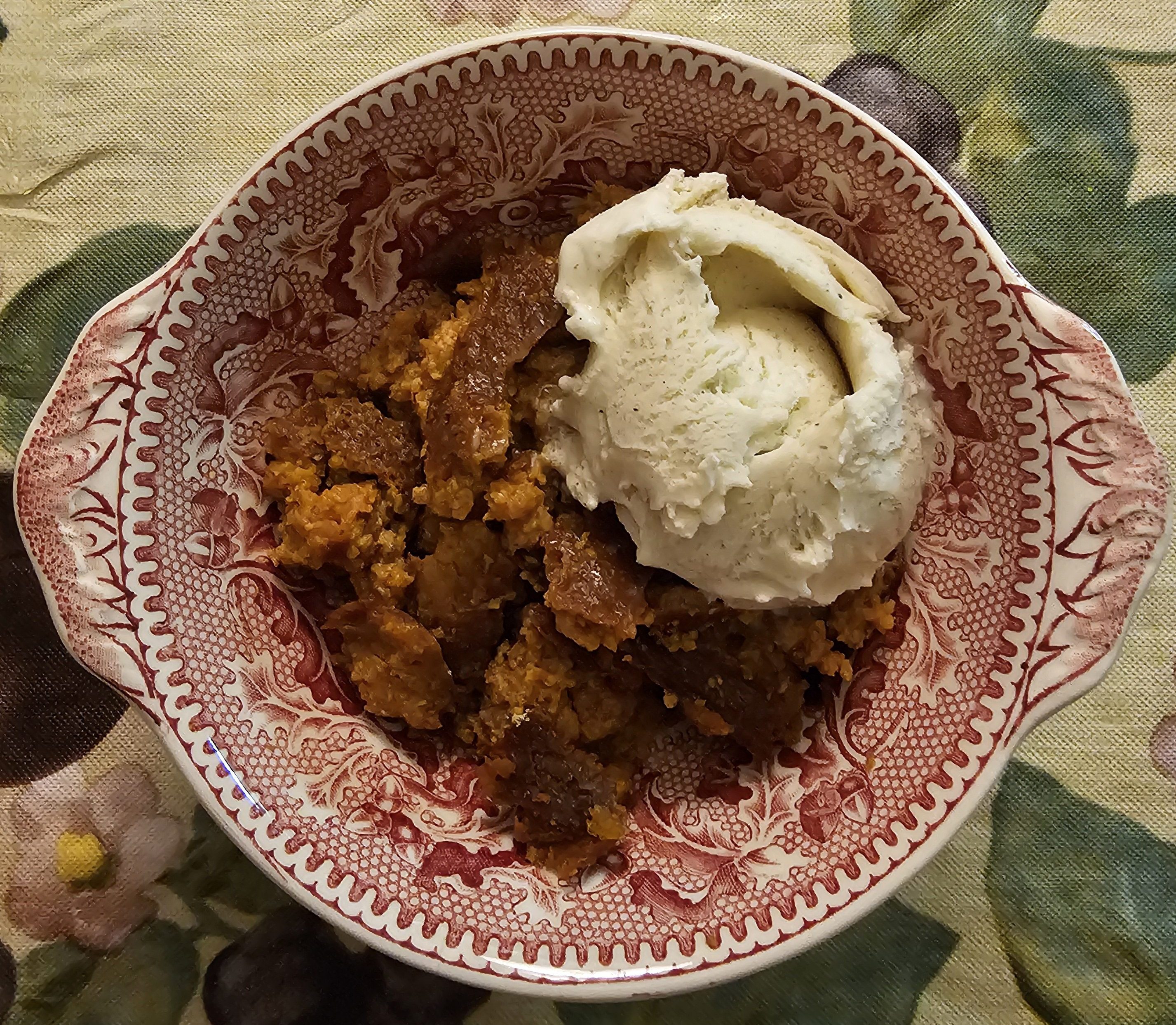
The result, while neither spectacular nor pretty, was not bad at all. While the pudding was baking, the aroma of molasses and corn was heavenly. I took it out after two hours and 20 minutes. It was not as moist as I would have liked, so maybe I should have baked it only two hours and at a lower temperature, and/or used a smaller baking dish.
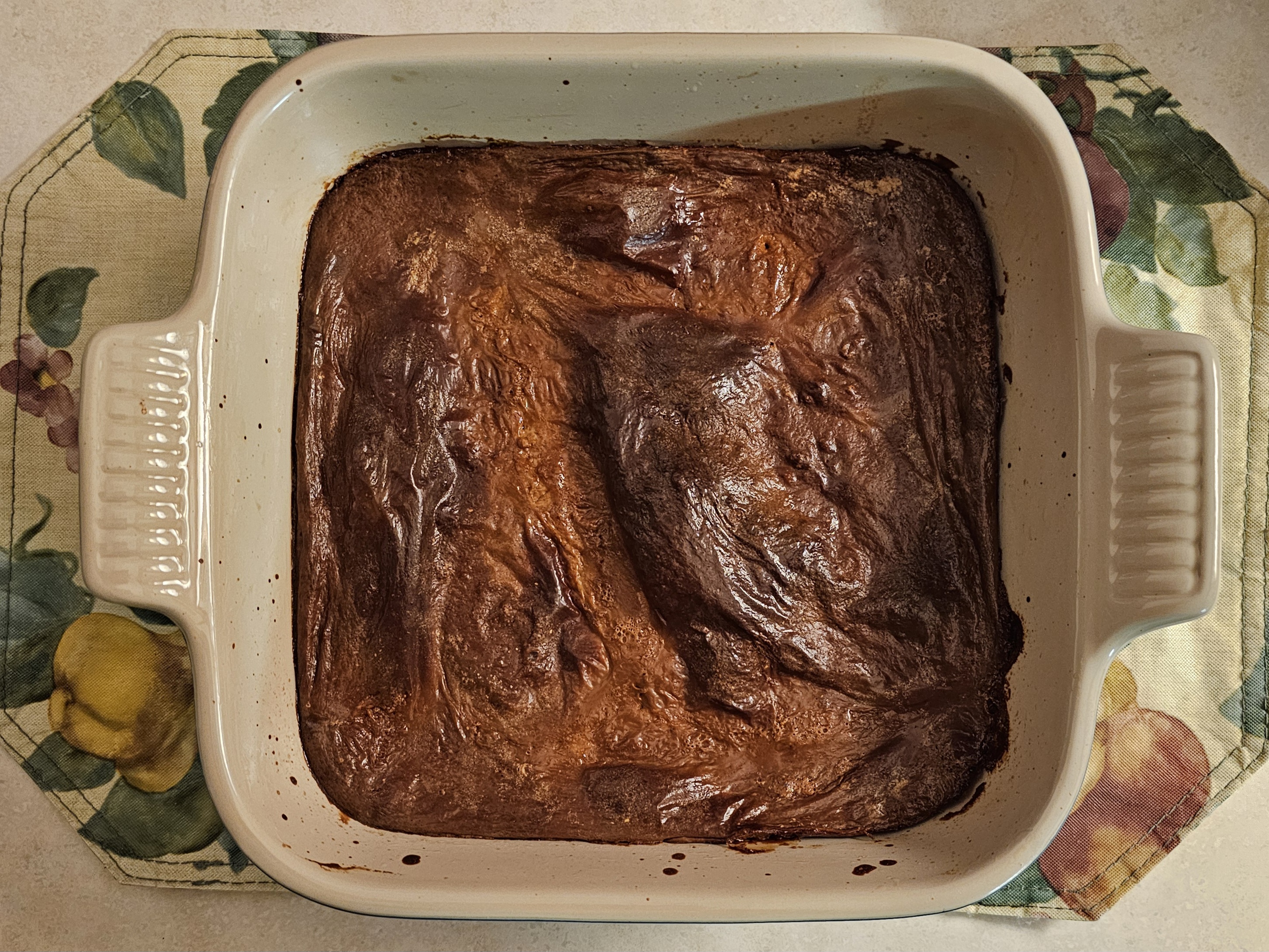
But it was still mighty tasty with a sprinkle of cinnamon and a scoop of vanilla ice cream.
At least it couldn’t possibly have turned out as badly as would the so-called “Perfect Italian Macaroni Dish,” which directs the cook to boil the macaroni for an hour and 15 minutes. “This will be a revelation to lovers of good macaroni,” says the recipe. Indeed.
Happy cooking!
This post was contributed by Linda Cantoni, a Distributed Proofreaders volunteer.


 Posted by LCantoni
  Hungry? Distributed Proofreaders volunteers have contributed over 225 cookbooks to Project Gutenberg, with recipes ranging over many centuries, many regions, and many styles. So keen is the interest that a Cookbook Lovers Team was recently formed for DP volunteers to break bread together, as it were, and talk about working on cookbook projects past, present, and future.

 Hot off the Press