Garage Musings

October 10, 2010

For some reason, quite a bit of DP’s history seems to be connected to garages. On the last of the 10 days celebrating 10 years of DP, let’s have another look at history by following Juliet Sutherland into her garage:

I’ve been working out in my garage for the last week or so and it has brought back lots of memories about Distributed Proofreaders. I joined DP in April, 2002 when the site still ran on a computer in our founder charlz’ house. Preserve old books! What a wonderful idea! As with so many DP volunteers, I was immediately hooked. Very soon, proofing wasn’t enough. I pestered charlz into sending me various directions until finally I was able to scan a book. Oh happy day! It was Land of the Blue Flower by Francis Hodgson Burnett and was quickly followed by The Little Hunchback Zia by the same author. I chose those books because they were very short and small. And thus began eight years of providing content to DP.

My favorite part of providing content was buying the old books. At that time there were very few archives of scanned books so we did most of our scanning ourselves. Where ever I went, I found the used book stores and scoured their discount areas for inexpensive books that we could work on at DP. I drove to used book sales as much as two hours away from home, and came back with a car full of books. I bought a little laptop computer to keep David’s list on so that I wouldn’t get duplicates. Yes, I was thoroughly addicted. The boxes and stacks kept piling up. Finally, I resorted to banishing them to the garage. And then some more, and a few more, and then another box or three or five. I quickly had far more material than I could ever scan in a lifetime. And a huge mound grew in the garage. Greg Newby got so tired of doing my copyright clearances that he asked me to help do them for everyone. And still the mounds grew. When I eventually made neater stacks I ended up with about 6 pallets worth of boxes, stacked 3-4 feet high. I put myself on a strict moratorium regarding buying books for DP. No more!

Fast-forward to my garage today. DP has posted over 18,000 titles. PG has over 30,000. The Internet Archive (TIA) has been making lovely scans of huge numbers of books. Do I really need everything in those boxes in the garage? I’ve been sorting through, finding the books that have been posted, the ones that have already been scanned by the Internet Archive, and the ones that appear in neither place. I’ve made it through 1.5 pallets worth so far. I’ve found 4 boxes of books that are already at PG, 2.5 boxes that are not at the Internet Archive, and 2 boxes worth of material that I recycled since it was in lousy shape and available from TIA. Also one mystery box.*

As I work on those books, I remember so many people who were active in the early years. Some are still at DP, others have moved on. I think about the newer volunteers who might enjoy working on some of these books. And I continue to be amazed at the dedication of the DP volunteers and the volume of material that they produce.

* Small world story. I found a box, all sealed up for shipping, that didn’t contain books and that was addressed to someone in a nearby town. The UPS label had the phone number, so I called, spoke to the addressee and he came by to pick up the box. I figured that UPS had delivered the box by mistake at a time when I was ordering lots of boxes of bound periodicals from ebay. But he was totally mystified. Nothing in the box looked familiar. Today I got an email from my oldest daughter with a forwarded message from facebook. Here is what must have actually happened. The addressee received something unmemorable in that box. The box was then used to deliver books to the Booksale where I volunteer. I must have taken the box home for my oldest daughter to use for packing up her things to move to California. She filled and taped up the box and put it in the garage with the rest of her things. When the movers came, the box was overlooked and eventually added to one of my piles of book boxes. After that move, the only major thing oldest daughter was missing was the box with the tiles she’d brought back from her semester abroad in Turkey. And now, 4 years later, the mystery of the missing tiles has been solved. Now we just have to get the box back….


In Pursuit of Poetry

October 8, 2010

Whenever I explain what Project Gutenberg is, one question that frequently arises is, “How do they decide which books to publish?” The easy answer, of course, is that we’ll prepare any public domain text that we can get our un-grubby, white-gloved archival hands on.  Like most easy answers, though, it doesn’t hold up well to closer scrutiny. If all of us content providers really spent our time chasing every book we came across, we’d never finish any one of them. So what really happens is that we find our niche. We choose an era; we choose a language; we choose an earthly (or otherwise!) region. Or, we choose a genre–some broad topic or style that falls just a little nearer and dearer.

I should confess up front. The majority of my content providing is done to finish up existing, but incomplete projects–lost illustrations, torn pages, that sort of thing. I call it entropy control. I also enjoy helping to proofread books that are slated to be published for Project Gutenberg. A few weeks ago, it happened, I was spending some time on a volume called The London Mercury–a kind of catch-all for literary reviews, much like the New York Time’s bestseller list of today. This is a fun kind of project to work on because it offers short articles that are easy to follow and finish, even if I only have a few minutes to spare for proofreading that day. And naturally, the works that are reviewed are almost universally qualified as potential Gutenberg works, too. I try to keep an eye open for works that look interesting to me, but most of the biographies, natural histories, and public policy reports just slide right by me. However, one review stood out.

More Translations from the Chinese, by Arthur Waley, received a glowing review for its “[skillfully] handled unrhymed verse,” and “rhythm and flow of sound…amazing in translations.” Several excerpts were included–eloquent, unadorned blank verse. I’ve always enjoyed the misleading simplicity of Japanese haiku, and these excerpts quickly captivated me. So naturally, I searched for More Translations on Project Gutenberg. And I found it.

The full volume does not disappoint. Beyond the limitations of a half-page review, Waley’s chosen poems really shine. “The Great Summons,” by Ch‘ü Yüan, was described by the Mercury’s review as “[t]he finest thing in the book.” According to the book’s notes, it was written by Ch‘ü during his nine-year exile from the Court, as a cry against his own depression. Being separated from his beloved homeland, Ch‘ü called to his soul to “come back again and go not east or west, or north or south!” He tells of the terrors, the “treacherous voids” that lie beyond the borders, tempting his soul back with beguiling lures of favorite foods, wine, song, and service to his king. Each new stanza unveils a happiness that is only found at home; it’s enough to lure anyone’s soul back time and again.

Shorter poems are not as layered, but instead evoke the quiet moods of the scenes described:

I sat drinking and did not notice the dusk,
Till falling petals filled the folds of my dress.
Drunken I rose and walked to the moonlit stream;
The birds were gone, and men also few.
“Self-Abandonment,” by Li Po

Having read that and others like it, I see why so many great artists of ancient Asia seem to incorporate such writings right into their paintings and woodcuts (such as Green Hills and White Clouds, by Gao Kogong). The poems themselves bring pictures to mind, and some of them simply cry out to be represented in pigment or fiber. Spanning from the eleventh century back to the fourth century B.C., the eight poets represented address timeless subjects that still capture the human condition. I was repeatedly reminded of Robert Frost’s poems–natural, evocative, and just a hint of humor to balance out the lyric pace and occasionally melancholy subject. Not coincidentally, Po Chu-I’s “Going alone to spend a night at the Hsien-Yu Temple” is a dead ringer for “Stopping by the woods on a snowy evening,” but older by over a millennium.

I now have More Translations from the Chinese permanently bookmarked in my browser, and drift back to it whenever I’m seeking a contemplative moment. Even the ebook number, #16500, has a nice round completeness to it. But this volume is simply More Translations, which implies that another volume came before. The London Mercury is kind enough to shed some light on this: “The new collection should not be missed by anyone who has the old one; those who have not should get the old one…which, on the whole, covers better poems.” As it happens, one of my local libraries has a copy of 170 Chinese Poems, by Arthur Waley, so as soon as I have the chance, I’ll borrow it and begin preparing it for Project Gutenberg. After all, I’m a content provider. It’s what I do.


“Turn around when possible.”

October 4, 2010

“Tern around whin possible,” suggested the sat-nav.

“But you told me to turn right at that junction,” I complained.  We all talk to our sat-navs, don’t we?

Ken, my Aussie-voiced sat-nav was silent.  (I’d got fed up with the previous incumbent, a very refined lady I called Penelope so I downloaded Ken, really just so I could swear at him without feeling that Penelope would burst into tears and complain to Mummy I suppose.)

I was five and half hours and 460km from home on the outskirts of Seville.  I had a further four hours and 400km of driving in front of me and that Australian idiot had sent me up a dirt track so I could crawl behind a Spanish cart, presumably being drawn by a Spanish donkey which was hidden up front in the clouds of dust.

It all started with a ‘Hello how are you’ email from a very old friend who told me that she’d sold up everything in England and was now a ‘near neighbour’ living in Spain.  I was very interested because this old lady has been collecting children’s books since she was a child herself and I’d been itching for a chance to have a look at her collection.  In response to a cordial welcome to the Iberian peninsula from me she said that she had packed up her whole library and shipped it out to Spain with her and that I’d be welcome to ‘pop over’ and have a look at it.  1800km round trip? Pop over?  Absolutely!

Ah-ha!  A turning.  Quick reverse into it and we’re off again.  This time I’m going to insist that if Ken tells me that there’s a ‘Roit tern ahid’ I’m going to want confirmation in writing on a road-sign too.

As it was so far and also as my old friend was not happy for me to take any books away we’d agreed that I would bring the computer and scanner with me and set up shop at her place while I harvested material for DP.  I had no idea how long all this would take, one page at a time, so I warned my wife that we may be living apart for quite a long time!  One good thing though, I knew that Lindy wouldn’t expect me to dress for dinner so I wouldn’t need much in the way of clothing.  Also we were just getting into summer in Almeria so shorts and tee-shirts would cover the body satisfactorily.  Little did I know…

I finally pulled up at a very grand gateway, “You hiv reeched your distination.” Thank you Ken.  The sun was setting as I drove up the drive to the house, parked and stepped out.  It was freezing!  Like all deserts, Almeria is baking during the day and fiendishly cold at night.  So much for shorts!

Lindy came to the door wearing what appeared to be two dressing gowns.  She had aged a lot since I had last seen her and seemed lost in the folds.  “Come in, dear boy,” she said.  “You’ll freeze out there.  Did you bring anything warmer to wear?  No matter.  I’ll find you something of Bill’s.”  She led the way right through the house into a tiny kitchen which was dominated by a huge stove which seemed to vibrate with the heat it was throwing out.  Soon I was muffled up and smelling distinctly of mothballs in a sweater and slightly tight trousers which belonged to Bill, her late husband.

She produced a bowl of hot soup from the pot which was simmering on the stove.  It was early evening so I said that I’d like to set up my computer this evening and make a start on any books I found first thing in the morning.

I was led into a huge dark room.  “I seldom come in here at night,” said Lindy. “That’s why I haven’t bothered to replace most of the bulbs as they blew.”  In the light of the two remaining lamps I could see that all the walls were lined with book-cases about ten feet high.  Above that were windows on three sides of the room.  “This used to be the counting-house,” Lindy said.  “It was where the day labourers would stand in line to receive their wages.  It’s the biggest room in the house so I thought it would be ideal to house the library.”  There were thousands of books.  The ones nearest the door seemed to be modern paper-backs but further off in the gloom the older books looked dark and dusty.  What struck me was the variation in size of those old tomes.  In places a second shelf had been fitted half way along an existing line of books to take two rows of smaller ones.  The end result was a feeling of complete disarray.  Not at all like a lending library with neat standard shelf sizes and careful labelling.  Tomorrow I was just going to have to start at one end and work my way round the room.  We cleared the books off a big table that stood in the middle of the room and I found a power outlet that I could plug my extension lead into.  Lindy produced a reading lamp and a short search found a working bulb for it.  All set for tomorrow.

Lindy said that she was an early riser and liked to take herself off to bed to read rather early in the evening.  I was happy with that plan as there was not much more I could do that evening and I was feeling a tad jaded after my ten hour drive.

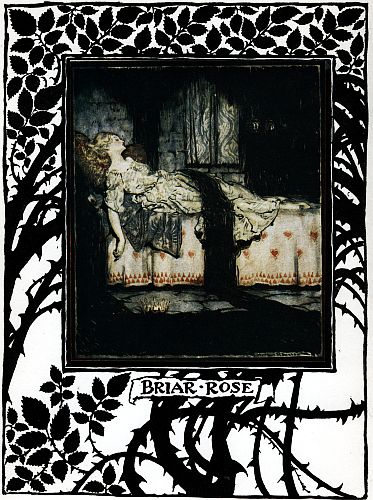
The next few days followed the same routine; find a book, check that the publication date was earlier than Jan 1923 (therefore out of copyright), and then check that it hadn’t been claimed by someone else at DP or had already made it into Project Gutenberg.  Once past those hurdles it’s just a matter of sitting down and scanning the book right through.  There were a few snags.  No Internet connection in the library so I had to work from a stored list of books already cleared for DP.  The move from a moist cool climate to the brutal climate of Almeria had not been kind to the books so most were very brittle and the pages were likely to drop out.  The worst ones were simply bundles of pages held between their separated covers and tied together with string.  Some of the books were priceless and have now made their way to the safety of Project Gutenberg.  For example, there was a first edition of The Sleeping Beauty, illustrated by Arthur Rackham.

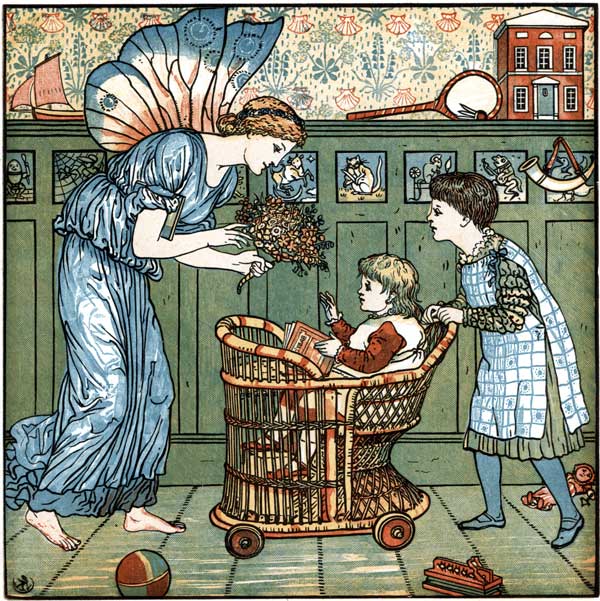
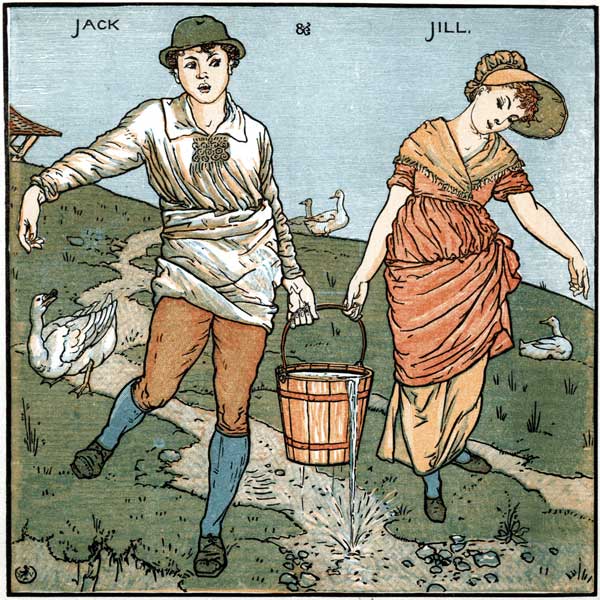
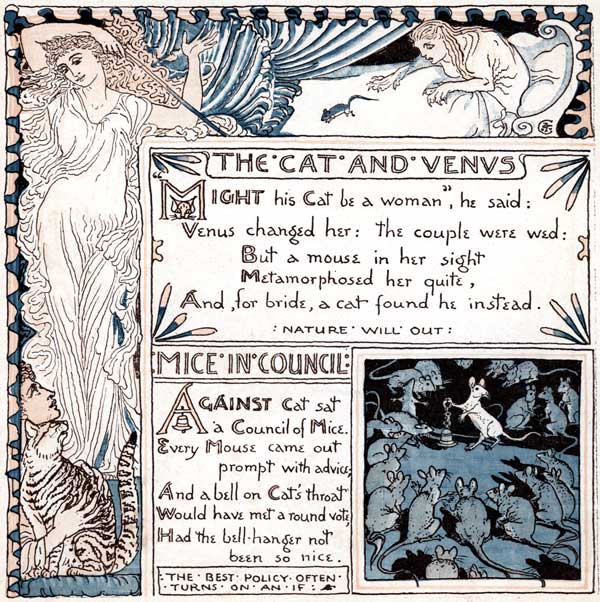
The really high point of my trip happened when I found an old manila folder containing the three ‘Baby’ books by Walter Crane.  The manila envelope had saved them from further damage but the pages were so fragile that I spent a whole afternoon just working on those images.  You can see the results here:

The Baby’s Bouquet

The Baby’s Opera

The Baby’s Own Aesop

I never did get to end of Lindy’s library.  I stuck it out for six days.  It was pretty clear from the start that I could only make a small dent in her collection.  The sizzling days when the only comfortable clothes were just a pair of shorts and frigid nights when my fingers became too stiff to safely turn the pages of a priceless book all became too much for me.  In the end I had to admit defeat and just be grateful for the wonderful books I had found.  The opportunity has passed now, I understand that Lindy’s library was broken up and sold off the following year and that she has moved back to England.  In any case another year in that environment would have rendered most of the older books too fragile to handle.  But still, we managed to preserve some of the gems from her collection so that children in years to come will be able to enjoy the books that she did when ‘she was a child herself’.  Thank you Lindy.

For other books that Mebyon scanned during his time at Lindy’s house, see here.