Hay Fever

May 1, 2025

A flamboyantly artistic and egotistic family of four each invites an acquaintance to their country house for the weekend. Chaos and hilarity ensue. That is the crux of Hay Fever, Noël Coward‘s hit 1925 farce, now available for free online a century later, thanks to the volunteers at Distributed Proofreaders and Project Gutenberg.

Coward – later renowned for witty comedies like Private Lives and Blithe Spirit – commenced his theatrical career as a child actor. He began writing plays in his teens and had his first West End production, I’ll Leave It to You, a light comedy in which he also starred, at the age of 20. Although reviews were mixed, they were positive enough to keep him encouraged.

Marie Tempest
Marie Tempest as Judith Bliss

In 1924, Coward had his first big hit in the West End and on Broadway, The Vortex. Although not a comedy, its taboo subjects – adultery and drug addiction – resulted in sell-out crowds. Around the same time, Coward was writing Hay Fever, with the celebrated Marie Tempest in mind for the role of the retired actress Judith Bliss. But Tempest wasn’t interested at first – until the success of The Vortex. Coward was thrilled. He later wrote admiringly, “Marie Tempest can tie up a parcel of books, speak with her back to the audience, light cigarettes, pour out drinks, do a hundred and one things with her hands and body and never lose a laugh, or mis-time a witticism.”

Hay Fever was a modest success in the West End, running for 337 performances (but not a success on Broadway, where it ran for only 49 performances). It has been revived a number of times, most notably in 1964 by the new National Theatre, founded by Laurence Olivier. Olivier asked Coward to direct that production. Coward declined at first, but then relented, because he would be working with “a cast that could have played the Albanian telephone directory.” Indeed they could: the cast included Edith Evans as Judith, Maggie Smith as Myra, Derek Jacobi as Simon, and Lynn Redgrave as Jackie.

Coward admitted that Hay Fever “had no plot and that there were few if any witty lines.” But he felt that “literate epigrams” are never as funny as “perfectly ordinary phrases” delivered “impeccably” in the context of the play. “Some of the biggest laughs in Hay Fever,” he said, “occur on such lines as ‘Go on,’ ‘No, there isn’t, is there?’ and ‘This haddock’s disgusting.'”

Hay Fever is still frequently performed by professional and community theaters the world over. Thanks to Distributed Proofreaders and Project Gutenberg, you can see why for yourself, and even, if you’re so inclined, download it for your own production.

This post was contributed by Linda Cantoni, a Distributed Proofreaders volunteer.


Come Out of the Kitchen

October 9, 2010

One of the joys of proofreading for Distributing Proofreaders is finding a book that keeps you proofreading beyond your daily goal because you want to find out what happens next. Come Out of the Kitchen by Alice Duer Miller was one such book. Even more fun was post-processing the book later on because then I got to read the whole book and I got to see the illustrations and photos that were missing during the proofreading phase.


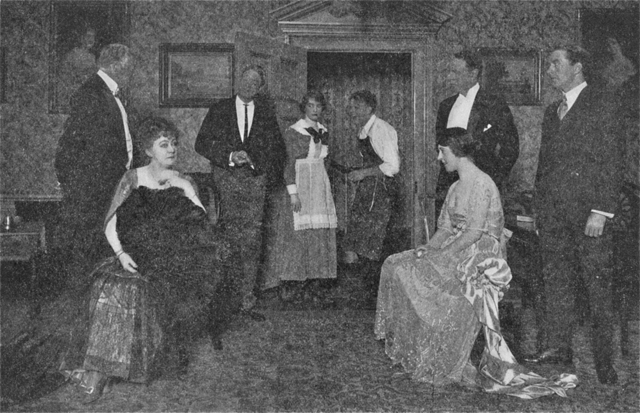
Scene from Act I of the 1916 play


Apparently, this story first appeared in Harper’s Bazar in 1915. It was then made into a comedy by A. E. Thomas that became a hit on Broadway, opening on October 1916 at the Cohan Theatre and playing for 224 performances. The play starred Ruth Chatterton, who twenty years later played the selfish wife in William Wyler’s classic film Dodsworth.

The novel was published in 1916, with photos from the play and illustrations. Later, there was also a film version of Come Out of the Kitchen in 1919, and a 1925 musical called The Magnolia Lady (47 performances) with Ruth Chatterton and her newly-aquired husband (Ralph Forbes).

The story is of a rich young man from the North who rents a Revelly Hall in the South. One condition that he made in renting the mansion was that servants be provided. The servants that came with the house included “an excellent cook, a good butler, a rather inefficient housemaid, and a dangerous extra boy,” none of whom were what they appeared to be, as shown in this segment early in the book:

On her the eyes of her future employer had already been fixed since the door first opened, and it would be hardly possible to exaggerate the effect produced by her appearance. She might have stepped from a Mid-Victorian Keepsake, or Book of Beauty. She should have worn eternally a crinoline and a wreath of flowers; her soft gray-blue eyes, her little bowed mouth, her slim throat, should have been the subject of a perpetual steel engraving. She was small, and light of bone, and her hands, crossed upon her check apron (for she was in her working dress), were so little and soft that they seemed hardly capable of lifting a pot or kettle.

Mrs. Falkener expressed the general sentiment exactly when she gasped:

“And you are the cook?”

The cook, whose eyes had been decorously fixed upon the floor, now raised them, and sweeping one rapid glance across both her employer and the speaker, whispered discreetly:

“Yes, ma’am.”

“What is your name?”

And at this question a curious thing happened. The butler and Reed answered simultaneously. Only, the butler said “Jane,” and Reed, with equal conviction, said “Ellen.”

Ignoring this seeming contradiction, the cook fixed her dove-like glance on Mrs. Falkener and answered:

“My name is Jane-Ellen, ma’am.”

Add to this mix: an amorous real estate man, a lecherous lawyer (who wanted to get the cook fired so she would work for him), Mrs. Falkener (who wanted the cook fired because she was too beautiful to have around the man she wanted as a son-in-law), at least one hat, and a cat. The result was a nice, fun read.