The Minute Boys

January 1, 2026

Distributed Proofreaders volunteers love working on vintage juvenile series. For example, the “Project Not Quite Nancy Drew” initiative focused on several series that aren’t as well known today as the Nancy Drew mystery series, but were nonetheless very popular in their day.
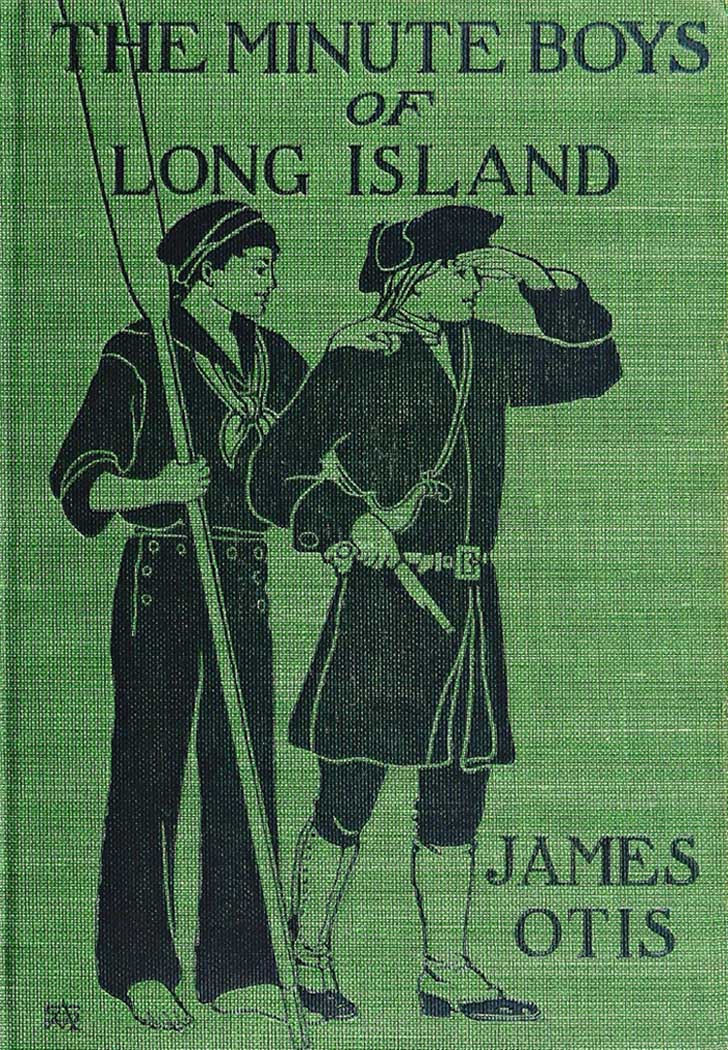
One well-liked series in the early 20th Century was The Minute Boys. Set during the American Revolution, the books recount the adventures of teenaged patriots calling themselves Minute Boys (after the famed Minutemen), who fight for the American cause in various parts of the colonies.

The series began in 1898, when Edward Stratemeyer, later head of a vast children’s literature syndicate and creator of several classic series, including Nancy Drew, the Hardy Boys, and the Bobbsey Twins, wrote The Minute Boys of Lexington, followed by The Minute Boys of Bunker Hill in 1899. These two volumes focused on critical battles in Massachusetts in 1775, the year before America formally declared its independence from Great Britain.

In 1904, James Otis Kaler (writing under the name James Otis) took over the series. Otis published over 160 books in his lifetime, primarily juvenile fiction. He set his nine Minute Boys books in various important Revolutionary War locations: the Green Mountains in Vermont; New York City, Long Island, and the Mohawk Valley in New York; Philadelphia and the Wyoming Valley in Pennsylvania; Boston; South Carolina; and Yorktown in Virginia, where the Americans won the final decisive battle.

The chief characters in these books unerringly display the ideal virtues expected of young men at the turn of the last century: love of family, love of country, bravery, and honor. The stories are exciting, well told, and based on real events. They feature actual historical figures of the time, such as Generals George Washington, Israel Putnam, and Nicholas Herkimer, among others. (Some of the stories are, unfortunately, also a product of their time, with some racial stereotypes typical of the era.)

Seven of Otis’s “Minute Boys” volumes are available at Project Gutenberg – enjoy them, thanks to the volunteers at Distributed Proofreaders, in this 250th anniversary year of American independence.

This post was contributed by Linda Cantoni, a Distributed Proofreaders volunteer. Hot off the Press wishes all its readers a happy, healthy, and adventurous New Year!


The Campaign of 1776 around New York and Brooklyn

July 4, 2015

Every once in a while, when my usual route home to Brooklyn from my job in Queens is clogged with traffic, I opt to take what I like to think of as the Revolutionary War Route. This route takes me past the site of a brilliant strategic move by the British that nearly cost the brand-new American nation its independence. You can learn much about that move from Henry Phelps Johnston’s fascinating account, The Campaign of 1776 around New York and Brooklyn, published in 1878.

map The campaign actually began months before the American Continental Congress issued its Declaration of Independence (the first e-book, by the way, that Project Gutenberg ever posted). Johnston relates how in January 1776, George Washington, rightly suspecting that the British would try to occupy New York City, obtained the Continental Congress’s approval to raise the city’s defenses. By August 1776, enough forts, batteries, barricades, and redoubts had been constructed so that the Americans “had inclosed themselves on the Brooklyn peninsula.”

The Americans, however, hadn’t reckoned on one key weakness in their position. Between them and the British lay a long, thickly wooded ridge, the product of glaciers receding thousands of years before. Today, this ridge is filled with parks and cemeteries, and along it runs the parkway I sometimes take to get home. Back in 1776, it was a wilderness. The Americans believed that they had all the important passes through this ridge under control.

But there was another pass that they had left essentially unguarded: the Jamaica Pass. Four miles to the east of the American lines, it was too isolated to keep covered effectively. Just a handful of officers were assigned to patrol it, for the Americans confidently believed that the British would be approaching from a different direction.

As Johnston puts it,

But little did the Americans suspect that at the very moment their defence seemed well arranged and their outguards vigilant they were already in the web which the enemy had been silently weaving around them during the night. That flanking column!… [W]ith crushing weight was it now to fall upon our outpost guards, who felt themselves secure along the hills and in the woods.

British troops poured through the pass, and the Americans were outflanked. They lost the Battle of Long Island, and eventually lost control of New York to the British. The war, fought on many fronts throughout the colonies, would not end until 1783.

The depth of Johnston’s scholarship is evident, but his writing is so clear that the reader never feels mired in detail. There are helpful maps, and a special bonus in Part II of the book: dozens of documents from the campaign that not only illustrate the strategies and concerns of the American generals, but also give a fascinating glimpse into everyday military life in the 18th Century. Johnston’s book is an outstanding contribution to American history.

Today is the 239th anniversary of American independence.

This post was contributed by Linda Cantoni, a Distributed Proofreaders volunteer.