Music after the Great War

September 1, 2024

In 1913, Igor Stravinsky‘s groundbreaking ballet, The Rite of Spring, premiered in Paris. The dissonant music and strange choreography caused near-riots at the first two performances. The young American music critic Carl Van Vechten recalled: “Three ladies sat in front of me [in a box] and a young man occupied the place behind me… The intense excitement under which he was laboring, thanks to the potent force of the music, betrayed itself presently when he began to beat rhythmically on the top of my head with his fists. My emotion was so great that I did not feel the blows for some time. They were perfectly synchronized with the beat of the music… We had both been carried beyond ourselves.”

So began Van Vechten’s love for Stravinsky’s music, as he recounts in Music after the Great War, a collection of seven lively essays on the performing arts scene of the early 20th Century. The book was published in 1915, when World War I was still in full swing, and in the title essay, “Music after the Great War,” Van Vechten speculates on which contemporary composers will prove to have the most lasting impact after the war. His picks: Stravinsky and Arnold Schoenberg – as well as a teenaged prodigy named Erich Korngold, who later became an Oscar-winning film composer.

As the assistant music critic for The New York Times, Van Vechten had the opportunity to travel to Paris and observe the avant-garde cultural scene first hand, and to meet some of its most important proponents. Indeed, two of the ladies in his box at the Rite of Spring performance were none other than Gertrude Stein and her partner Alice B. Toklas. Van Vechten doesn’t name them in his book, but Stein recounts in The Autobiography of Alice B. Toklas that Van Vechten, who became a lifelong friend, was there.

The essays in Music after the Great War include not only Van Vechten’s predictions in the title essay, but also extended appreciations of Stravinsky and of the Ballets Russes, which produced The Rite of Spring and several other Stravinsky ballets. “The music [of The Rite of Spring] is not descriptive, it is rhythmical,” Van Vechten writes. “All rhythms are beaten into the ears, one after another, and sometimes with complexities which seem decidedly unrhythmic on paper, but when carried out in performance assume a regularity of beat which a simple four-four time could not equal.”

Rite of Spring score excerpt
The first eight bars of the Sacrificial Dance in The Rite of Spring, showing the complex meter changes.

The remaining essays demonstrate the breadth and depth of Van Vechten’s interest in the performing arts. In “Music for Museums?” he decries the “fossilization” of symphonic concerts through constant recycling of familiar works while new music goes unperformed. Surprisingly for one so enamored of new music, however, in another essay Van Vechten expresses a fondness for Jules Massenet‘s florid and decidedly Romantic operas. The last two essays in the book set forth Van Vechten’s well-informed opinions on stage decoration in opera, ballet, and drama.

Thanks to the volunteers at Distributed Proofreaders and Project Gutenberg, this fascinating slice of cultural history is available to all.

This post was contributed by Linda Cantoni, a Distributed Proofreaders volunteer.


Celebrating 48,000 Titles

July 19, 2024

This post celebrates the 48,000th unique title Distributed Proofreaders has posted to Project Gutenberg: The Reign of King Oberon. Congratulations and thanks to all the Distributed Proofreaders and Project Gutenberg volunteers who worked on it!

The Victorian era marked a turning point in literature for children. In earlier eras, the primary goal was to provide children with moral and religious instruction, based on the puritanical idea that children are born with sin and must constantly be warned of its consequences. But a sea-change began to occur during the 19th Century. Childhood began to be seen more as a time of innocence and joy, and children’s literature began to reflect that. There were, of course, still moral lessons to be learned, but they could be taught in more entertaining ways, accompanied by eye-catching illustrations.

The Reign of King Oberon (subtitled The True Annals of Fairyland) is an excellent example of the Golden Age of children’s literature. Published around 1902, it is a collection of fairy tales from various sources, edited by English journalist Walter Jerrold and illustrated by his frequent collaborator, Charles Robinson.

The framing story takes place at the court of King Oberon and Queen Titania. These age-old royal personages are best known today as the King and Queen of the Fairies in Shakespeare’s comedy A Midsummer Night’s Dream. Jerrold borrows from Shakespeare the quarrel between Oberon and Titania over a changeling child whom each wants as a servant. They reconcile, and all the denizens of Fairyland gather at Oberon’s court to celebrate and tell stories. The changeling child listens carefully and later writes these stories down for our enjoyment.

Among the over two dozen stories in the collection are familiar tales by Hans Christian Andersen, the Brothers Grimm, and Charles Perreault, as well as Norse, Irish, French, and Eastern European folk tales. Thumbelina is here, as are Rumpelstiltskin, Hansel and Gretel, and many other beloved characters. The book has a beautiful, colorful cover, and there are numerous lovely pen-and-ink illustrations throughout.

The volunteers at Distributed Proofreaders are proud to have The Reign of King Oberon as their 48,000th unique title for Project Gutenberg!

This post was contributed by Linda Cantoni, a Distributed Proofreaders volunteer.


The Wizard of Window Dressing

July 1, 2024

In 1900, L. Frank Baum published The Wonderful Wizard of Oz, the first of 14 novels in his classic series on the magical land of Oz. But did you know that in the same year, he published a distinctly non-magical treatise, The Art of Decorating Dry Goods Windows and Interiors? Thanks to the volunteers at Distributed Proofreaders and Project Gutenberg, you can learn all about window dressing from one who was a wizard at it.

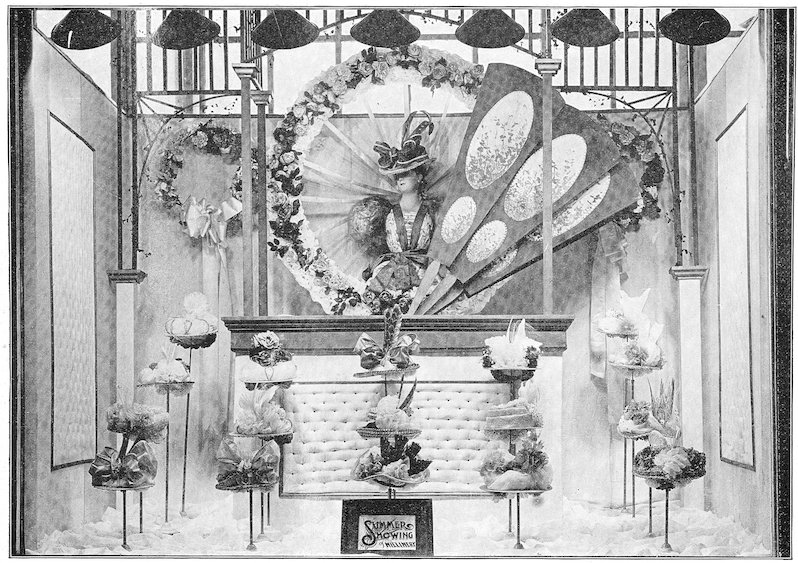
A millinery shop window design with a mechanical fan.

Baum was born near Syracuse, New York, into a wealthy family. He dabbled in writing from an early age, and his first efforts were on nonfiction topics like stamp collecting and chicken breeding. He also dabbled in drama, writing and acting in plays in a theater his father built for him, until the theater burned down, along with many of his scripts. He and his wife decided to try their luck out West. He opened a store in South Dakota, but it failed. He edited a newspaper there, and that failed. Then it was off to Chicago to become a newspaper reporter and traveling china salesman. In 1897, he founded a magazine on store window dressing, The Show Window, which is still in existence today as VMSD (visual marketing and store design).

Three years later, Baum wrote The Art of Decorating Dry Goods Windows and Interiors, which was published under the auspices of The Show Window. In his introduction, he points out:

Merchants of olden times stood in front of their shops and cried “buy!—buy!” in imploring tones. Modern merchants still cry “buy!—buy!” but they do it in a different way. They advertise in newspapers and display their wares in their show windowsThe last mode of inducing trade is the modern one, and therefore the best. More goods are sold through window display than through newspaper advertising. It is more direct. The newspaper advertisement says: “We have goods to sell.” The show window says: “Here they are!”

Baum’s book focuses on the practical rather than the theoretical, as he believed that the “simplest and easiest way of accomplishing any work is always the best.” It is filled with diagrams and photos showing designs for storefront windows, frameworks, fixtures for displaying merchandise, draperies, and backgrounds. Baum also gives detailed advice on creating eye-catching show cards, right down to the calligraphy and what brushes and paints to use for it. He even covers how to create proper order slips. A firm believer in modern methods, he includes several chapters on electric lighting and motorized displays, with numerous examples.

The success of the Oz series meant that Baum would be a window dresser no more. But The Art of Decorating Dry Goods Windows and Interiors gives us a glimpse of the breadth of his creative talents.

This post was contributed by Linda Cantoni, a Distributed Proofreaders volunteer.


Mapping Cholera

June 1, 2024

“Oxygen! nobody knows what that may be—is it any wonder the cholera has got to Dantzic? And yet there are people who say quarantine is no good!”

This 19th-Century speculation about cholera from George Eliot’s Middlemarch shows how little anyone knew, not just about oxygen, but more significantly about the terrible cholera epidemic that first hit Europe in the 1830s. Doctors and scientists struggled to find its cause, and most believed that it was carried by “miasma,” or foul air. But in the 1850s, the English physician John Snow was the first to use disease mapping to prove that cholera is transmitted not through the air, but through water. His findings, published in Cholera and the Water Supply (1854) and On the Mode of Communication of Cholera (2nd ed. 1855), revolutionized the water and sanitation systems of London and many large cities worldwide. These important works were turned into e-books by Distributed Proofreaders and are available for free download at Project Gutenberg.

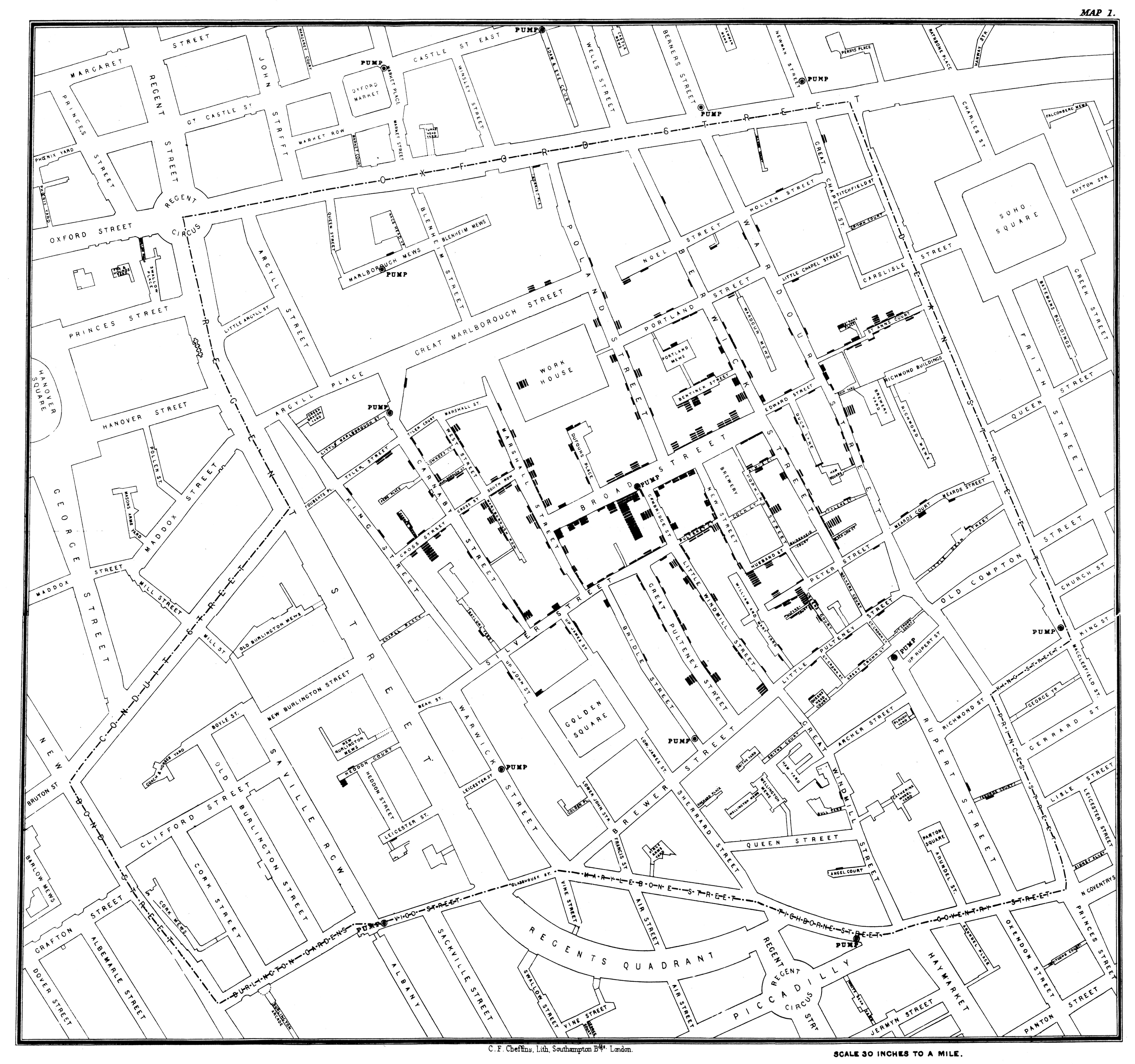
Soho cholera map from John Snow’s On the Mode of Communication of Cholera

No one yet knew that cholera is caused by a bacterial infection of the small intestine; the Vibrio cholerae bacterium was not identified as the cause until 1884. But Snow was all too familiar with its symptoms: profuse diarrhea and vomiting that caused severe dehydration, which in turn often led to death by organ failure. The first known cholera pandemic began in India in 1817. The rise of international trade and travel soon brought cholera to North America and Europe in waves of outbreaks.

A two-year outbreak in England beginning in 1848 prompted Snow to publish the first edition of On the Mode of Communication of Cholera in 1849. He rejected the miasma theory. His research showed that men who worked in London’s sewers, which were full of foul air, were no more prone to contracting cholera than the average citizen. Moreover, Snow himself was frequently exposed to patients with cholera, but he never caught the disease. He concluded that there must be some other medium – most likely water contaminated by feces.

Snow was able to put his theory to the test in 1854, when an outbreak in the Soho district of London killed 600 people in one week alone. Research by another scientist had already shown that cholera cases in another district plunged after the local water company changed its source to a cleaner part of the Thames River. Encouraged by this, Snow set out to test the waterborne theory. He used government death records to identify the cholera victims’ residences in Soho. He conducted house-to-house interviews of their families and learned that they drew their water from a particular well on Broad (now Broadwick) Street, as did a number of local businesses, including pubs and restaurants that some of the victims frequented. Rich and poor alike were affected; poverty and overcrowding were clearly not the cause. His map of the outbreak (above), with black bars indicating cholera deaths, vividly proves his point.

So what was the deadly problem with the Broad Street pump? Snow learned that the well was within just a few yards of a sewer. He took a sample of the water and saw “impurities of an organic nature.” And the water developed a foul odor when stored – a hallmark of water contaminated with sewage. He concluded that cholera was spread by evacuations from cholera patients entering the sewer and permeating into the nearby well. On that basis, he convinced the local authorities to disable the pump.

Snow’s cholera study went beyond Broad Street. He also mapped the different water supplies throughout London, which showed far fewer cholera deaths in areas where the water company sourced its water from a clean part of the Thames. And he provided detailed statistics as to where cholera deaths occurred.

Cholera killed millions all over the world in the 19th Century. The mortality rate was drastically reduced in developed countries once Snow’s and other scientists’ discoveries led to changes in sanitation systems. Unfortunately, cholera remains a problem today in developing countries that still have poor sanitation, as the European Centre for Disease Prevention and Control reports. But likelihood of death is much lower than it once was, thanks to modern hydrating treatments.

Snow’s diligent research and the unique and compelling way he presented it are key events in the early development of modern epidemiology. Thanks to the volunteers at Distributed Proofreaders and Project Gutenberg, you can be present at the birth of a vital, life-saving science.

This post was contributed by Linda Cantoni, a Distributed Proofreaders volunteer.


Lord Peter Views the Body

May 1, 2024

“As my Whimsy takes me” is the family motto of Lord Peter Death (yes, you read that right, though some pronounce it “deeth”) Bredon Wimsey, second son of the 15th Duke of Denver, Etonian and Oxonian, World War I veteran, and one of the great amateur detectives of classic British crime fiction. The creation of Dorothy L. Sayers, herself an Oxonian, he is the protagonist of 11 novels and over 20 short stories, still popular more than a century after his first appearance in 1923. Now that they are coming into the public domain in the U.S., Distributed Proofreaders volunteers are turning them into e-books for Project Gutenberg, free for everyone to enjoy.

Murder isn’t whimsical, of course, but Lord Peter often is – he is as famous for his self-deprecating wit as he is for his crime-solving genius. He’s also athletic, charming, well-read, musical, successful with the ladies (though not classically handsome) – and troubled. A victim of the “shell shock” that traumatized so many soldiers, he is prone to bouts of deep depression. He survived thanks to his loyal sergeant Bunter, who became his valet and highly competent assistant in crime detection.

Lord Peter first appeared in Whose Body? (1923), in which an unidentified man is found dead in someone’s bathtub, wearing only a pair of pince-nez. The novel was both popular and well received by the critics. Sayers later said that it disappointed her own expectations – she had wanted to write a novel with more depth – but its enduring popularity stems from her genius at creating an escapist delight with an unforgettable detective.

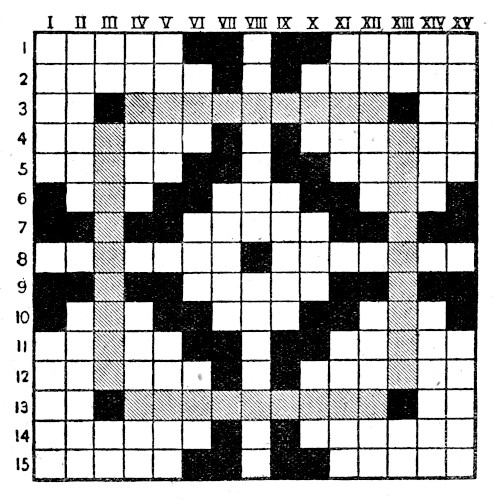
Crossword grid from Lord Peter Views the Body

Lord Peter’s next appearance was in Clouds of Witness (1926), where his elder brother, the 16th Duke of Denver, becomes a suspect in the murder of their sister’s fiancé. Though Lord Peter is still not as fully formed as a character as he would be later on, Sayers once again demonstrates the excellent storytelling powers that made this book a bestseller.

Unnatural Death (1927), prepared by our colleagues at Distributed Proofreaders Canada, involves the death of an elderly cancer victim and a complex inheritance issue, complete with a genealogical chart. Lord Peter, who so often sees things the police don’t, wonders if she really died of cancer. An inheritance and a cause-of-death issue also feature in The Unpleasantness at the Bellona Club (1928), in which a 90-year-old retired general is found dead at his club.

Sayers then varied her output to write a collection of 12 entertaining and ingenious short stories, Lord Peter Views the Body (1928). Her own whimsy (with a touch of the macabre) abounds here, with wonderfully intriguing titles like “The Abominable History of the Man with Copper Fingers” and “The Unsolved Puzzle of the Man with No Face.” One story even includes a fiendishly tricky crossword puzzle containing clues to the crime. You can try to solve it yourself (and the solution is provided at the end).

In the later Wimsey novels, Sayers deepens Lord Peter’s character and sets him some personal challenges that help him grow as a human being. Some commentators believe, from the novels and some of her letters, that she had something of a crush on her fictional creation. But by 1937, she was tired of mystery fiction and went back to scholarly work, her first love. She was one of the first women to officially receive her postponed degree from Oxford University in 1920 – she had already graduated in 1915 with first-class honors in medieval French. And after graduation she was one of the editors of several volumes of Oxford Poetry (also prepared by Distributed Proofreaders volunteers and available at Project Gutenberg). In the 1940s and 1950s, she turned her attention from crime fiction to, among other things, translating Dante’s Divine Comedy and the medieval French poem The Song of Roland into English. Both translations are well-respected and still in print.

But Sayers will always be linked in popular imagination with her other love – Lord Peter Wimsey. He has spawned films, television and radio series, “fan fiction” sequels, a family history, and even a cookbook. Distributed Proofreaders looks forward to seeing more of Sayers’s novels and stories enter the public domain and turning them into freely available e-books.

This post was contributed by Linda Cantoni, a Distributed Proofreaders volunteer who also has a crush on Lord Peter.


Distributed Proofreaders Site Maintenance – 17 April 2024

April 9, 2024

The Distributed Proofreaders site is scheduled to be completely unavailable starting at 3pm server time on Wednesday 17 April 2024 for a few hours as we roll out an update to our forum software in production. During this time, the main site and forums will be down, but the wiki will remain available.

If the upgrade is completed early, the site will return earlier.

Thank you for your patience. As you wait for Distributed Proofreaders to become available again, please feel free to browse through the excellent articles in this Blog.

We’ll keep this blog post updated with progress during the outage. You can also find us on Facebook.

Update 4:00pm DST: Maintenance continuing as planned.

Update 4:50pm DST: Site is back up and operational. Thank you for your patience!


My Distributed Proofreaders Journey

April 1, 2024

When I first discovered Distributed Proofreaders via a Google search, my quest was like that of many who were looking for an interesting and challenging activity during the pandemic. Turning public domain books into free e-books for Project Gutenberg – preserving history by proofreading one page at a time – seemed ideal. And one thing that particularly drew me to Distributed Proofreaders was that there was an active forum where like-minded folks could share knowledge and chat.

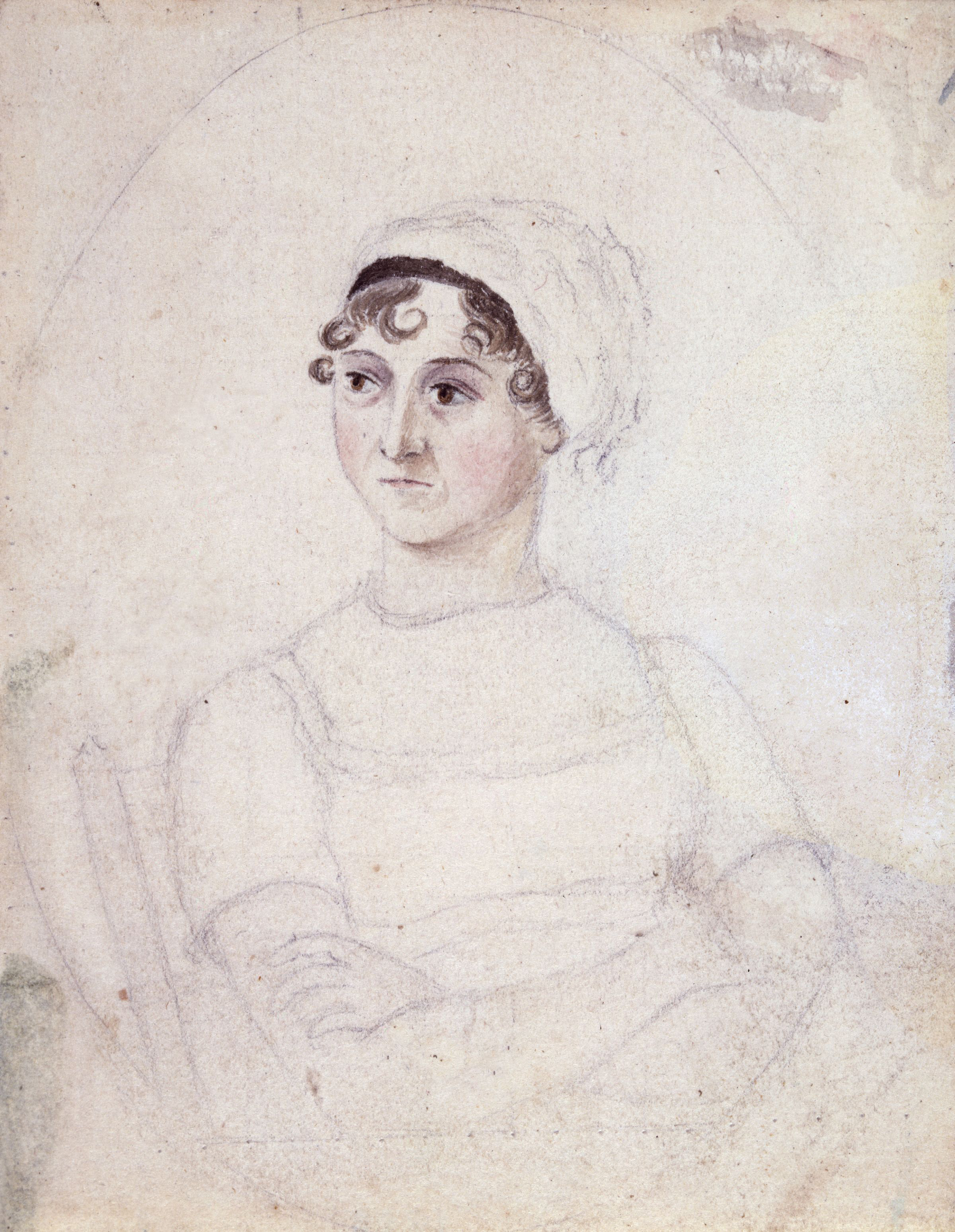
The Bookworm, Carl Spitzweg, c. 1850

I stalked that forum for a few days and noticed one particular forum thread was quite active – P3 Diehards. I said to myself, “I want to join that fun team.” Problem was, I was not a P3! P3 is the top of three levels of proofreaders, and the privilege must be earned.

And so my Distributed Proofreaders journey began, going through the registration process, taking the training quizzes, and starting at the lowest proofreading level, P1. I had my blinders on and was only interested in proofreading so I could qualify for level P3. Occasionally, on my breaks, I would browse the forum to see what everyone was talking about. There was always something complex that people were working through with help from others. It all sounded too bothersome and beyond my abilities at the time. So, back to proofing I would go.

And then one day it happened. A private message arrived in my inbox announcing my access to P3! I think it was maybe 30 seconds later I became a member of the P3 Diehards team. What a great group and a great goal – to save the old books from languishing in the P3 round for more than 100 days. Of course, there are other great teams at Distributed Proofreaders; this one just spoke to me. (I even wrote a poem about it!)

Fast forward two years, and a new interest was sparked to investigate some other parts of Distributed Proofreaders. There’s Formatting, Content Providing, Project Management, and Post-Processing. I decided I wanted to try them all!

Starting with formatting seemed like the logical first step. At first it’s difficult to understand which tags (such as for italics and poetry and so forth) go where, and more importantly why, but it is rewarding when the second level formatter, F2, confirms that my page was done correctly.

Next step: Project Manager (PM). A PM guides a book project through the rounds of proofreading and formatting and answers questions in the project discussion. I was prompted to this endeavor by a plea for more content to be provided for new members. However, I couldn’t yet create my own projects to manage, so I adopted a few from others for awhile. With kindness and expert knowledge, my mentor, Fay Dunn, guided me through setting up my first project and several more after that. It is fun to watch my projects going through the rounds, some more popular than others, but they are all like “my kids.”

So that meant the next step needed to be learning Content Providing (CP). CPs select books for processing through Distributed Proofreaders, harvesting page images from online sources and converting them into editable text using optical character recognition. For this step, there were nearly a dozen software applications that first needed to be downloaded. And, of course, about half of them were problematic with my device for one reason or another. BUT, there’s a forum with lots of knowledgeable people from all over the world. They came to my rescue, and finally everything was working.

It was slow going at first, what with learning all this new software AND the CP steps. One of those steps is obtaining copyright clearance from Project Gutenberg, because everything we work on has to be in the public domain. I can’t describe the thrill when I see the clearance email from the copyright team approving a project. I’ve now CP’d 10 projects and was recently handed my graduation diploma by my wonderful mentor!

Post Processing (PP) was the last on the list of areas to tackle. PPers convert the proofread and formatted text into its final e-book format for Project Gutenberg. This turned out to be the most arduous process. There was more software to download and learn, as well as learning new concepts and new lingo used in the Guidelines. Luckily my PM/CP mentor felt brave enough to help me through it all. After a crash course in HTML and CSS and some peeking at finished projects, I somehow managed to crank out my first PP project recently. A good amount of time will need to lapse before I tackle another PP project, but I have so much respect for those who get these books onto the Project Gutenberg site.

It’s mind-boggling the amount of intelligence in this Distributed Proofreaders pool of volunteers, from solving difficult software issues, to proofing questions about any known language to man, to devising detailed search functions; there’s always someone to provide the answer.

This journey has been one of the best experiences of my life. I conquered some complicated (for me) challenges. I almost gave up a couple of times, but my mentor kept encouraging and reassuring me. I’m so glad I persisted, as it gave me the opportunity to rub elbows with some brilliant, clever, and creative minds from around the world. It is a privilege to be among them.

This post was contributed by Susan E., a Distributed Proofreaders volunteer.


Post-Processing Fornander’s Hawaiian Antiquities

March 1, 2024

When searching for works to prepare as e-books at Distributed Proofreaders, I always try to find works that are still interesting today, add some diversity to Project Gutenberg’s collection, or are of significant cultural or historical importance.

Another criterion is that the works should be manageable by the volunteers here at Distributed Proofreaders, and in this, I like to explore the edges of what is possible. Each e-book on the site goes through multiple proofreading and formatting rounds, with volunteers carefully reviewing the images of each page with the computer-generated text generated from the images. Once all the pages have completed these steps, a post-processor carefully assembles them into an e-book.

Collections of folklore are always popular and interesting. They are timeless and offer an insight into the culture of a people. Over the years, I’ve added a couple of books with Hawaiian folklore from various authors, and, while digging deeper for more, I hit upon the mother-lode of many of these works: the Fornander Collection of Hawaiian Antiquities and Folk-Lore, a huge collection of material collected in the late 19th Century by Abraham Fornander, published between 1916 and 1920, in three large volumes, by the Bishop Museum Press in Honolulu.

Abraham Fornander was born in Sweden, on the island of Öland, on 4 November 1812, the son of a clergyman. He studied theology at the University of Uppsala, but dropped out and left Sweden to became a whaler. In 1838, he arrived on Hawaii. Here, he became a coffee planter, land-surveyor, and journalist. He also officially became a citizen of the (then still independent) Kingdom of Hawaii, and married Pinao Alanakapu, a Hawaiian chiefess. He started to promote public education and took up various official roles as inspector, governor, and judge. This allowed him to travel on the Hawaiian islands and collect a lot of information about Hawaiian mythology and the Hawaiian language. He used much of his collected materials to publish his Account of the Polynesian Race (a work I hope to tackle at some later date). After his death, he left a massive collection of notes and papers. These ended up in the Bernice P. Bishop Museum and ultimately were published, together with English translations, from 1916 to 1920. The first volume of Fornander’s collection is now available on Project Gutenberg (the following two volumes are still in progress at Distributed Proofreaders at the time of writing).

The volumes are bilingual, with the English translation on the left and Hawaiian original on the right. Since the Hawaiian language, as written at that time, used only standard letters and no diacritics, it is not that difficult for non-speakers to deal with. In fact, the Hawaiian alphabet is surprisingly short, with just 13 letters: five vowels: a e i o u (each with a long pronunciation and a short one, but here not distinguished); eight consonants: h k l m n p w; and the glottal stop (not shown in this text). Since all syllables in Hawaiian are a single consonant followed by a vowel or diphthong, to non-natives some words may appear long and repetitious, and in particular names can become pretty long — although there are also plenty of very short words to compensate.

Like many indigenous languages, Hawaiian is an endangered language. It was still widely spoken in the 19th Century, when the Hawaiian islands were an independent kingdom that maintained diplomatic relations with many countries. The Hawaiian Kingdom’s constitution was written in Hawaiian. Literacy was promoted and newspapers were regularly printed. However, through the machinations of American businessmen, the government of Queen Liliʻuokalani was overthrown in 1893, and after being run as a “Republic” for a short while, the territory was annexed by the United States in 1898. This led to the demise of the Hawaiian language. In 1896, English was made the sole official language, and the use of Hawaiian in schools was systematically suppressed. Only in the 1950’s did this trend slowly begin to reverse, with renewed interest in the language and indigenous culture, though Hawaii became a U.S. state in 1959. Hawaiian dictionaries were published, and a revival movement gained traction in the 1970’s, with schools once again teaching children the language. However, it is still spoken by only a small fraction of the current population of Hawaii.

Having Fornander’s collection easily accessible will be very valuable to learners of the language (even though the language used is probably archaic and the spelling differs a bit from modern Hawaiian) and to students of its folklore and history. The collection starts off, appropriately, with a mythological description of the discovery of the islands and the origins of the Hawaiian people. The first volume further includes, among many others, the popular story of Umi, a fifteenth-century chief or king, who usurped the throne from his older half-brother, then ruled for about 35 years and united the Hawaiian islands into a single kingdom.

Since today only about 24,000 speakers of Hawaiian remain, the hope of finding enough native speakers to help us out with this project was limited. We needed to ask non-Hawaiian-speaking volunteers to work on Hawaiian pages, even if they didn’t know a single word. Hawaiian is an Austronesian language, remotely related to languages such as Malay or Tagalog, so speakers of those might occasionally recognize a word, although it will often require some linguistic training to see the relationship (and that really is no help in proofreading those pages). Hawaiian is more closely related to Polynesian languages such as Tongan, Samoan, or Tahitian, and speakers of those languages can probably get some of the gist of the stories (but speakers of those languages are also not easily found).

So how to deal with such a massive and complex work?

Well, first, praise where praise is due: The many volunteers at Distributed Proofreaders dutifully ploughed through the Hawaiian pages and fixed a lot of errors left behind by the optical character recognition process (which turns scanned images into editable text). When I received the work to post-process, most of the hard work had already been done.

Still, post-processing a work like this is a considerable challenge. Post-processors have to create both text and HTML files for Project Gutenberg and make them both easily readable. First, I needed to untwine the English and Hawaiian text (which in the original book were on alternating pages), such that both the English and Hawaiian text became continuous texts, at least at the chapter level. To do this I simply made two copies of the text file, and then removed the English part of the text. Then I recombined them, so that the Hawaiian follows the corresponding English chapter.

Once the untwining was done, I started to add tags to demarcate chapter headings, poetry, tables, and footnotes, convert quotation marks to their proper curly shapes, etc., and deal with the issues the proofreaders noted. Then I came to the task of checking the entire text for remaining spelling issues, and that in a language I do not speak, without the help of a spelling-checker, and in an obsolete spelling.

Luckily, I’ve done this a few times before, and developed a few tools to help me make this easier. During my preparation, I tagged each fragment of text in my file with the language it is written in. This enables me to create word-lists, which I can inspect. Words that occur many times can be safely ignored, but those that are rare or unique may need some further inspection. Since I color-code by frequency, rare words jump out.

Using the word-list, I can identify suspect words, but that doesn’t always help. Then I can turn to a another tool and generate a KWIC (Keyword in Context) index. This allows me to see how each word is used, and, based on that, I can often decide how to deal with it.

The illustration below show how this works for the name Kekakapuomaluihi. At a glance, I can see this is used in Hawaiian and English. It is mentioned in the index (yellow background), pointing to the page it can actually be found, and its meaning is explained in a footnote (pink background).

Finally, I wanted to align the text in parallel columns, such that the English and Hawaiian could be read side-by-side, as in the original. This is less straightforward than it sounds, because sometimes a paragraph on the left is the equivalent of two on the right, and sometimes paragraph boundaries do not match. To make this work, I give all paragraphs in one language a label, and give the matching paragraphs in the other language the same label. This way, my software knows which paragraphs to place next to each other.

Having gone through all those steps, I was at last able to submit the work to Project Gutenberg. Now the first volume of Fornander’s monumental collection is freely available to all those interested in Hawaiian culture. At the time of writing, volume two is almost ready as well, and volume three is in the final formatting round at Distributed Proofreaders.

This post was contributed by Jeroen Hellingman, a Distributed Proofreaders volunteer who was the Project Manager and Post-Processor for the Fornander Collection.


The Collected Works of William Hazlitt

February 1, 2024

William Hazlitt (1775-1830) was a renowned English essayist, literary critic, painter, and philosopher, known for his sharp wit, insightful observations, and passionate prose. Now, thanks to the volunteers at Distributed Proofreaders and Project Gutenberg, after six years of preparation, all 12 volumes of the 1902-1906 edition of his Collected Works (plus an index volume) are available to the public for free.

Hazlitt’s works span a wide range of topics, including literature, art, politics, philosophy, and personal reflections. Here are some highlights.

Literary Criticism: Hazlitt’s contributions to literary criticism are particularly noteworthy. His essays on Shakespeare, Milton, Wordsworth, and other literary giants are insightful and thought-provoking, offering fresh perspectives on their works. He was also a keen observer of contemporary literature, providing critical evaluations of emerging writers and trends.

Philosophical Writings: Hazlitt’s philosophical writings explore themes of human nature, morality, and politics. His “Essay on the Principles of Human Action,” in Volume Seven, delves into the motivations behind human behavior, while his political essays reflect his liberal and revolutionary sympathies.

Art Criticism: Hazlitt’s passion for art is evident in his essays on painting, sculpture, and architecture. He was a strong advocate for the appreciation of art in everyday life, believing that it could enrich one’s understanding of the world and oneself.

Personal Essays: Hazlitt’s essays offer a glimpse into his thoughts, experiences, and sensibilities. His reflections on love, friendship, and the human condition are poignant and relatable, providing a glimpse into the mind of a brilliant and sensitive individual. One of his most famous essays, “The Fight,” in Volume Twelve, relates his brilliant observations about a boxing match he attended in 1821.

Overall, The Collected Works of William Hazlitt is a treasure trove of intellectual riches, showcasing the breadth and depth of Hazlitt’s genius. His essays are a delight to read, offering a stimulating blend of intellectual insight, literary appreciation, and personal reflection. Hazlitt’s legacy as a writer and thinker continues to inspire and inform readers today.

This post was contributed by Richard Tonsing, a Distributed Proofreaders volunteer who was both the Project Manager and the Post-Processor for all 13 volumes of The Collected Works of William Hazlitt.

The Collected Works of William Hazlitt

Volume One
The Round Table
Characters of Shakespear’s Plays
A Letter to William Gifford, Esq.

Volume Two
Memoirs of Thomas Holcroft
Liber Amoris
Characteristics

Volume Three
Free Thoughts on Public Affairs
Political Essays
Advertisement, etc., from The Eloquence of the British Senate

Volume Four
A Reply to Malthus
The Spirit of the Age
Etc.

Volume Five
Lectures on the English Poets and on the
Dramatic Literature of the Age of Elizabeth Etc.

Volume Six
Table Talk and
Conversations of James Northcote, Esq., R.A.

Volume Seven
The Plain Speaker
Essay on the Principles of Human Action
Etc.

Volume Eight
Lectures on the English Comic Writers
A View of the English Stage
Dramatic Essays from ‘The London Magazine’

Volume Nine
The Principal
Picture-Galleries in England
Notes of a Journey through France and Italy
Miscellaneous Essays on the Fine Arts

Volume Ten
Contributions to the Edinburgh Review

Volume Eleven
Fugitive Writings

Volume Twelve
Fugitive Writings

Index


Celebrating 47,000 Titles

December 20, 2023

This post celebrates the 47,000th unique title Distributed Proofreaders has posted to Project Gutenberg: the Betty Crocker Picture Cooky Book. Congratulations and thanks to all the Distributed Proofreaders and Project Gutenberg volunteers who worked on it!

Everybody loves cookies! So proclaims the fictional Betty Crocker in the introduction to the seminal 1948 booklet on baking them, the Betty Crocker Picture Cooky Book. Thanks to the volunteers at Distributed Proofreaders – especially the Cookbook Lovers team – you can re-create the delicious goodies that post-World War II American housewives made for the growing Baby Boom generation.

This early version of the Betty Crocker Picture Cooky Book is only a 46-page booklet, but it crams in “128 of the most popular tested recipes from her collection … with 70 ‘how-to-do’ tips, 50 success pointers and 175 illustrations.” All that for just 25 cents, if you sent it to Betty at General Mills, the Minnesota food conglomerate behind the icon. Later editions in full-size book form – particularly the classic 1963 edition – were greatly expanded to include hundreds of recipes. And, of course, some recipes were modernized based on changing tastes and eating habits. But the goal remained the same: to make it easy for busy homemakers to bring the comforting, nostalgic aromas and flavors of cookies to their families.

Snickerdoodles baked by Lisa Corcoran

This milestone is particularly meaningful because the booklet was contributed by a Distributed Proofreaders volunteer, Lisa Corcoran (Leebot). It belonged to her mother, and Lisa still bakes from it. She recalls:

“My mom collected lots of these promotional cookbooklets through the years, as well as recipes from various TV and cooking shows. She cooked and baked from scratch. My sister and I loved coming home from school to a batch of chocolate chip or peanut butter cookies, or Snickerdoodles (the recipe in the photo). At Christmas she made many types of cookies, many of which she’d assemble into gift boxes for neighbors and friends. The Berliner Kranser (little wreaths) recipe remains a favorite.”

Lisa prefers to substitute real butter for shortening in these recipes. She advises, “If you do substitute butter, make a couple of test cookies first as you may need to adjust the ratio of flour. If they spread out and are too buttery, work more flour into the dough until you get the right consistency.”

Distributed Proofreaders is proud to celebrate its 47,000th title with this very special cookbook. Many thanks to everyone who made it possible. And Happy Holidays to all!

This post was contributed by Linda Cantoni, a Distributed Proofreaders volunteer, with contributions from Lisa Corcoran (Leebot), leader of the Distributed Proofreaders Cookbook Lovers team.