“Turn around when possible.”

October 4, 2010

“Tern around whin possible,” suggested the sat-nav.

“But you told me to turn right at that junction,” I complained.  We all talk to our sat-navs, don’t we?

Ken, my Aussie-voiced sat-nav was silent.  (I’d got fed up with the previous incumbent, a very refined lady I called Penelope so I downloaded Ken, really just so I could swear at him without feeling that Penelope would burst into tears and complain to Mummy I suppose.)

I was five and half hours and 460km from home on the outskirts of Seville.  I had a further four hours and 400km of driving in front of me and that Australian idiot had sent me up a dirt track so I could crawl behind a Spanish cart, presumably being drawn by a Spanish donkey which was hidden up front in the clouds of dust.

It all started with a ‘Hello how are you’ email from a very old friend who told me that she’d sold up everything in England and was now a ‘near neighbour’ living in Spain.  I was very interested because this old lady has been collecting children’s books since she was a child herself and I’d been itching for a chance to have a look at her collection.  In response to a cordial welcome to the Iberian peninsula from me she said that she had packed up her whole library and shipped it out to Spain with her and that I’d be welcome to ‘pop over’ and have a look at it.  1800km round trip? Pop over?  Absolutely!

Ah-ha!  A turning.  Quick reverse into it and we’re off again.  This time I’m going to insist that if Ken tells me that there’s a ‘Roit tern ahid’ I’m going to want confirmation in writing on a road-sign too.

As it was so far and also as my old friend was not happy for me to take any books away we’d agreed that I would bring the computer and scanner with me and set up shop at her place while I harvested material for DP.  I had no idea how long all this would take, one page at a time, so I warned my wife that we may be living apart for quite a long time!  One good thing though, I knew that Lindy wouldn’t expect me to dress for dinner so I wouldn’t need much in the way of clothing.  Also we were just getting into summer in Almeria so shorts and tee-shirts would cover the body satisfactorily.  Little did I know…

I finally pulled up at a very grand gateway, “You hiv reeched your distination.” Thank you Ken.  The sun was setting as I drove up the drive to the house, parked and stepped out.  It was freezing!  Like all deserts, Almeria is baking during the day and fiendishly cold at night.  So much for shorts!

Lindy came to the door wearing what appeared to be two dressing gowns.  She had aged a lot since I had last seen her and seemed lost in the folds.  “Come in, dear boy,” she said.  “You’ll freeze out there.  Did you bring anything warmer to wear?  No matter.  I’ll find you something of Bill’s.”  She led the way right through the house into a tiny kitchen which was dominated by a huge stove which seemed to vibrate with the heat it was throwing out.  Soon I was muffled up and smelling distinctly of mothballs in a sweater and slightly tight trousers which belonged to Bill, her late husband.

She produced a bowl of hot soup from the pot which was simmering on the stove.  It was early evening so I said that I’d like to set up my computer this evening and make a start on any books I found first thing in the morning.

I was led into a huge dark room.  “I seldom come in here at night,” said Lindy. “That’s why I haven’t bothered to replace most of the bulbs as they blew.”  In the light of the two remaining lamps I could see that all the walls were lined with book-cases about ten feet high.  Above that were windows on three sides of the room.  “This used to be the counting-house,” Lindy said.  “It was where the day labourers would stand in line to receive their wages.  It’s the biggest room in the house so I thought it would be ideal to house the library.”  There were thousands of books.  The ones nearest the door seemed to be modern paper-backs but further off in the gloom the older books looked dark and dusty.  What struck me was the variation in size of those old tomes.  In places a second shelf had been fitted half way along an existing line of books to take two rows of smaller ones.  The end result was a feeling of complete disarray.  Not at all like a lending library with neat standard shelf sizes and careful labelling.  Tomorrow I was just going to have to start at one end and work my way round the room.  We cleared the books off a big table that stood in the middle of the room and I found a power outlet that I could plug my extension lead into.  Lindy produced a reading lamp and a short search found a working bulb for it.  All set for tomorrow.

Lindy said that she was an early riser and liked to take herself off to bed to read rather early in the evening.  I was happy with that plan as there was not much more I could do that evening and I was feeling a tad jaded after my ten hour drive.

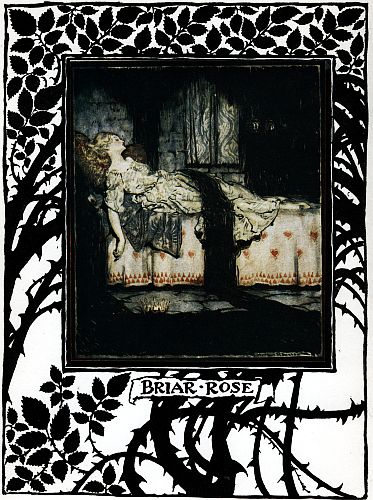
The next few days followed the same routine; find a book, check that the publication date was earlier than Jan 1923 (therefore out of copyright), and then check that it hadn’t been claimed by someone else at DP or had already made it into Project Gutenberg.  Once past those hurdles it’s just a matter of sitting down and scanning the book right through.  There were a few snags.  No Internet connection in the library so I had to work from a stored list of books already cleared for DP.  The move from a moist cool climate to the brutal climate of Almeria had not been kind to the books so most were very brittle and the pages were likely to drop out.  The worst ones were simply bundles of pages held between their separated covers and tied together with string.  Some of the books were priceless and have now made their way to the safety of Project Gutenberg.  For example, there was a first edition of The Sleeping Beauty, illustrated by Arthur Rackham.
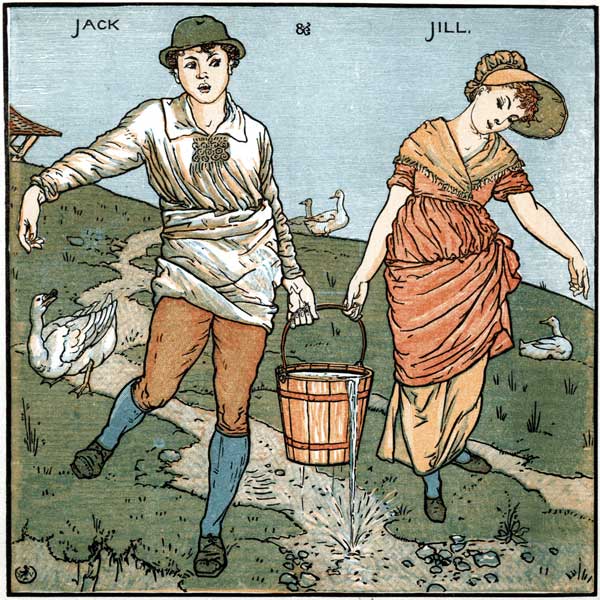
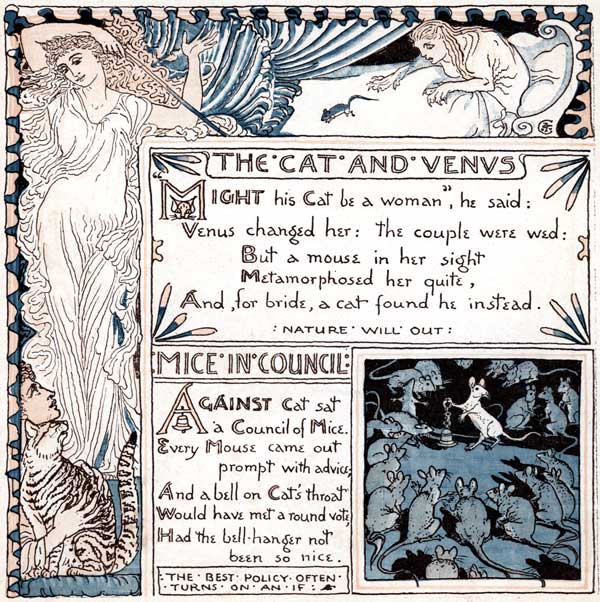
The really high point of my trip happened when I found an old manila folder containing the three ‘Baby’ books by Walter Crane.  The manila envelope had saved them from further damage but the pages were so fragile that I spent a whole afternoon just working on those images.  You can see the results here:
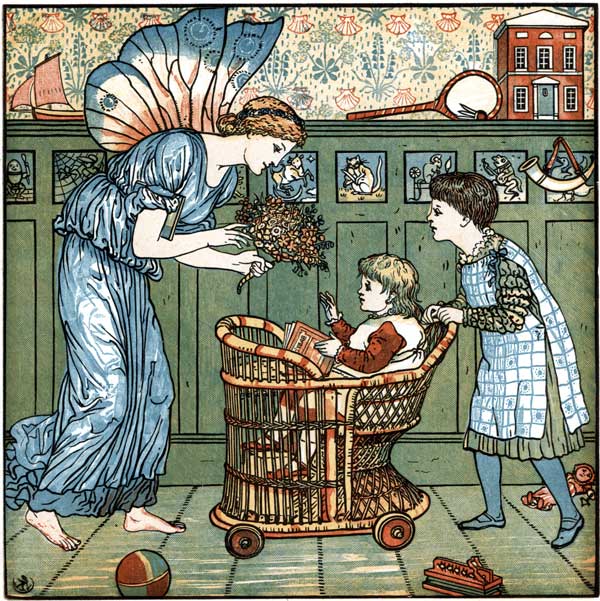
The Baby’s Bouquet

The Baby’s Opera

The Baby’s Own Aesop

I never did get to end of Lindy’s library.  I stuck it out for six days.  It was pretty clear from the start that I could only make a small dent in her collection.  The sizzling days when the only comfortable clothes were just a pair of shorts and frigid nights when my fingers became too stiff to safely turn the pages of a priceless book all became too much for me.  In the end I had to admit defeat and just be grateful for the wonderful books I had found.  The opportunity has passed now, I understand that Lindy’s library was broken up and sold off the following year and that she has moved back to England.  In any case another year in that environment would have rendered most of the older books too fragile to handle.  But still, we managed to preserve some of the gems from her collection so that children in years to come will be able to enjoy the books that she did when ‘she was a child herself’.  Thank you Lindy.

For other books that Mebyon scanned during his time at Lindy’s house, see here.


An Introduction to Astronomy

October 3, 2010

Volunteers at Distributed Proofreaders dedicate their efforts to “Preserving history one page at a time.” On rare occasions while working on a text, one encounters a sudden, remarkable, almost palpable connection to the author’s era.

On June 8, 2004, the sun, Venus, and the earth lined up for a few brief hours. Venus, looking like a perfectly round but otherwise undistinguished sunspot, passed across the face of the sun. Such planetary syzygies, results of the clockwork motion of the inner planets, can be predicted with great accuracy, and for centuries into the future.

In his 1916 book “An Introduction to Astronomy”, published by Project Gutenberg on April 24, 2010, the American mathematician and astronomer Forest Ray Moulton wrote,

The transits of Venus, which occur in June and December, are even more infrequent than those of Mercury. The transits of Venus occur in cycles whose intervals are, starting with a June transit, 8, 105.5, 8, and 112.5 years. The last two transits of Venus occurred on December 8, 1874, and on December 6, 1882. The next two will occur on June 8, 2004, and on June 5, 2012.

If Moulton’s book were to be updated a couple of years hence, the same passage would read:

The last two transits of Venus occurred on June 8, 2004, and on June 5–6, 2012. The next two will occur on December 10-11, 2117, and on December 8, 2125.

Almost a century ago, Moulton’s words must have borne the same force of prognostication, confidently predicting events no contemporaneous reader would be alive to witness. To the retrospect of a modern reader, Moulton’s words bridge the decades–and intervening scientific and technological revolutions–from Moulton’s era to our own.

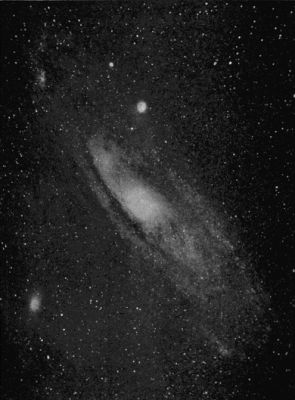
Today, “An Introduction to Astronomy” is an engagingly readable textbook of elementary astronomy, full of current information on geography, motions of the earth and moon, and star maps; incomplete but largely accurate data on the planets and their larger satellites; and poignantly naive descriptions of the “spiral nebulae”, now known to be galaxies in their own right–as numerous as the stars in our own galaxy and inconceivably remote. Pluto had not been discovered, so ironically Moulton’s planetary count, eight, agrees with the modern one.

In these days of interplanetary probes, space-based telescopes, digital data acquisition, and computer-enhanced images, it is easy to forget how recently astronomers’ knowledge was constrained by the limitations of ground-based, visible-light instruments–refracting and reflecting telescopes–and yet how detailed was their knowledge of the solar system and the cosmos beyond. Moulton’s “An Introduction to Astronomy” is a look back to the cosmology of the early 20th Century: Not a dead history, but a book of living information, and a thread of human connection to the science of decades past.

This review was contributed by DP-volunteer adhere.


The Journal of Sir Walter Scott, from the original manuscript at Abbotsford

October 2, 2010

Sir Walter Scott starts his journal with the words, “I have all my life regretted that I did not keep a regular Journal. I have myself lost recollection of much that was interesting, and I have deprived my family and the public of some curious information, by not carrying this resolution into effect.”

Fortunately, in November 1825, at the age of 54, Scott did start keeping a regular journal that, with only occasional breaks, he maintained until his death in 1832. The Journal was eventually published in 1890.

The Journal covers what is probably the most troublesome period of Scott’s life, including his near bankruptcy, the illness and death of his wife and then his own illness and death. Yet, through it all, his affection for his family and friends and his determination to work to clear his debts shine through, as the following entry from 1826 clearly shows:

[Abbotsford, Saturday,] June 17.—Left Edinburgh to-day after Parliament House to come [here]. My two girls met me at Torsonce, which was a pleasant surprise, and we returned in the sociable all together. Found everything right and well at Abbotsford under the new regime. I again took possession of the family bedroom and my widowed couch. This was a sore trial, but it was necessary not to blink such a resolution. Indeed, I do not like to have it thought that there is any way in which I can be beaten.

For all the doom and gloom of Scott’s circumstances, his sense of humour is often present in the entries:

Walked to Huntly Burn, where I found a certain lady on a visit—so youthy, so beautiful, so strong in voice—with sense and learning—above all, so fond of good conversation, that, in compassion to my eyes, ears, and understanding, I bolted in the middle of a tremendous shower of rain, and rather chose to be wet to the skin than to be bethumped with words at that rate. There seemed more than I of the same opinion, for Col. Ferguson chose the ducking rather than the conversation.

As a member of both the Scottish literary and legal establishments of his time, Scott’s Journal is also interesting for its references to many of the famous names of the age: Byron, Moore, the Duke of Wellington, Lockhart, Sheridan and many more.

Reading Scott’s Journal leaves you with a wonderful impression of his character, fortitude and humour and his genuine affection for the Scottish society on which he based so much of his writing. And, in the end, you cannot help but be impressed by a man who, having lost one fortune, managed to earn in the last 7 years of his life a second one sufficient to leave his estate free and clear of debts solely from his writings.

The Journal was the 6,000th book posted to Project Gutenberg by Distributed Proofreaders, back in February 2005.


A Decade of Dedication

October 1, 2010

Ten Years of Producing Public Domain Ebooks

Today it’s been 10 years since Distributed Proofreaders opened its doors to the public. Our aim is the same now as it was back then: producing electronic versions of public domain books that are free for everybody to enjoy.

As our former General Manager, Juliet Sutherland has been the guiding hand of Distributed Proofreaders over the course of many changes and several years. Currently she is the DP Foundation’s Chair, ensuring that Distributed Proofreaders will continue in its mission for years to come. She shares with us these reflections:

It’s hard for me to believe that DP has reached its 10 year anniversary. Looking back (DP front page from 2001) and looking forward I see a history and future of remarkable dedication to the site and to our purpose of transcribing public domain books. Over 18,000 books is a significant contribution to preserving and making accessible the written works of many countries and languages. To my mind, as important as our actual product is, the community that has grown around our production process is equally important. DP has been blessed with so many people who have dedicated large chunks of time. It is inevitable that over a period of 10 years some have moved on to other things. DP has been fortunate that for each of our most active volunteers who moves on, a new, enthusiastic volunteer has appeared. These new volunteers are the future of DP. To everyone who has volunteered at DP over the last 10 years, to everyone who is still contributing, and to the volunteers yet to come, THANK YOU!

Now let the celebration begin!

Yes, we definitely have reason to celebrate today. There are worlds between the first book DP posted to Project Gutenberg and the ones we post today. Just a couple of days ago an enormous and important work was finally finished, and I invite you to have a look at what producing an ebook can mean today: Principles of Orchestration by Nikolay Rimsky-Korsakov. Between those two books, there are more than 18.000 others, an enormous pile of books.

In addition to looking back, today is also a new start. We have more to give to the public than the finished ebooks: what we learn about the books we are working on and the stories that develop around them can be interesting as well. This blog is intended as a way for us to tell those stories, and at the same time to help you to find your way through the enormous amount of free ebooks available by now.