A little holiday magic?

December 15, 2010

Want to impress your friends and family with some conjuring after dinner? Whether you want to learn a few tricks to entertain the children, or like me, you are simply fascinated by how sleight of hand artists achieve their “magic,” you might enjoy “Hocus Pocus Junior: The Art of Legerdemain, or, The Art of Iugling set forth in his proper colours, fully, plainly, and exactly, so that an ignorant person may thereby learn the full perfection of the same, after a little practise.”

“Hocus Pocus Junior” is not just instructive, but fascinating from a historical perspective.  Printed in 1635, the book explains in detail how to perform conjuring tricks like the “Cups and Balls,” that still form the basis of sleight of hand artists’ acts today. However, some of the tricks described have likely lost their lustre: in the age of electric refrigeration and broad science education, it’s unlikely that we would be impressed by the ability to freeze a cauldron onto a stool using a handful of snow and some salt!

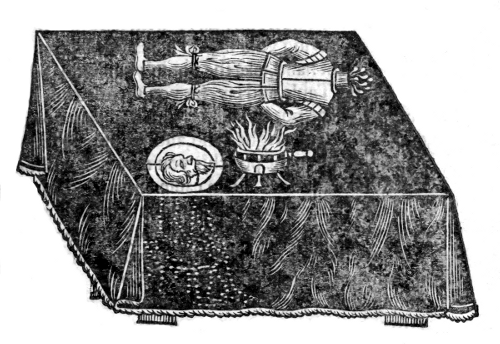
From the basic “Cups and Balls,” Hocus Pocus takes the reader through increasingly complex tricks with coins and ropes, on a side journey into how to silver mirrors using mercury (warning, don’t try this at home!), and culminates with advice on “Confederacie,” or the use of accomplices in the audience. However, my favorite has to be the gruesome, but probably not very convincing, “Decollation of Iohn Baptist:”

You must have a table with two good wide holes towards one end, also a cloth on purpose to cover the table with, so that the said covering may hang to the ground round about the table; also this covering must have two holes made in it even with the holes of the table, you must also have a platter of wood for the purpose, having a hole in the bottom to fit also unto the holes of the table, and it must, as also the table, be made to take in two pieces: having these in readinesse, you must have two boyes; the one must lie along upon the table with his backe upward, and he must put his head thorow the one hole of the table, cloth and all; the other must sit under the table and put his head thorow the other hole of the table, then put the platter about his neck, to make the sight more dreadfull to behold, you may forme some loome about the neckes of them, making small holes in them as it were veins, and besmeare it over with sheepes bloud, putting some bloud also and little bits of liver into the platter, and set a chafing-dish of coales before the head, strewing some brimstone upon the coales; for this will make the head seem so pale and wan, as if in very deed it were separated from the body.
Decollation of Iohn Baptist
The head may fetch a gaspe or two, and it will be better. Let no body bee present while you doe this, neither when you have given entrance, permit any to be medling, nor let them tarry long.
We do not know who wrote Hocus Pocus Junior; he probably did not want his fellow “Iuglers” to know who was spilling their secrets. However we do know of at least one famous illusionist who, hundreds of years later, read the book: the rare and precious original in the Library of Congress, which was scanned for Distributed Proofreaders to create this e-book, bears the inscription “Bequest of Harry Houdini April 1927.”

I hope you enjoy this little piece of history preserved.


An ex-maid’s maid.

December 8, 2010

"Why, she's going to ask me down there, too, to one of her week-end parties!"

“A Romance of Love and Fortune,” that is the subtitle of a light romance about a woman who becomes the maid of her ex-maid. The book is Miss Million’s Maid (1915) by Berta Ruck (Mrs. Oliver Onions).  In addition to love and fortune, it includes class snobbery, Irish royalty, theater, crime, and the Great War.

My story begins with an incident that is bound to happen some time in any household that boasts—or perhaps deplores—a high-spirited girl of twenty-three in it.

It begins with “a row” about a young man.

My story begins, too, where the first woman’s story began—in a garden.

It was the back garden of our red-roofed villa in that suburban street, Laburnum Grove, Putney, S.W.

Now all those eighty-five neat gardens up and down the leafy road are one exactly like the other, with the same green strip of lawn just not big enough for tennis, the same side borders gay with golden calceolaria, scarlet geranium, blue lobelia, and all the bright easy-to-grow London flowers. All the villas belonging to the gardens seem alike, too, with their green front doors, their white steps, their brightly polished door-knockers and their well-kept curtains.

From the look of these typically English, cheerful, middle-class, not-too-well-off little homes you’d know just the sort of people who live in them. The plump, house-keeping mother, the season-ticket father, the tennis-playing sons, the girls in dainty blouses, who put their little newly whitened shoes to dry on the bathroom window-sill, and who call laughing remarks to each other out of the window.

“I say, Gladys! don’t forget it’s the theatre to-night!”

“Oh, rather not! See you up at the Tennis Club presently?”

“No; I’m meeting Vera to shop and have lunch in Oxford Street.”

“Dissipated rakes! ‘We don’t have much money, but we do see life,’ eh?”

Yes! From what I see of them, they do get heaps of fun out of their lives, these young people who make up such a large slice of the population of our great London. There’s laughter and good-fellowship and enjoyment going on all up and down our road.

Except here. No laughter and parties and tennis club appointments at No. 45, where I, Beatrice Lovelace, live with my Aunt Anastasia. No gay times here!

Thus begins the tale of the great-granddaughter of Lady Anastasia. In the days of her great-grandmother the family lived in Lovelace Court. Since that time, the family has “come down in the world” and our heroine lives with her aunt as hermits, because the aunt believes “Better no society than the wrong society.”

Beatrice’s only friend is a naive maid. So when the maid inherits a fortune from a distant relative, our heroine decides to flee her hermitage by entering the employment of her maid. What follows then is a series of adventures as our heroine tries to protect her friend and show her the advantages of her new-found wealth. And, of course, what follows is also romance and plenty of humor along the way.


The Real plays of Little Women

December 4, 2010

In the first chapter of Little Women, there was a description of the plays that the March family performed for each other:

“I don’t mean to act any more after this time. I’m getting too old for such things,” observed Meg, who was as much a child as ever about ‘dressing-up’ frolics.

“You won’t stop, I know, as long as you can trail round in a white gown with your hair down, and wear gold-paper jewelry. You are the best actress we’ve got, and there’ll be an end of everything if you quit the boards,” said Jo. “We ought to rehearse tonight. Come here, Amy, and do the fainting scene, for you are as stiff as a poker in that.”

“I can’t help it. I never saw anyone faint, and I don’t choose to make myself all black and blue, tumbling flat as you do. If I can go down easily, I’ll drop. If I can’t, I shall fall into a chair and be graceful. I don’t care if Hugo does come at me with a pistol,” returned Amy, who was not gifted with dramatic power, but was chosen because she was small enough to be borne out shrieking by the villain of the piece.

“Do it this way. Clasp your hands so, and stagger across the room, crying frantically, ‘Roderigo! Save me! Save me!'” and away went Jo, with a melodramatic scream which was truly thrilling.

Amy followed, but she poked her hands out stiffly before her, and jerked herself along as if she went by machinery, and her “Ow!” was more suggestive of pins being run into her than of fear and anguish. Jo gave a despairing groan, and Meg laughed outright, while Beth let her bread burn as she watched the fun with interest. “It’s no use! Do the best you can when the time comes, and if the audience laughs, don’t blame me. Come on, Meg.”

Then things went smoothly, for Don Pedro defied the world in a speech of two pages without a single break. Hagar, the witch, chanted an awful incantation over her kettleful of simmering toads, with weird effect. Roderigo rent his chains asunder manfully, and Hugo died in agonies of remorse and arsenic, with a wild, “Ha! Ha!”

“It’s the best we’ve had yet,” said Meg, as the dead villain sat up and rubbed his elbows.

“I don’t see how you can write and act such splendid things, Jo. You’re a regular Shakespeare!” exclaimed Beth, who firmly believed that her sisters were gifted with wonderful genius in all things.

“Not quite,” replied Jo modestly. “I do think The Witches Curse, an Operatic Tragedy is rather a nice thing, but I’d like to try Macbeth, if we only had a trapdoor for Banquo. I always wanted to do the killing part. ‘Is that a dagger that I see before me?” muttered Jo, rolling her eyes and clutching at the air, as she had seen a famous tragedian do.

If you are interested in learning more about these plays, you can actually read them in Comic Tragedies Written by ‘Jo’ and ‘Meg’ and Acted by The ‘Little Women’. At first, when I was working on the post processing of this book, I thought it was written by Louisa May Alcott after writing Little Women, with her writing the plays in the style as if it were written by “Jo” and “Meg”. Later reading Little Women Letters from the House of Alcott,  I discovered that the plays were really written by Louisa May Alcott and her sister Anna in their youth.

How were the plays? Well, they were interesting, both historically and as works of young women who had yet to really know romance. The term “Tragedies” was probably a misnomer; they were more like romantic melodramas. Still, melodramas can be fun.


A Wonder Book for Girls and Boys

December 1, 2010

In the spring of 1850, Nathaniel Hawthorne (1804-1864), having just enjoyed his first great success with The Scarlet Letter, moved with his wife and two young children from bustling Salem, Massachusetts, to the Berkshire Hills in the western part of the state. Although “The Berkshires” are now one of America’s premier cultural and natural resorts, they were then a rather wild and remote place. The beauty and peace of its rolling hills made it the perfect setting for a writer who wanted inspiration and no distractions.

The Hawthornes rented a little red farmhouse in Lenox, on the summer estate of the wealthy Tappan family, and Hawthorne set to work. In just a year and a half, Hawthorne produced his masterpiece, The House of the Seven Gables, as well as The Blithedale Romance. And it was here that he wrote his enchanting book for children, A Wonder Book for Girls and Boys.

Midas

Midas’ Daughter Turned to Gold

A Wonder Book is a collection of stories within a frame story. Eustace Bright, a lively student at nearby Williams College, is visiting Tanglewood (Hawthorne’s fictional name for the Tappan estate). He gathers a group of “little folks” — the Hawthorne and Tappan children under assumed names like “Primrose” and “Cowslip” — and, in various places on and around the estate, charmingly narrates for them several ancient Greek myths.

Here is Perseus, lopping off the Gorgon’s Head; Midas, miserably living with his Golden Touch; Pandora and that terrible box; Hercules braving monsters to retrieve the Three Golden Apples; the generous old couple, Baucis and Philemon, unwittingly entertaining the gods in their poor cottage; Bellerophon taming Pegasus and defeating the Chimæra. Both the frame story and the myths are simply and beautifully told, with Hawthorne’s wonderfully evocative touches:

The golden days of October passed away, as so many other Octobers have, and brown November likewise, and the greater part of chill December, too. At last came merry Christmas, and Eustace Bright along with it, making it all the merrier by his presence. And, the day after his arrival from college, there came a mighty snow-storm. Up to this time, the winter had held back, and had given us a good many mild days, which were like smiles upon its wrinkled visage. The grass had kept itself green, in sheltered places, such as the nooks of southern hill-slopes, and along the lee of the stone fences. It was but a week or two ago, and since the beginning of the month, that the children had found a dandelion in bloom, on the margin of Shadow Brook, where it glides out of the dell.

In spite of his appreciation of the beauty of the Berkshires, his productivity there, and the birth of his daughter Rose in 1851, Hawthorne loathed the changeable climate. In one of his journals (later published as Twenty Days with Julian and Little Bunny by Papa), he wrote, “I detest it! I detest it!! I de-test it!!! I hate Berkshire with my whole soul, and would joyfully see its mountains laid flat.” The Hawthornes went back east in November 1852 and never returned.

But Hawthorne’s Wonder Book lives on, as does its sequel, Tanglewood Tales, published in 1853. The Tappans, in fact, adopted Hawthorne’s name for their estate, and their descendants donated Tanglewood to the Boston Symphony Orchestra for its now-famous summer concert series. The little red farmhouse burned down in 1890 and a privately-owned replica stands in its place.

Project Gutenberg’s version of A Wonder Book for Girls and Boys is the 1893 edition, with lovely, richly-detailed illustrations by Walter Crane.

This post was contributed by Linda Cantoni, a Distributed Proofreaders volunteer.


Mathematical Geography by Willis Ernest Johnson

November 27, 2010

Before the advent of coordinated universal time and internationally-recognized time zone boundaries, practical, day-to-day considerations of time measurement quickly became entangled in geographical, political, historical, and legal problems of surprising recalcitrance.

If you live in the northern hemisphere, does the sun pass due south of you every 24 hours? Perhaps surprisingly, no! An hour is 1/24 of a sidereal day, the time required for the earth to rotate once with respect to the stars. Because the earth orbits the sun, the sun’s position on the celestial sphere traverses a circle once per year. Consequently, the mean solar day is shorter than the sidereal day by a factor of roughly 1/365.25: The sun therefore passes due south on average every 23 hours, 56 minutes, 4 seconds. The actual length of the solar day varies seasonally because the earth’s orbit is not circular and the dates of perihelion and aphelion (when the earth is closest or furthest from the sun) do not coincide with the solstices (when the north pole is tipped most nearly toward or away from the sun).

A related phenomenon is said to have confounded Ferdinand Magellan’s crew briefly upon return to Spain after circumnavigating the globe. Their careful reckoning gave the date of September 6, 1522, but the Spaniards assured them the date was the 7th. Eventually the crew realized they had lost a day over their long voyage by traveling west, with the sun. Today we would say Magellan lost a day crossing the date line.

Civilizations successfully used local (solar) time for millennia. Only when consistent time measurements were required over extended longitudes did standard time become important. Of course, time standards were not immediately or universally adopted. Consequences ranged from minor confusion for travellers to legal cases with substantial financial stakes.

During the late Nineteenth Century in the United States, railroads and cities used their own time conventions for many years. When Mathematical Geography was written, the vicinity of El Paso Texas used four systems of time, due to the confluence of three U.S. time zones and an entirely separate Mexican standard time used in Juarez, across the Rio Grande.

In 1902, thirteen lawsuits were brought in the courts of Kentucky over the wording of fire insurance policies. In one case, the policy expired at noon on April 1, 1902, but left unspecified whether solar or standard time was to be reckoned. On the date in question, a warehouse fire began at 11:45 A.M. standard time, namely at 12:02:30 P.M. local time. Nearly $20,000 of insurance money hung in the balance of the court’s decision. Such improbable occurrences were not as rare as one might expect. Willis’s book does not divulge the outcome of these cases, but does highlight the need for pedantic attention to issues we might all regard as too obvious to warrant detailed consideration.

In the modern world of the global positioning system, universal time, and largely undisputed geopolitical boundaries, we easily forget that divisions of time and space are nothing more than social agreements. The earth has no intrinsic clocks convenient for international travel and commerce, nor many geographical features that unambiguously separate neighboring states, provinces, territories, or countries.

Mathematical Geography is not a mere catalogue of amusing events and curious factoids, but a clear, engaging, and systematic exposition of the shape and movement of the earth as an astronomical body, and the consequences for time-keeping, map making, and geodesy. Written in 1907 for use in American secondary schools and for teacher preparation, the book intertwines purely scientific issues of astronomy and geography with the historical growth of the United States in the 1800s as the political entity expanded across the North American continent, and with then-current legal and practical issues related to time and place. Much of the factual content is up-to-date, and even the remainder should be of historical interest.

Despite the book’s imposing title, the mathematical content is light, entailing only trigonometry, plane geometry, and basic algebra. Mathematical Geography is easily accessible to a modern reader with a good high school education. A curious and intelligent younger reader can also learn much, skipping brief mathematical derivations as needed or even learning useful mathematics in a realistic context.

This enjoyable book deserves, and earns, the attention of anyone who wants to understand more about the planet we inhabit and how the earth’s shape and motion affect our daily lives.

This review was contributed by DP-volunteer adhere.


The Art of Stage Dancing

November 24, 2010

It started as an all-too-common story: a young performer — an actor, dancer, musician, stage director — from the Midwest comes to New York to break into the big time on Broadway. His specialty act on the piano wowed ’em in his hometown, and he’s determined that it’ll wow ’em in New York.

But when he gets there to play his first gig, he finds that there’s no piano at the theater. Worse, he discovers that someone has stolen his act and has already performed it all over town. Now he has no job. He has no money. He trudges from agent to agent in a vain search for a break. He now understands why they call Broadway the “Boulevard of Broken Dreams.”

But the dream of Ned Wayburn (1874-1942) wasn’t broken yet. His ragtime piano playing eventually caught the attention of one of the great Broadway stars of the 1890s, May Irwin, who hired him to accompany her for the princely sum of $25 a week. And from that big break grew Wayburn’s outstanding career as the first important choreographer on Broadway.

Actually, Wayburn didn’t care for the title “choreographer.” He styled himself as a director, and from 1901 into the 1920s he was one of the kings of Broadway, his spectacular vaudeville shows drawing huge crowds. He perfected synchronized chorus-line dancing, using large numbers of attractive young female dancers in imaginative, precisely-timed production numbers. He hit the pinnacle of his career when he directed the Ziegfeld Follies several years in a row, from 1916 to 1923.

But in spite of his success, financial security frequently eluded Wayburn. He went bankrupt for the first of several times in 1908. He bought a theater in 1915 to showcase his own productions, only to have it shut down four months later. He became involved in a messy divorce and was nearly jailed for failing to pay alimony.

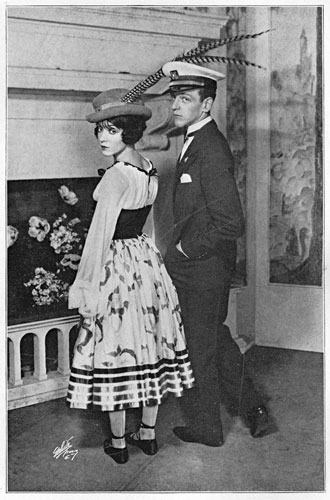
Fred and Adele Astaire

Fred and Adele Astaire, pupils of Ned Wayburn

To shore up his finances, Wayburn opened a dance school in Manhattan in 1905. Among his early students were a young Fred Astaire and his sister, Adele. By the 1920s, the school was a Broadway institution, training legions of dancers in Wayburn’s unique styles of tap dancing (which some claim he invented), acrobatic dancing, “modern Americanized ballet,” specialty dancing, and ballroom dancing. The Art of Stage Dancing, written in 1925, is essentially a book-length advertisement for the Ned Wayburn Studios of Stage Dancing — but a fascinating advertisement nonetheless.

Wayburn’s book is chock full of photographs of the Broadway stars of yesteryear whom Wayburn had taught, or with whom he had worked, in his long career: Fred and Adele Astaire, the Dolly Sisters, Eddie Cantor, Will Rogers, W.C. Fields, Marion Davies, Gertrude Lawrence, Al Jolson, and a host of other greats who are now, alas, forgotten.

But the book is more than just a self-congratulatory plug for Wayburn and his school. It’s also a complete guide for the would-be dancing star (primarily female, of course), with detailed, richly illustrated chapters on dance styles, steps, and tempos (with music); makeup and costume; stage technique; exercise, diet (with daily menus to slim down or fatten up), and health; and much more. Wayburn even threw in a collection of sample contracts so that his students would know what to expect in the real world.

Wayburn believed fervently in the power of confidence as the key to stage success:

Be patient, you who would star and see your name go up in the bright lights on the Great White Way. Do not get discouraged. You will meet with obstacles on the route to fame undoubtedly, as others have done, and, like the others who have finally arrived, you must overcome them one at a time as they appear, by sheer force of willpower, determination, pluck or whatever you desire to call it. If you are a weakling and lack strength of character do not ever take up a stage career, for you will get many a bump; so be prepared to stand it. For only those who are determined to succeed will ever reach the top, where there is plenty of room always.

Unfortunately, no amount of confidence could stop the march of time for Wayburn. The Depression brought both vaudeville and the Ned Wayburn Studios to a slow and painful end. Wayburn went bankrupt for the last time in 1935; he died in 1942 at the age of 68. But his legacy lives on in every Broadway show with a chorus line.

The Art of Stage Dancing was the 14,000th title posted to Project Gutenberg by Distributed Proofreaders.

This post was contributed by Linda Cantoni, a Distributed Proofreaders volunteer.


Real “Little Women” Letters

November 20, 2010

For all those who have ever read Little Women and loved it, Little Women Letters from the House of Alcott shows how much of Little Women was based upon Louisa May Alcott’s own family.  What makes this biography special is that it is primarily told in the letters that the Alcott family wrote each other, including a letter from five year old Anna telling her mother that “You have a splendid husband”.

I don’t know if Bronson Alcott was that splendid of a husband (he was a failure as a businessman, and his family lived in poverty most of their childhood), but he definitely was a “splendid” father.

Here is what he wrote Elizabeth on her fifth birthday:

Page of letter to Elizabeth on her 5th birthday

Page of letter to Elizabeth on her 5th birthday

1840

I    I    I    I    I    Years
one two three four five
birth-day
in the
cottage

My very dear little girl,

You make me very happy every time I look at your smiling pleasant face—and you make me very sorry every time I see your face look cross and unpleasant. You are now five years old. You can keep your little face pleasant all the time, if you will try, and be happy yourself, and make everybody else happy too. Father wants to have his little girl happy all the time. He hopes her little friends and her presents and plays will make her happy to-day; and this little note too. Last birthday you were in Beach Street, in the great City, now you are at your little cottage in the country where all is pretty and pleasant, and you have fields and woods, and brooks and flowers to please my little Queen, and keep her eyes, and ears, and hands and tongue and feet, all busy. This little note is from

FATHER,

who loves his little girl very much, and knows that she loves him very dearly.

Play, play,
All the day,
Jump and run
Every one,
Full of fun,
All take
A piece of cake,
For my sake.

Unfortunately, having him as a father had its downside, including the Fruitlands experiment and its failure that was immortalized by Louisa Alcott in her “Transcendental Wild Oats.”

The detail of it is thus described by a friend of the Alcott family, who had the story from Bronson Alcott himself:

The crop failures necessitated the community living on a barley diet, as anything animal was not allowed, not even milk and eggs. Now and then they gave a thought as to what they should do for shoes when those they had were gone; for depriving the cow of her skin was a crime not to be tolerated. The barley crop was injured in harvesting, and before long want was staring them in the face. The Alcotts remained at Fruitlands till mid-winter in dire poverty, all the guests having taken their departure as provisions vanished. Friends came to the rescue, and, Mr. Alcott concluded with pathos in his voice, “We put our little women on an ox-sled and made our way to Concord! So faded one of the dreams of my youth. I have given you the facts as they were; Louisa has given the comic side in ‘Transcendental Wild Oats’; but Mrs. Alcott could give you the tragic side.”

Indeed, it was always Mrs. Alcott who could have given the tragic side, skillfully as she kept her worries hidden. Her own family, indignant because Bronson Alcott could not better provide the material needs for his family, on more than one occasion besought the faithful wife to leave him.

Reading this book, I am struck by how strong an impact the father had on that family. Bronson Alcott was an idealist, with strongly-held views of the world, and he passed those strongly held views to his children with love and tender care.

Strongly-held views taught with love and tender care are not necessarily correct. For instance, I doubt my daughters would agree with the sentiment of a young Louisa Alcott that “love of cats” is a vice. Having Bronson Alcott as a father definitely was a mixed bag, the type of life that makes great source material for a novel.


A Week at Waterloo in 1815

November 17, 2010

One might think, from the title, that A Week at Waterloo in 1815 is an old soldier’s memoir of a glorious battle. But the lengthy subtitle, “Lady De Lancey’s Narrative: Being an Account of How She Nursed Her Husband, Colonel Sir William Howe De Lancey, Quartermaster-General of the Army, Mortally Wounded in the Great Battle,” is the first clue that this is no ordinary military tale. Lady De Lancey’s narrative is, instead, a heart-wrenching account of a young bride who tended to her husband in his last agonizing days.

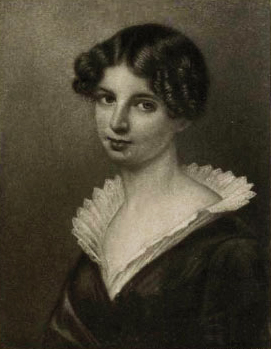
Lady Magdalene De Lancey

Lady Magdalene De Lancey

Magdalene Hall De Lancey (1793-1822), daughter of the noted Scottish geologist Sir James Hall of Dunglass, married Sir William Howe De Lancey (1778-1815) in April 1815. De Lancey was a descendant of the prominent De Lancey (or Delancey) family of New York City (Delancey Street on the Lower East Side of Manhattan was named after them). Sir William’s branch of the family were Loyalists during the American Revolution, and fled to England when the British lost the war in 1783. Sir William joined the British Army as a teenager in 1792, and, shortly after his marriage to Magdalene, began serving under the Duke of Wellington in the last Napoleonic War.

As was the custom in those days, Magdalene accompanied her new husband when he was posted to Brussels for the Belgian campaign, in June 1815. Their first days there were surprisingly peaceful and happy. It soon became clear, however, that the French would attack Brussels, so Magdalene moved to Antwerp while Sir William went off to battle. He wrote her on June 16, assuring her that he was safe.

It was the last letter she would receive from him. On June 18, 1815, in the first hours of the Battle of Waterloo, a cannonball struck Sir William in the back, sending him flying off his horse. Wellington himself saw Sir William fall, and rushed to his side. Believing that the wound was fatal, Sir William begged to be left to die on the field of battle, and asked Wellington to give his wife a last message. He was moved to a cottage, where, believed to be dead, he was left untended for a day and a half.

Meanwhile, the day after the battle, Magdalene was told that her husband had “died like a soldier.” Overcome by grief, she locked herself in her room:

I locked the outer door, and shut the inner one, so that no one could again intrude. They sent Emma [her maid] to entreat I would be bled; but I was not reasonable enough for that, and would not comply. I wandered about the room incessantly, beseeching for mercy, though I felt that now, even Heaven could not be merciful.

But Heaven was, for a time, merciful. The following day, Magdalene received the news that her husband was, in fact, alive, though badly wounded; a fellow officer had found him in the cottage and had gotten a surgeon to treat him. Magdalene made ready to go to her husband immediately. She was in a state of terror as she waited for her carriage:

I would not if I could, describe the state I was in for two hours more; then I lost all self-command. . . . My agitation and anxiety increased. I had the dreadful idea haunting me that I should arrive perhaps half an hour too late. This got the better of me, and I paced backward and forward in the parlour very fast, and my breathing was like screaming.

The horrors of the battle were brought home to her as her carriage approached Waterloo. “The horses screamed at the smell of corruption, which in many places was offensive,” she wrote. But she rejoiced to find her husband alive. His first stoic words to her were, “Come, Magdalene, this is a sad business, is it not?”

For the next six days, Magdalene nursed her husband in what was essentially a hovel with few supplies or conveniences. At first, he seemed to improve somewhat, but he was soon coughing up blood. His breathing became labored, and he developed severe chest pain and a fever. And no wonder: the cannonball had smashed eight of his ribs, and his lungs were punctured. The only medical treatment he received, typical of the day, was to be bled repeatedly — a fine treatment indeed for one who was bleeding internally!

On the night of the fifth day, Sir William, unable to sleep, asked Magdalene to lie down with him in his tiny sickbed against the wall:

He said if I could lie down beside him it would cut off five or six hours. I said it was impossible, for I was afraid to hurt him, there was so little room. His mind seemed quite bent upon it. Therefore I stood upon a chair and stepped over him, for he could not move an inch, and he lay at the outer edge. He was delighted; and it shortened the night indeed, for we both fell asleep.

The next day his lungs filled with water, and Magdalene knew the end was near:

I sat down by my husband and took his hand; he said he wished I would not look so unhappy. I wept; and he spoke to me with so much affection. He repeated every endearing expression. He bade me kiss him. He called me his dear wife. . . . [H]e looked up at me and said, “Magdalene, my love, the spirits.” I stooped down close to him and held the bottle of lavender to him: I also sprinkled some near him. He looked pleased. He gave a little gulp, as if something was in his throat. The doctor said, “Ah, poor De Lancey! He is gone.” I pressed my lips to his, and left the room.

Sir William was buried two days later near Brussels. Magdalene made a final visit to his grave on July 4. Her narrative concludes: “At eleven o’clock that same day, I set out for England. That day, three months before, I was married.”

After her return to England, Magdalene wrote A Week at Waterloo in 1815 at her brother’s request. It was privately circulated among family and friends. Magdalene remarried, but died in 1822, at the age of 29, giving birth to her third child. A Week at Waterloo in 1815 was published for the first time in 1906, and became a part of the Project Gutenberg library in 2010.

Magdalene De Lancey’s simple, unaffected style has an impact that no florid emotional verbiage could match. An introduction and notes in the published edition give historical context to the narrative, but her story transcends mere historical fact. It is a story of love and loss, ineffably human, and unforgettable.

This post was contributed by Linda Cantoni, a Distributed Proofreaders volunteer.


Mathematical Recreations and Essays

November 13, 2010

W. W. Rouse Ball‘s “Mathematical Recreations and Essays” contains an odd but decidedly interesting collection of essays about a range of different subjects. The 4th edition dating from 1905 was recently posted to Project Gutenberg. Far from being interesting to mathematicians only, this book has something for everybody who’s interested in puzzles and number games or in the history of science.

The book is divided into two parts of quite different character. The first part, titled “Mathematical Recreations,” ranges from simple number games of the “guess the number” kind to magical squares and mazes, discussing topics such as mathematical and geometrical fallacies, the “Eight Queens” problem on a chessboard, map colourings and many more. The problems presented are not exactly new or original and don’t pretend to be, but I like the systematic treatment given to many of them.

Part II of the book, titled “Miscellaneous Essays and Problems,” contains a wealth of historical information about mathematics-related topics made even more fascinating by the fact that it was written more than a century ago. It starts with a description of the development of the Mathematical Tripos at Cambridge, giving a very interesting glimpse into the history of mathematics education at one of Britain’s most prestigious universities. The next chapters give a history of classical geometrical problems, the quadrature of the circle the most prominent of them, followed by an introduction to Mersenne’s numbers. After that comes a short description of the “scientific” aspect of astrology, which the author himself wasn’t too sure whether to include. There’s a chapter introducing early cryptography, one on hyper-space, including space with more than three dimensions as well as non-Euclidean geometry, and one on time measurements.

But my absolute favourite is the last chapter on matter and ether theories. At the time this book was written, the internal workings of atoms were not yet known and the subject of the wildest speculations. The author gives an account of the different theories proposed and how they explain the way atoms interact with each other. Rather than reporting scientific developments from a historical standpoint, this chapter provides some valuable insights into science in action, which makes it really fun to read.

Tucked away behind the index are advertisements for the W. W. Rouse Ball’s other works, together with blurbs from probably every review that was ever printed. Let me cite from one of the reviews for this book, which I have to heartily agree with:

… A great deal of the information is hardly accessible in any English books; and Mr. Ball would deserve the gratitude of mathematicians for having merely collected the facts. But he has presented them with such lucidity and vivacity of style that there is not a dull page in the book; and he has added minute and full bibliographical references which greatly enhance the value of his work.–The Cambridge Review.

I thoroughly enjoyed reading this book and would really like to see the other works by this author on PG: they are surely worth a closer look.


Farthest North

November 10, 2010

In our time of comfortable air-travel, it is hard to imagine that just 115 years ago neither the North or the South-pole had ever been set foot upon by mankind, but this is exactly what the Norwegian explorer Fridtjof Nansen set out to do in 1893, with a purpose-built ship, the “Fram”, and a team of hardened men all willing to risk their lives for this mission.

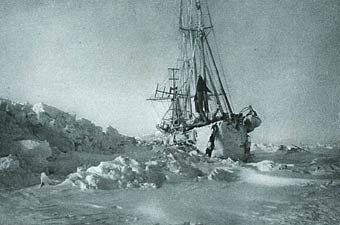
The "Fram" in the ice

The "Fram" in the ice (from Farthest North, volume II)

Nansen’s richly illustrated book, Farthest North; Being the Record of a Voyage of Exploration of the Ship “Fram” 1893-96 and of a Fifteen Months’ Sleigh Journey by Dr. Nansen and Lieut. Johansen, originally published in Norwegian in 1897, was translated into English the same year. In it, Nansen describes the inventiveness he used to organize such a mission with fairly limited means. The “Fram” had a number of interesting innovations. Its hull was specially designed to be lifted by the drifting ice, instead of being crushed; and the ship had a featured windmill, to provide electricity, and thus some bright electric light through the long polar night.

Volume I (Project Gutenberg ebook 30197) describes the planning phase, and how the “Fram” set out to sail as far North as it could, intentionally letting itself be captured by the ice, in an attempt to drift further North than any ship had reached before.

Volume II (Project Gutenberg ebook 34120) continues with the even more dare-devil attempt by Nansen and his companion Johanson to reach the North Pole on sledges pulled by dogs. During this trip, they killed their dogs one-by-one, feeding the weaker or exhausted ones to the remaining ones–the same, much criticized, method that brought Amundsen to the South Pole 16 years later. They reached the at that time record setting latitude of 86 degrees 15 minutes North before heading South again. During this trip South, they lost their remaining dogs, and were finally forced to build a hut and stop for the winter on Franz Josef Land, North of Spitsbergen. Here they survived by shooting over-curious ice-bears, and using them as food, until they were able to reach a small outpost built by the British explorer Jackson, just a few miles from where they survived the winter with so much hardship.

From here, the journey home proceeds smoothly, and the two explorers were rejoined with their crew who had survived another winter in the ice on the “Fram”, before being able to return home.

The "Fram" as it is today

The "Fram" as it is today, in the Fram Museum

The book is a pleasant read, and is illustrated with hundreds of photographs and drawings; including a number of color plates from pencil sketches made during the trip.

Nansen went on to become an influential statesman, with an important role for Norwegian independence, and an even more important role in saving millions of lives in Russia, Armenia, and Turkey with the High Commission for Refugees, for which he was awarded the Nobel peace prize in 1922.

After being the ship that reached the Northern-most latitude, the “Fram” also became the ship to reach the Southern-most latitude during Amundsens expedition to reach the South-Pole in 1911. Today, the “Fram” can still be visited: it has been pulled ashore in Oslo, and a museum, the Frammuseet, has been build around it. The visit will be even more impressive after reading this book, when, after short inspection of the cabins where these men have been living for three years, you realize some of the hardships they must have gone through. (This visit can easily be combined with a visit to the Norwegian Maritime Museum, the Kon-Tiki Museum, and the Viking Ship Museum, all located at walking distance from each other.)