The Boy Craftsman by A. Neely Hall

May 14, 2013

I want to make a doll’s house. And a miniature theatre. And fireworks. And a desk and shelves. And … and….

I’ve been reading a book published over a hundred years ago that would never see the light of day in today’s risk-averse society. Back then, it seems, the best present you could get for your twelve year old boy was a small axe and a selection of sharp blades—together with dangerous chemicals and other toxic substances. It was a time when boys and girls had different pastimes and every boy carried a small folding knife with him.

The Boy Craftsman, subtitled Practical and Profitable Ideas for a Boy’s Leisure Hours, was one of a series of similar books, and it starts with things a boy can make to earn money. These range from household items such as a display rack for plates for the dining room, to snow ploughs and newspapers. It’s lavishly illustrated with diagrams, photographs and templates for some of the parts. The instructions for all the projects are very detailed and the whole thing is inspirational. The author was enthusiastic about his subject and he wrote in a clear style, because the book was aimed at children. Judging by the illustrations, the boys in question were in the 11-16 age range, so well able to undertake the projects in the book.

After money-making ideas, Mr Hall moves on to discuss outdoor activities, the list of chapters suggesting building up to leaving the poor boy stranded in the great outdoors. It seems he’s being taught to make a shelter, transport and then how to catch his own food.

How to build a log-cabin
How to build a canvas canoe
Home-made traps
Toy guns, targets, and bows and arrows

Log Cabin

Even though I know things were different then, it’s impossible to shake off my 21st century sensibilities. Every time the book mentions yet another sharp implement, or painting things with white lead (enamel paint is suggested as an alternative), I suffer a moment of shock that children were given these things. The basic tools for a workshop are listed as “A hatchet, hammer, saw, plane, chisel, jack-knife, bit and bit-stock, screw-driver, and square”.

And here’s a chapter you’d never find in a book for teenagers these days,

Work to do with a knife

There are instructions for maintaining and sharpening your tools, for developing photographs, for making a bow and arrow (including metal arrowheads), setting up your own printing press, for making animal traps of various kinds, for creating “safe” fireworks.

A toy pistol, that will fire a piece of cardboard has a piece of advice that I think would have been good to repeat later when making arrows. “It is advisable to keep this pistol out of range of your companions’ faces.

Really? You think?

Physical activity isn’t forgotten, an outdoor gymnasium is constructed with everything you could need in 1905—including a punching bag platform and a vaulting pole. Pole vaulting for children? Where are my smelling salts, I think the shock’s getting too much for me.

The final section is given over to indoor pastimes, the first of which is creating a miniature theatre complete with scenery, props and mechanical effects. If that doesn’t appeal, you could always make a toy railway or clockwork cars. I noted with amusement the advice to boys about to dismantle an old clockwork mechanism for cleaning.

Before taking a set of works apart, it is well to examine it carefully and note the positions of the various springs and wheels, so it will be possible to put them together again properly should you wish to do so. Without taking notice of this, you are likely to have a handful of wheels as a result, with which you can do nothing except perhaps convert them into tops.

Have you ever sat and watched as an impatient person takes a mechanism apart without looking and then sits scratching their head at the piece left over when they’ve reassembled it? Seems it’s not a new phenomenon.

I think one of the most amazing things about so many of the books I read, is that they still have relevance now. The basic techniques and tools here still hold good and I can think of worse things than undertaking some of these projects with older children. Just imagine the quality time spent together—because there’s no way we’d leave them unsupervised with these things nowadays. Some of the projects might need a little thought (the doll’s houses use a lot of cigar boxes, for which an alternative would need to be identified) and some are no longer possible (creating a dark room for developing photographs from glass plates).

On the whole though, here’s a wide range of creative and constructive projects of varying sizes that I think kids (and their parents) would still enjoy doing. Why not download this book and try one or two? Perhaps not the log cabin, though.

See you later—I’m off to see what my own workshop contains.


A Silver Anniversary—25,000 Titles posted to Project Gutenberg!

April 10, 2013

25,000 Books Posted - The Art and Practice of Silver Printing

Today we are celebrating a special anniversary: the 25,000th project produced by Distributed Proofreaders has been posted to Project Gutenberg.

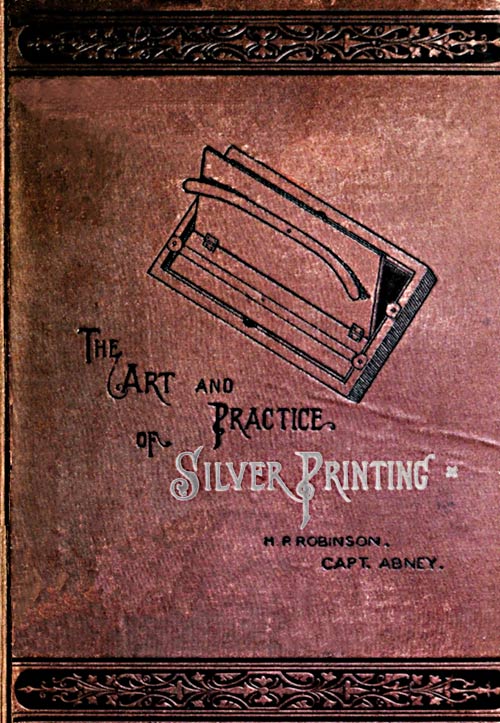
silver_printingThe Art and Practice of Silver Printing by Henry Peach Robinson and Captain William de Wiveleslie Abney is a fitting book to celebrate with, silver being generally connected with 25th anniversaries. Printed in 1881, the book gives a fascinating glimpse into early photographic printing techniques.

In our age of ubiquitous digital photography and image manipulation, it is fascinating to look back to the beginnings, when there was a lot of chemistry and craftsmanship involved in making even a single print. The book explains in great detail the whole process of getting from a photographic negative to a finished print, from preparing the chemical solutions involved and the paper, how to deal with different subjects, like portraits and landscapes, to how to mount the finished prints for presentation.

Thanks to all the volunteers who helped to produce this and the 24,999 books that got us to this milestone. All in all, that’s almost six million pages!


The Salem witchcraft, The planchette mystery, and Modern spiritualism

March 13, 2013

Some time ago I worked on a few pages of  The Salem witchcraft, The planchette mystery, and Modern spiritualism, a collection of articles reprinted by the Phrenological Journal.

It got me intrigued, so when I was notified the other week that it was available for smooth reading, I downloaded it.

The book contains three articles, as indicated in the title. The first article: The Salem Witchcraft, was what got me so intrigued back then. I had heard of the Salem witches, but never actually knew what happened there, so this was my chance to find out.

The article is a review of the work of Charles W. Upham. I think it is adequate to say that it is a summary of his work, although I am not (yet) familiar with his books.

The article neatly describes what happened in Salem in the 17th Century, tries to explain how and why things took the dreadful course they took. If you are curious to get the whole picture, you are in luck, because you can find Upham’s work on Project Gutenberg, too:

Salem witchcraft; with an account of Salem village and a history of opinions on witchcraft and kindred subjects. Volume 1 and 2

and

Salem Witchcraft and Cotton Mather

But back to the article: it certainly gives you a very good idea of the people, the circumstances and the goings on in Salem and surrounding areas. You can use it as an introduction to the Upham books, or as a good overview if you don’t have the time or inclination to go into too much detail. It certainly left me counting my lucky stars that I didn’t live there and then.

The Planchette

The planchette mystery had me in stitches. It was a welcome distraction after the Salem horrors.

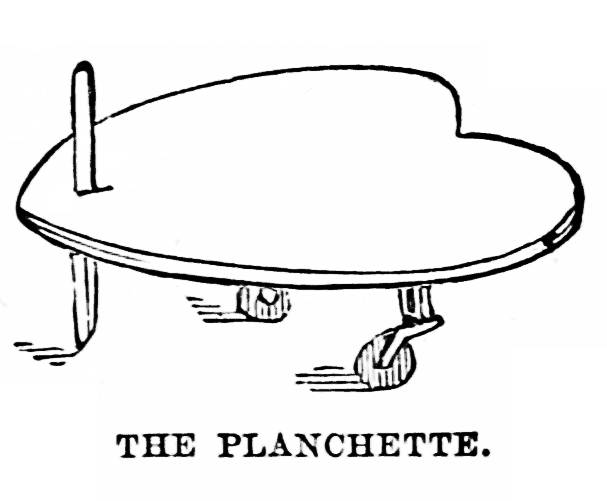
The author tries to lift the mystery of the Planchette. If, like me, you don’t know what a Planchette is, you’ll be a lot wiser by the end of the article. I got to know where it got its name, what it does, even how to use it.

The author of the articles goes to great lengths to show the flaws in theories which don’t fit his conviction, demanding proof of them, while at the same time failing to give a single proof himself.

However, he lists lots of examples of the wondrous results when using a planchette. It must indeed be a tiny miracle. You can have a nearly philosophical discussion with it, and it will answer you (well, it answered the author) in intelligible sentences up to 300 words of length. Go figure. I want a planchette now.

The article about Modern Spiritualism, written by Harriet Beecher Stowe of  Uncle Tom’s Cabin fame, rounds the book off. Mrs Beecher Stowe is a devout Christian and as such has a word or two to say about spiritualism. She laments that the churches don’t go back to their roots and have no comfort to offer, thus involuntarily helping bereft people to search solace in spiritualism. She compares the beliefs and traditions of the primitive Christians of the beginning of Christianity with the Christians of the (her) present day and shows how spiritualism wouldn’t stand a chance if only people still knew that there were angels, Satan and miracles, as Jesus and the Apostles knew. Nobody would ever have to lament a beloved one who died because … but read for yourself.

At first, I thought it was an odd compilation of articles, but on second thoughts I realised the ingenuity of it.

You have one example for the horrors caused by overzealous Christians; one example glorifying phrenology and mesmerism, and one condemning spiritualism and promoting Christianity. All of the phenomena discussed in the book above have one common denominator:

They have no proof.


Mendelssohn in Italy

February 3, 2013

Sometimes we DP volunteers wonder whether anyone actually reads or uses the e-books we produce. After all, with most of the world’s best-known works already posted to Project Gutenberg, nowadays we tend to labor on the somewhat obscure.

Mendelssohn

Felix Mendelssohn in 1839

But the books we produce are being read and used every day, by readers, students, teachers, scholars, and even musicians. Here’s a real-life example: Last year, my husband, an orchestra conductor, asked me to put together some program notes for one of his concerts. His idea was to have me be a sort of narrator, reading the notes to the audience before each piece. One of the pieces was to be Felix Mendelssohn’s Symphony No. 4, the “Italian.”

Because the notes were to be given live, I wanted to make sure they’d be especially interesting to a general audience.

Technical details about the music were not going to do the trick. With the Italian Symphony, I was in luck twice over. First, in the course of my research, I learned that it had been inspired by Mendelssohn’s first trip to Italy in 1830, when he was just 21. Second, better yet, I remembered a book then in progress at DP and since posted to PG: the Letters of Felix Mendelssohn Bartholdy from Italy and Switzerland. I decided to take appropriate excerpts from the letters and read one before each movement of the symphony.

These exuberant letters to Mendelssohn’s parents, brother, and sisters back home in Berlin express the manifold wonders he experienced on his journey. The ruined glory of the Roman Forum and the Colosseum, the stunning loveliness of the hills, the romantic palazzi and canals of Venice, all spoke to his deepest sense of beauty.

Here is young Mendelssohn, newly arrived in Venice, eagerly writing to his parents on October 10, 1830:

Italy at last! And what I have all my life considered as the greatest possible felicity is now begun, and I am basking in it.

You can hear this youthful enthusiasm in the exciting opening bars of the Italian Symphony, which he began writing on this trip. As he wrote to his sister Fanny from Rome on February 22, 1831:

I have once more begun to compose with fresh vigour, and the Italian symphony makes rapid progress; it will be the most sportive piece I have yet composed, especially the last movement.

Except for the last movement, which is based on a lively Italian dance called the saltarello, there is nothing particularly Italian about the music itself. Rather, it evokes the impressions of an awestruck tourist, impressions he shared with his family in his letters home.

The stately tone of the symphony’s second movement is reflected in this letter to his parents, from Rome, November 8, 1830:

Just as Venice, with her past, reminded me of a vast monument: her crumbling modern palaces, and the perpetual remembrance of former splendour, causing sad and discordant sensations; so does the past of Rome suggest the impersonation of history; her monuments elevate the soul, inspiring solemn yet serene feelings, and it is a thought fraught with exultation that man is capable of producing creations, which, after the lapse of a thousand years, still renovate and animate others.

The third movement of the symphony, a graceful minuet, puts one in mind of Botticelli’s lovely painting, Primavera. It hangs in the Uffizi Gallery in Florence, where Mendelssohn immersed himself in the glories of Italian art, as he wrote to his sisters, June 25, 1831:

I have to-day passed the whole forenoon, from ten till three, in the gallery; it was glorious!… I wandered about among the pictures, feeling so much sympathy, and such kindly emotions in gazing at them. I now first thoroughly realized the great charm of a large collection of the highest works of art. You pass from one to the other, sitting and dreaming for an hour before some picture, and then on to the next…. I could not help meditating on all these great men, so long passed away from earth, though their whole inner soul is still displayed in such lustre to us, and to all the world.

The symphony’s rushing, leaping saltarello finale may have been inspired by something like the festival Mendelssohn saw in Florence, as he described it to his sisters on June 26, 1831:

It was Midsummer’s day, and a celebrated fête was to take place in Florence the same evening…. I heard a tumult, and looking out of the window I saw crowds, both young and old, all hurrying in their holiday costumes across the bridges. I followed them to the Corso, and then to the races; afterwards to the illuminated Pergola, and last of all to a masked ball in the Goldoni Theatre…. I recalled to myself the various occurrences of the day, and the thoughts that had chased each other through my mind, and resolved to write them all to you. It is in fact a reminiscence for myself, for it may not be so suggestive to you, but it will one day be of service to me, enabling me to recall various scenes connected with fair Italy.

It was indeed of service to him. The memories and inspirations of the trip, recorded in his letters, enabled him to finish the symphony quickly upon his return to Germany, and he himself conducted the premiere in London in 1833. Although he was never entirely happy with it, it deservedly remains one of the most popular works in the symphonic repertoire.

And, thanks to DP, the audience at my husband’s concert, hearing Mendelssohn’s own words accompany his music, cheered loud and long.

This post was contributed by Linda Cantoni, a Distributed Proofreaders volunteer.


Notes of Founding Fathers

January 14, 2013

In the recent electoral campaigns in America, and in the discussions occurring after the recent shootings, there has been much talk about what the Founding Fathers would have wanted. The implied premise was that the Founding Fathers were an homogenous group of men with a common consensus on what they believed and wanted for America. James Madison‘s notes of the Constitutional Convention indicates otherwise.

The proceedings of the Constitutional Convention were secret at the time, but Madison kept comprehensive notes. Others took notes too, but his notes are the most complete.

Madison bequeathed these notes to his wife, the government bought them for $30,000 in 1837, and three years later they were published in The Papers of James Madison Purchased by Order of Congress, edited by Henry D. Gilpin.

In 1908, these notes were reprinted in the two volumes of The Journal of the Debates in the Convention Which Framed The Constitution of the United States May-September, 1787, edited by Gaillard Hunt. Volume one covered the convention through July 18th, and volume two covered the rest of the convention. This work included not only Madison’s notes but also those of Robert Yates (delegate from New York), Rufus King (delegate from Massachusetts), and William Pierce (delegate from Georgia).

Pierce’s notes included sketches of the delegates, including the following:

Mr. Madison is a character who has long been in public life; and what is very remarkable every Person seems to acknowledge his greatness. He blends together the profound politician, with the Scholar. In the management of every great question he evidently took the lead in the Convention, and tho’ he cannot be called an Orator, he is a most agreeable, eloquent, and convincing Speaker. From a spirit of industry and application which he possesses in a most eminent degree, he always comes forward the best informed Man of any point in debate. The affairs of the United States, he perhaps, has the most correct knowledge of, of any Man in the Union. He has been twice a Member of Congress, and was always thought one of the ablest Members that ever sat in that Council. Mr. Maddison is about 37 years of age, a Gentleman of great modesty,—with a remarkable sweet temper. He is easy and unreserved among his acquaintance, and has a most agreeable style of conversation.

Mr. Yates is said to be an able Judge. He is a Man of great legal abilities, but not distinguished as an Orator. Some of his Enemies say he is an anti-federal Man, but I discovered no such disposition in him. He is about 45 years old, and enjoys a great share of health.

Mr King is a Man much distinguished for his eloquence and great parliamentary talents. He was educated in Massachusetts, and is said to have good classical as well as legal knowledge. He has served for three years in the Congress of the United States with great and deserved applause, and is at this time high in the confidence and approbation of his Country-men. This Gentleman is about thirty three years of age, about five feet ten inches high, well formed, an handsome face, with a strong expressive Eye, and a sweet high toned voice. In his public speaking there is something peculiarly strong and rich in his expression, clear, and convincing in his arguments, rapid and irresistible at times in his eloquence but he is not always equal. His action is natural, swimming, and graceful, but there is a rudeness of manner sometimes accompanying it. But take him tout en semble, he may with propriety be ranked among the luminaries of the present Age.

Dr. Franklin is well known to be the greatest phylosopher of the present age;—all the operations of nature he seems to understand,—the very heavens obey him, and the Clouds yield up their Lightning to be imprisoned in his rod. But what claim he has to the politician, posterity must determine. It is certain that he does not shine much in public Council,—he is no Speaker, nor does he seem to let politics engage his attention. He is, however, a most extraordinary Man, and he tells a story in a style more engaging than anything I ever heard. Let his Biographer finish his character. He is 82 years old, and possesses an activity of mind equal to a youth of 25 years of age.

What is most striking about reading these two volumes is the radical differences in thought among basically good men.

One major difference was what the delegates feared to be the biggest danger of abuse. Some thought that danger lay in the Executive, others the Legislature.

Some thought the Executive power should be lodged in three men because if the power was lodged in a single person, that person would be an elective king. Others thought that the Executive power should be lodged in a single person.

Some thought the Executive should serve one set term and be ineligible for reelection, and others thought the executive should serve “during good behavior”.

Some thought the Executive should be elected by the Legislature. Others thought the Executive should be elected through state conventions.

Dr. Franklin proposed that the Executive should receive no salary, stipend fee or reward whatsoever for services.

Some thought that the final power rested in the people through their state legislatures. Others thought the states should be eliminated and replaced by districts answerable to the Legislature.

Some thought that only people who owned land should be qualified to serve in the Legislature. Others thought that this qualification was a scheme of the landed against the monied interests, “whose aids may be essential in particular emergencies to the public safety.”

There was major controversy between having the Legislature based primarily upon population (which favoured the large states) and upon equal power for each state (which favoured the small states). There was even controversy about whether or not the power of the current Atlantic states should be protected from Western states that would be added later. George Clymer thought “the encouragement of the Western Country was suicide on the old States.”

This controversy between large states and small paled in comparison to the controversy on the issue of slavery. That difference almost scuttled the convention.

Gouverneur Morris called domestic slavery “a nefarious institution,” “the curse of heaven on the States where it prevailed.”

Charles Pinkney warned that if the Committee should fail to insert some security to the Southern States against an emancipation of slaves he would have to vote against the plan.

In a way, the issue of slavery could have been a deal breaker. The Southern states did not get security that slaves would never be emancipated, but they did get enough political power (e.g., slaves being partly counted in determining the number of representatives) that they prevented emancipation for almost eighty years.

Some of these differences among our Founding Fathers were minor but many were major, and they all debunk the myth that they were an homogenous group of men with a common consensus on what they believed and wanted for America.


24,000 Books Posted – Celebrating with Lamartine’s “Cours Familier de Littérature”

November 6, 2012

Having had very busy post-processors in October, the celebration day for the 24,000th book snuck up on us quite suddenly. It turned out that we’d reach that point before October was over! I couldn’t assemble the information for today’s post any sooner, so sorry for being a week late.

It’s a long-standing tradition that we pick one book for the round number, and this time the honour went to volume 14 of the 28-volume “Cours Familier de Littérature” by Lamartine. Volume 14 was the last volume to be posted of all the volumes of this series that were in progress at Distributed Proofreaders.

Since I don’t speak French and know nothing of this series, I asked Mireille, who’s been managing all the Lamartine projects since starting on the series in 2007, for some information. Here’s what she has to say:

The name of Lamartine (1790-1869), one of the greatest French poets, is well known. He wrote “Les Méditations” (1820), “Le dernier chant du pèlerinage d’Harold” (1825), “Jocelyn” (1836),  and “La Chute d’un ange” (1838).

But the “Cours Familier de Littérature”, written for his living during 13 years, from 1856 until his death, is not so well known, and most probably is totally ignored by many people, French or not. That is why I have chosen and started, in 2007, to produce the 20 volumes of the series available on Gallica with Distributed Proofreaders.

The “Cours familier de Littérature” is quite unique in literature. It is more than a series of lessons about literature, it is the live illustration of Lamartine’s personal and profound feelings about events which occurred at that time and also in the past and in the entire world.

It is now difficult to find and buy the complete series of the 28 volumes written by Lamartine.

Volumes 18 and 23-28 are still missing in the Gallica collection, volume 2 was not prepared because of the very bad quality of the Gallica PDF format. Thanks to everybody who can help to find them.

Warm thanks to Lostpaces, the PPer of the 20 e-books published by Project Gutenberg.

Thanks, Mireille, for taking on and completing such an ambitious project! And thanks to all the volunteers who worked on those books over the years.

As soon as this information, including the missing volumes, was posted to the DP forums, offers for help poured in. It turns out that what was true back then isn’t necessarily true now. Thanks to the big scanning projects that digitize whole libraries, the missing volumes are available now with high quality scans. So the celebration of the last volume of this series on DP spawned a few new projects – the missing volumes will be run as well, so the series will be available with all its volumes on Project Gutenberg in the future.


Join the Smooothathon!

October 1, 2012

It is 12 years today since Distributed Proofreaders started producing quality e-books. During this time more than 23,500 e-books were sent off to Project Gutenberg for the world to read. This calls for some celebration—and what would be a better way to celebrate than to read the books we produce? This is what the Smooothathon is all about. Smooothathon is short for Smooth Reading Marathon—the extra “o” is for the extra smoothness. Like a marathon, it is a challenge—not an individual challenge, but a community challenge: to collectively read as many books as possible. So, like the famous runner in ancient Greece who ran 42 kilometers from Marathon to Athens, the Smooothathon will run for 42 days, from the first of October till November the eleventh, inclusive. This means we are going to read for 42 days!

“How can I take part in the Smooothathon?” you ask? Well, that is easy: Just grab a book from the Smooth Reading Pool and read away. You can read any way you like—on your computer screen, on your e-reader or tablet, or printed on paper. You can read while relaxing with some tea or a cup of hot chocolate, while sitting in the sun on the last warm days of fall or the first warm days of spring—any way you like, any way you enjoy, since enjoyment is what it should be.

Books galore

Lots of books to choose from  by heipei (contact)

There surely are some interesting or fun books to read for you too. Usually there are about 60 to 70 books in the Smooth Reading Pool, covering a wide range of genres, from fiction to poetry to non-fiction, as well as a variety of languages. And new books are being added every day!

This sounds like fun but you are not a member of Distributed Proofreaders? You can join the Smooothathon as well—anyone can read the books in the Smooth Reading Pool. However, if you register with Distributed Proofreaders, you can tell us more easily which books you have read and take part in the Smooothathon discussion on the forum. And you can inform us of any possible errors you find in the books to get them fixed before they are posted to Project Gutenberg. (The Smooth Reading FAQ explains how this is done.)

So grab a book to join the fun, and enjoy the Smooothathon!


DP Site Back Online

September 13, 2012

This is a followup of yesterday’s post regarding DP Site Slowness.

The process of repairing the past_tallies table was a long one, but it and all other mysql checks completed successfully. The post-recovery checklist was completed just before 11 p.m. server time (PDT) on Sept. 12 and we have returned to normal operations.

Thank you for your patience!

If you’re unfamiliar with Distributed Proofreaders (DP), there’s a link to the DP Front Page in the sidebar beside this post.

DP Site Slowness

September 12, 2012

Official Statement: The morning of Sept. 11 (PDT), Distributed Proofreaders had an incident with a client IP that had an unusually large number of web server connections open. That incident was resolved without issue.

As part of our response, the database server was stopped (a common preventative measure if there is a chance of data being siphoned off) and later restarted. However, during the normal startup checks of mysql, the db determined that repairs were needed on the past_tallies table, one of the largest on the system. This check is ongoing, must not be stopped, and we have no ETA as to its completion. The site will remain slow and/or unavailable as necessary until this process completes. This was unforeseeable and unfortunate, but is also unavoidable.

Our apologies for the inconvenience.

If you’re unfamiliar with Distributed Proofreaders (DP), there’s a link to the DP Front Page in the sidebar beside this post.

The Pony Express

May 13, 2012

When I was about seven, I read a story about the Pony Express in a book my grandparents had given me. This fascinated me, the idea of young men galloping through the wilderness to deliver mail, fighting off Indians and thundering into a depot to pass the mail on to the next rider. The Pony Express rider who was featured was Bill Cody, Buffalo Bill. The Pony Express only lasted for a couple of years, moving mail rapidly east and west in the old American West until tracks were laid and mail was shipped by train.

I had to write a report in elementary school on a topic about the development of the American West and was able to use the Pony Express as the central theme of my report. I had access to general reference books, history books, and Encyclopedias, but no first-hand accounts of the time.

How exciting, then, for me to get to work on two books here at Distributed Proofreaders, in a period of a few weeks, with accounts of the Pony Express and the settling of the West. These books were written by two men who were in the center of the events.

The first book is an autobiography, The Adventures of Buffalo Bill by Col. William F. Cody, published in 1904. Bill Cody was a teenaged rider for the Pony Express and told personal accounts of some of his rides. This book also imparted that Alexander Majors initiated the Pony Express and was Buffalo Bill’s boss.

The second book is Seventy Years on the Frontier, the autobiography of Alexander Majors, published in 1893. Majors shares from his unique viewpoint the changes he saw and contributed to in his lifetime. I had never really thought about the business and political sides of setting up the Pony Express and found these very interesting.

Without Distributed Proofreaders I never would have discovered either of these books. I am so pleased to have an opportunity to work on these accounts, written by the people involved, in the time period these events occurred. How much more interesting would my elementary school report have been had I had access to these books!

From The Adventures of Buffalo Bill (told in the third person):

When the time came for him to be ready for the first trip the boy was outside of his station with his pony ready, looking across the prairie for the rider who was to bring the mail pouches from the next station. Close upon time the man appeared. Drawing up to the station he jumped off, threw the bag to Cody, who in turn leaped into his saddle with it and started on his fifteen miles. He reached his first station on time, dismounted, and mounted a fresh pony which was standing ready, and started on the second relay. And so with the third, until he finished his thirty-five miles and threw the bag to the next man, who was waiting. And within an hour he was ready again for the rider coming from the direction of San Francisco. As soon as he had the mail he mounted a fresh pony and rode back over the same thirty-five miles.

Thus the boy did seventy miles every day for three months.

From Seventy Years on the Frontier:

Among the most noted and daring riders of the Pony Express was Hon. William F. Cody, better known as Buffalo Bill, whose reputation is now established the world over. While engaged in the express service, his route lay between Red Buttes and Three Crossings, a distance of 116 miles. It was a most dangerous, long, and lonely trail, . . . An average of fifteen miles an hour had to be made, including changes of horses, detours for safety, and time for meals. Once, upon reaching Three Crossings, he found that the rider on the next division, who had a route of seventy-six miles, had been killed during the night before, and he was called on to make the extra trip until another rider could be employed. This was a request the compliance with which would involve the most taxing labors and an endurance few persons are capable of; nevertheless, young Cody was promptly on hand for the additional journey, and reached Rocky Ridge, the limit of the second route, on time. This round trip of 384 miles was made without a stop, except for meals and to change horses, and every station on the route was entered on time. This is one of the longest and best ridden pony express journeys ever made.

Again from Seventy Years on the Frontier:

The quickest time that had ever been made with any message between San Francisco and New York, over the Butterfield line, which was the southern route, was twenty-one days. Our Pony Express shortened the time to ten days, which was our schedule time, without a single failure, being a difference of eleven days. . . .
Two important events transpired during the term of the Pony’s existence; one was the carrying of President Buchanan’s last message to Congress, in December, 1860, from the Missouri River to Sacramento, a distance of two thousand miles, in eight days and some hours. The other was the carrying of President Lincoln’s inaugural address of March 4, 1861, over the same route in seven days and, I think, seventeen hours, being the quickest time, taking the distance into consideration, on record in this or any other country, as far as I know.

These books are not just about the short-lived Pony Express, but cover many aspects of both men’s lives, times and observations. This level of detail, history and sense of excitement was not in the reference books I had access to. I am thrilled to be able to help preserve books like these.

Seventy Years on the Frontier is still in progress at Distributed Proofreaders. A link to the book will be added once it has been posted at Project Gutenberg. Edit February 26, 2013: Seventy Years on the Frontier has now been posted to Project Gutenberg.