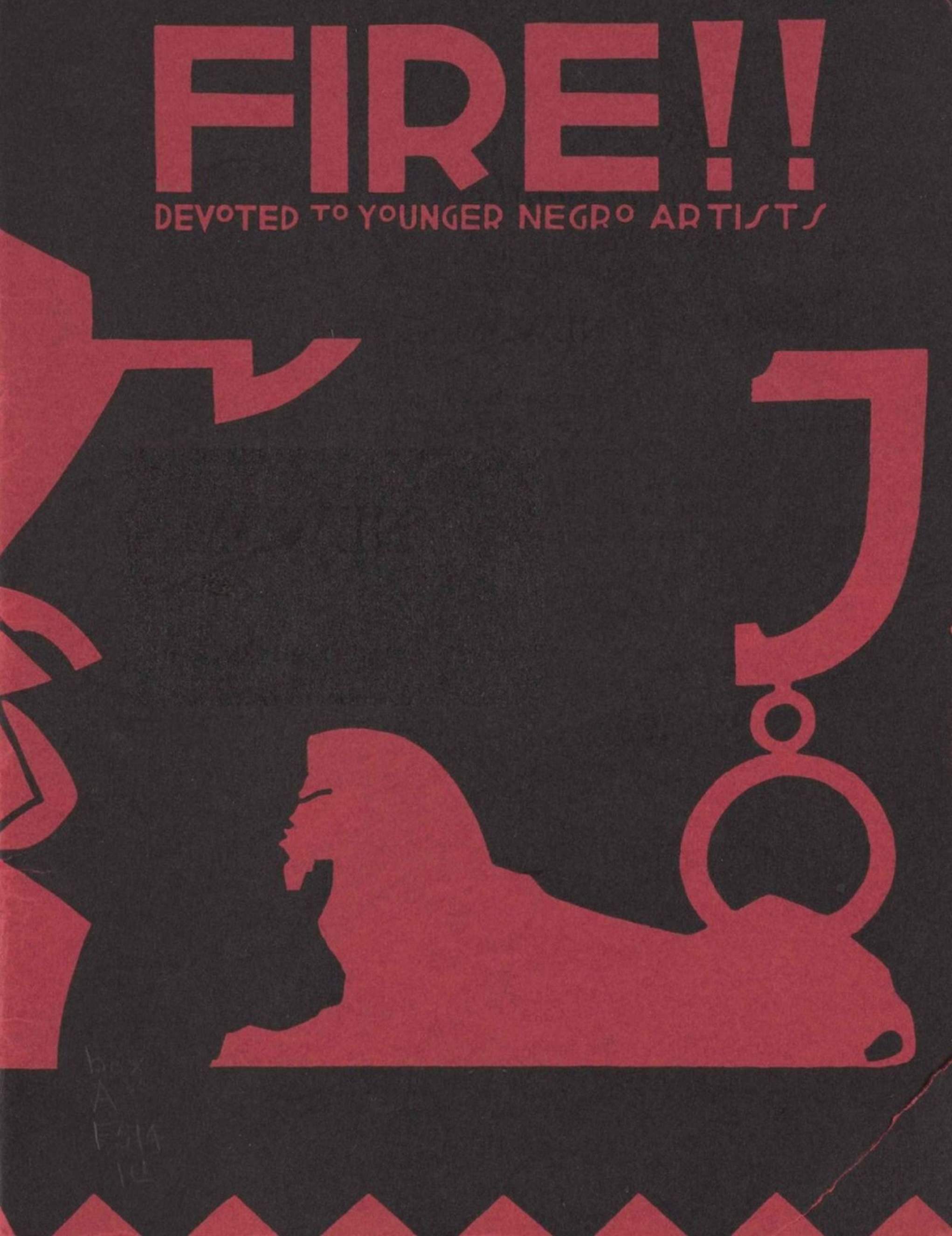
“FIRE … flaming, burning, searing, and penetrating far beneath the superficial items of the flesh to boil the sluggish blood.”
This is how the legendary magazine Fire!! begins. Some of the best and brightest African-American artists of the Harlem Renaissance created their stories, poems, plays, artwork, and essays to stir your blood. They didn’t want you to just read but also to feel their art!
The Harlem Renaissance was a rebirth of African-American culture that lasted mainly between 1920 and 1930. It began in Harlem, New York City, but it influenced Black artists in other places like Paris. It embraced every art form, from music to literature to art.
Fire!! was founded by many of the artists that were featured in its pages. They wanted to challenge the older ideas and give a place for new ones. These artists included poet Langston Hughes, novelist and playwright Zora Neale Hurston, novelist Wallace Thurman (also the editor), and poet Countee Cullen. The American painter Aaron Douglas created all of the artwork, including the cover above.
One of the poems by Hughes is “Elevator Boy,” which focuses on the reality of African-American employment at that time.
I got a job now Runnin’ an elevator In the Dennison Hotel in Jersey, Job aint no good though. No money around. Jobs are just chances Like everything else. Maybe a little luck now, Maybe not. Maybe a good job sometimes: Step out o’ the barrel, boy. Two new suits an’ A woman to sleep with. Maybe no luck for a long time. Only the elevators Goin’ up an’ down, Up an’ down, Or somebody else’s shoes To shine, Or greasy pots in a dirty kitchen. I been runnin’ this Elevator too long. Guess I’ll quit now.
Hurston shares a short play (“Color Struck”) and a story (“Sweat”). Both of these explore relationship dynamics. The play also looks at intra-racial bias within the African-American community.
Part of Fire!!‘s fame lies in the fact that there was only one issue. Sales for it were low, and reception was poor. Some found it offensive because a few pieces dealt with prostitution and homosexuality. Other people disliked the use of Black slang (found in Hurston’s contributions). Probably the final, and ironic, nail in the coffin for Fire!! was that its headquarters went up in flames. Perhaps the magazine was just too hot for the times.
We are lucky to have it.
This post was contributed by Carla Foust, a Distributed Proofreaders volunteer.
You may wonder why the free e-books that Distributed Proofreaders provides to Project Gutenberg are primarily older ones. That’s because they can make only public domain books available to the public. “Public domain” means that anyone can legally use the work for any purpose without having to get a copyright holder’s permission or to pay royalties. Karyn A. Temple, former United States Register of Copyrights, described the public domain as “part of copyright’s lifecycle, the next stage of life for that creative work. The public domain is an inherent and integral part of the copyright system. . . . It provides authors the inspiration and raw material to create something new.”
In the United States, copyright protection generally lasts for a period of 95 years for books published prior to 1978. This means that works published in 1927 and earlier are, as of this writing, automatically in the public domain. For works published in the United States before January 1, 1964, however, copyright renewal – a legal process that extends copyright protection for an additional 28 years – was required. Works published before that date whose copyrights were not renewed by the end of their 28th year entered the public domain.
As an example, if a work was published on December 1, 1963, a copyright extension could be granted to November 30, 1991. If the extension was not renewed, the work would enter the public domain on December 1, 1991.
There are a few exceptions to the copyright renewal requirement. For example, works published by the United States Government are not subject to copyright, so renewal is unnecessary. Additionally, works published by authors who died before the end of the 28th year from the work’s publication date are automatically renewed from the date of their death for 28 years, for the benefit of their heirs. And copyright renewal does not affect the automatic public domain status of works published more than 95 years ago.
For works published before January 1, 1964, but after the current 95-year public domain date, the Copyright Renewal summaries produced by Distributed Proofreaders and posted to Project Gutenberg can help determine whether a work’s copyright was not renewed, placing the work in the public domain. That enables Distributed Proofreaders and Project Gutenberg to make the work freely available to the public, like Margaret Sanger: An Autobiography, by Margaret Sanger, published in 1938, and All in the Day’s Work: An Autobiography, by Ida M. Tarbell, published in 1939, whose copyrights were not renewed.
Copyright renewal summaries have also proven valuable to other important cultural repositories. HathiTrust, a large nonprofit digital library, recently asked Distributed Proofreaders to prepare a series of artwork copyright renewals from 1965 to 1977. Their team started the process by providing an initial round of proofreading and were extremely grateful for Distributed Proofreaders’ help in preparing these renewal summaries for posting to Project Gutenberg. Among the lovely works that HathiTrust was able to release based on that renewal information are Four Seasons in Your Garden, by John C. Wister, illustrated by Natalie Harlan Davis (1938), and Flipper: A Sea-Lion, by Irma S. Black, illustrated by Glen Rounds (1940).
As with all copyright issues, there are complexities to copyright renewals. In order to make certain that a work is in the public domain, Project Gutenberg has established requirements for copyright clearances based on non-renewal, termed “Rule 6 clearances.” Volunteers seeking clearance under this rule must thoroughly research several things:
the author’s nationality, pen name, date of death if applicable, and other biographical information;
the date and location the work was first published and other details such as serialization, alternate titles, inclusion in collections, etc.;
whether and when there were any copyright renewals.
Complete information about this and all of Project Gutenberg’s copyright rules can be found on their Copyright How-To page.
All the U.S. copyright renewal volumes that Distributed Proofreaders volunteers have created, proofread, and posted to Project Gutenberg can be found here.
This post was contributed by Richard Tonsing, a Distributed Proofreaders volunteer.
This post celebrates the 46,000th unique title Distributed Proofreaders has posted to Project Gutenberg: the fifth and final volume of The English and Scottish Popular Ballads by Francis James Child. Congratulations and thanks to all the Distributed Proofreaders and Project Gutenberg volunteers who worked on these interesting and complex projects!
The 19th Century saw a great resurgence of interest in old English and Scottish folk songs. Fearing that these songs might be forgotten, a number of scholars, amateur and professional, sought to preserve them as best they could. Today we celebrate these efforts in our 46,000th title, the final volume of The English and Scottish Popular Ballads, a monumental five-volume study edited by Harvard professor Francis James Child, collectively known as the Child Ballads.
Published from 1882 to 1898, the Child Ballads are a fascinating collection of 305 traditional English and Scottish ballads that Child compiled along with their American variants. These ballads contain the roots of much of English-language folk music, and many have inspired and been recorded by modern folk artists.
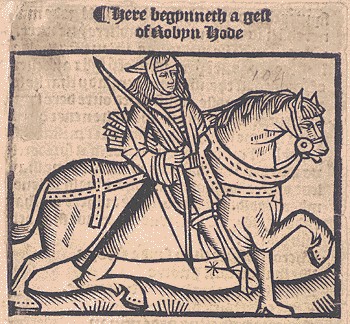
From a 16th-Century edition of A Gest of Robyn Hode (Child Ballad 117)
Child, being a specialist in English poetry, focused primarily on the lyrics of the ballads. But he did include, in the fifth volume, an index of published ballad music, along with an appendix containing the tunes of 55 of the ballads. (You can play these tunes as mp3 files in the HTML version of the e-book at Project Gutenberg.) Child also drew on the work of English musicologists, acknowledging his debt to the Reverend Sabine Baring-Gould, who famously compiled both the music and the lyrics of songs from Devon and Cornwall in Songs of the West.
Child’s scholarly work introduces and thoroughly annotates each ballad, closely examining textual variations in the various sources. Famous ballads include “Sir Patrick Spens” (Ballad 58, 18 versions) and “Bonny Barbara Allan” (Ballad 84, three versions). Several dozen of the ballads concern the adventures of the legendary Robin Hood.
Many Distributed Proofreaders volunteers have worked hard since 2007 on the varied challenges of the Child Ballad volumes. We are proud to celebrate the concluding volume of this important work as our 46,000th title posted to Project Gutenberg.
This post was contributed by Linda Cantoni, a Distributed Proofreaders volunteer.
“I’m sure I should be myself were I once among the heather on those hills.” — Cathy in Wuthering Heights
England’s Yorkshire moorland can be a wild, windy, and wet place, but in late summer it bursts into a breathtaking sea of the purple heather that Cathy yearned for as she lay dying and pining for Heathcliff. A fragrant evergreen, heather is the subject of an important and beautiful series of monographs, The Heathery, by early 19th-Century botanist H.C. Andrews. Thanks to the volunteers at Distributed Proofreaders and Project Gutenberg, all six volumes are now available to enjoy online.
Andrews was not just a botanist. He was also a talented artist who drew, colored, and engraved the illustrations for his works, and even published his books himself. The Heathery series, filled with his marvelously detailed color illustrations, was originally published between 1804 and 1812. It was so well regarded that a second edition, “corrected and enlarged,” was published in 1845; that is the edition at Project Gutenberg.
Several varieties of heather are native to the British Isles, the most common being ling or Scotch heather. But in The Heathery Andrews gives special attention to the many varieties in the genus Ericathat had recently been imported to Britain from the Cape of Good Hope in South Africa. Andrews mentions in his introduction to The Heathery that there were about 137 identified varieties. He notes, however, “This is certainly far short of the number at present cultivated in Britain; … we may fairly conjecture that the Genus is by no means bounded by the species we at present possess.” He was right: today there are over 850 identified species of Erica.
Andrews took a scientific approach in his monograph. Each description in The Heathery is presented in Latin and English. And, in his richly-colored illustrations, Andrews depicted not only the entire plant, but also its constituent parts, such as leaves and blossoms, in magnified form.
Distributed Proofreaders volunteers have contributed to Project Gutenberg several other botanical works written and illustrated by Andrews:
Coloured Engravings of Heaths, published in four volumes from 1794-1830. Volumes 2 through 4 are available at Project Gutenberg; Volume 1 is in progress at Distributed Proofreaders.
The Botanist’s Repository, a 10-volume work on “new and rare plants,” published from 1797-1812. Volumes 1 and 2 (combined in one volume) are available at Project Gutenberg; the remaining volumes are in progress at Distributed Proofreaders. Andrews’s father-in-law, John Kennedy, of the prominent Lee and Kennedy plant nursery, helped him with the descriptions of the plants.
A lovely monograph on Roses, published from 1805-1828.
Distributed Proofreaders and Project Gutenberg are proud to have preserved, for the free use of anyone anywhere, these exquisite works of botany.
This post was contributed by Linda Cantoni, a Distributed Proofreaders volunteer.
The Joachim Quartet, founded by violinist Joseph Joachim
Chamber music – sometimes called “the music of friends” – is one of the most intimate genres of classical music. In its ideal form, a handful of musicians – professional or amateur – play together in a private space for a small audience. There is no orchestra, no conductor, no soloist. In The Story of Chamber Music, you can read about its rich history and hear some of its music, thanks to the volunteers at Distributed Proofreaders and Project Gutenberg.
The author of The Story of Chamber Music, Nicholas Kilburn (1843-1923), was himself an amateur musician – his “day job” was running a locomotive repair company – with a music degree from the University of Cambridge. In his spare time, he was actively involved with a variety of British amateur musical groups as a conductor, pianist, organist, and cellist. Kilburn made a point of supporting the music of British composers, becoming a close friend of Edward Elgar. He was also an ardent disciple of Richard Wagner and wrote two books about his music.
Published in 1904, The Story of Chamber Music traces the origins of chamber music back to medieval times in Europe, when musicians entertained kings in private palace chambers. Noblemen took up the practice and used chamber music at their banquets “as a stimulus and a cover for conversation, a practice not even yet quite obsolete,” as Kilburn notes.
From these early times, Kilburn takes us to the 17th Century, when both private and public concerts of chamber music became popular entertainments. Two famous diarists of the era, Samuel Pepys and John Evelyn (both of whose diaries are available at Project Gutenberg), mention attending chamber concerts, with Pepys so transported by a wind ensemble that he “remained all night transported, so as I could not believe that ever any musique hath that real command over the soul of a man as this did upon me.”
Kilburn then shows how the musical giants of the Baroque, Classical, and Romantic Eras – Bach, Haydn, Handel, Mozart, Beethoven, Schubert, Mendelssohn, Schumann, Brahms, and others – further refined chamber music into the brilliant form we know today. The Story of Chamber Music was written at the tail-end of the Late Romantic Era, so Kilburn included studies of chamber music by later composers like Dvořák, Richard Strauss, and Bruckner. There is a chapter devoted to chamber music by Russian composers such as Glinka and Tchaikovsky. And he concludes with a chapter on contemporary chamber music, selecting for inclusion “[o]nly what is thought may prove acceptable and useful to earnest amateurs.” Kilburn speaks admiringly of the black composer Samuel Coleridge-Taylor and highlights the work of several other British composers.
The Story of Chamber Music contains over 75 music notation excerpts from string quartets and other chamber works. The e-book version at Project Gutenberg enhances the enjoyment of it by including audio files in MP3 format to accompany these excerpts. Distributed Proofreaders has a Music Team devoted to transcribing music notation and creating audio files using music software. Here, for example, is an excerpt from a Mozart string quartet, cited by Kilburn on page 67 and transcribed by a Distributed Proofreaders volunteer:
The e-book version also includes MusicXML files for the music excerpts – a standard open file format designed for sharing music notation. If you’re a musician, you can download MusicXML files into your favorite notation software for your own use.
Kilburn’s enthusiasm for chamber music is apparent on every page of his book. As he put it in his introduction:
[W]e may ask ourselves which of the great forms of musical composition we would plead for in case all the rest were doomed to destruction. Music for the orchestra, with its vivid colours, its strength and delicacy; the vast range of choral music; works for the organ, that huge modern plexus of pipe and reed;—these and others no doubt have strong claims on our musical affections. But, if forced to such a choice, it is certain that many a musician would, without hesitation, pledge himself to uphold the claims of Chamber music, for who can measure the almost infinite variety and charm which it affords, and that, too, with the slenderest means?
The Story of Chamber Music lets us read and listen to some of the “infinite variety and charm” of this lovely musical genre.
This post was contributed by Linda Cantoni, a Distributed Proofreaders volunteer.
On the rainy evening of December 21, 1908, Miss Marion Gilchrist, an elderly lady living in a flat in Glasgow, was found lying on her dining room floor with horrific blunt-force injuries. Blood was spattered all over the area where she lay and was soaked into the back leg of a nearby dining chair, the probable weapon. She had endured some 20 to 40 blows in a “furious … continuous assault” that smashed almost every bone in her face and skull.
Miss Gilchrist’s murder led to the arrest and conviction of an innocent man. But after nearly 20 years in prison, he was exonerated, thanks to Arthur Conan Doyle, creator of the greatest fictional detective in English literature, Sherlock Holmes. In The Case of Oscar Slater, he dissected the evidence, much as Holmes would have done, and his book ultimately led officials to review the case and free the man.
On the night of the murder, the family living in the flat below had heard a loud thud and three knocks coming from above – the knocks being a signal Miss Gilchrist had prearranged with the family in case she needed help. The head of the family, Arthur Adams, went up to see what had happened. He rang the bell, to no avail. Miss Gilchrist’s servant, Helen Lambie, who had gone out for about 10 minutes to buy the evening newspaper, arrived and unlocked the flat door. A “well-dressed” man came out of the spare bedroom, walked past Lambie and Adams without saying anything, went downstairs, and left the house. Lambie then discovered the dying Miss Gilchrist in the dining room.
Neither Lambie nor Adams recognized the man, and neither could give a definite description of him. Adams described him as “well-featured and clean-shaven.” Just before the discovery of the murder, Adams’s sister had seen a man loitering in front of the house. This man had “a long nose, with a most peculiar dip.” Another description, given a few days after the murder, came from 15-year-old Mary Barrowman, who claimed she had seen a man running down the steps of the house on the night of the murder. He had a “nose slightly turned to the right.” Neither Lambie nor Adams had mentioned any peculiarities in the nose of the man they saw.
The police thought the motive for the murder was robbery. Though she lived modestly, Miss Gilchrist collected fine jewelry. Some of it was found scattered around the spare bedroom, along with a broken wooden box and papers. A diamond brooch was missing.
The police put out a description of the suspect in the press. Then came a breakthrough. A member of a local gambling club reported to police that a fellow member, Oscar Slater, a German Jew with a “nose twisted to one side,” had attempted to sell a pawn ticket for a diamond brooch.
And so Oscar Slater’s nightmare began. On the flimsiest of evidence, he was arrested, tried, convicted, and sentenced to death. This created an outcry that led many prominent people to agitate for a review of the case. One of these was Conan Doyle.
Conan Doyle had already been devoting himself to righting real-life miscarriages of justice. In his 1924 memoir, Memories and Adventures, he noted, “The sad fact is that officialdom in England stands solid together, and that when you are forced to attack it you need not expect justice…” Thanks to him, a young Anglo-Indian lawyer named George Edalji, who had been wrongfully convicted of maiming livestock, was pardoned in 1907 after serving three years at hard labor. Conan Doyle’s efforts on Edalji’s behalf were in part responsible for the establishment that same year of England’s Court of Criminal Appeal.
Fresh from this success, Conan Doyle turned his attention to Oscar Slater’s case. There had already been some action on it: A petition sponsored by a Glasgow rabbi that garnered some 20,000 signatures, as well as a detailed brief (called a “memorial”) from Slater’s lawyers, prompted the government to stay the execution just two days before it was to take place in May 1909. In 1910, a volume of the Notable Scottish Trials series was devoted to Slater’s trial, edited by criminologist William Roughead, who became one of the greats of the true crime genre. Although Roughead couldn’t come right out and say there had been a miscarriage of justice – government officials had provided substantial information for his book, and he didn’t want to alienate them – he did hint at it.
Conan Doyle had no such strictures. Prompted by Roughead’s book, he wrote a 103-page pamphlet, The Case of Oscar Slater, published in 1912. In it, he tore the evidence to shreds with clarity and precision. He also appended the “memorial” of Slater’s lawyers.
First, Conan Doyle noted the curious behavior of the servant, Helen Lambie, at the scene. When Arthur Adams told her he had heard a loud noise, as if the “ceiling was like to crack,” she speculated that the clothesline pulley in the kitchen must have fallen down – not something likely to crack a ceiling. She expressed no surprise upon seeing a stranger emerge from one of the bedrooms, but let him pass without challenge. And instead of going to the dining room, where Miss Gilchrist had been sitting when Lambie left, she went first to the kitchen, ostensibly to check the pulley, and then to the spare bedroom. It was only after Adams asked where her mistress was that she went into the dining room and discovered the body.
Second, the descriptions of the suspect, though they generally fit Slater, were vague and inconsistent. In the end, Conan Doyle noted, the only points of similarity among them were that the suspect was clean-shaven, slim, and about 25-30 years old. Slater was 37 and had a mustache. Neither Adams nor Lambie, who had had the clearest view of him, had mentioned any peculiarity in his nose, though Slater did have a broken nose. And when they and Barrowman were brought in to identify Slater, they were first shown his photograph, and then saw him being led through a corridor by the police, casting grave doubt on the reliability of the formal identification. Even then, though the witnesses could say he resembled the man they had seen, they could not conclusively identify him.
Third, one of the most damning flaws in the evidence was that the diamond brooch that Slater had pawned was not Miss Gilchrist’s, but his own. And the police confirmed this very early in the case. This should have ended the matter immediately, as there was no other evidence connecting Slater to the crime.
But the police pursued it, in part because Slater had left for America right after the murder and had traveled under an assumed name. Slater, however, had been talking about the trip for some time, according to those who knew him, and he was traveling with a woman who was not his wife. His explanation that he used an alias (something he had done before in the course of his louche gambler’s life) to prevent his wife from finding out about his mistress was perfectly reasonable.
Conan Doyle meticulously went through many other inconsistencies and weaknesses in the evidence, including the lack of blood on the suspect’s clothes despite the very bloody scene. But the crown of his efforts was a potential defense theory that Slater’s attorneys never pursued: “One question which has to be asked was whether the assassin was after the jewels at all.” He pointed out that the suspect, in the very short time he had while Lambie was out, went to a spare bedroom, ignored several visible pieces of jewelry, and broke open a wooden box containing papers. How did he get in, if Lambie had locked the door as she claimed? What was he looking for, and how did he know where to find it? As Conan Doyle put it, “One is averse to throw out vague suspicions which may give pain to innocent people, and yet it is clear that there are lines of inquiry here which should be followed up, however negative the results.” He concluded that “it is on the conscience of the authorities, and in the last resort on that of the community that this verdict obtained under the circumstances which I have indicated, shall now be reconsidered.”
The Case of Oscar Slater was a best-seller, thanks to Conan Doyle’s fame and the low price of the pamphlet. But some critics were not impressed. The Times opined that his objections to the evidence “have probably been considered already, and with extreme care.” Another less circumspect newspaper referred to Slater as “a slimy blackguard of whom the community is well rid.” Nonetheless, Conan Doyle pressed on with his efforts to obtain a review of Slater’s case, spending his own money and supported by many people, including one of the original jurors. Slater languished in prison until 1927, when the original witnesses against him began retracting their testimony, and the government suddenly paroled him without public explanation. Upon Slater’s petition to the Secretary of State of Scotland, he was granted an appeal, thanks in no small part to the publicity Conan Doyle’s dogged efforts had garnered. On July 20, 1928, the verdict was quashed. Oscar Slater was truly free at last.
The postscript to this victory is a sorry one. The government awarded Slater £6,000 (just under half a million pounds in today’s money) as compensation. Conan Doyle asked him to remunerate those who had laid out money for his exoneration, including himself. Slater couldn’t understand why he should pay when they could apply to the government for reimbursement. The government refused to pay the costs, however, leaving Conan Doyle to threaten publicly to sue Slater. Slater ultimately sent him £250. And although the two men apparently never corresponded again, Slater was not bitter, and contributed to a memorial fund when Conan Doyle died in 1930. Slater retired quietly to a bungalow in Ayr, where he made a late and happy marriage to a young woman and tended his garden. He died peacefully in 1948.
Thanks to the volunteers at Distributed Proofreaders and Project Gutenberg, The Case of Oscar Slater, possibly Conan Doyle’s greatest work given the grave wrong that it helped to right, is now freely available to everyone.
This post was contributed by Linda Cantoni, a Distributed Proofreaders volunteer.
On February 9, 2023, Project Gutenberg posted its 70,000th title, Wakeman’s Handbook of Irish Antiquities (3rd ed.). Congratulations to all the Project Gutenberg and Distributed Proofreaders volunteers who made this milestone possible!
Knockmany Chamber, an ancient burial chamber in County Tyrone, Northern Ireland
In 1848, W.F. Wakeman, a young Irish draughtsman who had helped to map Ireland for the Ordnance Survey of Ireland, published a ground-breaking study of Irish archaeology, Archaeologia Hibernica. It featured numerous drawings he had made of the ancient buildings, monuments, and objects that he had come across in the course of his mapping work. The selling point of his book was that these archaeological wonders were “within easy access of Dublin.” He noted that a whole host of monuments, such as burial mounds, stone circles, cromlechs, and other artifacts, “lie within a journey of less than two hours from our metropolis.”
Sepulchral Chamber, Phoenix Park (Dublin)
In 1891, Wakeman published an updated edition of his handbook. He died in 1900, but his work remained in the forefront of Irish archaeology. John Cooke, a fellow of the Royal Society of Antiquarians of Ireland, took up the challenge of further updating Wakeman’s handbook, publishing a much expanded third edition in 1903 under the title Wakeman’s Handbook of Irish Antiquities, which is the edition now available at Project Gutenberg. Following Wakeman’s lead, Cooke’s edition uses decorative capitals at the start of each chapter that were taken from the famous Book of Kells. And it adds 60 illustrations to the already extensive list of Wakeman’s original drawings, for a total of 185. It even brings Wakeman’s work into the 20th Century by adding several photographs. (Cooke himself may have taken some of these photographs; he is best known today for his 1913 photographs of the slums of Dublin for a report on housing conditions among the poor.)
Many monuments omitted from the previous editions of Wakeman’s handbook are featured in Cooke’s edition, such as Knockmany Chamber, a photograph of which (above) is the frontispiece of that edition. Of course, archaeology continues to march on — that monument is now known as Knockmany Passage Tomb, and rather than dating from 500 B.C., as Cooke has it, it is now believed to date from about 3000 B.C. But Wakeman’s and Cooke’s patient groundwork in documenting these antiquities made further study possible, and, even more importantly, prevented them from being overlooked or even inadvertently destroyed by the unknowing.
The e-book version of Wakeman’s Handbook of Irish Antiquities is an outstanding example of the important books that the volunteers of Project Gutenberg and Distributed Proofreaders work hard to preserve and make freely available to the world. It is a fitting way to celebrate the milestone of Project Gutenberg’s 70,000th title.
This post was contributed by Linda Cantoni, a Distributed Proofreaders volunteer.
This post celebrates the 45,000th unique title Distributed Proofreaders has posted to Project Gutenberg: Down the Mackenzie and Up the Yukon in 1906. Congratulations and thanks to all the Distributed Proofreaders volunteers who worked on it!
Canada’s vast Northwest Territories province is comprised of nearly half a million square miles of land with a total population of only 41,970 as of the 2016 census. The harsh subarctic and polar climate has always made life difficult for humans, but that didn’t stop indigenous peoples from settling there, along with later incursions of Europeans in search of fur, gold, oil, and adventure.
In the summer of 1906, Elihu Stewart, the Canadian Chief Inspector of Timber and Forestry, embarked on a journey of thousands of miles on the Mackenzie and Yukon Rivers in order to assess the timber resources of the region. His report to the Canadian Government was published in 1913 as Down the Mackenzie and Up the Yukon in 1906. But it is no dry bureaucratic report. Stewart’s account vividly expresses his deep appreciation of the beauties of the landscape and his respect (from a white person’s point of view) for the indigenous and mixed peoples of the area. Part I of the book recounts his journey; Part II contains his observations of the natural resources and inhabitants of the region.
Travel in the region wasn’t easy in 1906, and Stewart – who was then over 60 years old – must have had a very hale constitution, not to mention courage, to undertake this journey. It began in Edmonton, Alberta, overland by a horse-drawn conveyance to the Athabasca River, where he boarded a steamer appropriately named Midnight Sun. The passengers included the noted explorer and ethnologist Vilhjalmur Stefansson, who spent the winter of 1906-07 living among the Inuit. Stewart and his fellow travelers journeyed on various steamers and scows hundreds of miles to the Great Slave Lake, the deepest lake in North America. This is the source of the thousand-mile-long Mackenzie River, which ultimately empties into the Arctic Ocean.
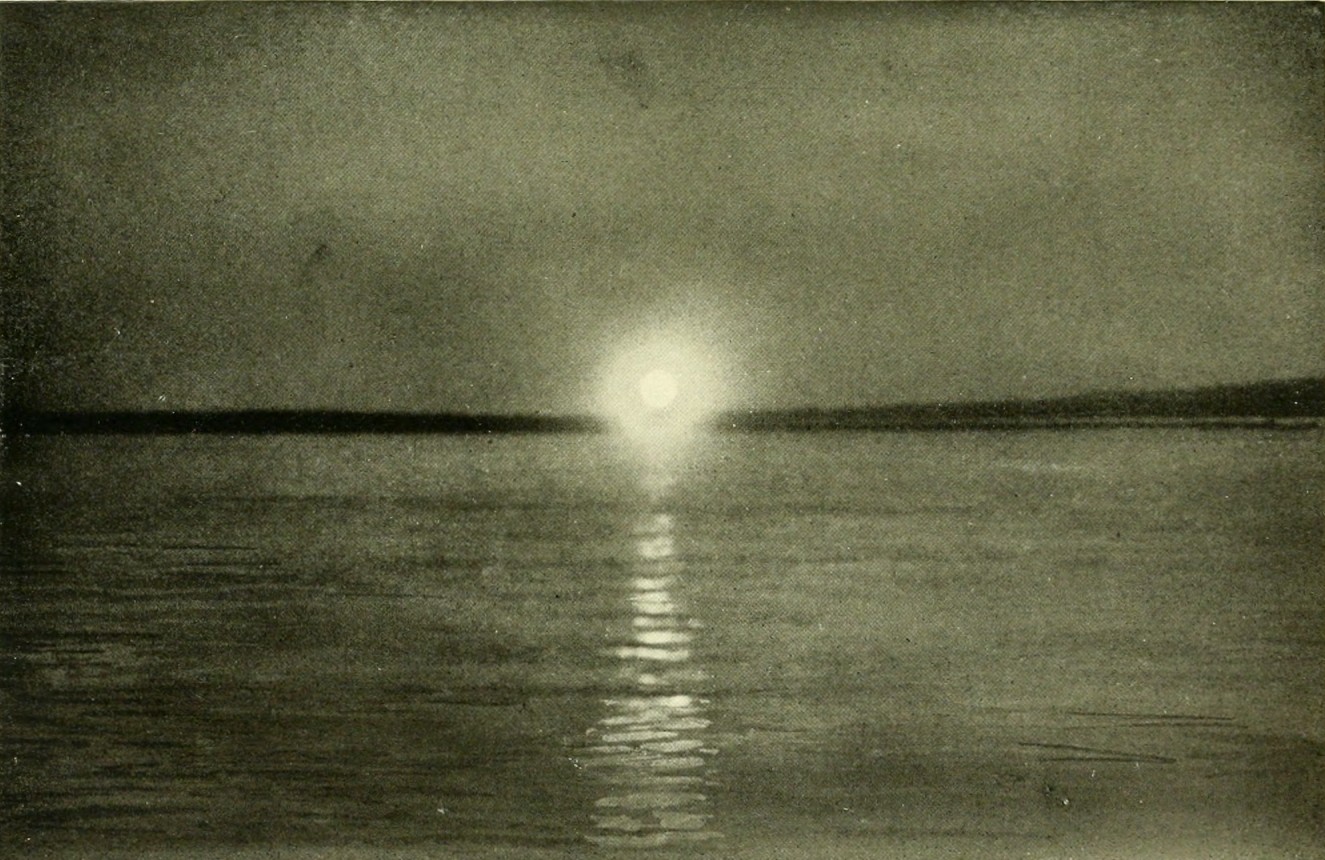
Photo of the midnight sun taken by Elihu Stewart at Point Separation on the Mackenzie River.
Stewart and the others continued north on the Mackenzie River to its delta and the tiny settlement of Arctic Red River (now known as Tsiigehtchic, still tiny today with a population of 138 as of 2021). There he found a rather desolate community:
“It certainly was the least desirable place for any civilised man to choose for a home, that I had yet seen in all this Northland. A few houses, the church and the graveyard were all crowded on the side of a hill rising abruptly from the river. Perpetual frost was found only a foot beneath the surface of the soil, and we no longer beheld the emblems of civilised life, the vegetable and flower gardens, that go so far to make many of those lonely posts seem somewhat cheerful.“
The travelers then turned west to Fort McPherson, from where Stewart intended to travel “alone” (but actually with several native assistants) by canoe. After an arduous journey of canoeing, portaging, and camping, they reached the Yukon Territory. On the way, he experienced a strange mirage of a great city, and was shocked to find instead a rather sad Indian encampment:
“I saw only about forty half-starved creatures out on the bank to welcome us, while behind among the trees were a dozen dilapidated tents; the entire surroundings indicating want and starvation, sickness and a struggle for existence known only to those who are condemned to live in this Arctic land.“
It was experiences like this that led Stewart to include in his book an impassioned plea for a centrally-located hospital, reachable by canoe from the various outposts of the Northwest Territories. He suggested Fort Simpson on the Mackenzie River, and indeed the Roman Catholic Church built a hospital there in 1916.
Stewart continued south on the Yukon River and gradually back to more “civilised” communities, such as the Klondike Gold Rush towns of Dawson City and Skagway, with their modern conveniences, entertainments, and colorful adventurers. He ended his journey at Vancouver, three months and 4,250 miles from where he started.
Elihu Stewart retired from his government job in 1907; he died at the age of 90 in 1935. During his tenure he initiated highly successful conservation programs under which millions of trees were planted and forest fire prevention measures were implemented all across Canada. Distributed Proofreaders is proud to celebrate its 45,000th title with this fascinating account of his extraordinary trip down the Mackenzie and up the Yukon.
This post was contributed by Linda Cantoni, a Distributed Proofreaders volunteer.
For want of a male heir to the throne of England, tens of thousands of people were murdered when Henry VIII, defying the Pope, divorced Catherine of Aragon to marry Anne Boleyn and declared himself head of the Church in England. Among the dead were, ironically, two diametrically opposed people: John Frith, a Protestant reformer who advocated religious toleration, and Thomas More, Henry’s Lord High Chancellor, a staunch Catholic who deplored Henry’s break with the Pope. A theological argument between Frith and More is laid out in A Boke Made by John Fryth, Prysoner in the Tower of London, written just before Frith was burned at the stake in 1533. Thanks to the volunteers at Distributed Proofreaders and Project Gutenberg, this important piece of Reformation history – a revised edition published in 1546 – is available with its original orthography intact.
Catherine of Aragon had failed to produce a son for Henry. He became infatuated with the young and beautiful Anne Boleyn and decided to make her his Queen in hopes that she would bear him a male heir. The sticking point was that divorce was impossible under Catholicism, then the official religion of England. In 1527, Henry asked the Pope to annul his marriage on the ground that Catherine was his brother’s widow, but the attempt failed. By 1531, Henry had had enough and began forcing the clergy to recognize him as the supreme head of the Church in England.
Despite Henry’s break with the Pope, persecution and execution of Protestant reformers in England continued. As Henry’s Lord High Chancellor, Thomas More was a vehement opponent of the Reformation and favored burning Protestants to root out heresy. More was also concerned that some of these “heretics” – like Frith – were rather well educated and well informed on religious doctrine, making them dangerous adversaries.
Frith, the son of an innkeeper, became acquainted with Protestant ideas while attending Cambridge University. In 1525 he had the honor of being invited to study at Cardinal Wolsey’s new Cardinal College (now Christ Church) at Oxford University. But the honor didn’t last long. In 1528, Frith and a number of other students were accused of possessing Protestant books and were imprisoned in the college’s fish cellar for six months. Four students died in the horrifying conditions, but Frith managed to survive. After his release, he fled to Antwerp.
While abroad, Frith wrote treatises criticizing the Pope and Catholic doctrines. Among them was a pamphlet, A christen sentence and true iudgement of the moste honorable sacrament of Christes body [and] bloude (available at Early English Books Online), outlining arguments against the Catholic concept of transubstantiation, i.e., the transformation of the Communion bread and wine into the actual body and blood of Christ. Frith unwisely returned to England in July 1532. Because England was still nominally a Catholic country in spite of Henry’s dispute with the Pope, Frith was arrested for heresy and imprisoned in the Tower of London.
Thomas More, meanwhile, had already resigned as Lord Chancellor in May 1532 because he could not in good conscience sign an oath recognizing Henry as head of the Church in England. But More remained concerned about the advance of the Protestant Reformation. After Frith’s arrest, More got hold of a copy of A christen sentence. Realizing that Frith’s theories on transubstantiation were buttressed by impressive scholarship, More wrote a Letter against Frith refuting Frith’s arguments (available as a PDF from Thomas More Studies). Frith, despite his imprisonment, managed to get a copy of More’s Letter and wrote A Boke Made by John Fryth to rebut More’s points.
Frith’s argument was essentially that the sacrament of Communion at the Mass was merely symbolic of Christ’s death. It could not be an actual transformation of the bread and wine into Christ’s body and blood, because it was impossible for a physical being to be in more than one place at once.
The rationality of this argument posed a problem for More, who was a lawyer, not a clergyman. But More shrewdly couched his own arguments in his Letter against Frith in terms that laymen could understand. And because Frith’s pamphlet was in English, More wrote his rebuttal in English, not Latin as a Catholic clergyman might. Both Frith and More understood that this would give them the widest possible audience in England. The essence of More’s argument was that Christ’s physical body can be in many places at once (multilocation) because God, being omnipotent, can make it so. What might seem unreasonable to a human would be perfectly reasonable to God, who in his almighty wisdom can make anything happen.
Frith did not accept this position. In his Boke, he did not deny God’s omnipotence. His first argument rested on science: “Christe had a naturall bodye, euen as myne ys (savynge synne) and that yt coulde no more be in two places at ones then myne can.” His second rested on the fundamental Scriptural concept of Christ as human, asserting that those who argue for transubstantiation “do take awaye the truthe of hys naturall bodye, and make it a very fantastycall bodye: from the which heresye God delyuer hys faythfull.” Thus Frith, accused of heresy, turned the tables on his opponents by calling them the heretics. He even suggested that they were cannibals, for they believed that “hys very fleshe is present to the teth of them that eate the Sacramēte, and that the wycked eate hys verye bodye.”
Frith’s Boke appends an account of his examination at trial, written while he was in Newgate Prison awaiting execution. Although he was questioned on several aspects of his theological beliefs, he baldly states that “The cause of my deathe is thys, because I can not in conscyence abiure and swere, that our Prelates opynyon of the Sacramente (that is) that the substaunce of breade ād wyne is verely chaunged into the fleshe and bloode of our sauyoure Iesus Christ is an vndoubted artycle of the faythe, necessarye to be beleued vnder payne of dampnacyon.”
While Frith languished in prison, the royal divorce crisis had rapidly come to a head. In 1533, Henry secretly married Anne Boleyn, got his new and compliant Archbishop of Canterbury to annul his marriage to Catherine, then had Anne crowned Queen Consort in June 1533. On July 9, 1533, the Pope excommunicated Henry. But it was too late for Frith, who had already been burned at Smithfield on July 4 at the age of 30. He was commemorated in John Foxe’s famous Fox’s Book of Martyrs.
Almost exactly two years after Frith’s execution, Thomas More himself became a martyr. As depicted in the play and film A Man for All Seasons, More once again refused to sign an oath denying the Pope’s supremacy. This time, Henry had him arrested and imprisoned in the Tower. Though given many chances to change his mind, More refused to do so. He was beheaded on July 6, 1535. Four centuries later, the Roman Catholic Church canonized him as a saint.
Frith closes his Boke with Christ’s advice to his Apostles: “Be wyse as Serpentes, and innocent as Dooues.” The full quote from the King James Version is, “Behold, I send you forth as sheep in the midst of wolves. Be ye therefore wise as serpents and harmless as doves” (Matt. 10:16). Frith became a sacrificial sheep, but he was certainly wise: His position on Communion was later officially adopted by the Church of England.
This post was contributed by Linda Cantoni, a Distributed Proofreaders volunteer.
Thanks to the volunteers at Distributed Proofreaders, the 1904 edition of A Classical Dictionary by John Lemprière is now available in the Project Gutenberg library. The complete title, A Classical Dictionary containing a copious account of all the proper names mentioned in ancient authors with tables of coins, weights, and measures used among the Greeks and Romans and a chronological table, shows just how comprehensive it is.
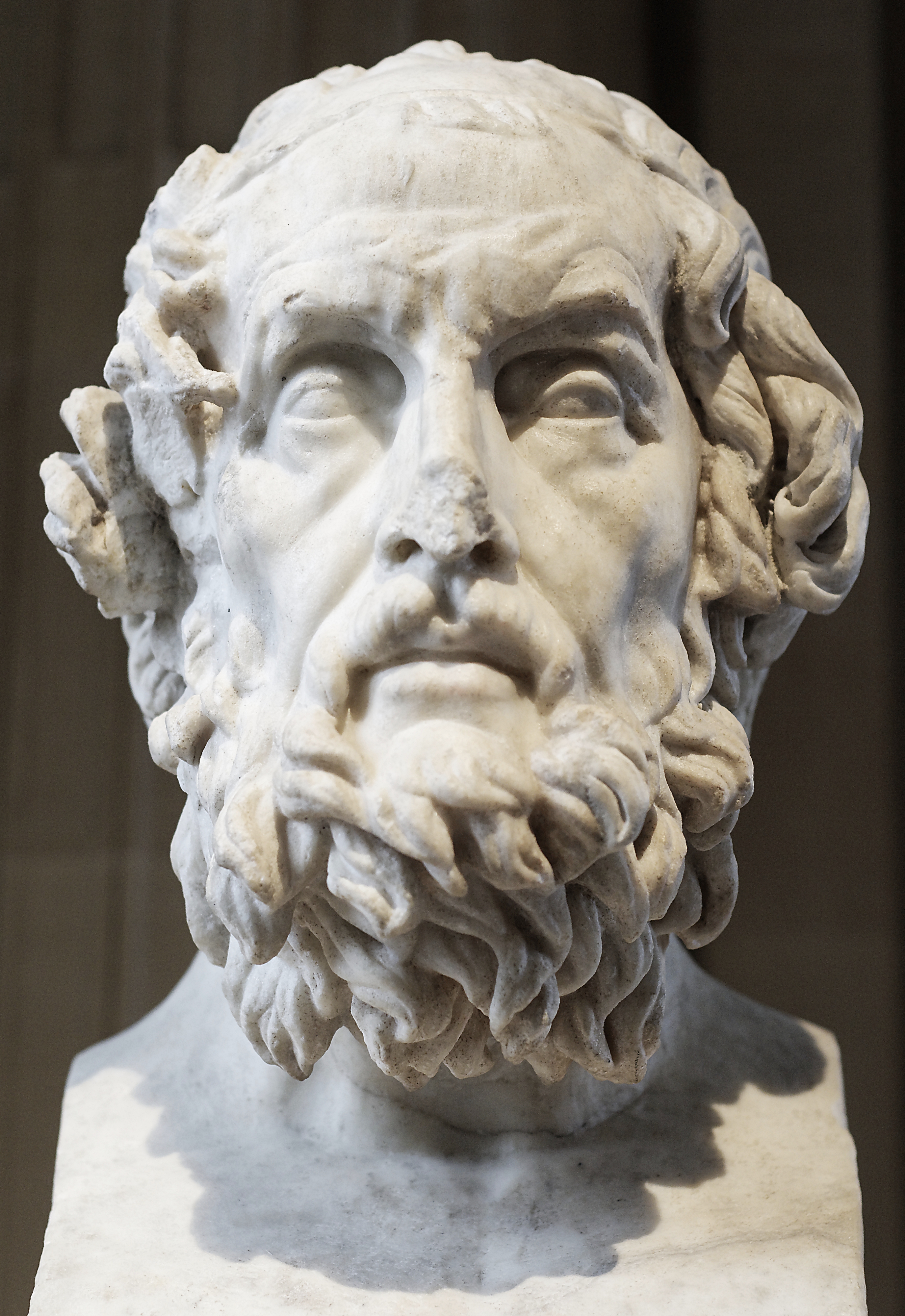
Bust of Homer (c. 1st Century A.D.), Musée du Louvre
Lemprière (1765-1824) began work on the Classical Dictionary in 1786 while a student at Pembroke College, Oxford, possibly inspired by the ground-breaking Dictionary of the English Language compiled by fellow Pembroke graduate Samuel Johnson. Lemprière published the completed work in 1788 under the title Bibliotheca Classica. For over 200 years, it has been an essential reference work, not just for teachers and students of the ancient Greek and Roman classics, but also for novelists, journalists, playwrights, and poets. John Keats – whose poetry is filled with classical allusions – is said to have known the book almost by heart.
The study of classical literature has long been considered a fundamental requirement to understanding the development of our modern Western culture. The lack of classical studies in recent years leaves many feeling inadequate to the reading or study of classical literature. A Classical Dictionary is the perfect companion for those who are interested in a self-study of classical authors like Homer, Aeschylus, Aristophanes, Euripides, or Sophocles. When I prepared the e-book version, with the bountiful help of fellow DP volunteer Stephen Rowland, I took the liberty of expanding most name and title abbreviations to their full commonly known names, and changed many Latin abbreviations for books, chapters, lines, etc., to their common English abbreviations, to improve ease of reading.
A Classical Dictionary identifies and explains the plethora of Greek and Roman deities with their alleged authority and powers and the myths surrounding them. Names of rivers, cities, and regions are identified, when possible, with 19th-Century names and descriptions.
With this dictionary, you can travel along with Jason and the Argonauts in the Argonauticaof Apollonius of Rhodes; learn how Helen of Troy’s abduction sparked the Trojan War in Homer’s Iliad; or follow Odysseus on his 10-year journey home after the Trojan War in Homer’s Odyssey. It will bring to life for you the Greek tragedies of King Agamemnon, Orestes, and others, or enable you to study the Roman histories by Julius Caesar, Josephus, Tacitus, and many more. Open your horizons now to these ancient works that have had such an impact on the development of today’s society.
This post was contributed by Rich Hulse (BookBuff), a Distributed Proofreaders volunteer who post-processed the e-book version of A Classical Dictionary.


 Posted by LCantoni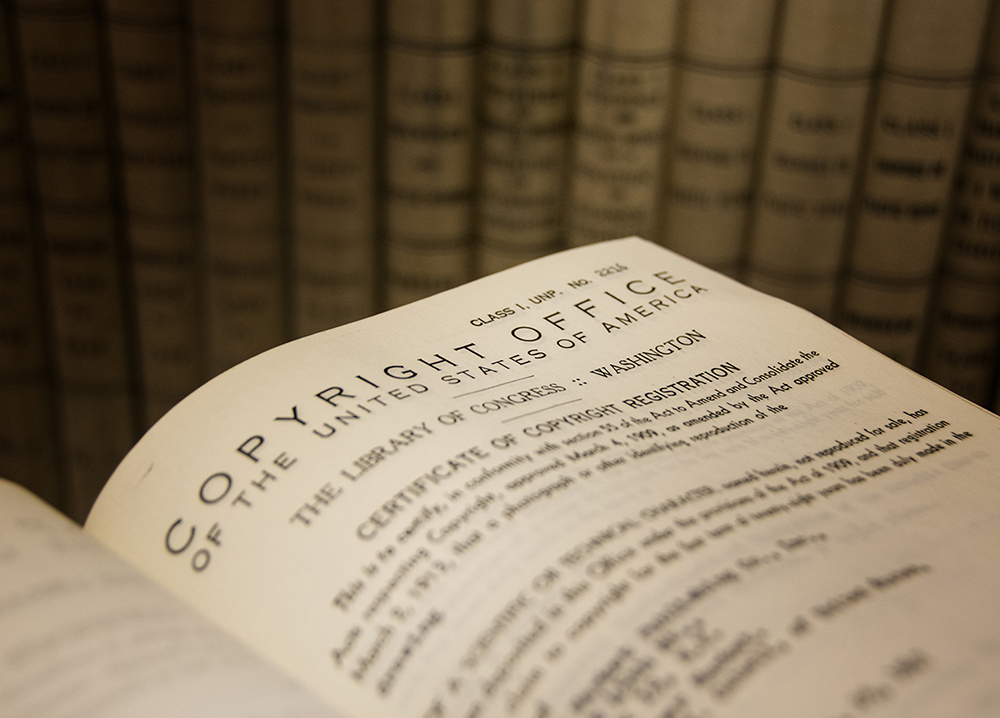






 Hot off the Press