Momotaro

October 20, 2010

Momotaro and retainers

In the same way that the classic fairy tale “Cinderella” has become part of Western culture, the fairy tale “Momotaro” has become ubiquitous in Japanese culture, with references to it cropping up in comic strips, movies, comedy shows, posters, anime, manga, advertisements, toys, and even government propaganda. There is even a Hello Kitty anime version of the tale available on DVD.

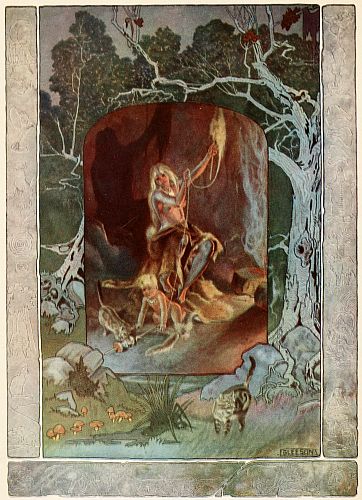
One illustrated telling of that story is Momotaro or Little Peachling, found in the Japanese Fairy Tale Series. This book tells the tale of an old couple that finds a peach, and from that peach pops up a little boy. They adopt him and he grows up strong and goes off to the island of the devils to take their riches. Joining him are three animals:

Then first a dog came to the side of the way and said; “Momotaro! What have you there hanging at your belt?” He replied: “I have some of the very best Japanese millet dumplings.” “Give me one and I will go with you,” said the dog. So Momotaro took a dumpling out of his pouch and gave it to the dog. Then a monkey came and got one the same way. A pheasant also came flying and said: “Give me a dumpling too, and I will go I along with you.” So all three went along with him.

There is a battle with a great multitude of the devil’s retainers, and then with the chief of the devils, called Akandoji. At the end Momotaro triumphs and returns to his adopted parents. There is a happy ending for everyone, except for the devils.

I had heard about the story for decades. This was the first time that I actually read it. Reading it as an adult, I had qualms about the legality of Momotaro’s actions. But then children don’t normally concern themselves with the property rights of devils.


Taxing the American Colonies

October 16, 2010

One of the follies listed in Barbara Tuchman’s The March of Folly: From Troy to Vietnam is “The British Lose America.” A major reason for this “folly” was the attempt to shift to the American colonies the burden of the high debts resulting from a recent war with France.

While, in hindsight, that attempt was “folly”; at the time, some thought it seemed like a good idea. That is shown in the political tract The Justice and Necessity of Taxing the American Colonies, Demonstrated Together with a Vindication of the Authority of Parliament, printed for J. Almon in London in 1766.

Americans are called insolent, undutiful, and disobedient. Addressing the colonies, the author states:

But let me tell thee that the money raised by the stamp act, being all necessary for paying the troops within thy own territories, must center wholly in thyself, and therefore cannot possibly drain thee of thy bullion.

It is true, this act will hinder thee from sucking out the blood of thy mother, and gorging thyself with the fruit of her labour. But at this thou oughtest not to repine, as experience assures us that the most certain method of rendering a body politick, as well as natural, wholesome and long-lived, is to preserve a due equilibrium between its different members; not to allow any part to rob another of its nourishment, but, when there is any danger, any probability of such a catastrophe, to make an immediate revulsion, for fear of an unnatural superfetation, or of the absolute ruin and destruction of the whole.

All countries, unaccustomed to taxes, are at first violently prepossessed against them, though the price, which they give for their liberty: like an ox untamed to the yoke, they show, at first, a very stubborn neck, but by degrees become docile, and yield a willing obedience. Scotland was very much averse to the tax on malt; but she is so far from being ruined by it, that it has only taught her to double her industry, and to supply, by labour, what she was obliged to give up to the necessities of the state. Can America be said to be poorer, to be more scanty of money than Scotland? No. What then follows? America must be taxed.

As to the claim by the Americans that they are not represented in parliament:

True; you are not; no more is one twentieth of the British nation; but they may, when they become freeholders, or burgesses: so may you; therefore complain not; for it is impossible to render any human institution absolutely perfect. Were the English animated by your spirit, they would overturn the constitution to-morrow.

Think of this as 18th century spin-doctoring. All in all, it was a good read. The book provides an interesting glimpse into that era.


Calculus Made Easy

October 13, 2010

The mathematical study of rates of change and total change, also known as “the differential and integral calculus”, has frightened generations of students. Ironically, this scholastic trauma is often unnecessary: Many formal rules of calculus are nearly trivial to carry out. The mathematical difficulties lie in understanding and using the rigorous logical framework of the calculus—what mathematicians nowadays term “elementary real analysis”—and in establishing the correctness of the formal manipulations and their connections with mathematical interpretations.

Sylvanus Phillips Thompson’s “Calculus Made Easy” gives cogent yet entertaining and irreverent explanations of these easy calculational rules. Justifications are conceptual, but beneficially simplified and intuitive. Popularized and later updated by the recreational mathematics author Martin Gardner, “Calculus Made Easy” has remained a widely-read introductory text for the past century.

With the appearance of Project Gutenberg’s public domain version on July 28, 2010, the second British edition of this classic, originally published in 1914, is freely available over the Internet. In its first weeks, the book has proved wildly popular for a mathematics text.

Thompson’s choice of material is both varied and selective. Most topics will be familiar to the modern student: Differentials as minute quantities; derivatives as relative rates of change; rules for differentiating sums, products, quotients, and compositions of functions; the geometric meaning of the first and second derivatives; finding maxima and minima; the natural exponential and logarithm functions; circular trig functions; partial derivatives; integration and antidifferentiation; the fundamental theorems; integration by parts, and by partial fractions; elementary differential equations, including exact first-order equations and d’Alembert’s solution of the one-dimensional wave equation.

If you’ve had unpleasant experiences with calculus, if your knowledge has grown rusty, or if you’ve simply never encountered this powerful and intriguing branch of mathematics, Thompson’s gem of a textbook should prove a pleasant, thought-provoking, and ultimately rewarding read.

This review was contributed by DP-volunteer adhere.


Come Out of the Kitchen

October 9, 2010

One of the joys of proofreading for Distributing Proofreaders is finding a book that keeps you proofreading beyond your daily goal because you want to find out what happens next. Come Out of the Kitchen by Alice Duer Miller was one such book. Even more fun was post-processing the book later on because then I got to read the whole book and I got to see the illustrations and photos that were missing during the proofreading phase.


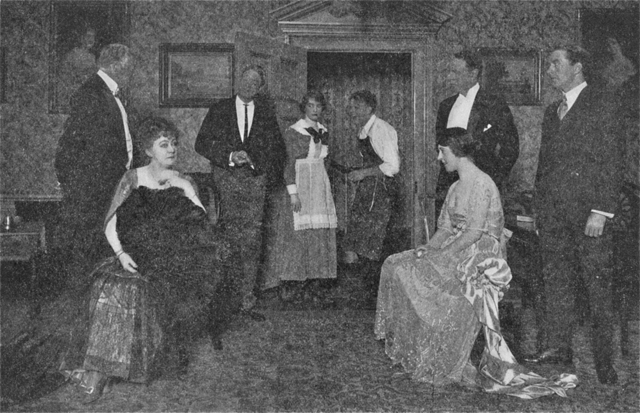
Scene from Act I of the 1916 play


Apparently, this story first appeared in Harper’s Bazar in 1915. It was then made into a comedy by A. E. Thomas that became a hit on Broadway, opening on October 1916 at the Cohan Theatre and playing for 224 performances. The play starred Ruth Chatterton, who twenty years later played the selfish wife in William Wyler’s classic film Dodsworth.

The novel was published in 1916, with photos from the play and illustrations. Later, there was also a film version of Come Out of the Kitchen in 1919, and a 1925 musical called The Magnolia Lady (47 performances) with Ruth Chatterton and her newly-aquired husband (Ralph Forbes).

The story is of a rich young man from the North who rents a Revelly Hall in the South. One condition that he made in renting the mansion was that servants be provided. The servants that came with the house included “an excellent cook, a good butler, a rather inefficient housemaid, and a dangerous extra boy,” none of whom were what they appeared to be, as shown in this segment early in the book:

On her the eyes of her future employer had already been fixed since the door first opened, and it would be hardly possible to exaggerate the effect produced by her appearance. She might have stepped from a Mid-Victorian Keepsake, or Book of Beauty. She should have worn eternally a crinoline and a wreath of flowers; her soft gray-blue eyes, her little bowed mouth, her slim throat, should have been the subject of a perpetual steel engraving. She was small, and light of bone, and her hands, crossed upon her check apron (for she was in her working dress), were so little and soft that they seemed hardly capable of lifting a pot or kettle.

Mrs. Falkener expressed the general sentiment exactly when she gasped:

“And you are the cook?”

The cook, whose eyes had been decorously fixed upon the floor, now raised them, and sweeping one rapid glance across both her employer and the speaker, whispered discreetly:

“Yes, ma’am.”

“What is your name?”

And at this question a curious thing happened. The butler and Reed answered simultaneously. Only, the butler said “Jane,” and Reed, with equal conviction, said “Ellen.”

Ignoring this seeming contradiction, the cook fixed her dove-like glance on Mrs. Falkener and answered:

“My name is Jane-Ellen, ma’am.”

Add to this mix: an amorous real estate man, a lecherous lawyer (who wanted to get the cook fired so she would work for him), Mrs. Falkener (who wanted the cook fired because she was too beautiful to have around the man she wanted as a son-in-law), at least one hat, and a cat. The result was a nice, fun read.

In Pursuit of Poetry

October 8, 2010

Whenever I explain what Project Gutenberg is, one question that frequently arises is, “How do they decide which books to publish?” The easy answer, of course, is that we’ll prepare any public domain text that we can get our un-grubby, white-gloved archival hands on.  Like most easy answers, though, it doesn’t hold up well to closer scrutiny. If all of us content providers really spent our time chasing every book we came across, we’d never finish any one of them. So what really happens is that we find our niche. We choose an era; we choose a language; we choose an earthly (or otherwise!) region. Or, we choose a genre–some broad topic or style that falls just a little nearer and dearer.

I should confess up front. The majority of my content providing is done to finish up existing, but incomplete projects–lost illustrations, torn pages, that sort of thing. I call it entropy control. I also enjoy helping to proofread books that are slated to be published for Project Gutenberg. A few weeks ago, it happened, I was spending some time on a volume called The London Mercury–a kind of catch-all for literary reviews, much like the New York Time’s bestseller list of today. This is a fun kind of project to work on because it offers short articles that are easy to follow and finish, even if I only have a few minutes to spare for proofreading that day. And naturally, the works that are reviewed are almost universally qualified as potential Gutenberg works, too. I try to keep an eye open for works that look interesting to me, but most of the biographies, natural histories, and public policy reports just slide right by me. However, one review stood out.

More Translations from the Chinese, by Arthur Waley, received a glowing review for its “[skillfully] handled unrhymed verse,” and “rhythm and flow of sound…amazing in translations.” Several excerpts were included–eloquent, unadorned blank verse. I’ve always enjoyed the misleading simplicity of Japanese haiku, and these excerpts quickly captivated me. So naturally, I searched for More Translations on Project Gutenberg. And I found it.

The full volume does not disappoint. Beyond the limitations of a half-page review, Waley’s chosen poems really shine. “The Great Summons,” by Ch‘ü Yüan, was described by the Mercury’s review as “[t]he finest thing in the book.” According to the book’s notes, it was written by Ch‘ü during his nine-year exile from the Court, as a cry against his own depression. Being separated from his beloved homeland, Ch‘ü called to his soul to “come back again and go not east or west, or north or south!” He tells of the terrors, the “treacherous voids” that lie beyond the borders, tempting his soul back with beguiling lures of favorite foods, wine, song, and service to his king. Each new stanza unveils a happiness that is only found at home; it’s enough to lure anyone’s soul back time and again.

Shorter poems are not as layered, but instead evoke the quiet moods of the scenes described:

I sat drinking and did not notice the dusk,
Till falling petals filled the folds of my dress.
Drunken I rose and walked to the moonlit stream;
The birds were gone, and men also few.
“Self-Abandonment,” by Li Po

Having read that and others like it, I see why so many great artists of ancient Asia seem to incorporate such writings right into their paintings and woodcuts (such as Green Hills and White Clouds, by Gao Kogong). The poems themselves bring pictures to mind, and some of them simply cry out to be represented in pigment or fiber. Spanning from the eleventh century back to the fourth century B.C., the eight poets represented address timeless subjects that still capture the human condition. I was repeatedly reminded of Robert Frost’s poems–natural, evocative, and just a hint of humor to balance out the lyric pace and occasionally melancholy subject. Not coincidentally, Po Chu-I’s “Going alone to spend a night at the Hsien-Yu Temple” is a dead ringer for “Stopping by the woods on a snowy evening,” but older by over a millennium.

I now have More Translations from the Chinese permanently bookmarked in my browser, and drift back to it whenever I’m seeking a contemplative moment. Even the ebook number, #16500, has a nice round completeness to it. But this volume is simply More Translations, which implies that another volume came before. The London Mercury is kind enough to shed some light on this: “The new collection should not be missed by anyone who has the old one; those who have not should get the old one…which, on the whole, covers better poems.” As it happens, one of my local libraries has a copy of 170 Chinese Poems, by Arthur Waley, so as soon as I have the chance, I’ll borrow it and begin preparing it for Project Gutenberg. After all, I’m a content provider. It’s what I do.


Thérèse de Dillmont: Encyclopedia of Needlework

October 7, 2010

In our age of industrial production a lot of things that were common knowledge as recent as a century ago are being forgotten. The people who knew how to do things and could have taught them to a future generation are mostly gone, so alternative ways of preserving knowledge are getting more and more important. The Crafts Bookshelf at Project Gutenberg is one such alternative way, containing how-to books for a lot of different crafts written at a time when the knowledge described was still widely in use.

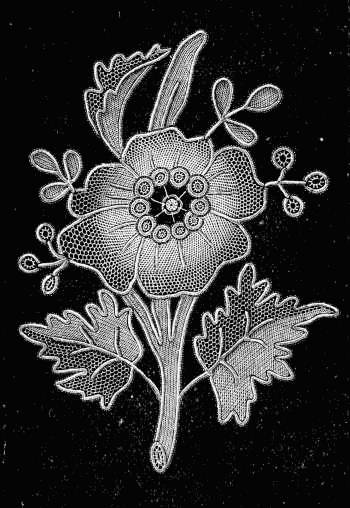
Spray in Needle-Point Lace

Spray in Needle-Point Lace

Because I’m interested in all kinds of needlework, Thérèse de Dillmont’s Encyclopedia of Needlework is a very special book for me. True to its title, this really is an encyclopedia, describing all the different kinds of needlework a woman at the end of the 19th century might need or want to do. Naturally the common kinds of needlework are covered extensively, like sewing, embroidery, knitting and crochet. But for me the real strength of this book lies in the crafts that are all but gone from common knowledge by now, like gold embroidery and the different kinds of needlepoint laces. When looking through this book I always get itching fingers wanting to try out different things, and more often than not have a problem because the materials needed have all but vanished, too.

Lots of illustrations explain the different techniques, and pictures of finished projects provide inspiration on what can be done. Having this book available in electronic form is a huge help for anybody who’s interested in keeping these crafts alive.


Principles of Orchestration, by Nikolay Rimsky-Korsakov

October 6, 2010

In 1905, Nikolay Rimsky-Korsakov (1844-1908) was a prominent Russian composer and a professor at the St. Petersburg Conservatory. When the 1905 Russian Revolution brought student demonstrations to the Conservatory, Rimsky-Korsakov was assigned to a committee charged with quelling the unrest. Instead, he sided with the students, declaring that they had the right to demonstrate. As a result, he was fired, and performances of his works were banned. But such was his reputation as a composer that the ban received national press attention, and a national outcry ensued. The ban was soon lifted, and Rimsky-Korsakov got his professorship back. He retired the following year, and died in 1908, before he could complete his masterpiece of musicology, Principles of Orchestration.

Rimsky-Korsakov is probably best known today for his magical Scheherazade suite, but his output included 15 operas and numerous other orchestral works. Incredibly, Rimsky-Korsakov had relatively little formal training in music. While preparing for a career in the Imperial Russian Navy, he took piano lessons, which he disliked, but his teacher recognized Rimsky-Korsakov’s musical talent and urged him to learn composition. Rimsky-Korsakov was entranced. By the time he was 27, he was a professor of composition and orchestration at the Conservatory — a part-time job, as he was still on active duty with the navy.

Rimsky-Korsakov’s years of teaching and practicing orchestral composition — as well as his membership in “The Five” (with fellow composers Moussorgsky, Borodin, Balakirev, and Cui) — gave him a keen sense of the power of orchestration. He became a master of color, texture, and mood, even though he knew little about music theory. He continued to teach himself as he went along, and ultimately his experience as a teacher made him, as he put it, the Conservatory’s best pupil. His desire to share what he had learned led him to begin writing Principles of Orchestration in 1873.

At his death 35 years later, it was still incomplete. At times, his attention was focused on composition, health problems, and family tragedies, and he laid the draft aside. Other times, he had crises of confidence, believing that the subject was too massive for him to treat successfully. Luckily, he left copious drafts and notes, and his protégé and son-in-law, Maximilian Steinberg, was able to cobble them together into an invaluable treatise, first published in English in 1922, that remains an essential reference for composers and orchestrators.

The main text in Volume I is relatively brief — just 152 pages in the English translation, with demonstrative music snippets throughout — but Volume II contains over 300 orchestral examples drawn from a wide variety of Rimsky-Korsakov’s works. These beautifully demonstrate his fundamental belief that “good orchestration means proper handling of parts.” He advocated simplicity in scoring for individual instruments, which, when artfully combined, would result in “brilliance and imaginative quality in orchestral tone coloring.”

The version of Principles of Orchestration that we produced at DP tries to bring that quality to life with mp3 sound files linked to the orchestral examples. These were transcribed by hand with music notation software that employs actual instrument sounds. While no computer-produced sound can ever replace the warmth of actual human performance, it is hoped that these sound files will give the reader at least a glimpse into Rimsky-Korsakov’s own brilliance and imagination.

This post was contributed by Linda Cantoni, a Distributed Proofreaders volunteer.


The Just So Stories, by Rudyard Kipling. Illustrated by Joseph M. Gleeson

October 5, 2010

Kipling has always been a favourite with young and old alike. To me, none of the other works that flowed from his enchanted pen were quite as magical as the “Just so Stories”.

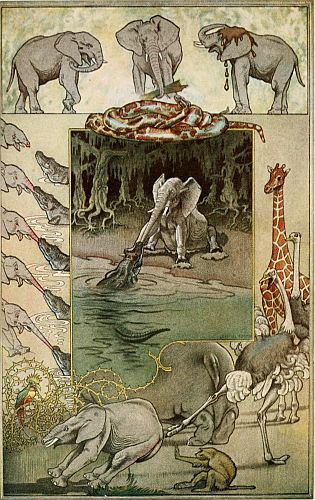
I hope I won’t give too much away if I mention just a few of them here. What do you do if you get swallowed by a hungry whale that’s eaten all the fish in the sea? You read the first story. If you read the third story you’d know not to make a Parsee angry. Don’t read the ninth story before the eighth Best Beloved … or it will never make sense. Dog people and Cat people and Horse people alike will enjoy the ‘leventh story. My own favourite story of them all is the story about the Elephant’s child that was ever so curious and ended up with a very long nose (and much spanking) because of all that curiousness.

Each story is sprinkled with words that were half borrowed from the native tongues of the story’s origin and stretched with just a little imagination to make them new and interesting.

The author’s constant lament throughout the book that he was not “allowed” to add any colour to the beautiful illustrations, has been remedied in the latest DP edition of this lovely classic. While the classic text is beautiful all by itself, Mr. Gleeson’s colour illustrations breathe life and joy into this edition that makes it even more enchanting than ever before.

I loved every second of this read, each time I read it again, I love it more.


An Introduction to Astronomy

October 3, 2010

Volunteers at Distributed Proofreaders dedicate their efforts to “Preserving history one page at a time.” On rare occasions while working on a text, one encounters a sudden, remarkable, almost palpable connection to the author’s era.

On June 8, 2004, the sun, Venus, and the earth lined up for a few brief hours. Venus, looking like a perfectly round but otherwise undistinguished sunspot, passed across the face of the sun. Such planetary syzygies, results of the clockwork motion of the inner planets, can be predicted with great accuracy, and for centuries into the future.

In his 1916 book “An Introduction to Astronomy”, published by Project Gutenberg on April 24, 2010, the American mathematician and astronomer Forest Ray Moulton wrote,

The transits of Venus, which occur in June and December, are even more infrequent than those of Mercury. The transits of Venus occur in cycles whose intervals are, starting with a June transit, 8, 105.5, 8, and 112.5 years. The last two transits of Venus occurred on December 8, 1874, and on December 6, 1882. The next two will occur on June 8, 2004, and on June 5, 2012.

If Moulton’s book were to be updated a couple of years hence, the same passage would read:

The last two transits of Venus occurred on June 8, 2004, and on June 5–6, 2012. The next two will occur on December 10-11, 2117, and on December 8, 2125.

Almost a century ago, Moulton’s words must have borne the same force of prognostication, confidently predicting events no contemporaneous reader would be alive to witness. To the retrospect of a modern reader, Moulton’s words bridge the decades–and intervening scientific and technological revolutions–from Moulton’s era to our own.

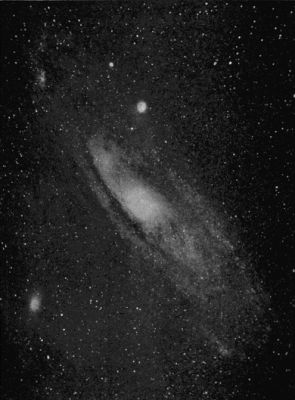
Today, “An Introduction to Astronomy” is an engagingly readable textbook of elementary astronomy, full of current information on geography, motions of the earth and moon, and star maps; incomplete but largely accurate data on the planets and their larger satellites; and poignantly naive descriptions of the “spiral nebulae”, now known to be galaxies in their own right–as numerous as the stars in our own galaxy and inconceivably remote. Pluto had not been discovered, so ironically Moulton’s planetary count, eight, agrees with the modern one.

In these days of interplanetary probes, space-based telescopes, digital data acquisition, and computer-enhanced images, it is easy to forget how recently astronomers’ knowledge was constrained by the limitations of ground-based, visible-light instruments–refracting and reflecting telescopes–and yet how detailed was their knowledge of the solar system and the cosmos beyond. Moulton’s “An Introduction to Astronomy” is a look back to the cosmology of the early 20th Century: Not a dead history, but a book of living information, and a thread of human connection to the science of decades past.

This review was contributed by DP-volunteer adhere.


The Journal of Sir Walter Scott, from the original manuscript at Abbotsford

October 2, 2010

Sir Walter Scott starts his journal with the words, “I have all my life regretted that I did not keep a regular Journal. I have myself lost recollection of much that was interesting, and I have deprived my family and the public of some curious information, by not carrying this resolution into effect.”

Fortunately, in November 1825, at the age of 54, Scott did start keeping a regular journal that, with only occasional breaks, he maintained until his death in 1832. The Journal was eventually published in 1890.

The Journal covers what is probably the most troublesome period of Scott’s life, including his near bankruptcy, the illness and death of his wife and then his own illness and death. Yet, through it all, his affection for his family and friends and his determination to work to clear his debts shine through, as the following entry from 1826 clearly shows:

[Abbotsford, Saturday,] June 17.—Left Edinburgh to-day after Parliament House to come [here]. My two girls met me at Torsonce, which was a pleasant surprise, and we returned in the sociable all together. Found everything right and well at Abbotsford under the new regime. I again took possession of the family bedroom and my widowed couch. This was a sore trial, but it was necessary not to blink such a resolution. Indeed, I do not like to have it thought that there is any way in which I can be beaten.

For all the doom and gloom of Scott’s circumstances, his sense of humour is often present in the entries:

Walked to Huntly Burn, where I found a certain lady on a visit—so youthy, so beautiful, so strong in voice—with sense and learning—above all, so fond of good conversation, that, in compassion to my eyes, ears, and understanding, I bolted in the middle of a tremendous shower of rain, and rather chose to be wet to the skin than to be bethumped with words at that rate. There seemed more than I of the same opinion, for Col. Ferguson chose the ducking rather than the conversation.

As a member of both the Scottish literary and legal establishments of his time, Scott’s Journal is also interesting for its references to many of the famous names of the age: Byron, Moore, the Duke of Wellington, Lockhart, Sheridan and many more.

Reading Scott’s Journal leaves you with a wonderful impression of his character, fortitude and humour and his genuine affection for the Scottish society on which he based so much of his writing. And, in the end, you cannot help but be impressed by a man who, having lost one fortune, managed to earn in the last 7 years of his life a second one sufficient to leave his estate free and clear of debts solely from his writings.

The Journal was the 6,000th book posted to Project Gutenberg by Distributed Proofreaders, back in February 2005.