Uncle Sam’s Place and Prospects (1899)

February 15, 2011

In Barbara Tuchman’s The Proud Tower, there is a chapter (“End of a Dream”) about America’s decision to become a colonial power. At the time, we had just won the Spanish-American war and there was a major political conflict between those that believed that America was destined to become an imperial power (the pro-imperialism forces) and those that believed that becoming an imperial power would destroy America’s principals of self-government and isolation (the anti-imperialism forces). The pro-imperialism forces won.

The political paper “Outlook: Uncle Sam’s Place and Prospects in International Politics” gives a feel for the nature of that political conflict. That paper was read by Newton MacMillan before The Fortnightly Club (Oswego, N. Y.) on May 2, 1899.

In that paper, Mr. MacMillan argued for colonization of the Philippines, in part, because it was needed to protect our interests in capturing the Chinese market. He cited statistics about the value of our exports to China and talked of conspiracies of other foreign powers to shut us out of that market.

But how long is this to continue? With our experience of tariffs we need not be reminded that low prices do not command markets. Continental Europe does not like us. We saw that during the Spanish war, and we have heard it since in various impatient declarations of hostility, at Berlin or Vienna, far more significant than official assurances of distinguished consideration. Indeed, if Germany, or France, or Russia does not openly break with us, it is because fear or prudence is stronger than inclination. The moment any one or all of them combined feels able to slam the door in our face without fear of reprisals, the door will be slammed.

He argued for setting up a base for operations against any attempts to shut us out of China.

So, in great measure, the Philippines mean for us a foothold in the East and a strong leverage on China. Would our co-operation be sought at this time, as it has been, not only by England but by Germany, if George Dewey had not sailed his ships into the harbor of Manila on the night of the 30th of April, 1898, dodging the sunken mines and torpedoes, that he might on the morrow fire “the shot heard round the world?” On that day and since then the world learned that we are a nation not only of shopkeepers and money-grabbers, but also of fighters; that in a prolonged war we stand unconquerable, irresistable. A year and a day ago we were a nation; to-day we are a power, and have only to assert ourselves as such.

Then, after arguing that we must subject the Philippines to our rule for economic reasons, he argued that colonization was needed to “make us less corrupt”:

But if, on the other hand, we set up good government in the colonies, how long shall we be content with misrule at home? Not long, I promise you. “It is one of the most beautiful compensations of this life,” says the wise man, “that no man can sincerely try to help another without helping himself.” No less true is this of nations. The eyes of the world are upon us and the conscience of civilization will hold us strictly accountable. As we deal with those ignorant wards whom the God of Battles has given into our keeping, even so shall we be dealt with. And in uplifting them from barbarism so shall we be uplifted.

He even stated that:

I believe the present low tone of our internal politics to be due to the long and peaceful isolation of the Republic.

In other words, peaceful isolation is bad, but colonizing foreign lands will save our soul. Interesting arguments.


Among the Forest People

January 26, 2011

Among the Forest People, by Clara Dillingham Pierson, is a charming book. Filled with small tales of denizens of a forest, the book teaches young children lessons on selfishness, bullying, kindness, humility, and other excellent values. Yet, in most instances, the stories are not preachy or overdrawn.

There were two stories which I found particularly amusing. The first one, “Mrs. Mourning Dove’s Housekeeping,” tells us that all of the other birds are aghast that Mrs. Mourning Dove’s nest is so untidy and seemingly unsafe:

“Really,” said one of the Blackbirds, who had flown over from the swamp near by, “I never should think of calling that thing a nest! It is nothing but a few twigs and sticks laid together. It is just as flat as a maple-leaf, and what is to keep those poor little Doves from tumbling to the ground I can’t see.”

There was much discussion amongst the birds and other forest denizens as to whether Mrs. Mourning Dove’s eggs would survive. And then the rumors started: the eggs had fallen through the nest; the eggs were on the forest floor; the eggs had been eaten up; there were no baby doves!

The story ends happily, with the neighbors admitting that Mrs. Dove is not a good housekeeper, which she freely admits herself, but that she is a lovely bird and is raising her children to be polite and proper. In the end, everyone is friends.

In “The Red Squirrels Begin Housekeeping,” we have a love story. Mr. Red Squirrel had been kept in a cage, but one day he was able to get free. He had no skill or training in how to live in the wild, and he was beginning to be very hungry, when PLOP came an acorn on top of his head. He was sitting under a maple tree, which of course did not make acorns! So Red quickly ate the acorn. He had barely finished that when from nowhere came a walnut down in front of him! He ate that, and these were rapidly followed by other nuts:

Next came a hazelnut, then a butternut, and last of all a fat kernel of yellow corn. He knew now that some friend was hidden in the branches above, so he tucked the corn in one of his cheek-pockets, and scampered up the maple trunk to find out who it was. He saw a whisking reddish-brown tail, and knew that some other Red Squirrel was there. But whoever it was did not mean to be caught, and such a chase as he had! Just as he thought he had overtaken his unknown friend, he could see nothing more of her, and he was almost vexed to think how careless he must have been to miss her. He ran up and down the tree on which he last saw her, and found a little hollow in one of its large branches. He looked in, and there she was, the same dainty creature whom he had so often watched from his cage. He could see that she was breathless from running so fast, yet she pretended to be surprised at seeing him.

A few paragraphs later, after Red Squirrel chatted with his benefactress, he asked her to marry him. She agreed, they set up housekeeping, and raised a family. Then in the fall, they began gathering nuts again, to get through the winter.

“Don’t stop to think how many you need,” said the little mother to her children. “Get every nut you can. It may be a very long winter.”

“And if you don’t eat them all,” said their hard-working father with a twinkle in his eyes, “you may want to drop a few down to some poor fellow who has none. That was your mother’s way.”

“When was it her way? What makes you smile when you say it? Mother, what does he mean?” cried the young Red Squirrels all in a breath.

And Mr. Gray Squirrel, a neighbor, tells the little red squirrels that their mom saved their dad’s life! it’s just a really cute story with a little moral about kindness.

Each tale in this book has a point, and most are made with care. Instead of being preachy, the book teaches with humor and by making the stories fun to read. I know that in today’s world it is not fashionable to give animals human voices and characteristics. However, that very technique is an effective teaching tool for small children, as I learned from personal experience. My children were much more willing to listen to a story about animals finding out how to behave than they were to hear me telling them not to be selfish, or to be kind, or to learn to think.

This would be an excellent book for a grandparent to share with a grandchild, or a parent to share with a child. It’s fun, funny, and charming.


Englishman from Paris: A Farce

January 20, 2011

One of the benefits of working on older books for Distributed Proofreaders is that they give glimpses into the popular culture of their time. Judging from the English farce The Englishman from Paris by Arthur Murphy, the year 1756 was a time of effeminate fops in France and xenophobic hooligans in Britain. No one looked good in this farce, but then that is normal for farces.

The play was made available to us through The Augustan Reprint Society, which reprinted the play in 1969, along with an introduction by Simon Trefman. That introduction tells about the checkered past of this play that had its “first and last performance at Drury Lane on 3 April 1756.”

He was going to write a sequel to one of Foote’s plays, The Englishman in Paris (C. G. 24 March 1753), a popular farce that satirized the boorish antics of a English squire in a country where politeness is the mode. Murphy’s idea was to show this blood returned to England as a Frenchified effeminate fop at odds with his family and former friends. Foote listened closely as Murphy gave him the plot and even some of the dialogue. Then, thinking that no one had a better right to a sequel than the author of the original, Foote, keeping his own counsel, wrote The Englishman Return’d From Paris in time for the new season.

Simon Trefman discusses how, despite similarities that cause Murphy to accuse Foote of plagiarism, there were substantial differences between the two plays.

Interestingly enough, Murphy’s sequel is based on different characters from those appearing in Foote’s play, but it is closer in spirit to the original than Foote’s own sequel. Murphy’s is an ironic and gentle comedy that at first glance seems to be chauvinistically anti-French and pro-English, reflecting public sentiment prior to the outbreak of the Seven-Years’ War with France. Though the climax of the plot is the fop’s rejection of French affectations (and Murphy made sure that the French dogs did not get the best of it), English brutality and intolerance are also exposed; and care is taken that nothing irrevocable is done so that there is room for reformation on both sides.

So how was the play as comedy? It is hard to tell from the printed page. Comedy is best seen acted, instead of read on a printed page or on a computer screen. There are moments where I could see what a good set of actors could do with this material. For instance, there is the Philosopher/teacher who plots against his student:

Florid. (Alone) I have already fixed a ridiculous Aposiation of Ideas in my young Pupil’s Mind concerning Marriage. If I can bring him to decline it, I shall see whether I can’t awaken Miss Harriet’s Affections in my own behalf—I have almost finish’d a short Treatise upon Beauty, which I shall dedicate to her. I must make all I can of this family; and then the pleasures of Imagination will strike the Internal Sense with a finer Impulse, when some Ideas of Property concur.

There is the Country Squire who discounts the advantages of foreign travel with the comment:

Quicksett. I don’t know that Sir Robert; I have seen a great many hopefull, promising young Men, come home such mere Ragouts. I’ll tell you what, Sir Robert—I was hugely pleas’d with one Inscription I once read in a country church-yard. “Here lies John Trott, an honest Man who was never out of his own Country.”

And there is the “hero” Jack, who spouts:

Jack. This Eyebrow is very obstinate today, here La Fleur, arch my Eyebrow. Tell my Lady Betty that I am so deranged by these People, that I must now go and take the Air to recover my Spirits—and tell my Lady Betty if she will come to the Park, we will entertain ouselves with a little Raillery upon the Mob of English Gentlemen. It is well observed by one of the wits of France that few People know how to take a walk, I’ll shew them how to walk. Plus belle que l’Aurora.

Of course, right after this, the mob doesn’t react with the admiration and respect he was expecting, and he barely escapes an angry mob only because they are diverted with beating up on a pickpocket.

And of course there is the unbelievable change in character, as the hero gives up his foolishness:

Jack. You must, Sir, and when you are arriv’d, divest yourself of your Prejudices; don’t follow the Example of Voltaire and Abbé Le Blanc, but dare to speak the Truth. Tell your countrymen you heard here of a King determin’d to prosecute a vigorous War, but more desirous of an honorable Peace—tell ’em we have Ministers who understand the true Interest of their country, and are determin’d to maintain the just rights of Great Britain—tell ’em that plain good Sense, honor, honesty, and a regard for our word, are the characteristicks of the English Nation—and tell ’em the most ridiculous object you saw in this country is a Frenchify’d Englishman.


Child’s Own Books

January 13, 2011

Book coverUsually, it is easier to develop short books for Project Gutenberg than it is to develop longer books, but sometimes short books can pose their own intellectual challenges. One such series of short books is the “CHILD’S OWN BOOK of Great Musicians” series (1915) by Thomas Tapper. These books have a couple of pages of illustrations so that the child can cut and paste those illustrations into the appropriate places to make a book and other places where the child can write a story about the musician.

Recently, we posted four books from this series. One book was on Bach (Johann Sebastian Bach: The story of the boy who sang in the streets). Another was on Haydn (Franz Joseph Haydn: The Story of the Choir Boy who became a Great Composer). Still another was on Mozart (Mozart: The story of a little boy and his sister who gave concerts). The fourth was on Beethoven (Beethoven: The story of a little boy who was forced to practice).

In each of these books, we produced an HTML file that shows what the finished workbook looks like, and a MIDI file that corresponded to an illustration of sheet music in the book (e.g., this minuet by Mozart). The MIDI files were produced by the DP Music Team.

The Mozart book project and the Beethoven book project have something that the other two book projects do not: a PDF file that shows what the workbook probably looked like before being finished, and that PDF file can be printed out to make a workbook that a child can fill in, just like the books sold almost a hundred years ago. Creating that PDF file was an interesting and challenging experience. The reason why the Mozart book and the Beethoven book project have a PDF and the others do not, is that these projects differ from the other two in that they had the two sheets of illustrations intact.

All in all, it has been an interesting challenge, especially the production of the PDF file, which was created in Microsoft Word. I learned a lot from it. Still, I am looking forward to working with longer, less challenging books.


Collection of Nebraska Pioneer Reminiscences

January 5, 2011

I have always been fascinated by tales of pioneers. Whether this is because I am of pioneer stock myself, or that I find it amazing that my ancestors were able to live happy productive lives in the most primitive of circumstances, I am not sure.

When the book Collection of Nebraska Pioneer Reminiscences became available for smooth-reading at Distributed Proofreaders, I immediately downloaded the text to read. I found it just as enthralling as I had hoped. The descriptions of the hardships suffered by the people settling this region of the country are, believe it or not, typical pioneer stories. My own family has a legend which says that my great-great-great-grandmother rode in her rocking chair with the household goods on the wagon, carrying a loaded shotgun and acting as lookout, as the family journeyed from Pennsylvania to Ohio. In the Nebraska reminiscences, I found reminders of this story. Many of the women were pressed into duty as guards, butchers, bakers, and candlestick-makers. The men expected it of their women, and the women seemed to take it all in stride.

I stand in awe of the bravery with which these pioneers faced blizzards, grasshoppers, prairie fires, visits by Indians (and raids by some Indians), tornadoes, and sheer boredom, not to mention frustration with the constantly-blowing wind. That is a recurring theme in many of the reminiscences in this book: The Wind takes on a personality all its own and to some of the pioneers seemed almost to become a living entity.

I don’t think I would be strong enough to survive walking across the Missouri River in the dead of winter, as Mrs. Elise G. Everett did. She wrote a selection for the book which she titled “Experiences of a Pioneer Woman.” This essay starts on p. 32. Mrs. Everett wrote,

“On December 31, 1866, in a bleak wind I crossed the Missouri river[sic] on the ice, carrying a nine months’ old baby … and my four and a half year old boy trudging along. My husband’s brother, Josiah Everett, carried three-year-old Eleanor in one arm and drove the team…. We lived with our brother until material for our shack could be brought from … Iowa. Five grown people and seven children, ranging in ages from ten years down, lived in that small shack for three months. That our friendship was unimpaired is a lasting monument to our tact, politeness, and good nature.”

I wonder if I could still be friends with anyone, after living in such close confines through a winter. Could you?

Some of the women were less content in their new lives. Many spoke of homesickness, and many were extremely lonely. One of the men who wrote an entry for the book was General Albert V. Cole (see p.18). He realized that his wife was not happy, but he wasn’t quite sure what to do about it. He wrote,

“… Mrs. Cole made butter, our first churn being a wash bowl in which she stirred the cream with a spoon, but the butter was sweet and we were happy, except that Mrs. Cole was very homesick. She was only nineteen years old and a thousand miles from her people, never before having been separated from her mother. I had never had a home, my parents having died when I was very small, and I had been pushed around from pillar to post. Now I had a home of my own and was delighted with the wildness of Nebraska, yet my heart went out to Mrs. Cole. The wind blew more fiercely than now and she made me promise that if our house ever blew down I would take her back to Michigan. That time very nearly came on April 13, 1873. The storm raged three days and nights and the snow flew so it could not be faced. I have experienced colder blizzards but never such a storm as this Easter one. I had built an addition of two rooms on my shanty and it was fortunate we had that much room before the storm for it was the means of saving the lives of four friends who were caught without shelter. Two of them, a man and wife, were building a house on their claim one-half mile east, the others were a young couple who had been taking a ride on that beautiful Sunday afternoon. The storm came suddenly about four in the afternoon; not a breath of air was stirring and it became very dark. The storm burst, black dirt filled the air, and the house rocked. Mrs. Cole almost prayed that the house would go down so she could go back East. But it weathered the blast; if it had not I know we would all have perished. The young man’s team had to have shelter and my board stable was only large enough for my oxen and cow so we took his horses to the sod house on the girl’s claim a mile away. Rain and hail were falling but the snow did not come until we got home or we would not have found our way. There were six grown people and one child to camp in our house three days and only one bed. The three women and the child occupied the bed, the men slept on the floor in another room. Monday morning the snow was drifted around and over the house and had packed in the cellar through a hole where I intended to put in a window some day. To get the potatoes from the cellar for breakfast I had to tunnel through the snow from the trap door in the kitchen. It was impossible to get to the well so we lifted the trap door and melted fresh snow when water was needed.”

General Cole continues with his description of the family’s life on the Nebraska plains in calmer times, as well. And, later in the book, the four friends relate this tale from their perspectives.

I understood completely Mrs. Cole’s homesickness, as I now live 1,836 miles from my family and the house where I grew up. I’ve lived here for nearly 32 years, and sometimes I am still so homesick it hurts. And I have nearly every convenience known to modern man!

There are several entries which tell about buffalo hunts, the ruts left in the prairie by the pioneers following the Oregon Trail, and other events in the history of Nebraska. But my favorite parts of the books are those which tell about the everyday life events and how the families overcame seemingly impossible odds, to grow and flourish in what was a remote frontier.

This book contains some material which is not politically correct, so if you are offended by references to Indians and raids and so on, I would recommend that you either do not read the book, or that you remember the time-frame in which it was written. It stands as an historical chronicle of an era that has long since passed away, but which is a vital part of the growth of this great United States of America.


A little holiday magic?

December 15, 2010

Want to impress your friends and family with some conjuring after dinner? Whether you want to learn a few tricks to entertain the children, or like me, you are simply fascinated by how sleight of hand artists achieve their “magic,” you might enjoy “Hocus Pocus Junior: The Art of Legerdemain, or, The Art of Iugling set forth in his proper colours, fully, plainly, and exactly, so that an ignorant person may thereby learn the full perfection of the same, after a little practise.”

“Hocus Pocus Junior” is not just instructive, but fascinating from a historical perspective.  Printed in 1635, the book explains in detail how to perform conjuring tricks like the “Cups and Balls,” that still form the basis of sleight of hand artists’ acts today. However, some of the tricks described have likely lost their lustre: in the age of electric refrigeration and broad science education, it’s unlikely that we would be impressed by the ability to freeze a cauldron onto a stool using a handful of snow and some salt!

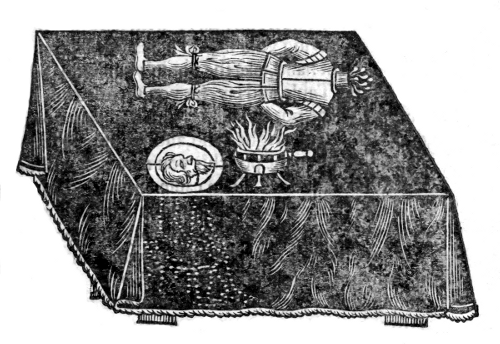
From the basic “Cups and Balls,” Hocus Pocus takes the reader through increasingly complex tricks with coins and ropes, on a side journey into how to silver mirrors using mercury (warning, don’t try this at home!), and culminates with advice on “Confederacie,” or the use of accomplices in the audience. However, my favorite has to be the gruesome, but probably not very convincing, “Decollation of Iohn Baptist:”

You must have a table with two good wide holes towards one end, also a cloth on purpose to cover the table with, so that the said covering may hang to the ground round about the table; also this covering must have two holes made in it even with the holes of the table, you must also have a platter of wood for the purpose, having a hole in the bottom to fit also unto the holes of the table, and it must, as also the table, be made to take in two pieces: having these in readinesse, you must have two boyes; the one must lie along upon the table with his backe upward, and he must put his head thorow the one hole of the table, cloth and all; the other must sit under the table and put his head thorow the other hole of the table, then put the platter about his neck, to make the sight more dreadfull to behold, you may forme some loome about the neckes of them, making small holes in them as it were veins, and besmeare it over with sheepes bloud, putting some bloud also and little bits of liver into the platter, and set a chafing-dish of coales before the head, strewing some brimstone upon the coales; for this will make the head seem so pale and wan, as if in very deed it were separated from the body.
Decollation of Iohn Baptist
The head may fetch a gaspe or two, and it will be better. Let no body bee present while you doe this, neither when you have given entrance, permit any to be medling, nor let them tarry long.

We do not know who wrote Hocus Pocus Junior; he probably did not want his fellow “Iuglers” to know who was spilling their secrets. However we do know of at least one famous illusionist who, hundreds of years later, read the book: the rare and precious original in the Library of Congress, which was scanned for Distributed Proofreaders to create this e-book, bears the inscription “Bequest of Harry Houdini April 1927.”

I hope you enjoy this little piece of history preserved.


An ex-maid’s maid.

December 8, 2010

"Why, she's going to ask me down there, too, to one of her week-end parties!"

“A Romance of Love and Fortune,” that is the subtitle of a light romance about a woman who becomes the maid of her ex-maid. The book is Miss Million’s Maid (1915) by Berta Ruck (Mrs. Oliver Onions).  In addition to love and fortune, it includes class snobbery, Irish royalty, theater, crime, and the Great War.

My story begins with an incident that is bound to happen some time in any household that boasts—or perhaps deplores—a high-spirited girl of twenty-three in it.

It begins with “a row” about a young man.

My story begins, too, where the first woman’s story began—in a garden.

It was the back garden of our red-roofed villa in that suburban street, Laburnum Grove, Putney, S.W.

Now all those eighty-five neat gardens up and down the leafy road are one exactly like the other, with the same green strip of lawn just not big enough for tennis, the same side borders gay with golden calceolaria, scarlet geranium, blue lobelia, and all the bright easy-to-grow London flowers. All the villas belonging to the gardens seem alike, too, with their green front doors, their white steps, their brightly polished door-knockers and their well-kept curtains.

From the look of these typically English, cheerful, middle-class, not-too-well-off little homes you’d know just the sort of people who live in them. The plump, house-keeping mother, the season-ticket father, the tennis-playing sons, the girls in dainty blouses, who put their little newly whitened shoes to dry on the bathroom window-sill, and who call laughing remarks to each other out of the window.

“I say, Gladys! don’t forget it’s the theatre to-night!”

“Oh, rather not! See you up at the Tennis Club presently?”

“No; I’m meeting Vera to shop and have lunch in Oxford Street.”

“Dissipated rakes! ‘We don’t have much money, but we do see life,’ eh?”

Yes! From what I see of them, they do get heaps of fun out of their lives, these young people who make up such a large slice of the population of our great London. There’s laughter and good-fellowship and enjoyment going on all up and down our road.

Except here. No laughter and parties and tennis club appointments at No. 45, where I, Beatrice Lovelace, live with my Aunt Anastasia. No gay times here!

Thus begins the tale of the great-granddaughter of Lady Anastasia. In the days of her great-grandmother the family lived in Lovelace Court. Since that time, the family has “come down in the world” and our heroine lives with her aunt as hermits, because the aunt believes “Better no society than the wrong society.”

Beatrice’s only friend is a naive maid. So when the maid inherits a fortune from a distant relative, our heroine decides to flee her hermitage by entering the employment of her maid. What follows then is a series of adventures as our heroine tries to protect her friend and show her the advantages of her new-found wealth. And, of course, what follows is also romance and plenty of humor along the way.


The Real plays of Little Women

December 4, 2010

In the first chapter of Little Women, there was a description of the plays that the March family performed for each other:

“I don’t mean to act any more after this time. I’m getting too old for such things,” observed Meg, who was as much a child as ever about ‘dressing-up’ frolics.

“You won’t stop, I know, as long as you can trail round in a white gown with your hair down, and wear gold-paper jewelry. You are the best actress we’ve got, and there’ll be an end of everything if you quit the boards,” said Jo. “We ought to rehearse tonight. Come here, Amy, and do the fainting scene, for you are as stiff as a poker in that.”

“I can’t help it. I never saw anyone faint, and I don’t choose to make myself all black and blue, tumbling flat as you do. If I can go down easily, I’ll drop. If I can’t, I shall fall into a chair and be graceful. I don’t care if Hugo does come at me with a pistol,” returned Amy, who was not gifted with dramatic power, but was chosen because she was small enough to be borne out shrieking by the villain of the piece.

“Do it this way. Clasp your hands so, and stagger across the room, crying frantically, ‘Roderigo! Save me! Save me!'” and away went Jo, with a melodramatic scream which was truly thrilling.

Amy followed, but she poked her hands out stiffly before her, and jerked herself along as if she went by machinery, and her “Ow!” was more suggestive of pins being run into her than of fear and anguish. Jo gave a despairing groan, and Meg laughed outright, while Beth let her bread burn as she watched the fun with interest. “It’s no use! Do the best you can when the time comes, and if the audience laughs, don’t blame me. Come on, Meg.”

Then things went smoothly, for Don Pedro defied the world in a speech of two pages without a single break. Hagar, the witch, chanted an awful incantation over her kettleful of simmering toads, with weird effect. Roderigo rent his chains asunder manfully, and Hugo died in agonies of remorse and arsenic, with a wild, “Ha! Ha!”

“It’s the best we’ve had yet,” said Meg, as the dead villain sat up and rubbed his elbows.

“I don’t see how you can write and act such splendid things, Jo. You’re a regular Shakespeare!” exclaimed Beth, who firmly believed that her sisters were gifted with wonderful genius in all things.

“Not quite,” replied Jo modestly. “I do think The Witches Curse, an Operatic Tragedy is rather a nice thing, but I’d like to try Macbeth, if we only had a trapdoor for Banquo. I always wanted to do the killing part. ‘Is that a dagger that I see before me?” muttered Jo, rolling her eyes and clutching at the air, as she had seen a famous tragedian do.

If you are interested in learning more about these plays, you can actually read them in Comic Tragedies Written by ‘Jo’ and ‘Meg’ and Acted by The ‘Little Women’. At first, when I was working on the post processing of this book, I thought it was written by Louisa May Alcott after writing Little Women, with her writing the plays in the style as if it were written by “Jo” and “Meg”. Later reading Little Women Letters from the House of Alcott,  I discovered that the plays were really written by Louisa May Alcott and her sister Anna in their youth.

How were the plays? Well, they were interesting, both historically and as works of young women who had yet to really know romance. The term “Tragedies” was probably a misnomer; they were more like romantic melodramas. Still, melodramas can be fun.


A Wonder Book for Girls and Boys

December 1, 2010

In the spring of 1850, Nathaniel Hawthorne (1804-1864), having just enjoyed his first great success with The Scarlet Letter, moved with his wife and two young children from bustling Salem, Massachusetts, to the Berkshire Hills in the western part of the state. Although “The Berkshires” are now one of America’s premier cultural and natural resorts, they were then a rather wild and remote place. The beauty and peace of its rolling hills made it the perfect setting for a writer who wanted inspiration and no distractions.

The Hawthornes rented a little red farmhouse in Lenox, on the summer estate of the wealthy Tappan family, and Hawthorne set to work. In just a year and a half, Hawthorne produced his masterpiece, The House of the Seven Gables, as well as The Blithedale Romance. And it was here that he wrote his enchanting book for children, A Wonder Book for Girls and Boys.

Midas

Midas’ Daughter Turned to Gold

A Wonder Book is a collection of stories within a frame story. Eustace Bright, a lively student at nearby Williams College, is visiting Tanglewood (Hawthorne’s fictional name for the Tappan estate). He gathers a group of “little folks” — the Hawthorne and Tappan children under assumed names like “Primrose” and “Cowslip” — and, in various places on and around the estate, charmingly narrates for them several ancient Greek myths.

Here is Perseus, lopping off the Gorgon’s Head; Midas, miserably living with his Golden Touch; Pandora and that terrible box; Hercules braving monsters to retrieve the Three Golden Apples; the generous old couple, Baucis and Philemon, unwittingly entertaining the gods in their poor cottage; Bellerophon taming Pegasus and defeating the Chimæra. Both the frame story and the myths are simply and beautifully told, with Hawthorne’s wonderfully evocative touches:

The golden days of October passed away, as so many other Octobers have, and brown November likewise, and the greater part of chill December, too. At last came merry Christmas, and Eustace Bright along with it, making it all the merrier by his presence. And, the day after his arrival from college, there came a mighty snow-storm. Up to this time, the winter had held back, and had given us a good many mild days, which were like smiles upon its wrinkled visage. The grass had kept itself green, in sheltered places, such as the nooks of southern hill-slopes, and along the lee of the stone fences. It was but a week or two ago, and since the beginning of the month, that the children had found a dandelion in bloom, on the margin of Shadow Brook, where it glides out of the dell.

In spite of his appreciation of the beauty of the Berkshires, his productivity there, and the birth of his daughter Rose in 1851, Hawthorne loathed the changeable climate. In one of his journals (later published as Twenty Days with Julian and Little Bunny by Papa), he wrote, “I detest it! I detest it!! I de-test it!!! I hate Berkshire with my whole soul, and would joyfully see its mountains laid flat.” The Hawthornes went back east in November 1852 and never returned.

But Hawthorne’s Wonder Book lives on, as does its sequel, Tanglewood Tales, published in 1853. The Tappans, in fact, adopted Hawthorne’s name for their estate, and their descendants donated Tanglewood to the Boston Symphony Orchestra for its now-famous summer concert series. The little red farmhouse burned down in 1890 and a privately-owned replica stands in its place.

Project Gutenberg’s version of A Wonder Book for Girls and Boys is the 1893 edition, with lovely, richly-detailed illustrations by Walter Crane.

This post was contributed by Linda Cantoni, a Distributed Proofreaders volunteer.


Mathematical Geography by Willis Ernest Johnson

November 27, 2010

Before the advent of coordinated universal time and internationally-recognized time zone boundaries, practical, day-to-day considerations of time measurement quickly became entangled in geographical, political, historical, and legal problems of surprising recalcitrance.

If you live in the northern hemisphere, does the sun pass due south of you every 24 hours? Perhaps surprisingly, no! An hour is 1/24 of a sidereal day, the time required for the earth to rotate once with respect to the stars. Because the earth orbits the sun, the sun’s position on the celestial sphere traverses a circle once per year. Consequently, the mean solar day is shorter than the sidereal day by a factor of roughly 1/365.25: The sun therefore passes due south on average every 23 hours, 56 minutes, 4 seconds. The actual length of the solar day varies seasonally because the earth’s orbit is not circular and the dates of perihelion and aphelion (when the earth is closest or furthest from the sun) do not coincide with the solstices (when the north pole is tipped most nearly toward or away from the sun).

A related phenomenon is said to have confounded Ferdinand Magellan’s crew briefly upon return to Spain after circumnavigating the globe. Their careful reckoning gave the date of September 6, 1522, but the Spaniards assured them the date was the 7th. Eventually the crew realized they had lost a day over their long voyage by traveling west, with the sun. Today we would say Magellan lost a day crossing the date line.

Civilizations successfully used local (solar) time for millennia. Only when consistent time measurements were required over extended longitudes did standard time become important. Of course, time standards were not immediately or universally adopted. Consequences ranged from minor confusion for travellers to legal cases with substantial financial stakes.

During the late Nineteenth Century in the United States, railroads and cities used their own time conventions for many years. When Mathematical Geography was written, the vicinity of El Paso Texas used four systems of time, due to the confluence of three U.S. time zones and an entirely separate Mexican standard time used in Juarez, across the Rio Grande.

In 1902, thirteen lawsuits were brought in the courts of Kentucky over the wording of fire insurance policies. In one case, the policy expired at noon on April 1, 1902, but left unspecified whether solar or standard time was to be reckoned. On the date in question, a warehouse fire began at 11:45 A.M. standard time, namely at 12:02:30 P.M. local time. Nearly $20,000 of insurance money hung in the balance of the court’s decision. Such improbable occurrences were not as rare as one might expect. Willis’s book does not divulge the outcome of these cases, but does highlight the need for pedantic attention to issues we might all regard as too obvious to warrant detailed consideration.

In the modern world of the global positioning system, universal time, and largely undisputed geopolitical boundaries, we easily forget that divisions of time and space are nothing more than social agreements. The earth has no intrinsic clocks convenient for international travel and commerce, nor many geographical features that unambiguously separate neighboring states, provinces, territories, or countries.

Mathematical Geography is not a mere catalogue of amusing events and curious factoids, but a clear, engaging, and systematic exposition of the shape and movement of the earth as an astronomical body, and the consequences for time-keeping, map making, and geodesy. Written in 1907 for use in American secondary schools and for teacher preparation, the book intertwines purely scientific issues of astronomy and geography with the historical growth of the United States in the 1800s as the political entity expanded across the North American continent, and with then-current legal and practical issues related to time and place. Much of the factual content is up-to-date, and even the remainder should be of historical interest.

Despite the book’s imposing title, the mathematical content is light, entailing only trigonometry, plane geometry, and basic algebra. Mathematical Geography is easily accessible to a modern reader with a good high school education. A curious and intelligent younger reader can also learn much, skipping brief mathematical derivations as needed or even learning useful mathematics in a realistic context.

This enjoyable book deserves, and earns, the attention of anyone who wants to understand more about the planet we inhabit and how the earth’s shape and motion affect our daily lives.

This review was contributed by DP-volunteer adhere.