It started as an all-too-common story: a young performer — an actor, dancer, musician, stage director — from the Midwest comes to New York to break into the big time on Broadway. His specialty act on the piano wowed ’em in his hometown, and he’s determined that it’ll wow ’em in New York.
But when he gets there to play his first gig, he finds that there’s no piano at the theater. Worse, he discovers that someone has stolen his act and has already performed it all over town. Now he has no job. He has no money. He trudges from agent to agent in a vain search for a break. He now understands why they call Broadway the “Boulevard of Broken Dreams.”
But the dream of Ned Wayburn (1874-1942) wasn’t broken yet. His ragtime piano playing eventually caught the attention of one of the great Broadway stars of the 1890s, May Irwin, who hired him to accompany her for the princely sum of $25 a week. And from that big break grew Wayburn’s outstanding career as the first important choreographer on Broadway.
Actually, Wayburn didn’t care for the title “choreographer.” He styled himself as a director, and from 1901 into the 1920s he was one of the kings of Broadway, his spectacular vaudeville shows drawing huge crowds. He perfected synchronized chorus-line dancing, using large numbers of attractive young female dancers in imaginative, precisely-timed production numbers. He hit the pinnacle of his career when he directed the Ziegfeld Follies several years in a row, from 1916 to 1923.
But in spite of his success, financial security frequently eluded Wayburn. He went bankrupt for the first of several times in 1908. He bought a theater in 1915 to showcase his own productions, only to have it shut down four months later. He became involved in a messy divorce and was nearly jailed for failing to pay alimony.
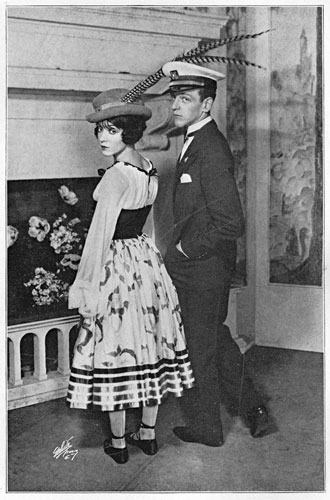
Fred and Adele Astaire, pupils of Ned Wayburn
To shore up his finances, Wayburn opened a dance school in Manhattan in 1905. Among his early students were a young Fred Astaire and his sister, Adele. By the 1920s, the school was a Broadway institution, training legions of dancers in Wayburn’s unique styles of tap dancing (which some claim he invented), acrobatic dancing, “modern Americanized ballet,” specialty dancing, and ballroom dancing. The Art of Stage Dancing, written in 1925, is essentially a book-length advertisement for the Ned Wayburn Studios of Stage Dancing — but a fascinating advertisement nonetheless.
Wayburn’s book is chock full of photographs of the Broadway stars of yesteryear whom Wayburn had taught, or with whom he had worked, in his long career: Fred and Adele Astaire, the Dolly Sisters, Eddie Cantor, Will Rogers, W.C. Fields, Marion Davies, Gertrude Lawrence, Al Jolson, and a host of other greats who are now, alas, forgotten.
But the book is more than just a self-congratulatory plug for Wayburn and his school. It’s also a complete guide for the would-be dancing star (primarily female, of course), with detailed, richly illustrated chapters on dance styles, steps, and tempos (with music); makeup and costume; stage technique; exercise, diet (with daily menus to slim down or fatten up), and health; and much more. Wayburn even threw in a collection of sample contracts so that his students would know what to expect in the real world.
Wayburn believed fervently in the power of confidence as the key to stage success:
Be patient, you who would star and see your name go up in the bright lights on the Great White Way. Do not get discouraged. You will meet with obstacles on the route to fame undoubtedly, as others have done, and, like the others who have finally arrived, you must overcome them one at a time as they appear, by sheer force of willpower, determination, pluck or whatever you desire to call it. If you are a weakling and lack strength of character do not ever take up a stage career, for you will get many a bump; so be prepared to stand it. For only those who are determined to succeed will ever reach the top, where there is plenty of room always.
Unfortunately, no amount of confidence could stop the march of time for Wayburn. The Depression brought both vaudeville and the Ned Wayburn Studios to a slow and painful end. Wayburn went bankrupt for the last time in 1935; he died in 1942 at the age of 68. But his legacy lives on in every Broadway show with a chorus line.
The Art of Stage Dancing was the 14,000th title posted to Project Gutenberg by Distributed Proofreaders.
This post was contributed by Linda Cantoni, a Distributed Proofreaders volunteer.


 Posted by LCantoni


 Hot off the Press