Distributed Proofreaders celebrates 20,000 books posted

April 9, 2011

Banner for DP's 20k celebration

Just half a year after our 10th anniversary, we have reason to celebrate another big milestone. As of today, Distributed Proofreaders has contributed 20,000 unique titles to the bookshelves of Project Gutenberg, free to enjoy for everybody.

Out of curiosity, I had a look at the numbers. It took us more than six years to post the first 10,000 books, reaching that milestone in March 2007.  We have doubled that number in just a bit over four years. That’s on average about 2500 projects posted per year!

In addition to being the biggest single producer of ebooks for Project Gutenberg, Distributed Proofreaders is a truly international community. People from all over the world contribute, bringing with them their unique skills and preferences. One area where this becomes obvious is the variety of different languages we’re working in. While most projects only contain a single language, there are those where two or even more languages are used. These books are often especially challenging, needing people with skills in different languages to complete. At Distributed Proofreaders, help with a language you’re not familiar with is never far away. Native speakers of lots of different languages as well as specialists in a few that aren’t even spoken anymore are always happy to answer questions about tricky issues, making it therefore possible to complete those challenging projects and post the resulting books to Project Gutenberg for everybody to enjoy.

To celebrate that diversity, we have chosen to showcase books containing at least two languages. Here’s a list of our projects for the 20,000 celebration for you to enjoy:

A big Thank You goes to everybody who has contributed to these and all the other books that make up this huge number, in whatever capacity.


Mathematical Geography by Willis Ernest Johnson

November 27, 2010

Before the advent of coordinated universal time and internationally-recognized time zone boundaries, practical, day-to-day considerations of time measurement quickly became entangled in geographical, political, historical, and legal problems of surprising recalcitrance.

If you live in the northern hemisphere, does the sun pass due south of you every 24 hours? Perhaps surprisingly, no! An hour is 1/24 of a sidereal day, the time required for the earth to rotate once with respect to the stars. Because the earth orbits the sun, the sun’s position on the celestial sphere traverses a circle once per year. Consequently, the mean solar day is shorter than the sidereal day by a factor of roughly 1/365.25: The sun therefore passes due south on average every 23 hours, 56 minutes, 4 seconds. The actual length of the solar day varies seasonally because the earth’s orbit is not circular and the dates of perihelion and aphelion (when the earth is closest or furthest from the sun) do not coincide with the solstices (when the north pole is tipped most nearly toward or away from the sun).

A related phenomenon is said to have confounded Ferdinand Magellan’s crew briefly upon return to Spain after circumnavigating the globe. Their careful reckoning gave the date of September 6, 1522, but the Spaniards assured them the date was the 7th. Eventually the crew realized they had lost a day over their long voyage by traveling west, with the sun. Today we would say Magellan lost a day crossing the date line.

Civilizations successfully used local (solar) time for millennia. Only when consistent time measurements were required over extended longitudes did standard time become important. Of course, time standards were not immediately or universally adopted. Consequences ranged from minor confusion for travellers to legal cases with substantial financial stakes.

During the late Nineteenth Century in the United States, railroads and cities used their own time conventions for many years. When Mathematical Geography was written, the vicinity of El Paso Texas used four systems of time, due to the confluence of three U.S. time zones and an entirely separate Mexican standard time used in Juarez, across the Rio Grande.

In 1902, thirteen lawsuits were brought in the courts of Kentucky over the wording of fire insurance policies. In one case, the policy expired at noon on April 1, 1902, but left unspecified whether solar or standard time was to be reckoned. On the date in question, a warehouse fire began at 11:45 A.M. standard time, namely at 12:02:30 P.M. local time. Nearly $20,000 of insurance money hung in the balance of the court’s decision. Such improbable occurrences were not as rare as one might expect. Willis’s book does not divulge the outcome of these cases, but does highlight the need for pedantic attention to issues we might all regard as too obvious to warrant detailed consideration.

In the modern world of the global positioning system, universal time, and largely undisputed geopolitical boundaries, we easily forget that divisions of time and space are nothing more than social agreements. The earth has no intrinsic clocks convenient for international travel and commerce, nor many geographical features that unambiguously separate neighboring states, provinces, territories, or countries.

Mathematical Geography is not a mere catalogue of amusing events and curious factoids, but a clear, engaging, and systematic exposition of the shape and movement of the earth as an astronomical body, and the consequences for time-keeping, map making, and geodesy. Written in 1907 for use in American secondary schools and for teacher preparation, the book intertwines purely scientific issues of astronomy and geography with the historical growth of the United States in the 1800s as the political entity expanded across the North American continent, and with then-current legal and practical issues related to time and place. Much of the factual content is up-to-date, and even the remainder should be of historical interest.

Despite the book’s imposing title, the mathematical content is light, entailing only trigonometry, plane geometry, and basic algebra. Mathematical Geography is easily accessible to a modern reader with a good high school education. A curious and intelligent younger reader can also learn much, skipping brief mathematical derivations as needed or even learning useful mathematics in a realistic context.

This enjoyable book deserves, and earns, the attention of anyone who wants to understand more about the planet we inhabit and how the earth’s shape and motion affect our daily lives.

This review was contributed by DP-volunteer adhere.


Mathematical Recreations and Essays

November 13, 2010

W. W. Rouse Ball‘s “Mathematical Recreations and Essays” contains an odd but decidedly interesting collection of essays about a range of different subjects. The 4th edition dating from 1905 was recently posted to Project Gutenberg. Far from being interesting to mathematicians only, this book has something for everybody who’s interested in puzzles and number games or in the history of science.

The book is divided into two parts of quite different character. The first part, titled “Mathematical Recreations,” ranges from simple number games of the “guess the number” kind to magical squares and mazes, discussing topics such as mathematical and geometrical fallacies, the “Eight Queens” problem on a chessboard, map colourings and many more. The problems presented are not exactly new or original and don’t pretend to be, but I like the systematic treatment given to many of them.

Part II of the book, titled “Miscellaneous Essays and Problems,” contains a wealth of historical information about mathematics-related topics made even more fascinating by the fact that it was written more than a century ago. It starts with a description of the development of the Mathematical Tripos at Cambridge, giving a very interesting glimpse into the history of mathematics education at one of Britain’s most prestigious universities. The next chapters give a history of classical geometrical problems, the quadrature of the circle the most prominent of them, followed by an introduction to Mersenne’s numbers. After that comes a short description of the “scientific” aspect of astrology, which the author himself wasn’t too sure whether to include. There’s a chapter introducing early cryptography, one on hyper-space, including space with more than three dimensions as well as non-Euclidean geometry, and one on time measurements.

But my absolute favourite is the last chapter on matter and ether theories. At the time this book was written, the internal workings of atoms were not yet known and the subject of the wildest speculations. The author gives an account of the different theories proposed and how they explain the way atoms interact with each other. Rather than reporting scientific developments from a historical standpoint, this chapter provides some valuable insights into science in action, which makes it really fun to read.

Tucked away behind the index are advertisements for the W. W. Rouse Ball’s other works, together with blurbs from probably every review that was ever printed. Let me cite from one of the reviews for this book, which I have to heartily agree with:

… A great deal of the information is hardly accessible in any English books; and Mr. Ball would deserve the gratitude of mathematicians for having merely collected the facts. But he has presented them with such lucidity and vivacity of style that there is not a dull page in the book; and he has added minute and full bibliographical references which greatly enhance the value of his work.–The Cambridge Review.

I thoroughly enjoyed reading this book and would really like to see the other works by this author on PG: they are surely worth a closer look.


Space, Time and Gravitation

October 27, 2010

According to Einstein’s general theory of relativity, first published in 1915, the phenomenon we experience as gravitation can be interpreted purely geometrically. Objects moving in the absence of external forces travel along “geodesics”, curves generalizing straight lines. However, in the presence of matter, the geometry of space-time is not Euclidean. Instead, nearby geodesics move closer together, similarly to longitude lines on the surface of the earth as one walks toward the north or south pole. Bodies moving along converging geodesics are, perforce, attracted to each other.

Eclipse Instruments at Sobral

Eclipse Instruments at Sobral

Among the predictions of general relativity is the bending of light by gravitation. In May 1919, Arthur Eddington led an expedition to the Isle of Principe in the Gulf of Guinea, West Africa. A companion expedition was sent to Sobral, in northern Brazil. A rare and timely astronomical coincidence was due to occur: a total solar eclipse as the sun passed through the Hyades, “an exceptional field of bright stars” in Eddington’s words. The expeditions’ goal was to photograph the deflection of starlight by the sun’s gravitational field. Newton’s law of gravitation also predicted deflection, but by an amount only half as great as Einstein’s prediction. The plates from Sobral showed, within bounds of experimental uncertainty, a greater deflection than predicted by Newtonian gravitation. Both sets of plates were entirely consistent with Einstein’s prediction. This initial experimental confirmation of general relativity catapulted Einstein to international fame.

Written in 1920, Eddington’s “Space, Time and Gravitation” is one of the first popular accounts of general relativity. The book begins with an imaginary conversation between a classical physicist, a pure mathematician, and a relativistic physicist who challenges the classical physicist (and therefore the reader) to reconsider the static, Galilean concepts of space and time. Chapter by chapter, using little more than the Pythagorean theorem, Eddington builds an ever-stronger case for the relativistic thesis: Space and time are not independent absolutes, but together comprise a single physical entity in which disparate physical ideas become unified.

The decades bracketing 1920 saw a dramatic shift in cosmology. In 1917, Einstein used general relativity to model the entire universe, introducing a “cosmological constant” in his field equations in order to obtain a static solution. In 1922, Alexander Friedmann found expanding solutions to Einstein’s original field equations (without a cosmological constant). By 1929, Edwin Hubble had discovered that distant galaxies were moving away from the earth at speeds proportional to their distance, an experimental suggestion that Friedmann’s model was closer to reality than Einstein’s. Eddington’s book predates these foundational discoveries, and even contains cosmological speculations that seem naive in retrospect. Despite this, the book remains a lively, accessible, and literate introduction to the rich geometric background underlying Einstein’s general theory of relativity.

This review was contributed by DP-volunteer adhere.


Calculus Made Easy

October 13, 2010

The mathematical study of rates of change and total change, also known as “the differential and integral calculus”, has frightened generations of students. Ironically, this scholastic trauma is often unnecessary: Many formal rules of calculus are nearly trivial to carry out. The mathematical difficulties lie in understanding and using the rigorous logical framework of the calculus—what mathematicians nowadays term “elementary real analysis”—and in establishing the correctness of the formal manipulations and their connections with mathematical interpretations.

Sylvanus Phillips Thompson’s “Calculus Made Easy” gives cogent yet entertaining and irreverent explanations of these easy calculational rules. Justifications are conceptual, but beneficially simplified and intuitive. Popularized and later updated by the recreational mathematics author Martin Gardner, “Calculus Made Easy” has remained a widely-read introductory text for the past century.

With the appearance of Project Gutenberg’s public domain version on July 28, 2010, the second British edition of this classic, originally published in 1914, is freely available over the Internet. In its first weeks, the book has proved wildly popular for a mathematics text.

Thompson’s choice of material is both varied and selective. Most topics will be familiar to the modern student: Differentials as minute quantities; derivatives as relative rates of change; rules for differentiating sums, products, quotients, and compositions of functions; the geometric meaning of the first and second derivatives; finding maxima and minima; the natural exponential and logarithm functions; circular trig functions; partial derivatives; integration and antidifferentiation; the fundamental theorems; integration by parts, and by partial fractions; elementary differential equations, including exact first-order equations and d’Alembert’s solution of the one-dimensional wave equation.

If you’ve had unpleasant experiences with calculus, if your knowledge has grown rusty, or if you’ve simply never encountered this powerful and intriguing branch of mathematics, Thompson’s gem of a textbook should prove a pleasant, thought-provoking, and ultimately rewarding read.

This review was contributed by DP-volunteer adhere.


Garage Musings

October 10, 2010

For some reason, quite a bit of DP’s history seems to be connected to garages. On the last of the 10 days celebrating 10 years of DP, let’s have another look at history by following Juliet Sutherland into her garage:

I’ve been working out in my garage for the last week or so and it has brought back lots of memories about Distributed Proofreaders. I joined DP in April, 2002 when the site still ran on a computer in our founder charlz’ house. Preserve old books! What a wonderful idea! As with so many DP volunteers, I was immediately hooked. Very soon, proofing wasn’t enough. I pestered charlz into sending me various directions until finally I was able to scan a book. Oh happy day! It was Land of the Blue Flower by Francis Hodgson Burnett and was quickly followed by The Little Hunchback Zia by the same author. I chose those books because they were very short and small. And thus began eight years of providing content to DP.

My favorite part of providing content was buying the old books. At that time there were very few archives of scanned books so we did most of our scanning ourselves. Where ever I went, I found the used book stores and scoured their discount areas for inexpensive books that we could work on at DP. I drove to used book sales as much as two hours away from home, and came back with a car full of books. I bought a little laptop computer to keep David’s list on so that I wouldn’t get duplicates. Yes, I was thoroughly addicted. The boxes and stacks kept piling up. Finally, I resorted to banishing them to the garage. And then some more, and a few more, and then another box or three or five. I quickly had far more material than I could ever scan in a lifetime. And a huge mound grew in the garage. Greg Newby got so tired of doing my copyright clearances that he asked me to help do them for everyone. And still the mounds grew. When I eventually made neater stacks I ended up with about 6 pallets worth of boxes, stacked 3-4 feet high. I put myself on a strict moratorium regarding buying books for DP. No more!

Fast-forward to my garage today. DP has posted over 18,000 titles. PG has over 30,000. The Internet Archive (TIA) has been making lovely scans of huge numbers of books. Do I really need everything in those boxes in the garage? I’ve been sorting through, finding the books that have been posted, the ones that have already been scanned by the Internet Archive, and the ones that appear in neither place. I’ve made it through 1.5 pallets worth so far. I’ve found 4 boxes of books that are already at PG, 2.5 boxes that are not at the Internet Archive, and 2 boxes worth of material that I recycled since it was in lousy shape and available from TIA. Also one mystery box.*

As I work on those books, I remember so many people who were active in the early years. Some are still at DP, others have moved on. I think about the newer volunteers who might enjoy working on some of these books. And I continue to be amazed at the dedication of the DP volunteers and the volume of material that they produce.

* Small world story. I found a box, all sealed up for shipping, that didn’t contain books and that was addressed to someone in a nearby town. The UPS label had the phone number, so I called, spoke to the addressee and he came by to pick up the box. I figured that UPS had delivered the box by mistake at a time when I was ordering lots of boxes of bound periodicals from ebay. But he was totally mystified. Nothing in the box looked familiar. Today I got an email from my oldest daughter with a forwarded message from facebook. Here is what must have actually happened. The addressee received something unmemorable in that box. The box was then used to deliver books to the Booksale where I volunteer. I must have taken the box home for my oldest daughter to use for packing up her things to move to California. She filled and taped up the box and put it in the garage with the rest of her things. When the movers came, the box was overlooked and eventually added to one of my piles of book boxes. After that move, the only major thing oldest daughter was missing was the box with the tiles she’d brought back from her semester abroad in Turkey. And now, 4 years later, the mystery of the missing tiles has been solved. Now we just have to get the box back….


Thérèse de Dillmont: Encyclopedia of Needlework

October 7, 2010

In our age of industrial production a lot of things that were common knowledge as recent as a century ago are being forgotten. The people who knew how to do things and could have taught them to a future generation are mostly gone, so alternative ways of preserving knowledge are getting more and more important. The Crafts Bookshelf at Project Gutenberg is one such alternative way, containing how-to books for a lot of different crafts written at a time when the knowledge described was still widely in use.

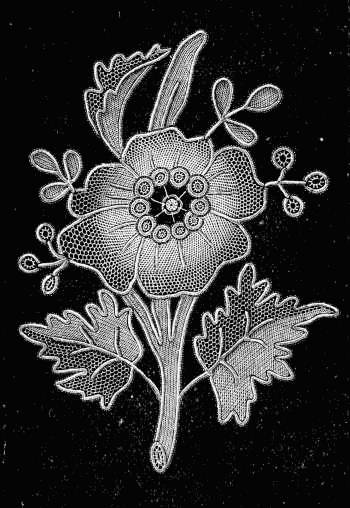
Spray in Needle-Point Lace

Spray in Needle-Point Lace

Because I’m interested in all kinds of needlework, Thérèse de Dillmont’s Encyclopedia of Needlework is a very special book for me. True to its title, this really is an encyclopedia, describing all the different kinds of needlework a woman at the end of the 19th century might need or want to do. Naturally the common kinds of needlework are covered extensively, like sewing, embroidery, knitting and crochet. But for me the real strength of this book lies in the crafts that are all but gone from common knowledge by now, like gold embroidery and the different kinds of needlepoint laces. When looking through this book I always get itching fingers wanting to try out different things, and more often than not have a problem because the materials needed have all but vanished, too.

Lots of illustrations explain the different techniques, and pictures of finished projects provide inspiration on what can be done. Having this book available in electronic form is a huge help for anybody who’s interested in keeping these crafts alive.


An Introduction to Astronomy

October 3, 2010

Volunteers at Distributed Proofreaders dedicate their efforts to “Preserving history one page at a time.” On rare occasions while working on a text, one encounters a sudden, remarkable, almost palpable connection to the author’s era.

On June 8, 2004, the sun, Venus, and the earth lined up for a few brief hours. Venus, looking like a perfectly round but otherwise undistinguished sunspot, passed across the face of the sun. Such planetary syzygies, results of the clockwork motion of the inner planets, can be predicted with great accuracy, and for centuries into the future.

In his 1916 book “An Introduction to Astronomy”, published by Project Gutenberg on April 24, 2010, the American mathematician and astronomer Forest Ray Moulton wrote,

The transits of Venus, which occur in June and December, are even more infrequent than those of Mercury. The transits of Venus occur in cycles whose intervals are, starting with a June transit, 8, 105.5, 8, and 112.5 years. The last two transits of Venus occurred on December 8, 1874, and on December 6, 1882. The next two will occur on June 8, 2004, and on June 5, 2012.

If Moulton’s book were to be updated a couple of years hence, the same passage would read:

The last two transits of Venus occurred on June 8, 2004, and on June 5–6, 2012. The next two will occur on December 10-11, 2117, and on December 8, 2125.

Almost a century ago, Moulton’s words must have borne the same force of prognostication, confidently predicting events no contemporaneous reader would be alive to witness. To the retrospect of a modern reader, Moulton’s words bridge the decades–and intervening scientific and technological revolutions–from Moulton’s era to our own.

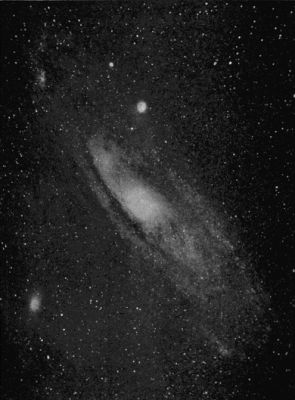
Today, “An Introduction to Astronomy” is an engagingly readable textbook of elementary astronomy, full of current information on geography, motions of the earth and moon, and star maps; incomplete but largely accurate data on the planets and their larger satellites; and poignantly naive descriptions of the “spiral nebulae”, now known to be galaxies in their own right–as numerous as the stars in our own galaxy and inconceivably remote. Pluto had not been discovered, so ironically Moulton’s planetary count, eight, agrees with the modern one.

In these days of interplanetary probes, space-based telescopes, digital data acquisition, and computer-enhanced images, it is easy to forget how recently astronomers’ knowledge was constrained by the limitations of ground-based, visible-light instruments–refracting and reflecting telescopes–and yet how detailed was their knowledge of the solar system and the cosmos beyond. Moulton’s “An Introduction to Astronomy” is a look back to the cosmology of the early 20th Century: Not a dead history, but a book of living information, and a thread of human connection to the science of decades past.

This review was contributed by DP-volunteer adhere.


A Decade of Dedication

October 1, 2010

Ten Years of Producing Public Domain Ebooks

Today it’s been 10 years since Distributed Proofreaders opened its doors to the public. Our aim is the same now as it was back then: producing electronic versions of public domain books that are free for everybody to enjoy.

As our former General Manager, Juliet Sutherland has been the guiding hand of Distributed Proofreaders over the course of many changes and several years. Currently she is the DP Foundation’s Chair, ensuring that Distributed Proofreaders will continue in its mission for years to come. She shares with us these reflections:

It’s hard for me to believe that DP has reached its 10 year anniversary. Looking back (DP front page from 2001) and looking forward I see a history and future of remarkable dedication to the site and to our purpose of transcribing public domain books. Over 18,000 books is a significant contribution to preserving and making accessible the written works of many countries and languages. To my mind, as important as our actual product is, the community that has grown around our production process is equally important. DP has been blessed with so many people who have dedicated large chunks of time. It is inevitable that over a period of 10 years some have moved on to other things. DP has been fortunate that for each of our most active volunteers who moves on, a new, enthusiastic volunteer has appeared. These new volunteers are the future of DP. To everyone who has volunteered at DP over the last 10 years, to everyone who is still contributing, and to the volunteers yet to come, THANK YOU!

Now let the celebration begin!

Yes, we definitely have reason to celebrate today. There are worlds between the first book DP posted to Project Gutenberg and the ones we post today. Just a couple of days ago an enormous and important work was finally finished, and I invite you to have a look at what producing an ebook can mean today: Principles of Orchestration by Nikolay Rimsky-Korsakov. Between those two books, there are more than 18.000 others, an enormous pile of books.

In addition to looking back, today is also a new start. We have more to give to the public than the finished ebooks: what we learn about the books we are working on and the stories that develop around them can be interesting as well. This blog is intended as a way for us to tell those stories, and at the same time to help you to find your way through the enormous amount of free ebooks available by now.