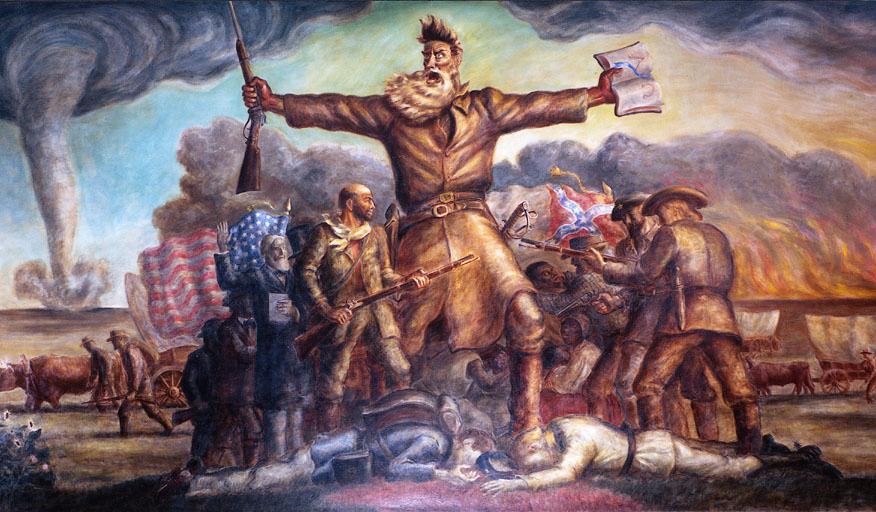
As a new Distributed Proofreaders post-processor finalizing proofread and formatted texts into ebooks for Project Gutenberg, I wanted to pick a simple project suitable for beginners, and was drawn to the 1924 book Life of John Brown by Michael Gold. I had proofread parts of this book in earlier stages, and thought it would be great to have an additional hand in preserving this piece of history. This is not Project Gutenberg’s only book on abolitionist John Brown (1800-1859): there are already other books by activists, Civil War veterans, and more. However, Life of John Brown is currently the only entry in the collection written by an avowed communist – one who has been neglected in historical appraisals of American literature, but whose background provides necessary context to this book.
Michael “Mike” Gold (1893-1967) was the pen name of Jewish-American writer Itzhok Isaak Granich, a prolific writer, editor, and literary critic of the American proletarian literature movement in the 1930s and 1940s. In April 1914, he was beaten by a police officer while attending an anti-capitalist speech in Union Square, New York City; he bought his first issue of the socialist journal The Masses the very next day, and became a lifelong communist. He eventually rose to the position of editor and frequent contributor of the Marxist periodical New Masses. Besides his commitment to communism, the American Civil War also was a great influence on his work: His pen name was supposedly lifted from a Jewish Union army veteran, Life of John Brown was his first published book, and he later wrote a play, Battle Hymn, based on Brown’s life. Despite his significant literary contributions and fame (his only novel, Jews without Money, went through eleven reprints in its first year alone), he was a marginalized figure during the McCarthy era due to the persecution of communists both real and perceived.
Life of John Brown covers Brown’s childhood up until his execution for the 1859 raid on Harpers Ferry. According to Gold’s sources, Brown was an honest and hardworking man struck by the injustices of racism and slavery from an early age. This later led him to move to Kansas to defend abolitionists from the pro-slavery border ruffians in the clashes that became known as Bleeding Kansas. Brown was determined to prevent Kansas from becoming a slave state, and quickly emerged as a militant leader on the side of the abolitionists, also known as Jayhawkers or Free-Staters. Unsurprisingly, Gold also tries to claim Brown as a leftist or anti-capitalist, a prototype of the communist revolution to come. This assertion is probably wishful thinking on Gold’s part, as Brown’s last courtroom speech suggests he was motivated more by deep Christian convictions than anything else. The book also does not mention him participating in any of the utopian socialist experimental communities of his era, such as Brook Farm, as he spent most of his life as a regular farmer who happened to be involved in armed conflict. Still, none of this has stopped leftists from claiming Brown as an inspirational figure, as shown by the existence of left-wing gun clubs (or “community defense organizations”) named after him. As Gold concludes in the final chapter:
Who knows but that some time in America the John Browns of today will be worshipped in like manner? The outlaws of today, the unknown soldiers of freedom.
In this light, Life of John Brown is one of a litany of examples of how the American left would come to appropriate Brown’s uprising as a predecessor of their own struggles for racial and economic justice.
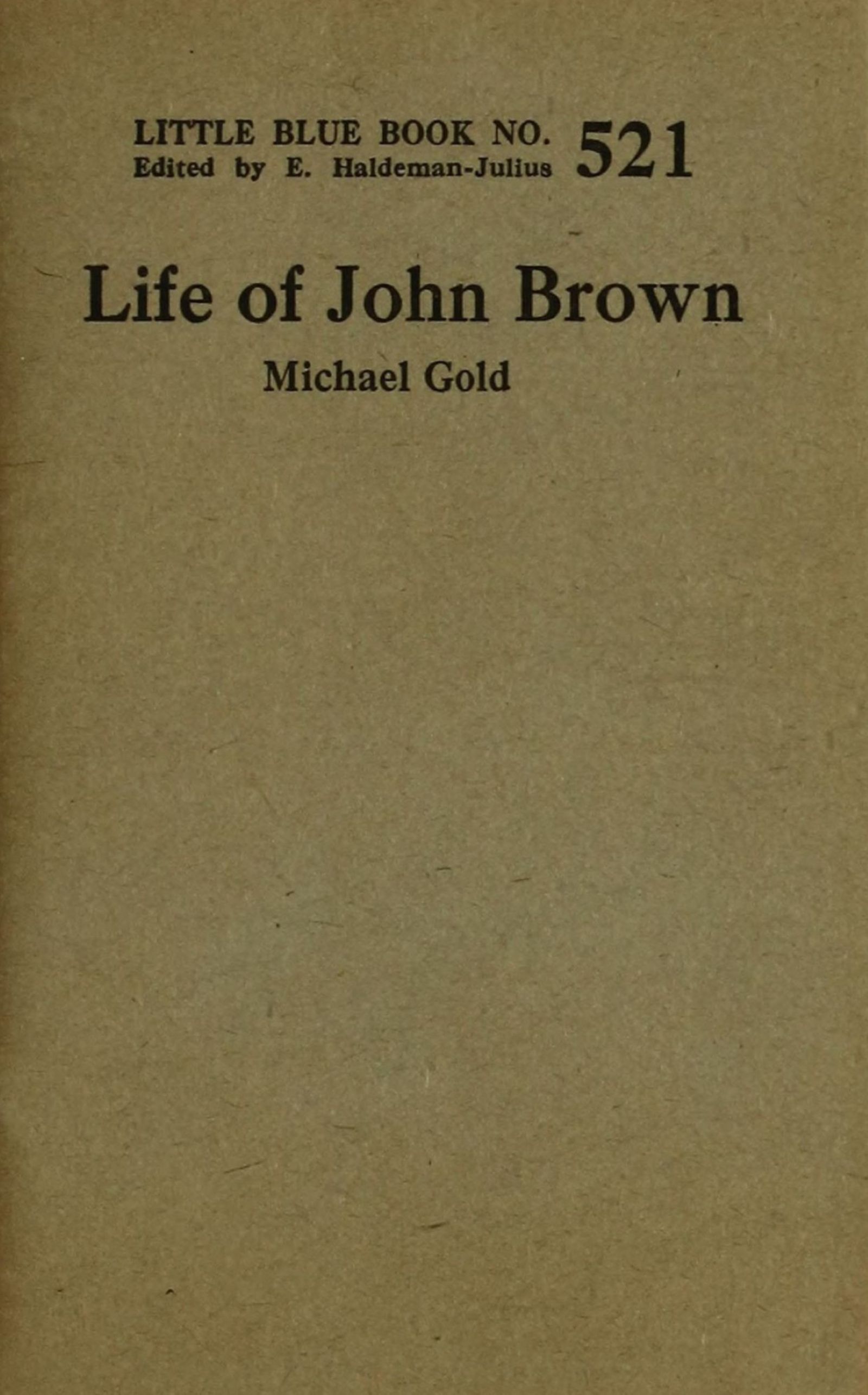
Haldeman-Julius Publications had a socialist slant and, as a company based in Kansas, had an interest in publishing books like this. After Emanuel Haldeman-Julius (1889-1951) took over the printing press of socialist newspaper The Appeal to Reason in 1922, he focused on the mass production of paperback books, many of which had socialist and atheist themes. These Little Blue Books, of which Life of John Brown was number 521, circulated in the hundreds of millions, but their cheap production value (even the covers were just paper) meant that many of them did not survive history’s wear-and-tear. Haldeman-Julius’s publishing also drew the critical eye of the FBI, and he died a month after a federal jury convicted him for tax evasion. Fortunately, some of these books have been preserved and found their way into the hands of Tim Miller, another Distributed Proofreaders volunteer who provides content for us to work on. Many of these Little Blue Books have never been available on the internet. You can help with this historical preservation project (and get a sneak peak at what made the FBI so mad) by joining Distributed Proofreaders today!
This post was contributed by Sam Lamb, a Distributed Proofreaders volunteer. Librarian Dani Rowland (University of Washington Bothell) and Professor Tim Miller (Labette Community College) assisted with research and proofreading for this blog post.
Further Reading
- Bleeding Kansas, Bleeding Missouri: The Long Civil War on the Border – edited by Jonathan Earle and Diane Mutti Burke (University Press of Kansas, 2014)
- His Soul Goes Marching On: Responses to John Brown and the Harpers Ferry Raid – edited by Paul Finkelman (University Press of Virginia, 1995)
- John Brown Speaks: Letters and Statements from Charlestown – Louis DeCaro Jr. (Rowman & Littlefield, 2015)
- John Brown, Abolitionist: The Man Who Killed Slavery, Sparked the Civil War, and Seeded Civil Rights – David S. Reynolds (Alfred A. Knopf, 2005)
- Michael Gold: The People’s Writer – Patrick Chura (SUNY Press, 2020)
- Publisher for the Masses, Emanuel Haldeman-Julius – R. Alton Lee (University of Nebraska Press, 2018)


 Hot off the Press