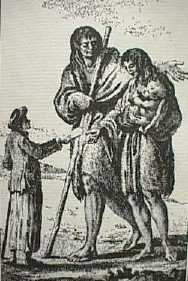
From the 15th Century on, European voyagers to the New World and beyond recounted fabulous tales of the strange peoples they encountered. Among these were the so-called Patagonian Giants. They were a tribe of super-tall people whom the Portuguese explorer Ferdinand Magellan and his crew supposedly encountered in southern Argentina during their voyage around the world in 1519-1522. The legend persisted for over 200 years. In May 1766, after Commodore John Byron‘s ship HMS Dolphin returned from its circumnavigation of the world, the Gentleman’s Magazine reported that the Dolphin “has found out a new country in the East, the inhabitants of which are eight feet and a half high.”
Seizing on this absurdity, the English politician, writer, and wit Horace Walpole wrote An Account of the Giants Lately Discovered, a satirical “Letter to a Friend in the Country” published in July 1766. Walpole was already a celebrated author; his wildly popular Gothic novel, The Castle of Otranto (1764), spawned an entire literary genre. He now took pen in hand to lampoon the alleged discovery of “Five Hundred Giants on Horseback” in Patagonia. Walpole notes that there have been few sightings of these giants over the years, and speculates that it is because they may be “a roving Nation, and seldom come down to the Coast; and then I suppose, only to bob for Whales.”
Walpole savages British colonialism by suggesting, “As soon as they are properly civilized, that is, enslaved, due care will undoubtedly be taken to specify in their Charter that these Giants shall be subject to the Parliament of Great-Britain, and shall not wear a Sheep’s Skin that is not legally Stamped.” That last clause is a clear dig at the infamous Stamp Act of 1765, a British revenue-raising measure that required American colonists to buy specially stamped paper, including sheepskin parchment, for printed matter. (It was later one of the major catalysts of the American Revolution.)
He has even harsher words for the slave trade:
“I would advise our prudent Merchants to employ [the Giants] in the Sugar Trade; … they must be worse treated, if possible, than our Black Slaves are; they must be lamed and maimed, and have their Spirits well broken, or they may become dangerous. This too will give a little respite to Africa, where we have half exhausted the Human, I mean, the Black Breed, by that wise maxim of our Planters, that if a Slave lives Four Years, he has earned his Purchase-Money, consequently you may afford to work him to Death in that time.”
Walpole even mocks the corporations that grew fat on imperialism, suggesting that the Giants “ought to be put under their Majesties, a West-Indian Company; the Directors of which may retail out a small Portion of their Imperial Revenues to the Proprietors, under the name of a Dividend.”
There are several other references to 18th-Century affairs in An Account of the Giants Lately Discovered: the Cock Lane Ghost hoax, the South Sea Bubble fraud, the mythical Beast of Gévaudan, the alleged misdeeds of the Russian empress Catherine the Great (whom Walpole calls “a Soldier’s Trull”), the plundering of India, and the “Humiliation” of Ireland, among others. Walpole even manages to slip in a sly reference to his own best-seller, The Castle of Otranto, as “the Cold Tale of a late notable Author, who did not know better what to do with his Giant than to make him grow till he shook his own Castle about his own Ears.”
The alleged sighting of the Patagonian Giants was later debunked in a 1773 account of Commodore Byron’s voyage. But Walpole did not need validation to wield his satiric flair. Thanks to the volunteers at Distributed Proofreaders and Project Gutenberg, you can enjoy Walpole’s wit yourself, for free.
This post was contributed by Linda Cantoni, a Distributed Proofreaders volunteer.


 Hot off the Press