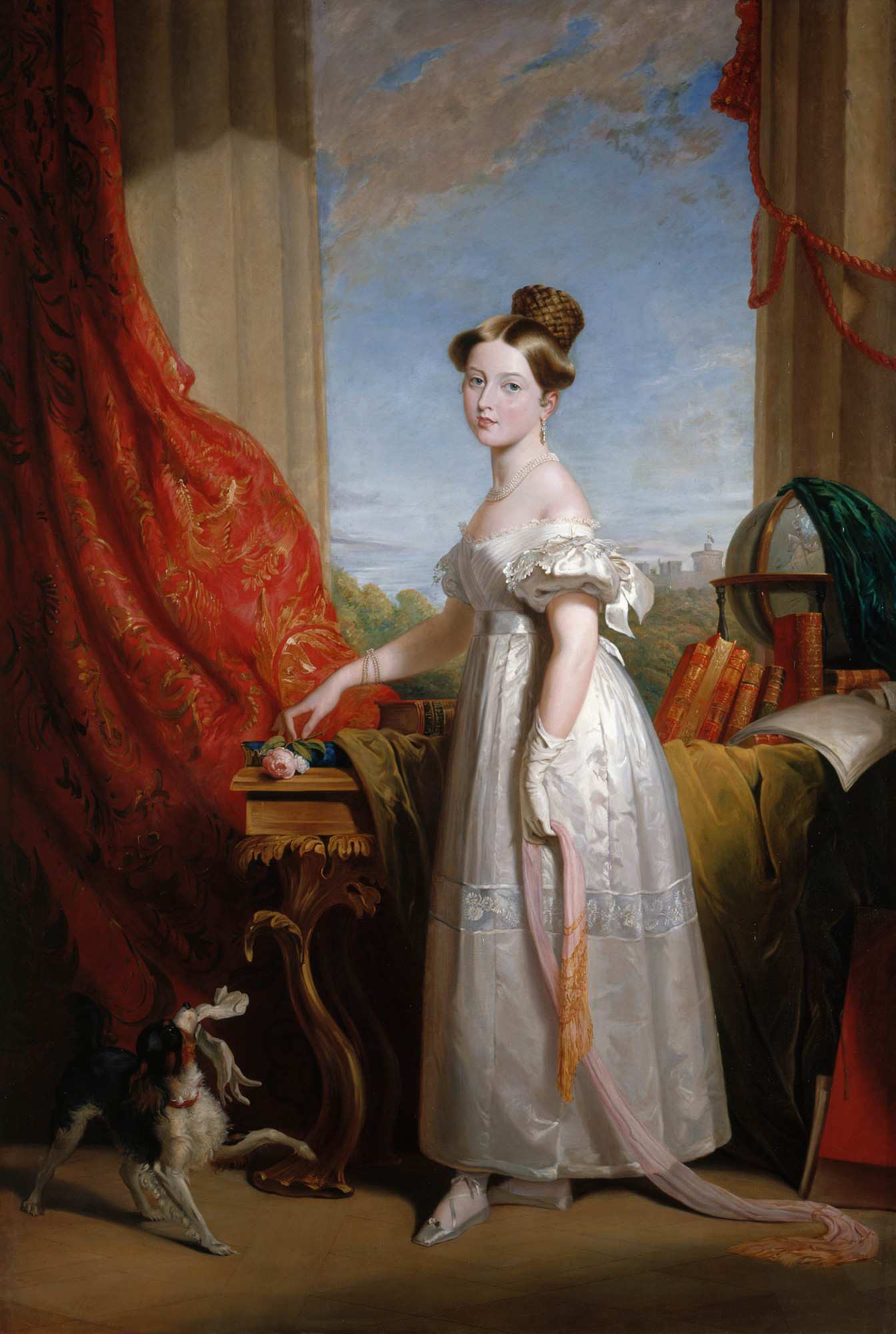
Queen Victoria ruled the United Kingdom of Great Britain and Ireland for 63 years, the longest-reigning British monarch until Queen Elizabeth II’s 70-year reign. An entire era of social, cultural, industrial, and imperial changes – from Victoria becoming Queen in 1837 at the age of 18 to her death in 1901 at the age of 81 – was named after her.
The clichéd image most people have in their minds when they hear Victoria’s name is that of an elderly, grim widow given to proclaiming, “We are not amused.” But she began as a teenaged queen, inexperienced in politics but earnestly wanting to do the right thing.
The Girlhood of Queen Victoria (Vol. I) is part of a two-volume collection of extracts from her early journals, beginning in 1832, when she was 13, and ending in 1840, upon her marriage to Prince Albert when she was 21. (Volume II is in progress at Distributed Proofreaders.) The first volume begins with her first “Royal Progress” through England in August 1832 (though she was then five years away from becoming Queen), and ends in August 1838, two months after her official coronation ceremony.
Victoria’s journals reveal a lively girl, fond of music and dancing. On her 14th birthday, her uncle, King William IV, arranged a “Juvenile Ball” in her honor, to which many teenaged noblemen had been invited. Her excitement is palpable:
I danced first with my cousin George Cambridge, then with Prince George Lieven, then with Lord Brook, then Lord March, then with Lord Athlone, then with Lord Fitzroy Lennox, then with Lord Emlyn. [After supper] I then danced one more quadrille with Lord Paget. I danced in all 8 quadrilles. We came home at ½ past 12. I was very much amused.
Despite her secluded life and her diligent studies in history, law, and languages, Victoria was often amused. She loved going to plays, ballets, and the opera, and she made many sketches of the performing artists she saw, some of which are included in The Girlhood of Queen Victoria. But as she matured, the vision of her future became more sobering. Her uncle, King Leopold of Belgium, soon began advising her on her royal responsibilities, and suggested her first cousin, Prince Albert of Saxe-Coburg, as a possible candidate for marriage. Victoria and Albert first met in 1836, when she turned 17 and he was about to. She found him “extremely handsome,” and became very fond of him and his brother Ernest, but there was no indication at that point that she was in love with Albert.
On her 18th birthday in 1837, she noted, “How old! and yet how far am I from being what I should be.” She vowed to “study with renewed assiduity … and to strive to become every day less trifling and more fit for what, if Heaven wills it, I’m some day to be!” That day came on June 20, 1837, when King William died and she became Queen. She wrote in her journal, “I am very young and perhaps in many, though not in all things, inexperienced, but I am sure, that very few have more real good will and more real desire to do what is fit and right than I have.” In the ensuing months, Victoria, though indeed very young, grew up quickly in the world of government and politics, with the close guidance of her Whig Prime Minister, Lord Melbourne.
These extracts from Victoria’s journals, published in 1912, were edited, with an introduction and explanatory material, by Viscount Esher, under the auspices of Victoria’s son King Edward VII and her grandson King George V. Lord Esher had a close relationship to both Victoria and Edward, so anything too controversial or personal in the journals was expurgated. Nonetheless, The Girlhood of Queen Victoria has great historical value and is cited by Victoria’s biographers to this day.
Thanks to the volunteers at Distributed Proofreaders and Project Gutenberg, you can get a fascinating glimpse into young Victoria’s world for free.
This post was contributed by Linda Cantoni, a Distributed Proofreaders volunteer.


 Hot off the Press