Billy Budd

September 1, 2025

In 1890, the New York Times said of Herman Melville, “There are more people to-day who believe Herman Melville dead than there are those who know he is living.” He was alive, but his writing career was not. Unbeknownst to the world, he spent his final few years working on his great novella, Billy Budd. It would not be published until 1924, 33 years after his death. Thanks to the volunteers at Distributed Proofreaders and Project Gutenberg, you can read the very first publication of it for free.
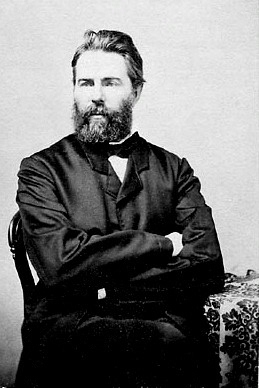
Herman Melville in 1860

Melville had a brilliant start in 1846 with a best-selling novel, Typee, and its equally popular sequel, Omoo, both based on his escapades in the South Seas after he jumped ship on a whaling voyage. Undeterred by the mediocre sales of his next few novels, in 1850 he bought a farm, Arrowhead, in the Berkshire Hills of western Massachusetts, to concentrate on what he believed would be his masterpiece, Moby Dick. But it was the most dismal failure of his career.

He wrote several more novels and story collections, but he never had another success. No longer able to support his family on his writing alone, in 1863 he moved to New York City to work as a customs inspector, fitfully publishing articles and poetry. After his death in 1891, his papers, stored in an old tin breadbox, eventually went to his granddaughter, Eleanor Melville Metcalf.

In 1919, Raymond Weaver, an English professor at Columbia University, was asked to write an article for the centenary of Melville’s birth. Prof. Weaver was astonished to find that nothing had ever been written about Melville’s life. He located Mrs. Metcalf and discovered that she had not only a trove of family papers, but also the hitherto unknown and unfinished Billy Budd manuscript and other writings. The family papers enabled Weaver to publish the very first full Melville biography, Herman Melville: Mariner and Mystic, in 1921. And in 1924, working with Mrs. Metcalf to sift through, decipher, and edit the manuscript, Billy Budd was finally made known to the world in Volume XIII of the first collection of Melville’s works, which includes other short writings and is the edition available at Project Gutenberg. (Because of the disordered and often contradictory state of Melville’s manuscript, several different versions of Billy Budd followed Prof. Weaver’s edition.)

Billy Budd is the story, set in 1797, of a young sailor who has been impressed into service with the Royal Navy on board H.M.S. Indomitable (Bellipotent in later editions). Handsome and good-natured, he is popular with the crew, but not with the unpopular and sadistic Master-at-Arms, Claggart, whose envy (and, according to some interpretations, homoerotic attraction) leads him to hate Billy. He falsely accuses Billy of conspiracy to mutiny. The result is a tragedy that forces the sympathetic Captain Vere to make a decision, based on his view of British naval law of the time, that is still the subject of scholarly legal debate.

Prof. Weaver’s discoveries sparked a Melville Revival that continues to this day. At last this once-obscure writer of sea-stories was recognized as the greatest American novelist. Adaptations of Billy Budd for stage and screen abound, among them an opera by Benjamin Britten and a film by Peter Ustinov starring Terence Stamp as Billy. Just last month, a new audiobook version of Billy Budd, narrated by Paul Giamatti, was published by the Berkshire County Historical Society, which preserves Arrowhead as a museum. Distributed Proofreaders and Project Gutenberg – which has many of Melville’s works in its library – have helped make it possible for everyone to participate in the revival.

This post was contributed by Linda Cantoni, a Distributed Proofreaders volunteer and a member of the Board of Directors of the Berkshire County Historical Society.


Newton’s Principia

August 1, 2025

“There goes the man that writt a book that neither he nor any body else understands.”

So declared a Cambridge University student as Isaac Newton passed him on the street. And the book that Newton “writt” was his monumental work on physics, Philosophiæ Naturalis Principia Mathematica (The Mathematical Principles of Natural Philosophy), better known as Newton’s Principia. Thanks to the volunteers at Distributed Proofreaders and Project Gutenberg, you can delve into an English translation of this major milestone of science for free.

In a letter to fellow physicist (and bitter rival) Robert Hooke, Newton famously said, “If I have seen further it is by standing on the shoulders of giants.” The Principia is the work of a giant. In it, Newton expounds, with mathematical proof, what is now the bedrock of modern physics: his groundbreaking laws of motion and universal gravitation, and his explanations of the motion of planets, moons, comets, tides, fluids, and other physical phenomena.

The Principia arose from a dispute among Hooke, the astronomer Edmond Halley, and the architect Christopher Wren about using mathematical derivations to demonstrate Kepler’s laws of planetary motion. Halley visited Newton at Cambridge in 1684 to discuss the question and was astonished to learn that Newton had already worked out the derivations. A few months later, Newton sent Halley a nine-page paper on the subject, De motu corporum in gyrum (Of the Movement of Bodies in Orbit). Halley, thunderstruck by what he perceived as a revolution in celestial mechanics, urged the Royal Society to publish it. But Newton wanted to rework it first. For the next two years, Newton obsessively expanded his paper, often forgetting to eat. The nine-page manuscript turned into a three-volume book – in Latin, the scientific language of the day – and was finally published in 1687, under the imprimatur of the great diarist Samuel Pepys, then the President of the Royal Society. (The English version at Project Gutenberg is the first American edition of 1846, using British mathematician Andrew Motte’s 1729 translation; the original Latin version was also prepared for Project Gutenberg by Distributed Proofreaders volunteers.)

The publication of the Principia transformed Newton’s life and career. Though he was a distinguished professor at Cambridge who had spent years in dogged research and experimentation in mathematics, mechanics, dynamics, optics, and even alchemy, he had never actually completed any of this work. Now, in his 40s, he had finally brought forth his highest accomplishment, a work that, though he could not have foreseen it then, ultimately enabled human beings to leave Earth to explore the universe beyond it. It was an instant hit throughout Europe among mathematicians, physicists, and even philosophers like John Locke, who did not understand the math but very much appreciated the scientific principles. Hooke was so impressed that he claimed Newton had stolen the ideas from him, but no one ever believed him.

Preparing the e-book version of the Principia posed quite a few challenges, including dealing with numerous mathematical equations and symbols, diagrams, tables, Greek letters, and astrological symbols. Many Distributed Proofreaders volunteers worked hard on it over the years to make this historic work freely accessible to all.

This blog post was contributed by Linda Cantoni, a Distributed Proofreaders volunteer, and is dedicated to the memory of Chris Curnow and John Welch, beloved Distributed Proofreaders volunteers who helped prepare Newton’s Principia.


Aesop in Words of One Syllable

July 1, 2025

In the 19th Century, British and American children’s literature evolved from puritanical moral and religious instruction to delightfully imaginative tales meant to awaken a sense of wonder. But morality and imagination could certainly thrive together. Æsop’s Fables in Words of One Syllable is an excellent example of this.

The ancient Greek storyteller Aesop may or may not have existed, and he may or may not have written the hundreds of morality tales attributed to him. Yet his stories have been popular from the time of Aristotle to the present day, and their morals have contributed classic expressions like “sour grapes” to the English language. The first English version, printed by William Caxton in 1484, was intended for adults. In the 16th and 17th Centuries, English schoolboys were taught Latin and English from various translations of the fables. It wasn’t until the 18th Century that the fables began to appear in illustrated editions intended to entertain (while edifying) children. And in the 19th Century, with the flowering of children’s literature, there was a veritable explosion of illustrated Aesops.

Æsop’s Fables in Words of One Syllable is unique among the illustrated editions: It’s written entirely in words of one syllable (except for the title, of course). It’s part of a “One Syllable” series written between 1867 and 1870 by Mary Godolphin, the pen name of Lucy Aikin. Aikin was a prominent English historian, poet, and feminist who also took a keen interest in the education of children. Other books in her “One Syllable” series include Robinson Crusoe, The Swiss Family Robinson, and The Pilgrim’s Progress. They’re all designed to make reading them easy for children.

The Aesop volume, in an 1895 edition published after Aikin’s death, contains 99 fables, including those featuring the boy who cried wolf, the fox and the grapes, and the goose that laid the golden (“gold”) egg. Notably absent are “The Tortoise and the Hare” and “The Ant and the Grasshopper,” perhaps because Aikin couldn’t come up with one-syllable synonyms for some of those creatures. But there’s plenty here to enjoy, thanks to the volunteers at Distributed Proofreaders and Project Gutenberg.

This post was contributed by Linda Cantoni, a Distributed Proofreaders volunteer.


Egypt in London

June 1, 2025

What do the Rosetta Stone, mummies, and a self-made scholar have in common?

Answer: The British Museum, which has the second largest collection of ancient Egyptian artifacts in the world (the largest is in Cairo), with over 100,000 pieces. And the self-made scholar, E.A. Wallis Budge, was one of the collection’s most important curators in the late 19th to early 20th Centuries. Thanks to the volunteers at Distributed Proofreaders and Project Gutenberg, you can explore the collection as it was in 1909, along with just about every aspect of ancient Egyptian life and history, with A Guide to the Egyptian Collections in the British Museum, Budge’s comprehensive overview.

Budge was born in 1857 into a working-class family. He left school at age 12 to work as a bookseller’s clerk. Young Budge studied Hebrew and Syriac in his spare time, and frequented the British Museum, eventually becoming acquainted with the head of Oriental Antiquities there. With his help, Budge learned Assyrian, studied cuneiform tablets in the Museum’s collection, and had access to the Museum’s library. He spent his lunch hours studying at St. Paul’s Cathedral, where the organist took an interest in him and arranged for him to go to Cambridge University on a private scholarship. Budge studied ancient languages there until 1883, when he went to work for the British Museum. He became an expert at acquiring antiquities for the museum, contributing over 11,000 objects. He ultimately rose to become the head of its Department of Egyptian and Assyrian Antiquities, where he served until his retirement in 1924.

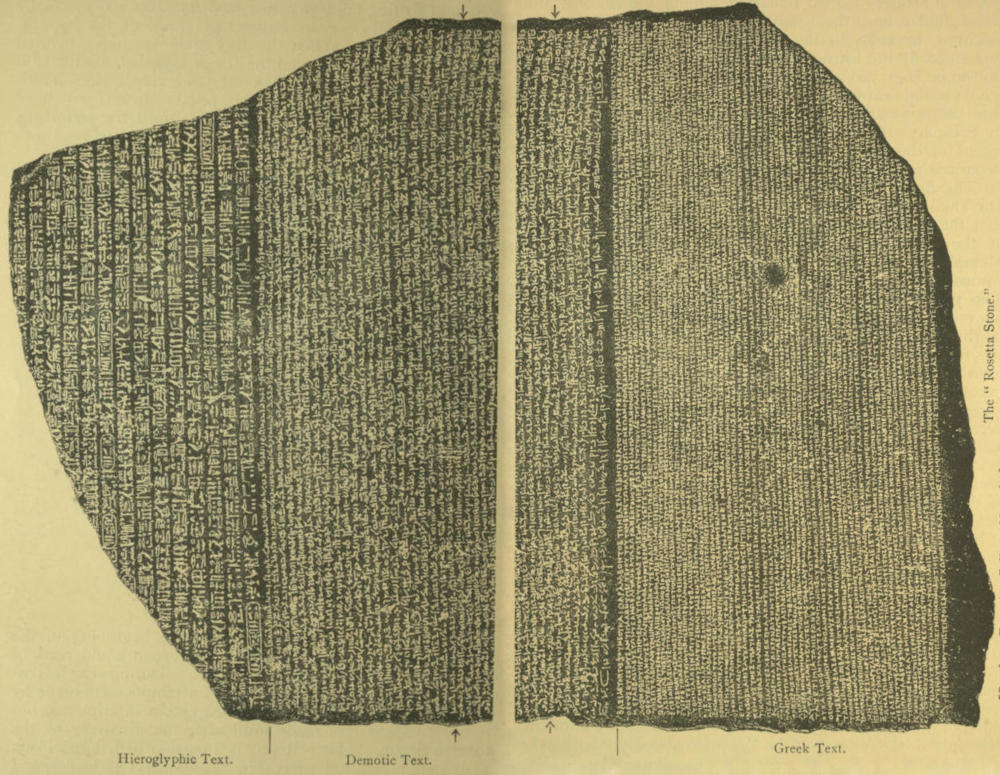
When Budge’s guide was published in 1909, the British Museum had nearly 50,000 objects in its Egyptian collection. The guide gives a fascinating overview of important items such as the Rosetta Stone, one of the jewels of the collection. This fragment from a larger stele, created in about 196 B.C., contains three inscriptions in three different scripts: Egyptian hieroglyphs; Demotic, which was used mainly for documents; and Ancient Greek. Budge describes how over the course of two decades, scholars painstakingly worked at deciphering these inscriptions. He explains that royal Egyptian names like Ptolemy and Cleopatra were decipherable from cartouches on the stone. Budge notes that it was not until 1822 that French scholar Jean-François Champollion “drew up classified lists of the hieroglyphics, and formulated a system of grammar and general decipherment which is the foundation upon which all subsequent Egyptologists have worked.”

The Rosetta Stone

Budge’s guide is lavishly illustrated with 53 plates and 180 other illustrations throughout the text. But it is much more than just a catalog of objects and their descriptions. As Budge notes, the collection “illustrates, in a more or less comprehensive manner, the history and civilization of the Egyptians from the time when their country was passing out of the Predynastic Period under a settled form of government, about B.C. 4500, to the time of the downfall of the power of the Queens Candace at Meroë, in the Egyptian Sûdân, in the second or third century after Christ.” Based on the collection, he is able to give a vivid, detailed picture of ancient Egypt’s history and geography, languages and literature, manners and customs, art and architecture, religion and science, and every schoolchild’s favorite subject, mummies and their tombs.

The text of Budge’s guide is filled with Egyptian hieroglyphs, as well as latinized Egyptian words, Coptic, and Ancient Greek. In preparing the text for Project Gutenberg, Distributed Proofreaders was fortunate to have the help of volunteers who are experts in ancient languages. They helped ensure that these parts of the text have been correctly rendered. Thanks to Distributed Proofreaders teamwork, you can enjoy this fascinating and accessible account of ancient Egypt for free.

This post was contributed by Linda Cantoni, a Distributed Proofreaders volunteer.


Hay Fever

May 1, 2025

A flamboyantly artistic and egotistic family of four each invites an acquaintance to their country house for the weekend. Chaos and hilarity ensue. That is the crux of Hay Fever, Noël Coward‘s hit 1925 farce, now available for free online a century later, thanks to the volunteers at Distributed Proofreaders and Project Gutenberg.

Coward – later renowned for witty comedies like Private Lives and Blithe Spirit – commenced his theatrical career as a child actor. He began writing plays in his teens and had his first West End production, I’ll Leave It to You, a light comedy in which he also starred, at the age of 20. Although reviews were mixed, they were positive enough to keep him encouraged.

Marie Tempest
Marie Tempest as Judith Bliss

In 1924, Coward had his first big hit in the West End and on Broadway, The Vortex. Although not a comedy, its taboo subjects – adultery and drug addiction – resulted in sell-out crowds. Around the same time, Coward was writing Hay Fever, with the celebrated Marie Tempest in mind for the role of the retired actress Judith Bliss. But Tempest wasn’t interested at first – until the success of The Vortex. Coward was thrilled. He later wrote admiringly, “Marie Tempest can tie up a parcel of books, speak with her back to the audience, light cigarettes, pour out drinks, do a hundred and one things with her hands and body and never lose a laugh, or mis-time a witticism.”

Hay Fever was a modest success in the West End, running for 337 performances (but not a success on Broadway, where it ran for only 49 performances). It has been revived a number of times, most notably in 1964 by the new National Theatre, founded by Laurence Olivier. Olivier asked Coward to direct that production. Coward declined at first, but then relented, because he would be working with “a cast that could have played the Albanian telephone directory.” Indeed they could: the cast included Edith Evans as Judith, Maggie Smith as Myra, Derek Jacobi as Simon, and Lynn Redgrave as Jackie.

Coward admitted that Hay Fever “had no plot and that there were few if any witty lines.” But he felt that “literate epigrams” are never as funny as “perfectly ordinary phrases” delivered “impeccably” in the context of the play. “Some of the biggest laughs in Hay Fever,” he said, “occur on such lines as ‘Go on,’ ‘No, there isn’t, is there?’ and ‘This haddock’s disgusting.'”

Hay Fever is still frequently performed by professional and community theaters the world over. Thanks to Distributed Proofreaders and Project Gutenberg, you can see why for yourself, and even, if you’re so inclined, download it for your own production.

This post was contributed by Linda Cantoni, a Distributed Proofreaders volunteer.


Celebrating 49,000 Titles

April 12, 2025

49K Banner

This post celebrates the 49,000th unique title Distributed Proofreaders has posted to Project Gutenberg: The Trail of the Serpent, by Mary Elizabeth Braddon. Congratulations and thanks to all the Distributed Proofreaders and Project Gutenberg volunteers who worked on it!


I don’t suppose it rained harder in the good town of Slopperton-on-the-Sloshy than it rained anywhere else. But it did rain… A bad, determined, black-minded November day. A day on which the fog shaped itself into a demon, and lurked behind men’s shoulders, whispering into their ears, “Cut your throat!—you know you’ve got a razor, and can’t shave with it, because you’ve been drinking and your hand shakes; one little gash under the left ear, and the business is done. It’s the best thing you can do. It is, really.” … A bad day—a dangerous day

This excerpt from the opening paragraph of The Trail of the Serpent, by the queen of the Victorian sensation novel, Mary Elizabeth Braddon, aptly sets the atmosphere for this dark tale of a career criminal, his many victims, and the mute detective who, despite his disability, is hot on the perpetrator’s trail. Some say that The Trail of the Serpent, published in 1860, was the first English detective novel. It helped begin the trend of thrilling novels that enraptured the British public, novels that in turn inspired the pulp fiction of the 20th Century.

The author of this decidedly unladylike story was born in London in 1835. Her mother left Braddon’s solicitor father due to infidelity and brought her up alone, managing to give her a good private education. She began writing stories as a child after her godfather gave her a writing desk. As a teenager, she became an actress to help support herself and her mother, performing under a stage name to preserve her family’s reputation. Though she initially had some success, her acting career began to wane when she was in her twenties, but not before she attracted the attention of Edward Bulwer-Lytton, who became one of her literary mentors.

In 1860, a printer who had seen her poems in a local newspaper offered Braddon £10 for a serialized novel, combining, as she later described it in an article in The Idler magazine, “the human interest and genial humor of Dickens with the plot-weaving of G.W.M. Reynolds,” a popular mystery novelist. Published as Three Times Dead, the novel was not a success. “That one living creature ever bought a number of ‘Three Times Dead’ I greatly doubt,” she said. And instead of the promised £10, all she received was the printer’s 50-shilling advance. But the publisher John Maxwell – a married man who became her lover, later her husband and the father of her six children – convinced her to revise it and turn it into The Trail of the Serpent, which sold a thousand copies in the first week.

It’s not hard to see why it was so popular. The lurid melodrama has everything – horrid murders, dark secrets, shocking coincidences, miserable poverty, suicides, abandoned children. But what makes it worth reading today – so much so that it was brought back into print in 2003 – is Braddon’s wonderful writing style. It is piquant, wonderfully descriptive, and frequently funny. It is also quite reminiscent of the style of Dickens, including her keen interest in the lives of the poor, though Braddon is far less sentimental. And her characters are vividly drawn, especially the “serpent” of the title, Jabez North, and the detective Joe Peters, who, despite his inability to speak, brilliantly pursues him.

Braddon wrote over 80 novels, many of which are available at Project Gutenberg. Perhaps her best known are Lady Audley’s Secret and Aurora Floyd. But The Trail of the Serpent is a very worthy beginning to her sensational career.

The volunteers at Distributed Proofreaders are proud to have The Trail of the Serpent as their 49,000th unique title for Project Gutenberg!

This post was contributed by Linda Cantoni, a Distributed Proofreaders volunteer.


They Might Be Giants

April 1, 2025

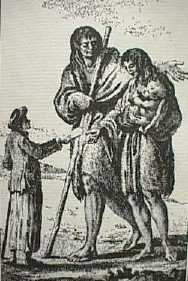
From the 15th Century on, European voyagers to the New World and beyond recounted fabulous tales of the strange peoples they encountered. Among these were the so-called Patagonian Giants. They were a tribe of super-tall people whom the Portuguese explorer Ferdinand Magellan and his crew supposedly encountered in southern Argentina during their voyage around the world in 1519-1522. The legend persisted for over 200 years. In May 1766, after Commodore John Byron‘s ship HMS Dolphin returned from its circumnavigation of the world, the Gentleman’s Magazine reported that the Dolphin “has found out a new country in the East, the inhabitants of which are eight feet and a half high.”

Seizing on this absurdity, the English politician, writer, and wit Horace Walpole wrote An Account of the Giants Lately Discovered, a satirical “Letter to a Friend in the Country” published in July 1766. Walpole was already a celebrated author; his wildly popular Gothic novel, The Castle of Otranto (1764), spawned an entire literary genre. He now took pen in hand to lampoon the alleged discovery of “Five Hundred Giants on Horseback” in Patagonia. Walpole notes that there have been few sightings of these giants over the years, and speculates that it is because they may be “a roving Nation, and seldom come down to the Coast; and then I suppose, only to bob for Whales.”

Walpole savages British colonialism by suggesting, “As soon as they are properly civilized, that is, enslaved, due care will undoubtedly be taken to specify in their Charter that these Giants shall be subject to the Parliament of Great-Britain, and shall not wear a Sheep’s Skin that is not legally Stamped.” That last clause is a clear dig at the infamous Stamp Act of 1765, a British revenue-raising measure that required American colonists to buy specially stamped paper, including sheepskin parchment, for printed matter. (It was later one of the major catalysts of the American Revolution.)

He has even harsher words for the slave trade:

“I would advise our prudent Merchants to employ [the Giants] in the Sugar Trade; … they must be worse treated, if possible, than our Black Slaves are; they must be lamed and maimed, and have their Spirits well broken, or they may become dangerous. This too will give a little respite to Africa, where we have half exhausted the Human, I mean, the Black Breed, by that wise maxim of our Planters, that if a Slave lives Four Years, he has earned his Purchase-Money, consequently you may afford to work him to Death in that time.”

Walpole even mocks the corporations that grew fat on imperialism, suggesting that the Giants “ought to be put under their Majesties, a West-Indian Company; the Directors of which may retail out a small Portion of their Imperial Revenues to the Proprietors, under the name of a Dividend.”

There are several other references to 18th-Century affairs in An Account of the Giants Lately Discovered: the Cock Lane Ghost hoax, the South Sea Bubble fraud, the mythical Beast of Gévaudan, the alleged misdeeds of the Russian empress Catherine the Great (whom Walpole calls “a Soldier’s Trull”), the plundering of India, and the “Humiliation” of Ireland, among others. Walpole even manages to slip in a sly reference to his own best-seller, The Castle of Otranto, as “the Cold Tale of a late notable Author, who did not know better what to do with his Giant than to make him grow till he shook his own Castle about his own Ears.”

The alleged sighting of the Patagonian Giants was later debunked in a 1773 account of Commodore Byron’s voyage. But Walpole did not need validation to wield his satiric flair. Thanks to the volunteers at Distributed Proofreaders and Project Gutenberg, you can enjoy Walpole’s wit yourself, for free.

This post was contributed by Linda Cantoni, a Distributed Proofreaders volunteer.


Distributed Proofreaders Site Maintenance – 15 March 2025

March 13, 2025

The Distributed Proofreaders site is scheduled to be completely unavailable starting at 9am server time on 15 March 2025 as we update our Operating System. We hope to have completed the update by end of day. During this time the main site, forum, and wiki will be unavailable.

Please consider using this maintenance window to do Smooth Reads that you have taken out prior to the downtime.

Please save all of your work before we start the maintenance at 9am server time. Proofreading pages offline while the server is down and saving them when it comes back up will not work.

If the upgrade and related checks are completed early, the site will return sooner.

Thank you for your patience. As you wait for Distributed Proofreaders to become available again, please feel free to browse through the excellent articles in this Blog.

We’ll keep this blog post updated with progress during the outage. You can also find us on Facebook.

Update 9am EDT: Maintenance has started.

Update 11am EDT: Maintenance continuing as planned.

Update 1pm EDT: Maintenance continuing as planned.

Update 3pm EDT: Maintenance continuing as planned.Update

Update 3:35pm EDT: Site is back up and operational. Thank you for your patience!


The Girlhood of Queen Victoria

March 1, 2025
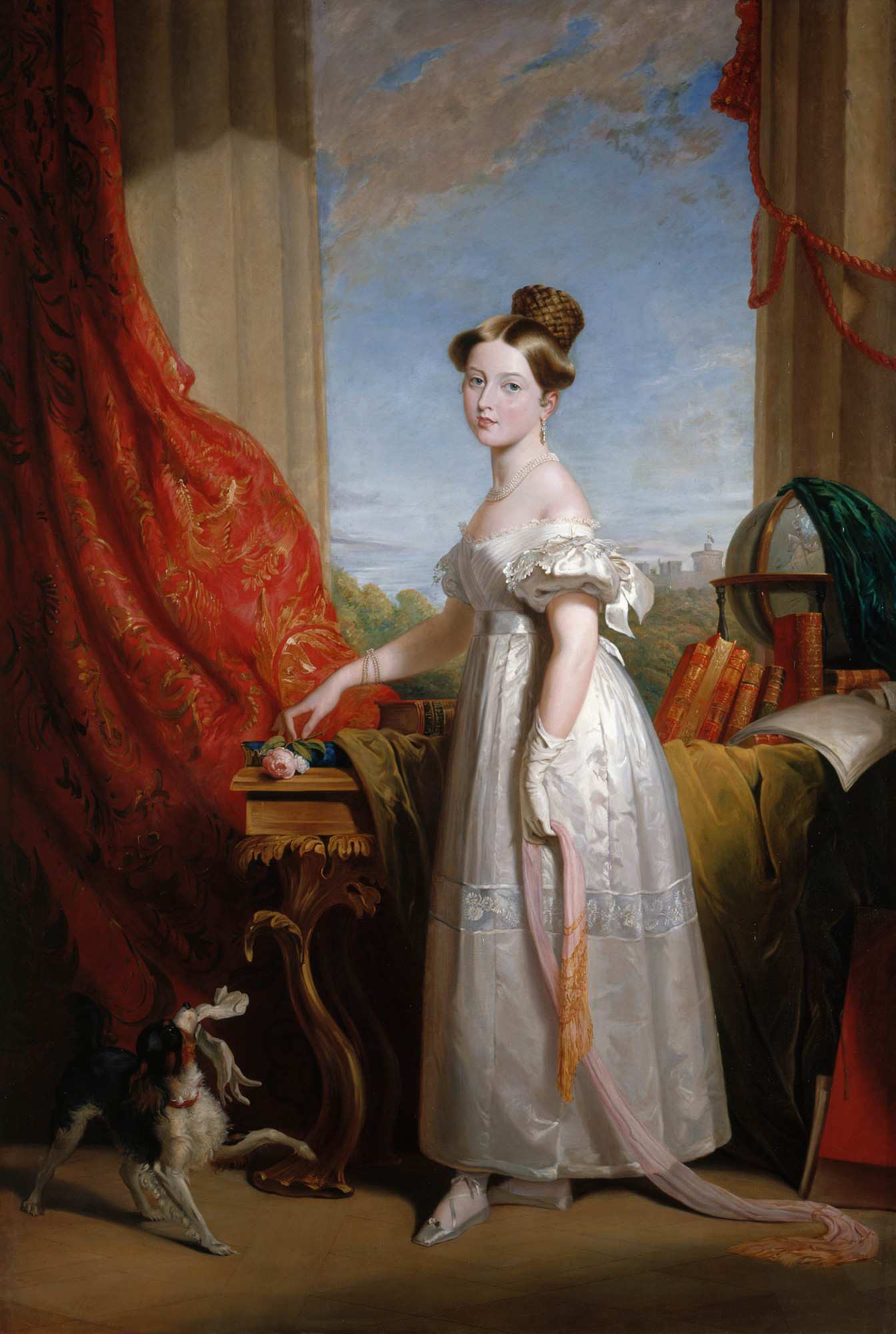
Princess Victoria at 13 with her spaniel, Dash, painted by George Hayter

Queen Victoria ruled the United Kingdom of Great Britain and Ireland for 63 years, the longest-reigning British monarch until Queen Elizabeth II’s 70-year reign. An entire era of social, cultural, industrial, and imperial changes – from Victoria becoming Queen in 1837 at the age of 18 to her death in 1901 at the age of 81 – was named after her.

The clichéd image most people have in their minds when they hear Victoria’s name is that of an elderly, grim widow given to proclaiming, “We are not amused.” But she began as a teenaged queen, inexperienced in politics but earnestly wanting to do the right thing.

The Girlhood of Queen Victoria (Vol. I) is part of a two-volume collection of extracts from her early journals, beginning in 1832, when she was 13, and ending in 1840, upon her marriage to Prince Albert when she was 21. (Volume II is in progress at Distributed Proofreaders.) The first volume begins with her first “Royal Progress” through England in August 1832 (though she was then five years away from becoming Queen), and ends in August 1838, two months after her official coronation ceremony.

Victoria’s journals reveal a lively girl, fond of music and dancing. On her 14th birthday, her uncle, King William IV, arranged a “Juvenile Ball” in her honor, to which many teenaged noblemen had been invited. Her excitement is palpable:

I danced first with my cousin George Cambridge, then with Prince George Lieven, then with Lord Brook, then Lord March, then with Lord Athlone, then with Lord Fitzroy Lennox, then with Lord Emlyn. [After supper] I then danced one more quadrille with Lord Paget. I danced in all 8 quadrilles. We came home at ½ past 12. I was very much amused.

Despite her secluded life and her diligent studies in history, law, and languages, Victoria was often amused. She loved going to plays, ballets, and the opera, and she made many sketches of the performing artists she saw, some of which are included in The Girlhood of Queen Victoria. But as she matured, the vision of her future became more sobering. Her uncle, King Leopold of Belgium, soon began advising her on her royal responsibilities, and suggested her first cousin, Prince Albert of Saxe-Coburg, as a possible candidate for marriage. Victoria and Albert first met in 1836, when she turned 17 and he was about to. She found him “extremely handsome,” and became very fond of him and his brother Ernest, but there was no indication at that point that she was in love with Albert.

On her 18th birthday in 1837, she noted, “How old! and yet how far am I from being what I should be.” She vowed to “study with renewed assiduity … and to strive to become every day less trifling and more fit for what, if Heaven wills it, I’m some day to be!” That day came on June 20, 1837, when King William died and she became Queen. She wrote in her journal, “I am very young and perhaps in many, though not in all things, inexperienced, but I am sure, that very few have more real good will and more real desire to do what is fit and right than I have.” In the ensuing months, Victoria, though indeed very young, grew up quickly in the world of government and politics, with the close guidance of her Whig Prime Minister, Lord Melbourne.

These extracts from Victoria’s journals, published in 1912, were edited, with an introduction and explanatory material, by Viscount Esher, under the auspices of Victoria’s son King Edward VII and her grandson King George V. Lord Esher had a close relationship to both Victoria and Edward, so anything too controversial or personal in the journals was expurgated. Nonetheless, The Girlhood of Queen Victoria has great historical value and is cited by Victoria’s biographers to this day.

Thanks to the volunteers at Distributed Proofreaders and Project Gutenberg, you can get a fascinating glimpse into young Victoria’s world for free.

This post was contributed by Linda Cantoni, a Distributed Proofreaders volunteer.


Jethro Tull’s Horse-Hoeing Husbandry

February 1, 2025

You might think Horse-Hoeing Husbandry is a little-known album by the 20th-Century progressive rock band Jethro Tull – but no. It is, in fact, a well-known book (in agricultural circles) by the 18th-Century progressive agriculturalist Jethro Tull, after whom the band was named. (Ian Anderson, leader of the rock band, once said that his agent, a history buff, came up with the name. Anderson had no idea it was “a dead guy who invented the seed drill” and wished he had changed it to “something less historical”). The volunteers at Distributed Proofreaders and Project Gutenberg have now made it possible for you to tell the difference.

Jethro Tull (the agriculturalist) was born in Berkshire, England, in 1674. He read law at Oxford and became a barrister. After he married, he and his wife settled on his father’s farm in Oxfordshire, where he became an avid gentleman farmer. Tull then traveled to the Continent to improve his health. He was struck by the similarity between his agricultural ideas and those actually in operation in the vineyards of France and Italy. He had theorized, and to his mind the success of the vineyards proved, that fertilizing the soil with manure was unnecessary – frequently tilling the soil was not only enough, but was also much more cost-effective.

On his return to England, Tull moved to the aptly named Prosperous Farm near Hungerford, where he put his farming ideas into practice. He invented a seed drill that automatically sowed and planted seeds, a method that was far more productive than hand-broadcasting. He also found that hoeing the soil with a device pulled by a horse was much more effective and less labor-intensive than hand-hoeing by individual workers. He expanded on his ideas about tilling in Horse-Hoeing Husbandry (subtitled “An Essay on the Principles of Vegetation and Tillage. Designed to introduce a New Method of Culture; Whereby the Produce of Land will be increased, and the usual Expence lessened”), first published in 1731.

In addition to finding fertilization with manure to be unnecessary, Tull railed against the use of it in growing food for human consumption. In a chapter entitled “Of Dung,” he writes, “’Tis a Wonder how delicate Palates can dispense with eating their own and their Beasts Ordure, but a little more putrefied and evaporated; together with all Sorts of Filth and Nastiness, a Tincture of which those Roots must unavoidably receive, that grow amongst it.” Later it was proven that some fertilization with manure is still necessary for the best results, but Tull’s innovative methods revolutionized agriculture in Europe and America, and are still in use today, albeit with more sophisticated machinery.

Tull died in 1741, but Horse-Hoeing Husbandry continued in print for many years afterward. The edition that Distributed Proofreaders contributed to Project Gutenberg is the fourth, published in 1762.

This post was contributed by Linda Cantoni, a Distributed Proofreaders volunteer.